Home » Jazz Articles » The Blue Note Portal » The Beatles—Future Perfect, Part 3
The Beatles—Future Perfect, Part 3
Courtesy AI
Chapters
1 | 2 | 3 | 4 | 5 | 6 | 7 | 8 | 9 | 10 | 11 | 12 | 13 | 14The Beat Goes On—Year 2092
The intense glare of the live broadcast had faded hours ago, leaving the control room bathed in the amber glow of background standby. Outside the high-altitude windows of 2092, solar arrays silently tracked the Sun, keeping the CCE's baseline status idling.A week had passed since the 400 million live subscribers disconnected from the Beatles CCE event. Yet, on the telemetry monitors, the 1968 frequency wave wasn't flatlining. It was still humming.
Julian stared at the idling quantum readouts. "This doesn't make sense; it should be dark down there," Julian whispered, pointing at the low-power coherence graph. "The event was last week, the audience is unplugged. But there is activity."
Xample leaned over the console, his face lit by the amber monitors. "It's running on residual archive data. Just background noise."
"Is it?" Julian turned to him. "Xap, think about what happened during the CCE event. We focused four hundred million living minds into a single coordinate in time. That wasn't just a broadcast—it was a quantum field event. What if the CCE event didn't just render a temporary reconstruction, but permanently stitched a consensus alternative reality of 1968? Think about it: when George, John, Paul, and Donovan went to the guesthouse the day after Maya, Chloe, Zack, and Kyle had already left, they hadn't forgotten them. That might well mean something... "
Xample mused with a wry smile, "And if the physical environment held there overnight, what happens after a couple of weeks? If we meet them in London now, would they remember Maya and company?"
"Also, think about a quantum field attractor effect," Julian said. "The 1968 figures started as historical shells. But a consensus field that powerful acts like a gravitational magnet. What if original consciousness, existing outside linear time, were made aware of this reality? We play virtual games—might they? Remember what Dr. Kiran said about the Fillmore—we attracted musicians to the live event, and that was with just seven minds connected. We just had over 400 million consciousnesses synchronized."
Julian leaned back against the console deck. "But we can't just ask random locals on the street. Nobody in a Soho pub knows who Future Perfect is. The only people down there who have any clue are the ones who were on the banks of the Ganges in Rishikesh when the band first crossed over."
Xample nodded slowly. "Exactly. The inner circle. The ones who saw it happen."
He looked down at his watch, then up at the secondary sync headsets hanging on the rack, a calculating grin spreading across his face.
"Well, we've got fifteen minutes each day to spend six hours in London." Xample smiled. "Tomorrow, 10 PM. We'll soon know the answer to your question."
The clock on the main terminal ticked over to 9:49 PM.
Julian stepped out of the prep lounge. "Yeah baby, London here we come!"
Xample was leaning against the main telemetry deck, holding two neural sync headsets, his eyes fixed on regional geographic coordinates that were nowhere near Great Britain.
"Cool your jets, Jules," Xample said smoothly.
Julian paused, frowning. "What do you mean?"
"1960s British law," Xample said, holding up a finger. "Sure, the band doesn't need to walk through Heathrow Customs if they're materializing in a safe spot. But what happens two weeks later when a pair of London bobbies stop them for a random passport check on Carnaby Street? That stuff happened all the time back then. What happens when we book their first major gig, and the Ministry of Labour comes knocking, demanding work permits and tax IDs for four undocumented musicians who don't legally exist?"
Julian opened his mouth, then closed it. He sank onto the edge of the console deck. "Red tape. They'll shut the band down before they even play a venue."
A slow, brilliant grin spread across Xample's face.
"Which is why we aren't dropping into London tonight," Xample said, tapping a new set of coordinates into the temporal deck. "No mon. We be off to Jamaica."
Julian blinked. "Jamaica?"
"Think about it, Julian," Xample said, leaning in, his eyes sparkling with pure managerial genius. "In 1968, reggae is literally being born on the streets of Kingston out of rocksteady and ska. Nobody in the Western record industry is paying attention yet. That's later in the '70s."
Xample tossed one of the headsets to Julian, who caught it automatically.
"We simply buy a property and build a state-of-the-art recording studio in Kingston," Xample explained. "We set up an offshore West Indian label. Imagine it, Julian—Bob Marley, Peter Tosh, the whole local scene, collaborating in our studio... teaming up with Future Perfect."
Julian's jaw slowly dropped as the realization began to wash over him.
"And the best part?" Xample added, holding up four fingers. "Through that Jamaican label, we grease a few local palms, fast-track some political paperwork, and pull four official Commonwealth passports. Full British Commonwealth documentation."
"So when the UK police stop them on the street... " Julian whispered, a wide smile breaking out.
... "or when the union inspectors show up at a venue," Xample finished, "Maya, Chloe, Zack, and Kyle pull out official Commonwealth passports and papers as contracted international talent under our registered label. Complete legal protection. Travel, work permits, and gig red tape—solved in one move."
Julian looked down at the headset in his hands, shaking his head in absolute admiration. "Bob Marley, Peter Tosh, and a bulletproof legal front... Xample, you're a genius."
"We're now music managers, about to change the world!" Xample smiled, slipping his headset over his ears and adjusting the temporal dial to 1:24. "Set the 2092 clock for fifteen minutes, Julian. Let's go buy a studio in Kingston."
Kingston 1968
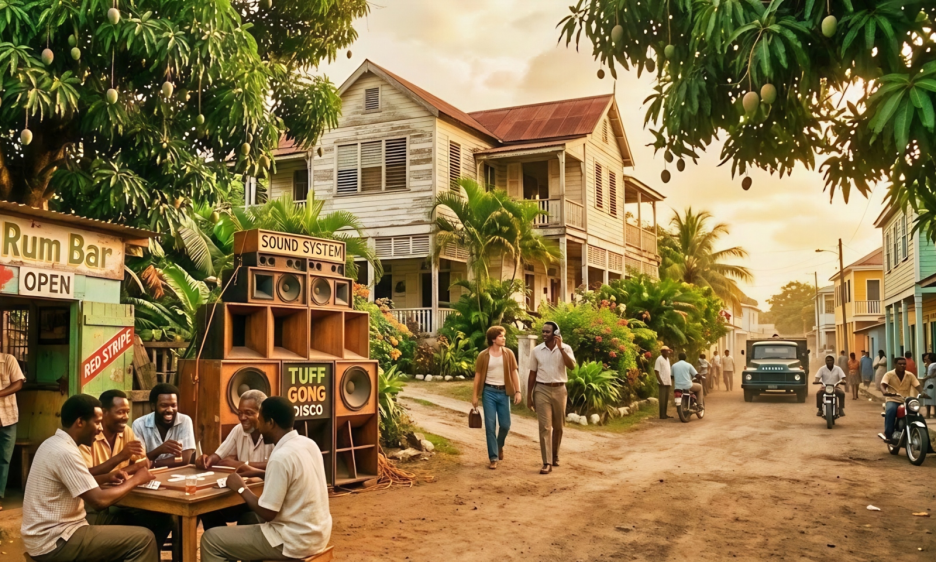
The heat hit first. Not the dry heat of a Los Angeles soundstage or the filtered climate of a 2092 orbital—this was a wet, living heat that smelled of salt, diesel, ripe fruit, and woodsmoke. It pressed against Julian's skin the moment the sync stabilized, and for a disorienting half-second he forgot which century he was in."Easy there, mon," Xample said, already grinning, adjusting his collar. "You look like a tourist. Don't look like a tourist."
"We are tourists," Julian whispered, scanning the street. Dusty storefronts. A rum bar with painted letters. A cluster of men in patched shirts gathered around a domino table. Somewhere down the block, a sound system thumped a rocksteady rhythm through speakers the size of coffins.
"No," Xample said, heading toward the sound. "We're investors. There's a difference. Tourists take pictures. Investors take meetings."
Two weeks later, they owned a house.
It took Xample approximately three days to identify the right property—a sprawling, slightly dilapidated two-story structure on the edge of Kingston, with a high-walled courtyard, a mango tree, and enough interior space to convert half of it into a recording studio. The owner, an aging Chinese-Jamaican businessman named Mr. Chen, was initially suspicious of two men with no visible history and an alarming amount of cash.
"You have references?" Chen asked, eyeing them over his spectacles.
"References from whom?" Xample asked. "There's nobody to ask about us, Mr. Chen."
Chen sold them the house for a reasonable price—partly because Xample paid in crisp, untraceable 1968 dollars, and partly because Xample had taken the time to learn the correct words in the correct order: respect, business, family, future. Chen understood those words in any language.
The studio took another three weeks, and given the constraints, they built it right.
Xample sourced the best the era could offer—high-end gear that many studios in London or New York would envy. Through a network of discreet contacts, they secured:
An 8-track recorder—just emerging as the new industry standard, purchased from a Hollywood studio that had upgraded to 16-track and was offloading its "obsolete" machine at a price that made Xample's eyes water with delight. Even in the Experience, I love a deal, he thought to himself.
A Neve console—the gold standard of 1968, shipped from England and installed by a technician who flew down from London, stayed for three days, and left with a bottle of rum and a story he'd tell for the rest of his life.
Studio-grade microphones—Neumann U87s, AKG C12s, and a pair of vintage ribbon mics for the room, all purchased from a retiring New York engineer who'd never met anyone quite like Xample and didn't quite know how to say no.
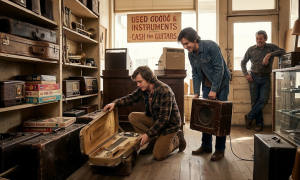
An Instrument Locker from Nashville—vintage electric and acoustic guitars, bass guitars, fiddles, mandolins, drums, and percussion.
The day the final crate arrived, Julian stood in the control room, running his hand across the Neve's gleaming faders like a man touching a relic.
"Eight tracks," he whispered. "Hard to believe the Beatles only just got eight tracks, and we walk in with eight tracks."
"We've got the best room in the Caribbean," Xample said, grinning.
The acoustic treatment of the studio walls was a blend of professional foam panels and local ingenuity. The tape machine sat on a concrete slab for isolation. The control room window looked into the live room like a portal into another dimension—which, in a sense, it was.
Admiring the studio with Julian, Xample leaned against the console and sighed. "Bob Marley. He's in Delaware, living with his mother, working on a Chrysler assembly line. He's miserable. We're going to send him a letter, a plane ticket, and an offer from a brand-new label called Tuff Gong Records."
"Tuff Gong? That's a great name."
"Yeah," Xample said. "It works."
Bob Marley arrived eight days later. He stood at the gate of the house, squinting at the studio windows. When Xample came out to meet him, Marley didn't smile.
"Who are you?" he asked.
"Just call me Xap, spelled with an X, spoken like a Z. This is my studio and label," Xample said.
They shook hands awkwardly. They looked at each other for a long moment, and then Marley walked past Xample into the courtyard, set down his suitcase, and looked around.
"Come inside," Xample said. "I want you to meet the musicians."
The first session was a collision.
Marley had brought a song he'd been carrying—a slow, searching thing about homecoming and heartbreak. He stood at the microphone, acoustic guitar in hand, clearly uncomfortable with the studio's clinical brightness and a group of musicians who did not look hip to him.
Xample introduced the band.
"This is Maya and Chloe Benning. Zack Sutherland. Kyle Reed. They call themselves Future Perfect. They've agreed to back you."
Marley looked at them—wearing Western clothing, two women with Gretsch and Les Paul guitars, a man with a Fender bass, and a drummer/percussionist. Shaking his head, he said, "You're a long way from Nashville."
"Actually, we're a long way from the Rockies," Maya said, smiling. "But I listen with my heart, not my eyes. You might be surprised."
Marley sang his song once alone. It was good—raw and honest, but constrained by a single voice and his single acoustic guitar. When it ended, Xample said, "Why don't you go to the kitchen and tell Hattie what you'd like to eat? I'll meet you under the mango tree while they work this out."
Twenty minutes passed as Xample and Marley sized each other up under the tree. Julian came out onto the deck and announced they were ready. Marley looked skeptical, fearing the worst—he had, after all, given up a good-paying job for this.
When they walked back in, Maya, always ready for a laugh, had a cowboy hat hanging on a mic stand. "Put this on, Bob. It will help you feel what we're doing."
He was ready to walk. Zack laughed, "She's messin' with you."
With that, they launched into an intro. Kyle quickly found the pocket, sitting neatly behind Zack's bass. Chloe's rhythm guitar didn't ride the beat; it punched through it—a hard, dry cut on the afterbeat that snapped like a fist striking a table at a revival meeting. Each chord was a spark struck from stone.
Maya didn't play right away; she extended her arm, welcoming Bob to the microphone. He wore a huge grin as he took the hat off the mic stand. Instead of putting it away, he put it on his head and began singing.
Maya's guitar line arrived like a tune you'd hummed once and couldn't shake—a coiled, circling phrase of five or six notes that slipped under the vocal, answered it, then ran ahead of it like a child chasing a kite. It didn't argue with the singer; it agreed with him, echoing his phrasing in a brighter register, turning his lament into a duet. The notes were round and warm, played with a slight chorused shimmer, as if the strings themselves remembered the melody better than the man who wrote it.
When they finished, it seemed too perfect to speak. They all looked at each other. The reticent Bob was replaced by a man who glowed with obvious joy. Zack and Kyle high-fived, and Bob hugged Maya.
Xap motioned to the engineer: "Let's hear what that sounds like."
Julian saw tears forming in Bob's eyes as he listened. The quality was beyond his wildest imagination.
Later that afternoon, they were joined by Montgomery Robinson—"Monty" to the jazz circles he'd moved in since he was seventeen. A keyboard player from the New Orleans tradition with a conservatory polish that had never quite sanded the funk off his left hand, Monty had played with a young Herbie Hancock in Chicago before drifting to Jamaica six months earlier after a breakup in New York that he described as "musical differences, if you catch my meaning."
Three days later, they had enough tracks for an album. Julian was leaning over the Neve console, listening back to a mix. The track was cooked to perfection, but Xap was pacing behind the board, his eyes fixed on the ceiling speakers, listening for the empty spaces in the arrangement.
"It needs brass," Xap said, stopping abruptly. "Not lush, smooth padding. I want bite. I want something that hits you right in the solar plexus on the offbeat."
Monty looked up from the Hammond organ, a slow, knowing smile spreading across his face as he ran a thumb over the keys. "You thinking a slide? A trombone to smooth out the middle?"
"No," Xap said flatly. "That trombone sound is becoming a cliché. I want three-piece heat. A tenor for the soul, a trumpet for the roof, and someone on baritone or alto as the needs arises."
Monty stopped playing. He stared at Xap for three long seconds, processing the sheer weight of a baritone sax in a reggae-rock pocket, then let out a low, appreciative laugh.
"Baritone instead of a slide... damn, Xap," Monty said, shaking his head. "That's nasty. That's staccato. That's New Orleans meets street-level funk."
Xap leaned on the edge of the console, looking Monty dead in the eye. "What would it take to get us a tenor, baritone, and trumpet here the day after tomorrow?"
Monty reached into his breast pocket, pulled out a beat-up address book, and tossed it onto the Neve's wooden wristband.
"A phone call and three airplane tickets," Monty grinned, "will get you the best horn section you've ever heard."
To Be Continued...
About The Beatles

Tags
PREVIOUS / NEXT


Become a Sustaining Member

Since 1995, All About Jazz has championed jazz as an art form and supported the musicians who create it. Over three decades, it has grown into one of the world's leading jazz resources, serving hundreds of thousands of readers, musicians, presenters and industry professionals each month.
Help Build the Future of All About Jazz
Your support helps us continue building All About Jazz for the next generation—expanding our editorial coverage, preserving jazz history, developing new community features and creating better ways to discover the music and the people behind it.
Become a sustaining member for as little as $20 per year and you'll immediately enjoy an ad-free experience along with access to subscriber features and future articles for a full year.
Together, we're not simply sustaining All About Jazz—we're building its future. Thank you for being part of the journey.