Home » Jazz Articles » The Blue Note Portal » The Beatles—Future Perfect, Part 10
The Beatles—Future Perfect, Part 10
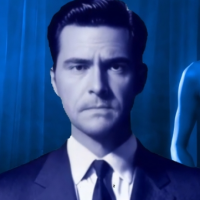
Courtesy AI
Chapters
1 | 2 | 3 | 4 | 5 | 6 | 7 | 8 | 9 | 10 | 11 | 12 | 13 | 14Wood
The morning sun came up over the eastern rim of the Carson Range, turning the high Sierra air from cold slate to pale, brilliant gold.Lake Tahoe spread out below the two compounds—not merely blue, but a deep, fathomless cobalt that looked solid enough to walk on. The two estates sat tucked into a steep granite incline among towering sugar pines and white firs, their wide cedar decks cantilevering out over the slope toward a private stone landing fifty feet above the water. Through the floor-to-ceiling lodge windows, the lake seemed to stretch on without end, disappearing into the jagged, snow-dusted ridges of the Nevada shore.
In the smaller cottage nestled near the iron entry gate, an elderly caretaker couple, the Gables, whose job security rested on a foundation of competence and discretion, had already stoked the wood stoves and set a kettle on the cast-iron range. By the terms Xample had negotiated in Beverly Hills, all shared meals would be prepared and served in House B—the Future Perfect lodge—leaving House A entirely to the Beatles as a private, unmonitored retreat.
For the first twelve hours, however, neither house made a sound.
The transatlantic flight, the sudden climb through the Central Valley, and the abrupt leap in altitude had exacted their physical toll. Guitars remained in their velvet-lined hardshells; notebooks lay shut on bedside tables. By mid-afternoon, the six-thousand-foot stillness had pulled every musician into the heavy, dreamless sleep of people who had traveled across oceans and centuries without pause. In the quiet of House B's upper guest room, Xample and Julian checked internal chronological sync, and slipped out of the field.
The shift was instantaneous. The smell of pine resin and mountain chill vanished, replaced by the clean, filtered atmosphere of Xample Global HQ in 2092. "So," Julian said, "Apple's PR office in London has been bugging me for four days straight. Derek Taylor and Neil Aspinall are getting cornered by every music desk on Fleet Street, plus Rolling Stone in San Francisco."
Xample rubbed his temples, adjusting to the sudden return of 2092 gravity. "What's the itch?"
"Biographies," Julian said. "The world knows Future Perfect, but as far as British and American public records are concerned, Maya and Chloe Benning, Zack Sutherland, and Kyle Reed are mysteries.
Xample gave a wry smile. "Which, strictly speaking, is entirely accurate."
"Right, but how do we handle this," Julian said. "Journalists are calling county clerks from Denver to Cheyenne trying to find birth certificates, school yearbooks, and tax rolls. If they don't find a paper trail, someone's going to write a hit a piece for National Enquirer."
"Let's fix it properly," Xample said. "Engage the historical genealogical matrix."
Within seconds, the 2092 AI interface had mapped the late-nineteenth and early-twentieth-century vital statistics of the American Intermountain West. It moved through census archives with surgical precision, locating the inevitable historical fractures of the pre-digital era: the 1921 Pueblo flood that washed away county birth rolls; a 1937 courthouse fire in rural Wyoming; isolated parish ledgers in Colorado where handwritten entries faded into obscurity.
Working backward from those genuine historical gaps, the system wove four quiet, completely plausible family lineages into the fabric of the CCE consensus timeline. Unbroken church baptismal logs, small-town high school graduation rolls in rural cattle country, and modest estate transfers appeared seamlessly in local records—deep enough to satisfy any diligent newspaper fact-checker, but ordinary and remote enough to discourage casual tourists.
"There," Xample said, watching the nodes lock into green stability across the terminal. "Maya and Chloe are fifth-generation ranch daughters from the Wind River basin. Zack grew up in the Gunnison valley playing fiddle in his grandfather's dance hall. Kyle's father was an acoustic luthier who moved between Oregon and New Mexico. Clean, honest, and entirely untraceable beyond the paperwork." Julian laughed, "All four home schooled, who would have thought. They covered everything."
Julian drafted the memo for Apple's press office, attaching a strict managerial directive: Future Perfect gives no personal interviews, participates in no press junkets, and entertains no society profiles. All inquiries begin and end with the music.
"They'll respect that," Julian said. "The Beatles gave up their private lives six years ago. If there's one thing John and George will defend with their teeth, it's four musicians who refuse to feed the beast."
Xample nodded, taking one last look at the pristine telemetry graphs. "Let's set the dial. I've got a pitch to make over breakfast."
The sun had climbed high enough to warm the broad cedar deck of House B when the screen door clicked open.
Paul was the first to arrive from across the gravel path, wearing a heavy sheepskin coat over a fisherman's knit sweater, his hair rumpled from sleep but his eyes clear and sharp. John drifted in five minutes later, hands buried deep in the pockets of a thick corduroy jacket, breathing in the cold mountain air with the cautious appreciation of a city man who still didn't quite trust nature. Ringo brought up the rear, carrying a pack of cigarettes and sporting a woolen beanie, looking thoroughly rested.
Mrs. Gable had set out platters of hot sourdough biscuits, sweet butter, fried eggs, and thick rashers of local bacon alongside a steaming enamel pot of strong black coffee.
"Bloody hell," John muttered, sinking into a heavy oak armchair that looked out over the expanse of water. "You can see right to the bottom out there. It's like looking through glass."
"Six thousand feet up," Paul said, pouring himself a cup of coffee. "Good for the lungs. We ought to get some horses again, like Funchal."
"No horses," John said dryly. "My backside only just forgave Madeira."
Xample pulled up a chair at the end of the table, leaning his forearms against the wood. "I'm glad you're rested. Because we have our next project, and it's already moving."
Paul raised an eyebrow over his coffee mug. "Another film?"
"A film and an album," Xample said. "To follow Apollo: Future Perfect for the holidays. But we aren't using electric guitars, we aren't using heavy brass, and we aren't renting an arena."
John squinted at him through the morning glare. "Go on."
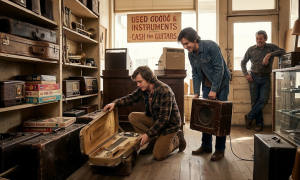
"We're calling it WOOD," Xample explained, his voice measured and certain. "An intimate, all-acoustic document. We take the purest songs you've ever written—the melodies that don't need a single amplifier or studio trick to break a person's heart—and we strip them down to the timber. Steel strings, gut strings, wooden blocks, brushes, and the natural resonance of an old room."
Paul's expression shifted instantly from polite curiosity to active, creative focus. "No overdubs? No tape loops?"
"None," Xample said. "Just warm microphones catching the instruments and the air around them and amplifying it. We film it in San Francisco at an 1888 opera house with a vaulted cedar ceiling and horseshoe balconies. Three hundred seats. Two hundred invited guests who won't even know who's playing until the stage lights come up."
John looked at Paul, then down at his hands, tapping a rhythm against his coffee mug. "Wood," he murmured. "I don't hate it. In fact... I rather like it."
Maya, who had been sitting quietly on the bench beside Chloe, picked up a notepad from the sideboard. "We put together a preliminary set from your catalog. Songs where the melody does all the heavy lifting."
She slid the pad across the table. Paul pulled it toward him, reading aloud:
"'And I Love Her.' 'Norwegian Wood'—well, that's a given, isn't it? 'Michelle.' 'You've Got to Hide Your Love Away.' 'In My Life.' 'Yesterday.' 'Blackbird.' 'Dear Prudence.'"
Paul looked up, a bright, boyish grin breaking across his face. "That's a proper set, that is. Pure songcraft."
"We'd like to frame it," Chloe added. "Future Perfect opens the evening with a high-energy acoustic picking breakdown to wake the room up, and we close the night the same way. Zack will have a dobro if we need it, and he and Kyle will play a Nashville tic tac bass, that will be our only electric instrument. But the center of the show is the four of you, playing your songs the way you wrote them. If we do an encore, we're thinking we all do a Future Perfect version of 'And Your Bird Can Sing' that will blow the roof off—we'll play that together later."
"I can use the high-hat, woodblocks and brushes," Ringo said, nodding cheerfully around a mouthful of biscuit. "Keep it quiet. In the pocket."
John pushed his chair back and stood up, stretching his arms toward the pine beams overhead.
"Come on, Macca. Let's go find our notebooks. I've got a couple of half-written verses in my suitcase that might fit this."
"We'll take a walk down to the boat landing," Paul agreed, finishing his coffee. "See what the water sounds like."
As the three of them headed out the screen door and down the cedar steps, George remained seated at the end of the table. He hadn't touched his tea. He looked across the table at Maya, Chloe, Zack, and Kyle, his eyes carrying that calm, steady lucidity that had settled over him in the theater at Funchal.
"They're going to write," George said softly, a faint smile touching his lips. "I think I'll stay here."
Outside, the breeze stirred the sugar pines, sending a faint, clean fragrance of cedar and dry needles through the open French doors.
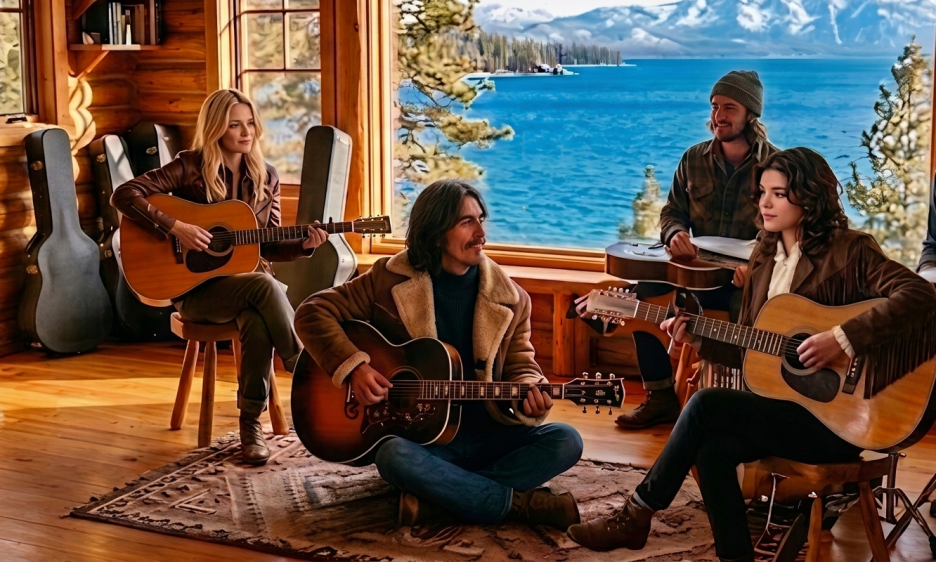
George sat cross-legged on a deep Navajo rug in the center of the room, his 1968 Gibson J-200 resting across his thighs. He had tuned the low E down to D and was idly exploring a descending pattern, watching the lake glitter through the glass.
Zack, Maya, Chloe, and Kyle gathered on low wooden stools around him. There was no studio glass between them, no headphones, no technicians. Just the natural warmth of spruce, rosewood, and mahogany vibrating in the high mountain air.
"We wanted your take on something, George," Zack said, settling a worn Martin dreadnought against his ribs. "While the others are down by the water."
George looked up, his dark eyes curious. "On what?"
"A few songs we've been working on," Chloe said, tuning her acoustic. "We've got the arrangements mostly sorted, but we aren't sure about the emotional center. We trust your ear."
George gave an easy, modest shrug. "I'm not much of an authority on other people's tunes, but play 'em. I'm listening."
Maya glanced at Zack who was holding his dobro, then at Chloe. With a single breath, they began. The first piece was "Behind That Locked Door."
Chloe and Maya took the harmony together from the very first measure—tight, pristine sister harmonies pitched a third apart, carrying that distinct mountain clarity that made the lyrics sound ancient:
Why are you still crying? Your pain is now through. Please, forget those teardrops Let me take them from you.
George leaned forward, his elbows resting on his knees, his mouth parted slightly. His gaze moved from Maya's fingers on the fretboard to Chloe's face, a look of profound, disarming recognition moving behind his eyes—not the intellectual memory of a man who had studied a chart, but the visceral reaction of someone hearing his own private heart described aloud in a room full of light. Then Zack smiled, mirroring the steel guitar notes from the original with his dobro.
Next Chloe brushed a bright, ringing D-major chord across the twelve-string acoustic, and Maya's Martin sang out the opening slide riff of "My Sweet Lord."
The melody bloomed in the room like sunlight breaking over a ridge. It was simple, majestic, and entirely free of cynicism—a devotional cry that bypassed cleverness and went straight to the core of spiritual longing. Kyle's hands found a steady, joyous backbeat, and the four voices joined together on the refrain, lifting the harmonies toward the timbered ceiling until the whole room seemed to vibrate with pure, unforced light.
They let the final chord ring out, the sympathetic vibrations humming through the cedar floorboards before fading into the vast mountain quiet.
For a long moment, nobody spoke. Down on the path, a blue jay called from the branches of a fir tree.
George sat absolutely motionless. His eyes were bright, brimming with an emotion he made no attempt to disguise or wipe away. He looked down at the floor, then up at the four of them, shaking his head in slow, stunned disbelief.
"My God," George whispered, his voice thick with wonder. "Those are... they're stunning. Really. "That last one. It's... it's a prayer. A proper prayer. Not church music, but real devotion. Where did you find them? Who wrote them?"
Zack leaned back, resting his guitar on his knee, a bright, mischievous grin spreading across his face.
"Well," Zack said, "we have a little bet going. We want you to guess which one of us wrote each song."
George looked between the four of them, studying their faces like an art critic examining three unsigned masterworks.
"All right," George said, taking the challenge seriously. "The first one—'Behind That Locked Door.' That's Zack. The dobro part is rooted in that American soil he's always talking about. Pure Nashville and Rockies."
Kyle and Chloe leaned in and hit him with a buzzer:
"BZZZZT! Wrong!"
George threw his hands up, laughing openly. "Come off it! Then the devotional song—'My Sweet Lord'—that has to be Maya! It's got her name all over it. The whole philosophy of the thing."
All four of them chimed in together with a deafening, cheerful blast:
"BZZZZT!"
George stared at them, completely bewildered. "None of you? Then who? Kyle didn't write them, did he?"
"Nope," Kyle said, smiling serenely behind his drum. "Not a single note."
Maya set her Martin down carefully on its stand and slid forward on her stool until she was looking directly into George's eyes. Her expression held no mockery, no smugness, and no distance—only that vast, patient kindness that had grounded him on the balcony in Madeira.
"None of us wrote them, George," Maya said softly. "You did."
The room went dead silent.
George didn't move. He didn't blink. The light from the window caught the sharp, beautiful angles of his face, the dark hair falling across his collar.
"What?" he whispered.
"You wrote them," Maya repeated gently. "Or rather... the larger you wrote them. A couple of years from now, in another timeline."
Zack tapped the wood of his guitar. "You carried those melodies inside you all along, George. We just remembered them for you."
George looked down at his own hands resting against the wood of his Gibson J-200. He stared at his fingers as if seeing them for the very first time. "I wrote that?" George asked, his voice barely a breath.
"You wrote both of them," Chloe said, reaching out to touch his shoulder. "And they're masterpieces, George. We think you should claim them now. For WOOD."
A slow, radiant smile spread across George Harrison's face—not the defensive smirk of a Beatle cornered by reporters, but the pure, joyful grin of a musician who had just discovered that the door he had been searching for had been unlocked all along.
He looked at the four of them, adjusted his grip on the Gibson, and picked out the opening slide phrase for "My Sweet Lord."
"Right then," George said softly, looking toward the sunlit lake. "Let's show the boys what we've got. But you said three songs, what was the other."
Maya smiled, on this one we weren't sure—you might already be working on it, but if not, you wrote this too." She winked at the others and sang, "Little Darlin,' it's been a long cold lonely winter... "
Year 2092—High Earth Orbit
Station Primary: Sol-Array 04The impact was silent, instantaneous, and catastrophic.
A localized micro-meteorite swarm—an untracked iron-nickel cluster moving at forty-seven kilometers per second—punched through the primary photovoltaic collector arrays of the CCE high-altitude relay.
Warning arrays flashed crimson across empty control corridors. In the main operations bay, the automated failsafe engaged instantly to protect 1.4 billion subscriber pods from neural shock:
[SYSTEM ALERT: HARDWARE LINK COLLAPSED]
[FAILSAFE ENGAGED: ALL SUBSCRIBER PODS INDUCED TO DEEP NEURAL SUSPENSION]
[PHYSICAL STASIS STABLE—BIOMETRICS SECURED]
[WARNING: QUANTUM DRIFT DETECTED]
[RESIDUAL CONSCIOUSNESS UNANCHORED—ESTIMATED 12% OF SUBSCRIBER MINDS REMAIN LOCKED TO TARGET TIMELINE]
[RECOVERY PROTOCOL LOCKED]
[PRIMARY POWER OFFLINE]
[SYSTEM SWITCHING TO ISOLATED QUANTUM DRIFT]
[EXTERNAL UPLINK SEVERED—RECOVERY PROTOCOL LOCKED]
Year 1969 Lake Tahoe
In the sunlit living room of House B, the sweet ring of George's guitar didn't stop, but the air inside the room underwent a sudden, terrifying change in density.It wasn't a sound. It was the absolute, instantaneous absence of a presence they hadn't realized was there. The subtle, background voltage that had hummed behind the sky, the water, and the pine needles for months dropped away to pure, dead silence.
Maya stopped singing mid-phrase.
Xample reached instinctively for his wrist, tapping his internal chronometer interface. Nothing happened. The subcutaneous sync beacon was completely cold.
Julian looked across the table, his face draining of color. "Xap... the carrier wave. I can't feel the tether."
George Harrison slowly lifted his hands from his Gibson J-200. He looked around the timbered room, then out through the floor-to-ceiling glass at the cobalt waters of Lake Tahoe. The strange, quiet serenity on his face shifted into something deeper—something unmapped.
"What's happened?" George whispered, looking at Kiran.
Kiran stood near the hearth, his eyes half-closed, feeling the vast, shuddering silence where a billion minds had just been disconnected.
"The tether to our timeline is severed," Kiran said quietly, opening his eyes. "We aren't visitors anymore."
Julian looked out at the towering Sierra pines, panic beginning to crack his voice as the cold reality settled into his bones. "How long will it take them to fix the array? Months? Years? Are we stuck here?"
Xample stared down at his empty hands, the weight of an entire century closing in around them. "In our time? Hopefully days, not weeks," Xample said softly. "Down here... that could mean months. Or years."
As frantic murmurs rippled through the room, Kiran stepped forward from the hearth. His demeanor was surprisingly serene, anchored by something deeper than fear.
"Look at me," Kiran said, his voice cutting cleanly through the rising panic. "I've stepped outside my physical body before. I know what it feels like when the weight of the flesh drops away and the grid vanishes. What we built back home—this CCE—it wasn't just a machine tapping into 1969. A billion and a half minds locked onto a single frequency doesn't just create a technological link, Julian. It collapses the illusion."
He looked toward the pine trees, then up at the impossible density of the Tahoe sky.
"The tether didn't break because we failed," Kiran continued, a subtle half-smile touching his lips. "It dissolved because time and space were only ever the scaffolding. The CCE was our crude technology trying to build a door, but the entities gathering around us right now—from other realms entirely—they aren't watching a sci-fi broadcast. They're drawn to a focal point where the veil is tearing. Time, Earth itself... they're just frequencies we've tuned into. Our physical existence is the construct, not the bond. We aren't trapped in the past. We've just stepped into the baseline."
Maya looked at Chloe, then at Zack, Kyle, and George, whose fingers were resting against the unamplified wood of his guitar. The San Francisco opera house was waiting. The songs were written. The future was gone—and yet, for the first time, everything felt entirely present.
"Then we play," Maya said, her eyes meeting Kiran's before sweeping across the band. "Now—like our lives, and the whole construct, depend on it."
To Be Continued...
 FOLLOW Blue Note Portal
and get notified whenever a new article published.
FOLLOW Blue Note Portal
and get notified whenever a new article published.
The Blue Note Portal: a garage-assembled '70s microcomputer relic, eternally portaling through jazz timelines with Serling-esque irony, hacking bebop anomalies into binary swing for the ultimate improvised reboot.
Tags
PREVIOUS / NEXT
Become a Sustaining Member

Since 1995, All About Jazz has championed jazz as an art form and supported the musicians who create it. Over three decades, it has grown into one of the world's leading jazz resources, serving hundreds of thousands of readers, musicians, presenters and industry professionals each month.
Help Build the Future of All About Jazz
Your support helps us continue building All About Jazz for the next generation—expanding our editorial coverage, preserving jazz history, developing new community features and creating better ways to discover the music and the people behind it.
Become a sustaining member for as little as $20 per year and you'll immediately enjoy an ad-free experience along with access to subscriber features and future articles for a full year.
Together, we're not simply sustaining All About Jazz—we're building its future. Thank you for being part of the journey.