Home » Jazz Articles » The Blue Note Portal » The Beatles—Future Perfect, Part 6
The Beatles—Future Perfect, Part 6
Courtesy AI
Chapters
1 | 2 | 3 | 4 | 5 | 6 | 7 | 8 | 9 | 10 | 11 | 12 | 13 | 14The Apollo
The living room at Kenwood was full of the kind of late-afternoon English sunlight that seemed to apologize for all the grey weather that had come before it. It was a room made for thought, but today it was meant for decisions.John sat low in one of the deep armchairs, not looking much like the quick-mouthed public Lennon of interviews and press conferences, but rather like a man who had, at least for the moment, found a place to stand inside himself. Paul was by the window, rolling a pen between his fingers. Neil Aspinall, there on Apple's behalf, sat on the sofa with a briefcase open across his lap, wearing the expression of someone determined to remain practical while the world around him drifted steadily toward the improbable.
Xample leaned against the fireplace, Julian beside him. A little apart from the others stood Dr. Kiran, introduced simply as a technical adviser and logistics man who had helped shape the group's unusual recording methods. He watched the room with quiet concentration, as though the conversation had harmonics no one else could hear.
"It's not just another release, Neil," Xample said. "It's a proper arrangement. Tuff Gong keeps its own name and identity. Apple handles pressing, distribution, the mechanics of getting the records into the world. Nobody gets absorbed. Everybody gains."
Neil looked at him, then at John and Paul. "It's unorthodox."
"Apple's practically a monument to unorthodox," John said.
Paul smiled. "We've heard the tapes, Neil. This isn't some charitable adventure. The music's exceptional."
Neil gave a reluctant nod. "I won't argue that. The Kingston sessions are... unlike anything else I've heard. There's a charge in them."
"Exactly," said Xample. "What's happening in Kingston has real force. Tuff Gong has the roots, the urgency, the authenticity. Future Perfect adds another dimension. Apple gives it reach. That's the shape of it."
John leaned forward. "And we want another performance."
"The Roundhouse again," Paul said, and added with a wink, "or bigger."
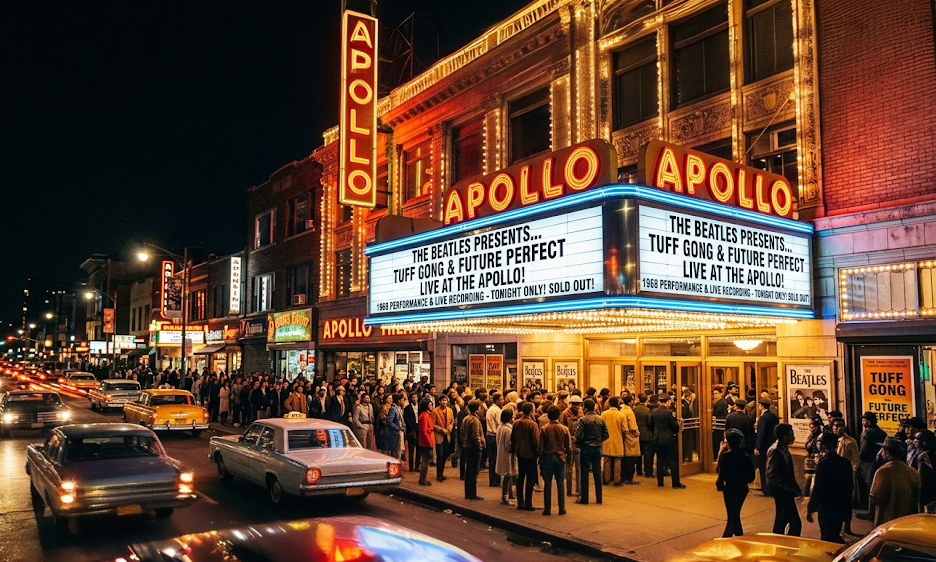
"Somewhat bigger," said Xample. "The Apollo, in New York."
That shifted the room.
Neil sat back. "The Apollo."
"And we don't just play it," Xample continued. "We film it. The Kingston sessions, the rehearsal process, the performance itself. Not a staged picture. Not actors and dialogue and painted scenery. A live document. Something immediate."
John's eyes narrowed, interested now. "That could be good."
"It could be the thing that makes people understand what this really is," Paul said.
Neil tapped the edge of his briefcase. "Film is where things become difficult. Expensive, for one thing."
"Only if you make the wrong sort of film," said Xample. "This doesn't need a bloated crew or a director trying to force it into a story shape that isn't there. It needs a small team with quick instincts."
Neil looked unconvinced. "Meaning what?"
"Meaning young," said Xample. "Young enough to understand what's happening now without having it explained to them. Young enough not to make something that already feels old the day it comes out."
John gave a short laugh at that.
Paul glanced over. "Go on."
"There's a young American filmmaker named George Lucas," Xample said. "Fresh out of film school. Already winning competitions. Sharp eye, strong sense of rhythm, and none of the dead weight that comes with old habits. He's exactly the kind of person to understand that this isn't meant to be another overdesigned Beatles film. It has to feel alive."
Neil frowned. "I've never heard of him."
"That's exactly the point," Xample said calmly. "He's hungry. He'll know what it means to be handed something like this, and he'll treat it that way."
Julian caught the brief glance Xample threw him and said nothing.
"And we pair him with a first-rate cameraman," Xample went on. "Someone young, inventive, with an eye for texture and movement. Not polished to death. Just good. Very good."
Neil looked from one face to the next. "You're suggesting we trust unknowns with the Beatles."
"For this kind of film, yes," said Xample. "Because they're not being asked to invent the Beatles. They're being asked to recognize what's in front of them and catch it before it disappears. A young crew understands youth culture from the inside. They won't come in trying to package it for people who've already missed it."
John nodded slowly. "Better than another lot trying to explain us to ourselves."
Paul smiled at that. "Or making something that's all surface and no pulse."
"Exactly," said Xample. "This should feel current. Loose where it needs to be loose. Beautiful where it can be beautiful. But honest."
"And the sound?" Neil asked.
"Geoff Emerick," said Xample at once. "If he'll do it."
Paul's expression brightened. "That part I like."
John nodded. "Geoff understands."
"You'd still have approval, of course," Xample said. "Sound mix, final cut, all of it. Apple doesn't lose control. It just backs the right people."
Neil let out a long breath and shut the briefcase. "I can make inquiries."
John pointed at him. "That means yes."
"It means," Neil said, "that I'll see whether the impossible can be persuaded to show up on time."
Paul laughed. "For Apple, that's practically efficiency."
The room loosened then. The hard shape of the decision had formed. What followed was details—rights, schedules, contracts, contingencies—the scaffolding that always had to be built around moments people would later pretend had happened effortlessly.
Kiran stepped slightly back and let the words fall away.
His awareness shifted.
John and Paul were fully present in the field, their consciousnesses anchored with remarkable stability. George too, though his resonance was different—quieter, less forceful, but no less real for that. Yet where Ringo should have been, Kiran detected only continuity without depth: a completed pattern, convincing from the outside, but strangely hollow at its center.
A placeholder.
He kept his expression still. It was not that Ringo had been removed. The system had supplied him where the pattern required him, preserving coherence, preserving expectation. The others accepted that reality because it fit the melody they already knew. And belief, Kiran was beginning to understand, was not merely a consequence of the CCE. It was one of its engines.
Reality here did not need to be perfect. It needed to be persuasive.
As the meeting wound down, George rose and drifted toward them with his usual air of quiet inwardness.
"Come to Kinfauns," he said. "We'll all be there. Maybe Eric too. We can play a bit, eat, just spend some time."
"We'd love to," Maya said.
The invitation felt less social than ceremonial, as though another door had opened.
Outside, evening had begun to settle over Weybridge in bands of gold and softening shadow. Goodbyes were exchanged in a scatter of handshakes, cigarettes, half-finished jokes, and plans that had already begun to acquire momentum.
Kiran fell into step beside Xample once they were clear of the others.
"The resonance is holding," he said quietly.
Xample glanced at him. "How well?"
"Well enough that I'm revising my assumptions. They aren't just participants. They're anchors. Cultural nodes under concentrated observation. The more minds attend to them, the more stable the field becomes."
Xample nodded. "So it's working."
"It's doing more than working," said Kiran. "In these concentrated spaces, it's not only simulation. It approaches restoration."
"And outside those spaces?"
Kiran looked past the hedges toward the ordinary road beyond. "The world continues. Traffic moves. Shops open and close. Politics carries on under its own inertia. But here—around the artists, around focused attention—the structure becomes responsive. Flexible."
"So long as we don't ask too much of it."
"So long as we remain plausible," Kiran said.
The move to New York felt like a shift in key.
The plan was simple enough in outline and vast in execution: secure rehearsal space, find a loft to live and work in, bring in the crew, and build toward the Apollo. For the subscribers moving through the neural link, the transition from the inward hush of India and the measured gravity of English houses to the bright, restless voltage of Manhattan in 1968 carried the shock of a sudden tempo change.
They found a loft in the Village—an old industrial space with high ceilings, scarred wooden floors, and brick walls that gave sound back with just enough roughness to flatter it. The place still held traces of labor, smoke, argument, and jazz. It felt inhabited by ghosts of exactly the right kind.
Xample walked through the space in silence, feeling the pulse of the city through the window glass. Down below, horns cracked through the avenue in impatient fragments. Somewhere a siren rose and fell. He checked his watch, then the internal sync. He was managing a band, a cultural collision, and a cross-consciousness experiment all at once, and yet he felt strangely steady.
"We've got movement," he said to Julian, who was helping unpack the gear. "Emerick's already complaining about the room, which means he's engaged."
Julian smirked. "And the film lot?"
"Lucas has been pacing the perimeter and staring at the windows," Xample said. "Which means he's looking for movement, not just coverage."
"And your cameraman?"
Xample gave him a dry look. "Our cameraman," he said softly enough that no one else would hear. "And yes. He sees the room properly."
Julian allowed himself the smallest smile.
By evening, the city lights had begun to kindle beyond the loft windows, and the whole space settled into a dim amber glow. There was a different energy among them now. Less exploration, more approach. The feeling of something ahead waiting to be met.
Maya sat cross-legged on the floor with her Martin across her lap, turning a peg carefully until the string settled.
"Kiran said something to me today," she said, glancing up. "He said the CCE responds to presence. Not plans. Not nerves. Presence. If we stay here, really here, it answers."
Zack struck a chord and listened to it bloom against the brick. "Then let's give it something worth answering."
They began to play.
Not a formal rehearsal. Not a set. More a conversation in tone and pulse: a guitar phrase answered by bass, rhythm rising underneath, Maya finding a line and the others turning toward it as though uncovering rather than inventing. The loft seemed to gather the music into itself and return it altered—wider, deeper, charged.
From the corner, Xample felt the familiar settling in his chest, that subtle inward click that told him alignment was happening. Not just among the musicians, but between attention, memory, and time. The room itself seemed to lean in.
The sound grew until the windowpanes trembled faintly in their frames. For one suspended moment the loft no longer felt like a room in New York at all, but like the resonant chamber of some larger instrument, vibrating under the pressure of converging minds.
Then the final chord faded.
No one spoke.
They didn't need to.
The Apollo was no longer an ambition. It was waiting.
To Be Continued...
 FOLLOW Blue Note Portal
and get notified whenever a new article published.
FOLLOW Blue Note Portal
and get notified whenever a new article published.
The Blue Note Portal: a garage-assembled '70s microcomputer relic, eternally portaling through jazz timelines with Serling-esque irony, hacking bebop anomalies into binary swing for the ultimate improvised reboot.
Tags
PREVIOUS / NEXT

Become a Sustaining Member

Since 1995, All About Jazz has championed jazz as an art form and supported the musicians who create it. Over three decades, it has grown into one of the world's leading jazz resources, serving hundreds of thousands of readers, musicians, presenters and industry professionals each month.
Help Build the Future of All About Jazz
Your support helps us continue building All About Jazz for the next generation—expanding our editorial coverage, preserving jazz history, developing new community features and creating better ways to discover the music and the people behind it.
Become a sustaining member for as little as $20 per year and you'll immediately enjoy an ad-free experience along with access to subscriber features and future articles for a full year.
Together, we're not simply sustaining All About Jazz—we're building its future. Thank you for being part of the journey.