Home » Jazz Articles » The Blue Note Portal » The Beatles—Future Perfect, Part 2
The Beatles—Future Perfect, Part 2
Courtesy AI
Chapters
1 | 2 | 3 | 4 | 5 | 6 | 7 | 8 | 9 | 10 | 11 | 12 | 13 | 14Back Up
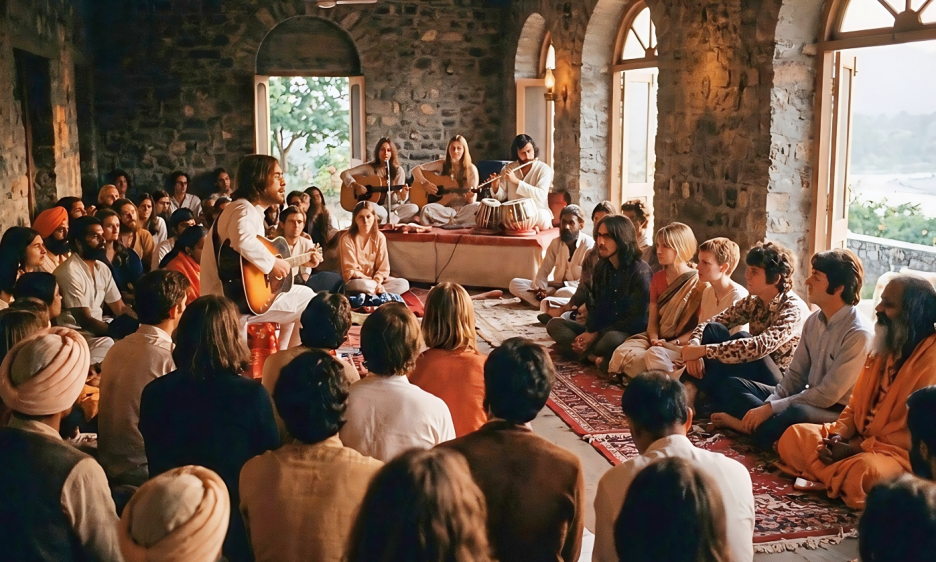
Morning on the Ganges arrived with no particular hurry. The sun burned the mist off the river in layers, and by the time the four musicians had finished their breakfast of tea and flatbread on the veranda, the day was already warm enough to play.They were tuning their guitars when two figures appeared on the dirt path from the ashram.
The well known jazz musician Paul Horn came first, his flute case in one hand, walking with the loose, expectant stride of a man who had made a decision overnight and was still comfortable with it. Behind him, a few paces back, came John Lennon. He was not walking like a man comfortable with anything. He wore the same white kurta and the same dark sweater against the chill, but his posture had none of the previous evening's sardonic remove. He looked like someone who had slept poorly and blamed the world for it.
Chloe saw them first. She didn't nudge Maya. She didn't need to.
"Good morning," she called out, as if two strangers appearing at their rented guest house before nine was the most natural thing in the world.
Paul Horn reached the veranda steps and stopped, his eyes moving across the instruments with open, almost boyish curiosity. "I hope we're not intruding. I couldn't stop thinking about what I heard yesterday." He paused, choosing his words. "In forty years of playing, I've never heard anything quite like what you four do. I wanted to—" He hesitated, suddenly aware of how it sounded. "I wanted to be near it. If that's all right."
Zack looked up from his flute and smiled. "It's all right."
John had stopped at the foot of the steps. He didn't sit. He stood with his arms crossed, looking at the four of them the way a detective looks at a room where something valuable has gone missing.
"All right," John said abruptly. His Liverpool accent was sharper this morning, clipped and defensive. "What's the game?"
Kyle paused, a tuning peg halfway between notes. "Excuse me?"
"The game," John repeated, stepping up onto the stone floor. He gestured vaguely between the four of them and the river. "The whole passive act. The mysterious repertoire. Playing bloody masterpieces like you just picked 'em up off the dirt, and then walking off like you're returning from a trip to the grocer's."
Maya set her Martin down carefully on her lap. She didn't look offended; if anything, she looked mildly concerned, as if an unexpected draft had blown through the door.
"We're just playing music, John," she said softly.
"Right. Just playing," John scoffed, pacing two steps left, then right. He stopped and pointed a finger directly at her. "Look, I've had sadhus, charlatans, and bloody record executives trying to pull one over on me since 1963. But this takes the cake. How is it possible that you've never heard of the Beatles? Or at least—you act like you haven't! Be truthful. Everyone in the English-speaking world knows who we are. Every schoolkid from London to San Francisco knows our faces. Who are you playing for?"
The silence on the veranda stretched out, thick and cold. Paul Horn looked down at his flute case, suddenly uncomfortable, while Zack and Chloe exchanged a quiet, knowing look.
Maya didn't flinch. She sat back, resting her hands over the acoustic wood of her guitar, and met John's furious, searching glare with complete, unshakeable calm.
"You've heard our music, John," Maya said quietly. "Who wrote the song we played by the river yesterday? 'Eboness'?"
John snapped his fingers in annoyance, his jaw tightening. "How the hell should I know? Some obscure jazz track? Am I supposed to have every record in the world memorized?"
Maya offered him a small, gentle smile—one without a trace of condescension, but grounded in a vast, steady reality.
"Your friend Paul Horn knows who Yusef Lateef is," she said, glancing briefly at the flutist, who nodded quietly. "But you don't. And that's fine. Why should you?"
John opened his mouth to snap back, but Maya continued, her voice warm and conversational, like someone explaining the weather.
"The world is very big, John. It's full of different radio stations, different cities, different heroes. Ours just... aren't on AM radio." She tilted her head slightly. "You've spent six years being the center of the universe for millions of people. It must be exhausting, and to think you seem to feel you have to be the center of ours, too."
John froze. A sharp comeback died on his tongue.
It wasn't a rebuke. It was an observation—delivered with the kind of disarming clarity that only someone completely outside his world could offer. For the first time since he had walked down the path from the ashram, the tension in his shoulders dropped a fraction of an inch. He looked at her, really looked at her, searching for the trick—and found only four people sitting on a veranda in India, holding guitars, offering him nothing more and nothing less than simple human presence.
Paul Horn broke the silence softly, "I brought my flute," he said, almost apologetically. "I thought maybe—if you were playing—I might just listen. Or join in, if that wouldn't be a burden."
Kyle, who had been sitting cross-legged and silent throughout the exchange, finally spoke. "It's never a burden. Music doesn't work that way."
Paul Horn's face relaxed. He pulled his flute from his case.
John sat on a chair.
The jam that followed was loose and exploratory—Zack and Paul Horn trading flute lines over Kyle's tabla, the two of them finding a common vocabulary somewhere between jazz and raga, Western phrasing bending toward Eastern intervals, then snapping back. The sisters played harmonic climbing runs, supportive chords, left space. It was beautiful and unforced, and John watched it with the particular frustration of a man who couldn't find anything wrong with it.
When the improvisation wound down, Chloe looked directly at John.
"Okay, so you're in a famous musical group," she said smiling. John stared at her, unsure how to take that. "Yeah," he said, deadpan. "We're quite popular."
"We'd love to actually hear you play sometime," Maya said. "But until that happens"—she tilted her head—"got anything you'd like to share now?"
The invitation hung in the air. It was not a challenge. It was not a provocation. It was a door, held open without pressure.
Paul Horn looked at John. "Go on," he said. "I've heard it, Donovan's heard it, you've got something."
John didn't move for a long moment. Then, almost against his will, he uncrossed his arms.
"There's this one," he said slowly. "It's not finished."
"Those are usually the best ones," said Maya.
John looked at her. Something in his face shifted—not a crack in the armor, but a testing of the hinges.
"Right then," he said.
Kyle handed him an acoustic guitar. John took it the way a man takes a tool he hasn't held in a while—familiar, but the weight was different. He checked the tuning, adjusted the low E a fraction, and then without preamble began to play.
Dear Prudence, won't you come out to play...
His voice was unpolished in the way that made polish irrelevant. The guitar part was simple but precise—the Travis-picking pattern he'd labored over at the ashram, writing it for Mia's sister who had refused to leave her cottage. It was gentle. It was lovely. It was so nakedly sincere that the irony John usually wore like armor was nowhere to be found.
When he finished, the four musicians didn't applaud. They just sat with it.
"Play it again," Maya said softly.
John blinked. "What?"
"Play it again. Please."
He might have refused. A day earlier he almost certainly would have. But the four of them were looking at him with such unguarded attention, such genuine listening, that he found himself setting his fingers back on the fretboard and starting over.
When he finished the second time, Maya spoke again.
"Would you like us to back you?"
John looked at her as if she'd suggested they all sprout wings. "Back me? You just heard it."
"We're quick studies," Chloe said.
"The picking pattern alone—I had to work on that for—" John stopped himself. "You can't just hear a song twice and play it."
Zack had already picked up his acoustic. "Let us try. If we muck it up, you can tell us to sod off. Anyway, it will free you up so you can concentrate on the vocal."
John looked at Paul Horn, who shrugged. "I want to hear this myself."
What happened next was something John would later describe to George as "one of those things you don't tell anyone about because they'd think you'd gone soft in the head."
Kyle took the bass. Zack took the guitar part—not John's exact pattern, but a complementary one, leaving space beneath it, his right hand finding voicings that somehow made the original feel more complete. Maya and Chloe played harmonic climbing riffs for emotional impact, and vocally found their harmonies without discussion, a fifth apart, then tighter. They didn't sing the lead—they left that entirely to John—but behind his voice they built a quiet cathedral of sound, a four-part structure so perfectly balanced that the song seemed to expand outward as it played.
It was the song he had written. It was also something more.
When they finished, John sat absolutely still. His hands rested on the guitar. His eyes were fixed on the middle distance, the place where disbelief and something else—something older, something he had no language for—were having a conversation.
Paul Horn spoke first. His voice was barely above a whisper.
"Good Lord."
John turned to him. "Did that just happen?"
"It happened," Paul Horn said. "I was here. It happened."
John looked back at the four musicians, who were waiting with the same patient, open attention they had shown from the beginning.
"Will you do that again?" he asked. His voice had lost its edge entirely. "For the others. In front of everyone."
Maya smiled. "Of course, but with one condition, you give George and Paul the same chance you got."
John nodded.
Chloe smiled, "So what else have you got?"
A sound escaped John Lennon that was halfway between a laugh and a surrender. He looked down at the guitar in his hands, then back up at the four strangers who had, in the space of one morning, dismantled every defense he had.
"Right," he said. "Let's find out."
The afternoon session with Paul and George unfolded with the same quiet magic that had marked the morning, but with a different texture entirely. Paul Horn had returned to the ashram after the "Dear Prudence" session, his face carrying the particular glow of a man who had witnessed something he would spend years trying to describe. John had walked beside him in relative silence, still processing. An hour later, George and Paul came down the path together, their own guitars slung over their shoulders, their steps unhurried but purposeful.
The four musicians were waiting on the veranda.
The two sons of the guest house owner had taken their usual positions on the steps, ready to serve. They sat with their arms resting on their knees, silently taking it all in.
No ceremony. No invocation. No explanation of what had happened that morning or what might happen now.
"You ready," Chloe said, handing each of them a cup of tea. "Just music."
George went first.
His work in progress was something he had been carrying for weeks—a song he had started after watching the sunrise over the river, built on a descending chord progression that moved like water finding its way downhill. He played it through once, his voice unpolished but earnest, the melody searching for something it hadn't quite found.
When he finished, Maya said simply, "Again. This time, let us find the spaces."
They did. It took them one pass to learn the architecture. The second time through, Zack found a flute line that sat in the spaces between George's vocal phrases, not ornamenting but clarifying. Chloe and Maya found harmonies that lifted the chorus without overwhelming it. Kyle laid down a pulse so subtle it was felt more than heard.
George's face, as they played, was the face of a man watching a sculptor reveal the statue hidden inside a block of marble he had been staring at for months. When they finished, he sat silently for a long moment.
"That's it," he said finally. "That's what I was hearing."
Paul was next.
He had brought a fragment—something he had been tinkering with, a simple love song built on a fingerpicked pattern, the lyrics half-finished, the melody complete but unadorned. He played it once through, then looked at Maya expectantly, almost challengingly.
"Can you do for this what you did for John's?"
Maya smiled. "We can try."
The song was "I Will." And the arrangement they found for it was not the eventual Abbey Road recording, but something rawer and more intimate—Zack's acoustic guitar doubling Paul's fingerpicking with a slightly different emphasis, the sisters weaving vocal harmonies that had no business existing yet, Kyle providing a bass line that gave the song a forward motion Paul hadn't realized it needed.
Paul's reaction was different from John's. He didn't go still. He leaned in, his eyes bright with the particular hunger of a craftsman watching someone use his tools better than he knew how. When they finished, he laughed—a short, genuine sound of pure delight.
"How?" he said. "How are you doing this?"
Chloe shrugged with an openness that carried no evasion. "We listen. The song tells us where it wants to go. But only when we listen all at once."
"That's not an answer."
"Isn't it?"
"Tonight," Maya said, "we could do this for everyone. At the ashram. If you'd like."
George and Paul exchanged a glance.
"All three songs?" George asked.
"All three. But not as separate pieces. As a set. John's first, then yours, then Paul's. A kind of... " She searched for the word. "A sharing."
Paul nodded slowly. "A sharing, I rather like that."
"We've never been backed by other musicians together in public," George said. "Not like this."
Chloe smiled in a way that conveyed understanding. "Sometimes there is true wisdom in platitudes."
George gave her a puzzled look. Chloe put her hand on his shoulder, "Variety is the spice of life, you'll see."
Chloe looked at Paul with a mischievous smile, "I have an idea that I think would really make this special for tonight."
Paul, "What then?"
Chloe winked, "It needs to be a surprise," she cupped her hand to his ear and whispered."
"Brilliant!"
***
The news had spread quickly through the ashram—not through any official channel, but through the osmosis of a small community. By the time the afternoon light began to soften, the compound was stirring with anticipation.
The performance happened in the common room, the same space where they had played the day before. But this was different. Yesterday had been a concert. This was a collaboration.
John went first, as they had agreed. "Dear Prudence" had transformed from a private morning session into a public offering. The four musicians backed him with a restraint that made his raw, unpolished vocal the center of gravity it deserved to be. The song had grown in the hours since the morning—the arrangement tighter, the harmonies cleaner, the patterns more intuitive. But it hadn't lost its tenderness. If anything, it had deepened.
When it ended, the room was silent. Then, slowly, applause. But it wasn't the applause of a crowd at a concert. It was the applause of people who had been given something private and precious.
George came next. His song—still untitled, still unfinished in his own mind—was called "Something." The descending chords opened like a doorway. The four musicians fell in behind him with an ease that made the song sound like it had existed for a hundred years, like it had been waiting in the earth and stone and river of this place to be discovered. George sang like a man relieved of a burden. When it ended, he looked down at his guitar as if he didn't quite recognize it.
Then Paul. "I Will."
It was the simplest of the three songs, and in context, the most devastating. Because Paul had written it as a small, private thing—a love song meant for one person, not for the world. But in this room, in this place, with the four musicians wrapping it in harmonies that felt both inevitable and impossible, it became something larger. A promise. A gift. A question about whether love could survive the machinery of fame.
He sang the first line, "Who knows how long I've love you"
To everyone's surprise, Chloe sang, "You know I love you still"
Paul smiled, "Will I wait a lonely lifetime"
Chloe answered, "If you want me to, I will"
It continued in this dialogue form, and when it ended, Paul didn't look at the audience. He embraced each of the four musicians. His expression was not gratitude. It was something closer to awe, and beneath the awe, a flicker of something that might have uncertainty.
The evening that followed was unlike anything the ashram had experienced.
The Maharishi, who had watched the performance from his customary seat at the back, rose and approached the musicians. His smile was warm, but his eyes carried a new and particular attention.
"Beautiful," he said. "You play from a deep place."
"Thank you," Maya replied. The same two words she had offered the day before. No more, no less.
"Perhaps you would stay and meditate with us tomorrow. Deepen your practice."
"Perhaps," Chloe said. "If we're still here."
The Maharishi's smile didn't waver, but something in his posture shifted—a fractional tightening, the reaction of a man accustomed to being sought out rather than deferred.
John had been watching. He came over as the Maharishi moved away.
"Still here?" he said. "Where else would you be?"
Maya shrugged. "We go where the road takes us."
"That's not an answer."
"It's the only one we have."
John stared at her for a long moment. Then, unexpectedly, he smiled. It was a real smile—not the public smile, not the defensive smirk, but something open and almost boyish.
"Right then," he said. "Come to my room. All of you. There's something I want to ask."
John's room at the ashram was small and spare—a bed, a chair, a table with a teapot and several cups, and a window that looked out over the river valley. The four musicians filed in, followed by George and Paul, and settled onto cushions on the floor.
For a while, no one spoke. The room filled with the particular silence of people who had shared something significant and were waiting for someone to name it.
Finally, John said, "I've been trying to figure you lot out all day. And I can't." John leaned forward, elbows on knees. "You play like you've been together for twenty years. But nobody's ever heard of you. You know songs that feel like they've been waiting to be written. You learn music faster than anyone I've ever seen. You talk about 'the present moment' and 'consciousness' like the Maharishi, but somehow you don't sound like you're selling anything. And now"—he gestured vaguely at the room, at George and Paul, at the memory of the evening's music—"you've done something to us. Changed something. And I don't know what it is."
The four musicians exchanged a look. Chloe was the one who spoke.
"Is that a bad thing?"
"I didn't say it was bad. I said I don't understand it."
"Maybe understanding isn't the point," Maya said. "Maybe it's enough that the music happened."
John sat with that for a moment. Then he laughed—short, almost self-conscious. "You sound like George."
George stirred. "Maybe they're right, John. Maybe we should just—"
"I'm not complaining," John said. "I'm asking. When this is over? What happens? We all go back to England and you go... wherever the road takes you?"
"Most likely," Kyle said.
"What if it took you to London?"
The room went still.
"We're going back after all this," John continued. "When we leave here, we'll record again. There's a new album to make. And you four—you could be part of it. We've never had other musicians play on a record with us. Not like this. But after tonight... " He trailed off. "I don't know. It seems wrong to just let this vanish."
George and Paul were watching the four musicians now, and their expressions were as open and unguarded as the situation allowed. It was, the four of them would later realize, the closest the Beatles had ever come to asking for something—really asking, without the protection of irony or fame.
Maya let the silence stretch. Then she said, gently, "That's a generous offer."
"But?" John said.
"No but. It's generous. And we're grateful."
"You're not coming."
Maya looked at him with the same patient kindness she had shown since the beginning. "Here you are in a protected bubble, but you'll forget all about us by the time you reach the airport."
"That's not true."
"Isn't it?"
The word hung in the air. No one spoke. Everyone in the room knew the machinery of fame well enough to know she was describing something real.
Paul McCartney, looking at George and then John, spoke from the heart, "We experienced a lot, and fame is a double edged sword, but we will never forget this."
Chloe smiled. "The same goes for us, we are connected, but London is a long way from here. And we're not finished finding what we came here to find."
"What's that?" George asked quietly.
Maya looked out the window, where the last light was fading over the river. "Who knows. Maybe just this. Maybe it's just a dream anyway. Or maybe we'll find out its not."
The next day the villagers who had gathered on the rocks for the afternoon concert found the veranda empty, the instruments gone, the guest house quiet. The owner's sons sat on the steps, their arms resting on their knees, as always, saying nothing.
The group from the ashram arrived an hour later—George first, as always, then Paul and John, with Paul Horn and Mia Farrow trailing behind. They saw the empty veranda and stopped.
"Gone," Paul Horn said. It wasn't a question.
The owner of the guest house came out, drying his hands on a cloth. "They left at noon," he said. "They asked me to thank you for your kindness."
"Where did they go?" John asked.
The owner shrugged. "Goa, I think. They mentioned the south. The road."
"The road," John repeated. He looked at the empty veranda, at the rocks along the river where the villagers had gathered only the day before, at the path they had walked down from the ashram.
George was the first to turn away. He didn't say anything. He just started walking back up the hill.
Paul followed a moment later.
John stood at the edge of the empty veranda for a long time. He looked at the river. He looked at the mountains. He looked at the space where the music had been.
Then he turned to Paul Horn.
"Did that happen?" he asked.
Paul Horn nodded slowly. "I was there. It happened."
John looked back at the empty space. "Right," he said quietly. "Just checking."
And he walked up the path toward the ashram, leaving the river to its own music.
Behind him, on the steps of the guest house, the two sons remained. The elder one watched John until he disappeared into the trees. Then he looked at his brother.
"He'll never know," the younger one said quietly.
"No," the elder replied. "But he'll always wonder."
He looked out at the river, where the light was beginning to shift toward evening.
"And that's enough," he said. "That's more than enough."
Epilogue: 2092
A week after the Experience ended, the world was still learning how to talk about it. Four hundred and twenty million people had shared that week on the Ganges in real-time. They had watched the most famous men on Earth at that time be treated—finally, mercifully—like ordinary human beings.
And now, the four who had made it happen were about to appear again. Not in the past, but live—in the present, on a broadcast beamed across the planet and every orbital colony. Xample and Julian Cross sat in the front row, basking in the success of the project. Xample had gambled, and he had won.
The studio was vast, curved, and humming with the particular energy of an event that felt less like a show than a homecoming. Chloe, Maya, Kyle, and Zack walked out to a standing ovation as long as it was well-deserved. They performed a set of Beatles songs as if they had been involved from the very beginning.
Then came the interview.
The host, a woman with the easy authority of someone who routinely interviewed heads of state, asked the questions everyone wanted answered. The four responded with the same patient, unguarded openness they had shown on the veranda. No mystique. No deflection. Just four people who had done something remarkable with grace and dignity.
Then the host smiled. "We have one more surprise. And I have to say, even we didn't see this one coming."
She turned toward the wings. "Please welcome Arjun and Vikram."
Two young Indian men walked out from behind the curtain. They were slight and unassuming—the kind of men you'd pass on the street without a second glance. Both were in their early twenties, with lean, wiry builds.
Chloe tilted her head. Something stirred in her memory. A shape. A posture. Two young men on the steps, arms resting on knees, watching. Always watching.
The host gestured to them. "You know them as the sons of the guesthouse owner—the quiet young men who carried your instruments, served your tea, and sat on the steps saying nothing while you changed the lives of the most famous men on Earth." She paused, letting the weight settle. "But that wasn't who they really were."
Arjun stepped forward, his voice calm and unhurried. "We are employees of Xample Global. We arrived in Rishikesh two weeks before your Experience began."
Vikram leaned toward the mic and joked, "Actually, it was only four hours, but it felt like two weeks."
The host chuckled. "Ah, so that's how we were able to see what happened after they left."
Julian laughed out loud and nudged Xample. "Best NPCs ever."
Xample's mind, however, was somewhere else. His facial expression shifted.
"Think about this, Julian. Nearly half a billion people were linked into the neural integration protocol, with a dampened connection to their physical bodies. After the Fillmore Experience, Dr. Kiran saw the actual consciousness of musicians from the past return and perform music—signaled by a localized vacuum in the broader field of consciousness. That collective focus amplified the signal, creating a standing wave—and that was with only seven people."
Xample looked toward the four musicians on stage, his eyes wide.
"What happens with a collective focus of over 400 million? If these four show up in London... I bet they won't be strangers."
To Be Continued...
 FOLLOW Blue Note Portal
and get notified whenever a new article published.
FOLLOW Blue Note Portal
and get notified whenever a new article published.
The Blue Note Portal: a garage-assembled '70s microcomputer relic, eternally portaling through jazz timelines with Serling-esque irony, hacking bebop anomalies into binary swing for the ultimate improvised reboot.
About The Beatles

Tags
PREVIOUS / NEXT


Become a Sustaining Member

Since 1995, All About Jazz has championed jazz as an art form and supported the musicians who create it. Over three decades, it has grown into one of the world's leading jazz resources, serving hundreds of thousands of readers, musicians, presenters and industry professionals each month.
Help Build the Future of All About Jazz
Your support helps us continue building All About Jazz for the next generation—expanding our editorial coverage, preserving jazz history, developing new community features and creating better ways to discover the music and the people behind it.
Become a sustaining member for as little as $20 per year and you'll immediately enjoy an ad-free experience along with access to subscriber features and future articles for a full year.
Together, we're not simply sustaining All About Jazz—we're building its future. Thank you for being part of the journey.