Home » Jazz Articles » The Blue Note Portal » The Beatles—Future Perfect, Part 7
The Beatles—Future Perfect, Part 7
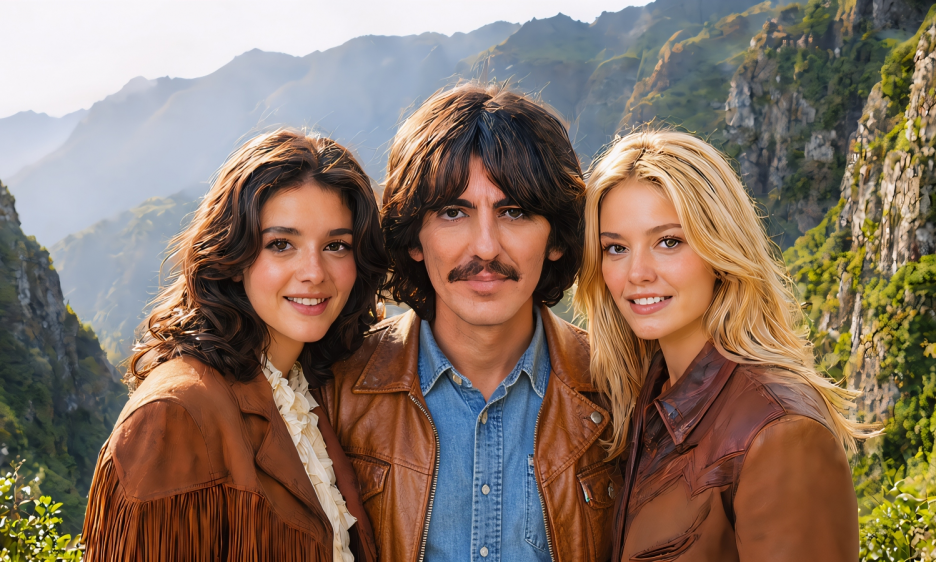
Courtesy AI
Chapters
1 | 2 | 3 | 4 | 5 | 6 | 7 | 8 | 9 | 10 | 11 | 12 | 13 | 14Intimate Immersion
By the spring of 1969, the Apollo had ceased to be merely a theater in Harlem. It had become a point of origin.The film—Apollo: Future Perfect—opened to excited audiences around the globe. George Lucas's cameras had caught magic discovering itself in real time—the raw, triumphant build-up as well as the concert itself. Bob Marley standing under the Apollo lights in his cowboy hat, smiling as if he had just found a door in the world no one had told him was there. Future Perfect moving from behind him into their own music with a quiet confidence that made the transition feel inevitable. John, Paul, George, and Ringo not as monuments, but as musicians listening hard—sometimes astonished, sometimes laughing, sometimes visibly moved by what the others had brought out of them.
Most of all, it showed them evolving.
The response was immediate and profound.
Young people came out of cinemas wanting guitars. Older musicians came out wanting to practice again. Conservatory students and garage bands, jazz players and church singers, folk clubs and school orchestras began speaking of the performances as though they had not merely watched a film, but found an inspiration.
The Beatles, meanwhile, did not split. They had matured, and so did their audience. The screaming fans had grown up or moved on. The Apollo film gave the world an inside look at the magic of music-making and the internal dynamics of a band, allowing them to step outside their bubble and be recognized primarily as singer-songwriters who took their creative gifts seriously. That brought a newfound openness to the exceptional musicianship of Future Perfect, who—due to their established fame in 2092—were more than content to remain in a prominent, supporting role. The Beatles had not healed every old wound, but they felt the magic of the music again.
Real music—music emerging from that mysterious creative source.
John and Paul wrote together sometimes, as they had in the beginning, tossing lines back and forth across a piano or a pair of acoustic guitars. Other days John arrived with a song that belonged only to him, sharp-edged and vulnerable beneath the sarcasm. Paul brought melodies with their internal architecture already complete, but open to insights from John and George. George brought songs less often, but when he did, they were treated seriously, especially by Future Perfect.
They had changed the atmosphere.
The phrase began with a reviewer in Melody Maker after the second Apollo screening.
The Future Perfect Beatles, he wrote. Not a replacement for what they were, but the fullest expression of what they had always been trying to become.
John initially dismissed it, but knew it was true.
Paul claimed not to have read it, and then quipped, "Not bad, that."
George laughed when asked about it: "The past is always replaced by the future."
By mid 2092, the number of CCE subscribers passed 1.4 billion. Julian saw it happen from the upper control gallery, standing beside Dr. Kiran while the count rose by thousands at a time.
Below them, the CCE operations floor glowed in layered bands of blue and amber. Scores of technicians moved quietly among their stations, though there was very little now that required direct intervention. The system had grown beyond supervision in the ordinary sense. It responded to focus, emotional coherence, cultural memory, and the strange shared intention of more than a billion people entering the same world with open attention.
Julian finally let out an audible slow breath.
Kiran did not look away from the monitors.
"That is no longer a subscriber base," he said. "It is a resonance field."
The resonance maps had changed almost every day since the Apollo event. At first the differences were subtle: stronger continuity in the secondary environments, increased detail in locations the system had previously treated as background. Streets that should have existed only as plausible architecture now held living movement inside them. Cafés carried conversations with no visible narrative purpose. Musicians who had never been programmed into the event appeared in clubs, rehearsal rooms, and audience seats.
Then Kiran began to recognize some of them.
Xample's answer to touring was to reimagine it. At the first planning meeting, he laid out his thoughts: "There is a reason you slept in the back rooms of strip clubs in Hamburg and played seven hours a night for peanuts. At the end of the day, you are gifted performers and you know it—it's who you are and what you are supposed to do. At the same time, you didn't pay all those dues to suffer through these grueling tours."
John, feet up on a chair in the Apple office, raised an eyebrow. "And what exactly do you propose?"
"A residency," Xample said.
Paul laughed. "Like Elvis in Las Vegas?"
"Nothing like Las Vegas."
"That's a relief."
Xample spread photographs across the table showing some of the most beautiful and exotic places on Earth.
John scoffed. "All well and good, but there's no audience."
Xample smiled. "You could live like kings for the rest of your lives just from your share of the Apollo film."
John responded sharply, "What's that got to do with a residency?"
"We don't just tour and dash in and out of these locations," Xample explained. "We visit them, experience them, and bring the same film crew we had at the Apollo. A documentary of each place seen through your eyes as you experience it, followed by a few performances. Always in venues built for live music—intimate, with great acoustics. Even if only five hundred attend, the film pays for everything and earns more than any stadium performance ever could. Your fans go to the theater and experience the next best thing to being there."
He paused, letting the point settle. "You stay in one place long enough to become human beings again. You write there. You eat there. You invite people over. You sleep. You play a few concerts in the finest rooms the city has. Then you move when you want to move."
George studied the photographs. "And no arenas?"
"No arenas. You rent estates, ranches, yachts, perhaps even ships. Private security with no advance notice. Tahiti, New Zealand, ranches in the American West, Argentina, Northern California, Switzerland, the islands of Italy and Greece, Okinawa, Hawaii, Taiwan, Madeira—it's up to you. And the whole time, you are writing and playing music."
They had entertained lofty visions in the past, but those had never panned out. This time felt different. John gave Paul a knowing look, while George's expression made clear he was all in. And so it was, the plan was set in motion.
Their first destination was Madeira.
The chartered 707 touched down on the island, carrying the band, Future Perfect, and their team. Rather than checking into a standard hotel, Xample had leased an entire historic quinta—a sprawling nineteenth-century British-Portuguese estate surrounded by botanical gardens, private cottages, and sweeping views of the Atlantic. The main manor house easily accommodated the core musicians, while the surrounding cottages housed the technical crew and security team in total privacy.
The week in Funchal moved with the slow, rhythmic grace of the Atlantic tide. During the days, the group ventured into the lush interior of the island. They had local guides with sturdy, sure-footed horses to traverse the levada paths—the ancient stone irrigation channels that cut through the precipitous, emerald-green valleys.
The Madeira residency was perhaps the first time the chains of their fame truly fell away, replaced by the simple, ancient rhythm of the island. The days bled into one another, exploring the gardens of the quinta.
One afternoon, a few days before their performance, the group found themselves away from the manor, riding their horses along a high, narrow trail that clung to the island's northern cliffs. The Atlantic crashed against the volcanic rock hundreds of feet below, a vast, churning expanse of cobalt and foam that made the world feel both dangerous and impossibly wide.
As the horses picked their way along the jagged basalt path, the familiar tension that usually sat between the band and the horizon—simply evaporated. There was only the rhythmic thud of hooves on stone and the shared, wordless labor of navigating the climb.
Paul, riding a few paces ahead of Maya, pulled his horse to a stop where the trail widened near a grove of ancient, twisted laurel trees. He looked back at her, his face flushed not from exertion, but from a kind of quiet, startling clarity. He reached up to adjust his hat, his hand lingering for a moment as he looked out at the vast horizon.
"I'd forgotten," Paul said, his voice carrying easily over the wind, "what it felt like to just be a person in the world." He glanced at Maya, then at the others who had caught up, his expression softened by an unexpected vulnerability. "Just a man on a horse, looking at the same sea as everyone else."
John, who had been riding slightly behind, moved his horse up alongside them. He didn't offer a joke or a witty deflection; he just watched the way the sunlight hit the crests of the waves below.
For their upcoming performances, they secured the Teatro Municipal Baltazar Dias in the heart of Funchal. Officially inaugurated in 1888 and modeled after Lisbon's Teatro de São Carlos and Milan's La Scala, the venue was a masterpiece of nineteenth-century Italian theater architecture. With its horseshoe-shaped auditorium, painted ceiling, and rich red velvet boxes, its acoustics were magnificent and its atmosphere intensely personal, a capacity of only 300.
During the evenings they used the empty, echoing hall to stretch out, rehearse new material, and let George Lucas's camera crew capture the intimate creative process.
The theater, with its gilded balconies and velvet hush, became their sanctuary. They didn't just rehearse; they experimented with the space, playing in the wings, on the empty stage, and even from the highest tier of the gallery to test how the sound folded into the horseshoe curve of the auditorium.
At the end of the week, they scheduled just two evening shows, three hundred extremely lucky locals and travelers per night. Inside the horseshoe hall, without the scream of thirty thousand fans, every subtle acoustic guitar pluck, vocal harmony, and room echo landed with pristine clarity.
Sitting on the stage under the ornate ceiling, John looked across at Paul, George, Ringo and Future Perfect, struck by the sudden, quiet reality that they were playing music simply for the joy of hearing it bounce off the walls.
On the night of their first performance, the atmosphere was markedly different from any of their previous performances. When the Beatles joined Future Perfect on stage, the shift in the room was palpable, for most of their songs, Kyle covered percussion and Ringo played drums. The Beatles were not performing as icons; they were part of a collective. As they played, even the wood of the stage seemed to vibrate in sympathy, and the painted ceiling acted as a sounding board, casting their harmonies back down with a warmth that felt almost physical.
Between songs, Maya stood at the edge of the stage, her silhouette framed by the red velvet curtains. She looked out at the audience, then toward the back of the hall where the shadows pooled. For a moment, she was simply listening to the acoustic clarity.
As they began the opening notes of the next song, Paul caught Maya's eye and nodded, a look of profound, quiet contentment on his face. In that moment, he wasn't the man who had been suffocated by fame; he was simply a musician, in a beautiful room, on a beautiful island, sharing a song that had not yet been written but felt, to everyone in the room, like something they had known their entire lives.
The music swirled upward, mixing with the scent of old wood and salt air, filling the horseshoe hall until there was no past or future—only the resonant, singing present.
To Be Continued...
 FOLLOW Blue Note Portal
and get notified whenever a new article published.
FOLLOW Blue Note Portal
and get notified whenever a new article published.
The Blue Note Portal: a garage-assembled '70s microcomputer relic, eternally portaling through jazz timelines with Serling-esque irony, hacking bebop anomalies into binary swing for the ultimate improvised reboot.
About The Beatles

Tags
PREVIOUS / NEXT

Become a Sustaining Member

Since 1995, All About Jazz has championed jazz as an art form and supported the musicians who create it. Over three decades, it has grown into one of the world's leading jazz resources, serving hundreds of thousands of readers, musicians, presenters and industry professionals each month.
Help Build the Future of All About Jazz
Your support helps us continue building All About Jazz for the next generation—expanding our editorial coverage, preserving jazz history, developing new community features and creating better ways to discover the music and the people behind it.
Become a sustaining member for as little as $20 per year and you'll immediately enjoy an ad-free experience along with access to subscriber features and future articles for a full year.
Together, we're not simply sustaining All About Jazz—we're building its future. Thank you for being part of the journey.