Home » Jazz Articles » The Blue Note Portal » Wolf—Future Perfect, 2. Debussy
Wolf—Future Perfect, 2. Debussy
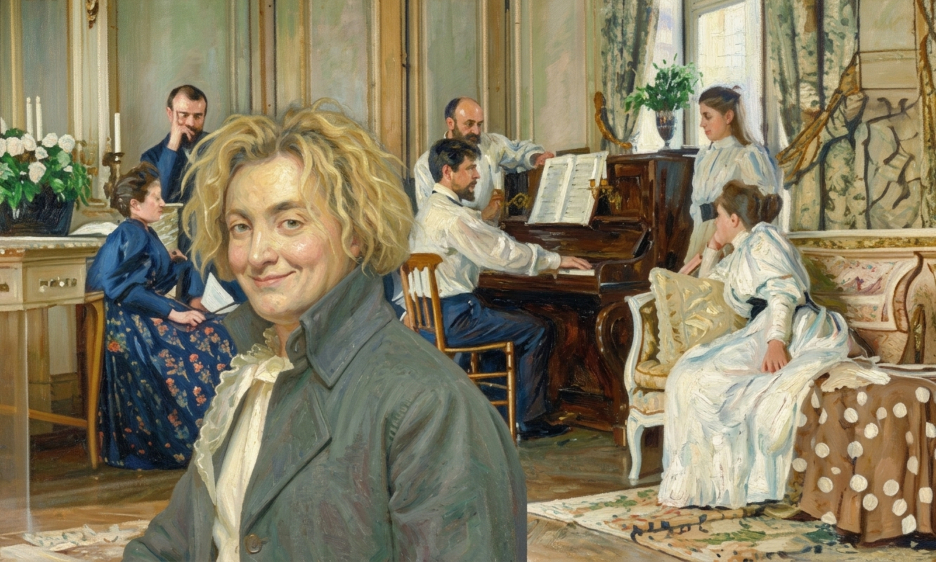
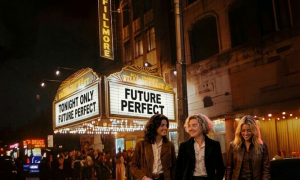
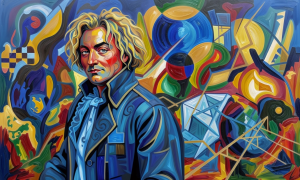
Courtesy AI collage with adapted historic photo
1970—New York
The laughter in the West 26th Street rehearsal loft gradually subsided. Maya was still holding her Les Paul against her hip, staring at the slight figure sitting on the piano bench. Chloe set her Telecaster gently into its stand, wiping her palms on her jeans, her expression caught somewhere between utter bewilderment and radiant amusement."So," Chloe said, crossing her arms and leaning against the edge of the mixing riser with a broad smile, "you're clearly not looking for a $300 per night gig are you?"
Wolfgang Amadeus Mozart gave a modest shrug, elegantly adjusting his sleeve. "The currency seems terribly flimsy. Paper without silver backing? An absurd conceit."
Chloe stepped forward, her green eyes fixed intently on him. How in the world did you learn to play blues like that!"
Wolfgang smiled at Xap. Xap laughed shaking his head in bemused disbelief, "He listened to "Big Legged Woman" by Booker T. Laury a couple of times, and then played along with him the third time.
Maya laughed, "Hopefully Xap and Kiran brought you here for a reason. If you're done shocking us with your ingenious pranks... do you want to grace us with your valuable time and play with us?"
Wolf burst into a bright, musical laugh that bounced off the cavernous ceiling. "My dear girl, where I dwell, time is no longer of the essence. By all means, let me experience what has shaped you. Show me the world that broke the rules I spent my lifetime bending."
Maya smiled, setting her guitar down and stepping toward the grand piano. "I've got a better idea. We take some time. No pressure, no rigid schedules. We play you some music that changed things after your era—some of the records that altered how people hear sound. You listen, you tell us how it hits you, and we learn how that mind of yours dissects it. Are you willing?"
Mozart looked between Maya and Chloe, his boyish face split by an enormous, conspiratorial grin. "Will there be pastries?"
"All you can eat," Zack said with a grin.
"Then lead on patrons," Mozart declared, flourishing his silk scarf like a theatrical cape. "I am entirely at your mercy."
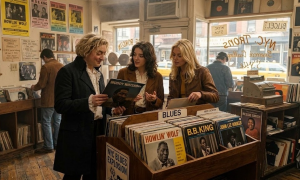
Julian slipped behind the studio console, while Kiran and Xap pulled up a cluster of vintage leather armchairs near the Steinway. Kyle leaned against the edge of the drum riser, a fresh bottle of soda in hand, watching Wolf with intense curiosity.
"Let's start about a century after you," Maya explained, pulling a pristine vinyl sleeve from a wooden crate beside the stereo playback desk. "Late nineteenth century. France. A man named Claude Debussy. In your time, music had to resolve—tonic, dominant, tension, release. It had to march in order."
"It had to please the Archbishop," Wolf corrected dryly, rolling his eyes. "A man whose sense of harmony was as narrow as his waistline was wide."
"Right," Maya laughed. "Debussy decided harmony didn't need to march. He wanted it to float. He wanted to paint light, water, and air."
She placed the needle down. The turntable gave a subtle, low-frequency rumble before the crisp vinyl silence gave way to the delicate, solo piano opening of Clair de lune.
Mozart sat completely still.
His posture shifted almost instantaneously. The restless, fidgety energy vanished, replaced by a focus so sharp it seemed to drop the temperature in the room. His pale eyes fixed on the revolving black disc. As the opening nine-eight meter unfolded—sparse, suspended, swaying like a pendulum slowed by honey—his head tilted slightly to the right.
He didn't move a muscle through the gentle descent of the opening theme. When Debussy introduced the lush, rolled chords in D-flat major, drifting into the tempo rubato, Wolf's fingers twitched against his thighs, mirroring the voicings in the air.
He listened without a single word until the final, whisper-quiet arpeggio drifted upward and dissolved into the warm hiss of the vinyl's run-out groove.
Maya didn't even have time to lift the needle before Wolf bolted off his chair and landed squarely on the bench of the Steinway.
"Mein Gott," he breathed, staring down at the keys. He didn't look at sheet music; he didn't need to. After that single listening, his hands settled naturally into the exact key: D-flat major.
He struck the opening major-third dyad—F and A-flat—holding it, letting the sound bloom in the iron harp.
"He is refusing to resolve it," Wolf murmured, his voice hushed with sheer fascination. "Listen to that. The ear begs for a cadential fall, it begs to be told where home is... and he simply refuses. He lets the note hang in the mist."
He played through the first eight bars with astonishing precision, capturing the delicate, feather-light dynamic touch of the recording, but his face was animated with manic curiosity.
"It is not architecture at all," he laughed softly, looking over his shoulder at Zack and Chloe. "In Vienna, they would have thrown him into the Danube for this! They would have called it sloppy voice-leading. Look here."
His left hand moved down into the lower register, executing Debussy's parallel thirds and fifths.
"Parallel movements. Forbidden! The pedants at the court would have wept into their powdered wigs. But why?" He struck the chords harder, savoring the wash of overtones. "Because it does not move forward. It stays suspended. It is the sound of looking at the moon and forgetting that dawn will ever come."
"Now listen to what happens when you blow it up into a full orchestra," Julian said. "Stanley Black conducting the London Symphony Orchestra."
Julian hit play on the studio monitors.
The room flooded with strings. The muted, delicate woodwinds took the piano's suspended melodies and turned them into vast, cinematic waves of sound. The harps glissando like rippling water under starlight.
Mozart stood up from the bench, pacing three quick strides toward the big studio monitors, his hands clasped behind his back. His eyes darted back and forth as if he were physically watching the instruments enter the room.
"The flutes... " he whispered. "Yes. He gives the line to the woodwinds not for volume, but for timbre. He is mixing colors like a painter on canvas. In my E-flat Symphony, I fought with the players just to let the clarinets sing independently without the violins drowning them out. But here... the brass doesn't even enter! It is pure silk. Pure atmosphere."
The orchestral climax swelled—a rich, sweeping tapestry of strings carrying the theme with lush, late-Romantic vibrato before cascading back down into the delicate harp figurations.
When the track faded, Wolf was already back on the piano bench. He didn't just replay Debussy's phrases; his hands began to wander, reshaping the theme.
"He is brilliant, this Frenchman," Wolf said, his fingers weaving Debussy's floating pentatonic lines into a fresh, spontaneous web. "He captures the dream. But you see... he is so enamored with the fog that he forgets to give it teeth."
Wolf's right hand suddenly broke away from the gentle French impressionism. Over Debussy's D-flat major harmony, he introduced a sharp, biting chromatic counter-melody—two voices chasing each other in pristine, rapid-fire Bach-like counterpoint, weaving through the shimmering modal chord without breaking the delicate texture.
"If you are going to suspend time," Wolf mused, his fingers dancing effortlessly across the upper register, blending eighteenth-century counterpoint directly into nineteenth-century impressionism, "you must still give the ear a thread to follow through the maze. I would have taken his moonlit water... and I would have sent a ripple through it. Like this."
He dropped a surprising, low minor-ninth chord in the bass, then resolved it instantly with an exquisite, crystalline ornament that sounded half like an opera aria and half like modern jazz.
He pulled his hands back, sitting upright. His chest heaved slightly, and his eyes sparkled with pure, unadulterated joy.
Wolf turned to Maya with an eager, boyish grin. "I want to hear everything."
Disclaimer
This is a fictional account exploring what might have happened if a temporal quantum event had occurred. While real musicians and historical figures appear within these pages, they exist here in an alternate timeline—a reality that quantum theory suggests was possible, but that never came to pass. All interactions, conversations, and events involving these individuals are entirely fictional, products of a world that exists only in the space between what was and what might have been.About the Series
Future Perfect follows a time-traveling band from the year 2092—winners of a planet-wide musical talent search—who journey back to the golden decade of 1964 to 1974. Over a billion subscribers plug into the Chronos-Consciousness Engine (CCE) to experience the band's exploits first-hand in a vivid, waking-dream state. Originally designed as a hyper-realistic historical simulation, the sheer volume of connected minds has triggered a quantum event that is drawing actual consciousness into this alternate reality. Ideally, new readers should start at the beginning of the series.
 FOLLOW Blue Note Portal
and get notified whenever a new article published.
The Blue Note Portal: a garage-assembled '70s microcomputer relic, eternally portaling through jazz timelines with Serling-esque irony, hacking bebop anomalies into binary swing for the ultimate improvised reboot.
About Wolfgang Amadeus Mozart
Tags
PREVIOUS / NEXT


Become a Sustaining Member

Since 1995, All About Jazz has championed jazz as an art form and supported the musicians who create it. Over three decades, it has grown into one of the world's leading jazz resources, serving hundreds of thousands of readers, musicians, presenters and industry professionals each month.
Help Build the Future of All About Jazz
Your support helps us continue building All About Jazz for the next generation—expanding our editorial coverage, preserving jazz history, developing new community features and creating better ways to discover the music and the people behind it.
Become a sustaining member for as little as $20 per year and you'll immediately enjoy an ad-free experience along with access to subscriber features and future articles for a full year.
Together, we're not simply sustaining All About Jazz—we're building its future. Thank you for being part of the journey.