Home » Jazz Articles » The Blue Note Portal » Wolf—Future Perfect, 3. Satie
Wolf—Future Perfect, 3. Satie
Courtesy AI
New York 1970
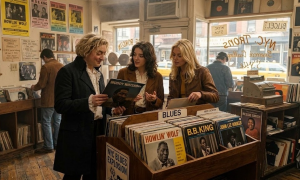
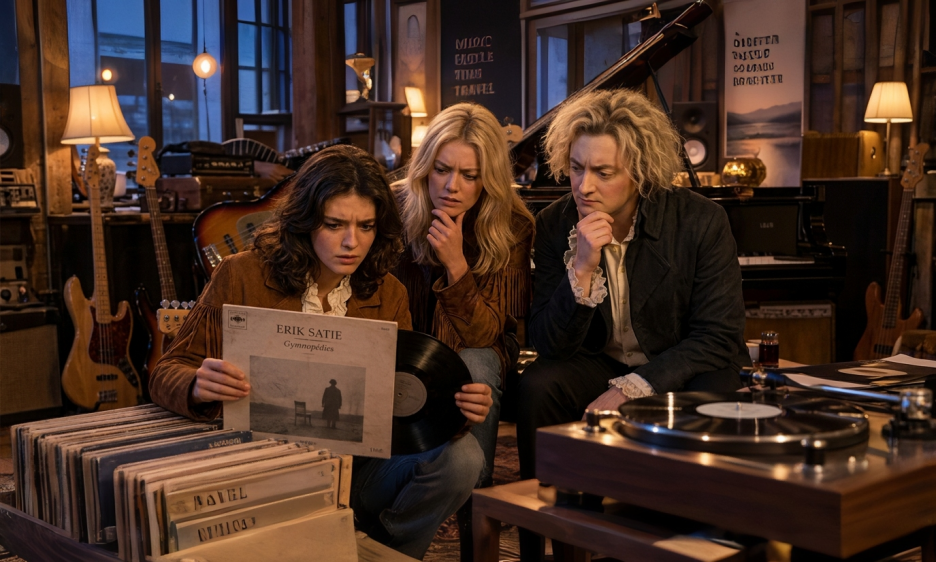
Maya didn't miss a beat. She dropped to one knee beside the wooden crates, her fingers walking rapidly across the album spines until she extracted a slightly worn sleeve."If Debussy was a painter," Maya said, pulling the black vinyl free, "this next guy was a minimalist with a pencil. Erik Satie. He lived around the same time, but he disliked the grandeur of the concert hall. He wrote music intended to be ambient—he called it 'furniture music,' which is what we call background music today."
Wolf's brow furrowed, his aristocratic nose wrinkling in mild offense. "Music as furniture? An insult to the muse. A composer builds a world; he does not build a footstool."
"Just listen," Chloe said softly, leaning forward.
Maya dropped the needle on a 1968 pressing of Satie's "Gymnopédie No. 1." The studio monitors hissed gently before a painfully slow, deliberate bass note sounded, followed by an equally slow, lonely chord. Then, a single, drifting melodic line entered. It was heartbreakingly sparse, alternating between a G major seventh and a D major seventh chord, moving with the sluggish, inevitable sway of a hypnotist's pendulum.
Wolf sat entirely paralyzed. He watched the spinning record as if waiting for a trick.
A minute passed. The melody repeated, barely changing. The harmony refused to progress toward any traditional cadence. There was no counterpoint, no development, no virtuosic flair. It was naked.
"He is pulling a prank," Wolf finally whispered, looking over his shoulder at Julian. "Where is the rest of the music? Where is the development? The B-section? He is just... pacing in a circle."
"There is no rest of the music, man," Zack chuckled, plucking a muted, sympathetic harmonic on his bass. "That's the whole point. He stripped away the architecture completely. No rules, no ego. Just a mood."
Wolf slowly turned back to the Steinway. He reached out with one hand, striking the G major seventh chord. He let it sustain until the overtones bled away into the room's silence. He didn't add trills. He didn't add Bach-like countermelody. For the first time since arriving, the manic energy drained out of him, leaving something profoundly still and quietly sad.
"It takes a terrifying amount of courage," Wolf said, his voice unusually subdued, "to leave this much empty space. In my time, silence was an enemy to be filled. If a composer left this much space, they would assume he had simply run out of ideas. But Satie... he is not empty. He is hollowed out by grief. It is the sound of walking through a grand palace after everyone you love has died."
He pulled his hands from the keys and looked up, his eyes suddenly flashing with that familiar, ravenous spark. "But I cannot stay in that room for long. It is too heavy."
Maya smiled faintly, already sliding her fingers over another album sleeve. "Well, Debussy must have had a similar reaction, here is his orchestration."
She pulled out a fresh LP, carefully swapping the vinyl on the turntable and sliding the tonearm into place.
The studio monitors filled with a completely transformed atmosphere. A warm, shimmering wave of strings rose up, anchored by a delicate horn, carrying the same melancholy melody into the grand light of a full orchestra.
Wolf gasped, jumping up from the piano bench as if the wood had suddenly caught fire. He took two steps toward the speakers, his eyes wide, his chin trembling slightly as the French horn lifted Satie's melody into the air.
"Ach... Mein Gott," Wolf breathed, pressing both hands against his cheeks. "He didn't change a single note of the sequence, did he? But he gave it air! He gave it a pulse! He draped a velvet cloak over a ghost!"
He began to pace furiously around the room, gesturing wildly at the ceiling as the oboes and flutes took over the theme.
"Do you hear what he did with the woodwinds?" Wolf laughed aloud, a breathless, euphoric sound. "Satie built a statue out of ice, and Debussy put a candle behind it to make it glow! He took that terrifying silence and made it... luxurious. It is no longer a graveyard. It is a sunset over a kingdom that never existed!"
Wolf spun on his heel and pointed a triumphant finger directly at Maya, his silk scarf askew and his hair sticking up wildly.
"You have shattered my universe in twenty minutes," Wolf beamed, his eyes glowing with sheer delight. "What absolute sorcery are you hiding in those crates next?"
Disclaimer
This is a fictional account exploring what might have happened if a temporal quantum event had occurred. While real musicians and historical figures appear within these pages, they exist here in an alternate timeline—a reality that quantum theory suggests was possible, but that never came to pass. All interactions, conversations, and events involving these individuals are entirely fictional, products of a world that exists only in the space between what was and what might have been.About the Series
Future Perfect follows a time-traveling band from the year 2092—winners of a planet-wide musical talent search—who journey back to the golden decade of 1964 to 1974. Over a billion subscribers plug into the Chronos-Consciousness Engine (CCE) to experience the band's exploits first-hand in a vivid, waking-dream state. Originally designed as a hyper-realistic historical simulation, the sheer volume of connected minds has triggered a quantum event that is drawing actual consciousness into this alternate reality. Ideally, new readers should start at the beginning of the series.
 FOLLOW Blue Note Portal
and get notified whenever a new article published.
The Blue Note Portal: a garage-assembled '70s microcomputer relic, eternally portaling through jazz timelines with Serling-esque irony, hacking bebop anomalies into binary swing for the ultimate improvised reboot.
About Wolfgang Amadeus Mozart

Tags
PREVIOUS / NEXT

Become a Sustaining Member

Since 1995, All About Jazz has championed jazz as an art form and supported the musicians who create it. Over three decades, it has grown into one of the world's leading jazz resources, serving hundreds of thousands of readers, musicians, presenters and industry professionals each month.
Help Build the Future of All About Jazz
Your support helps us continue building All About Jazz for the next generation—expanding our editorial coverage, preserving jazz history, developing new community features and creating better ways to discover the music and the people behind it.
Become a sustaining member for as little as $20 per year and you'll immediately enjoy an ad-free experience along with access to subscriber features and future articles for a full year.
Together, we're not simply sustaining All About Jazz—we're building its future. Thank you for being part of the journey.