Home » Jazz Articles » The Blue Note Portal » The Beatles—Future Perfect, Part 4
The Beatles—Future Perfect, Part 4
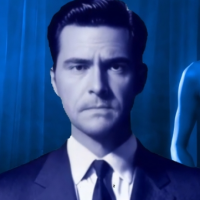
Courtesy AI
Chapters
1 | 2 | 3 | 4 | 5 | 6 | 7 | 8 | 9 | 10 | 11 | 12 | 13 | 14Tuff Gong London
In the weeks leading up to London, Xap had executed his strategy with pure managerial brilliance. From their new studio in Kingston, he had shipped two separate white-label test pressings directly to the pirate radio ship MV Caroline, idling in the North Sea.Single A was a fiery, horn-infused roots track by an unknown raw Jamaican singer named Bob Marley. Single B was a soaring, ultra-sophisticated track by an unknown American group named Future Perfect. Both carried only one identifying mark: Tuff Gong Records, Kingston, Jamaica. Radio Caroline played them on repeat over the airwaves, setting off a frantic music-industry manhunt across London for the mysterious offshore label.
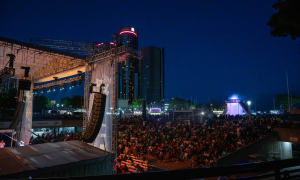
When the Roundhouse in North London was booked for a joint debut, tickets vanished in hours. The crowd packed into the cavernous, smoke-filled turntable shed.
The Roundhouse
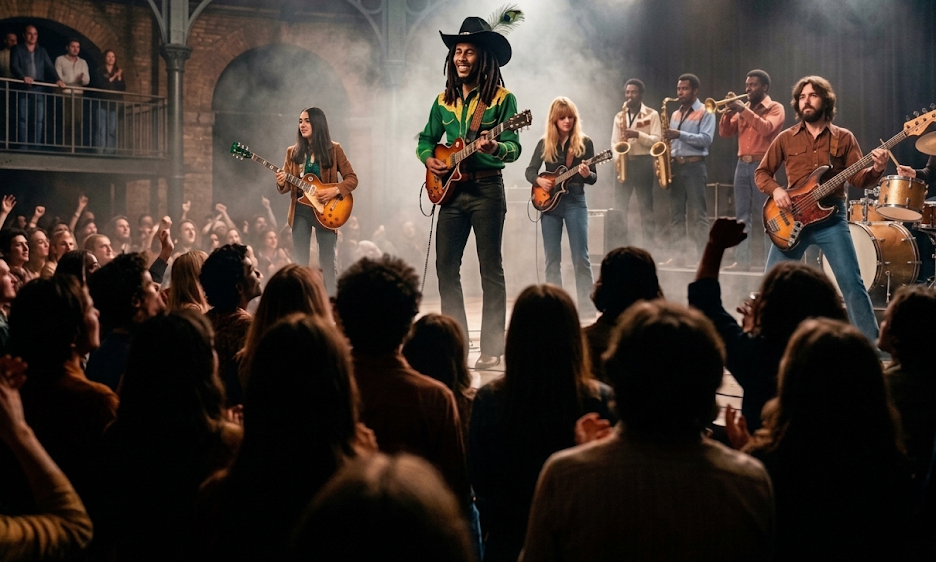
The lights dimmed over the roaring Roundhouse crowd. Bob Marley walked out onto the stage wearing tailored Jamaica threads, holding his electric guitar, and sporting a cowboy hat with a peacock feather, and it worked. Behind him stepped Maya, Chloe, Zack, Kyle, Monty, and the three-piece horn section.Bob tipped the brim of the hat, looking out at the cheering, packed house, and flashed a brilliant smile. "My lucky hat," he muttered softly into the mic, before launching straight into his groove.
For forty-five minutes, plus an encore, Bob Marley and the band turned the Roundhouse into a boiling cauldron of rhythm. The three-piece horn section—tenor sax, baritone sax, and trumpet—staccato-punched through the offbeat, cutting through Zack's fat basslines like a buzzsaw. The London crowd was completely hypnotized. As Bob finished his final, triumphant chorus to deafening applause, the audience cheered for what they assumed was a rising reggae star backed by professional session players.
"Thank you, London!" Bob shouted, tipping his hat. "Take a breath. We be back in thirty minutes!"
The Reveal & The Picking Frenzy
During the thirty-minute intermission, the chatter in the Roundhouse reached a fever pitch.Up in the VIP balcony, Xap and Julian stood near the iron railing, drinking cold lagers and soaking in the atmosphere. Thirty feet away, sitting at a dimly lit table surrounded by half-empty glasses, were John Lennon and Paul McCartney, leaning in close, talking animatedly.
Downstairs, the stage lights dimmed once more. Bob Marley walked back out, completely transformed in a fresh, crisp shirt. He didn't carry a guitar. Instead, he walked over to a heavy percussion rig beside Kyle's drum kit, grabbed a pair of shaker sticks, and stepped up to the center microphone.
"London," Bob said, his voice echoing through the hall. "Earlier on, my friends were holding down the rhythm for me. Now, it is my absolute honor to introduce FUTURE PERFECT!"
A sudden, bewildered hush swept through the Roundhouse.
Maya, Chloe, Zack, Kyle, and the horns stepped into the spotlights in sleek but casual Western wear—leather fringe jackets, sportcoats with leather ornaments sewn in, tailored Western jeans, boots, and Western hats. Maya held an electric acoustic guitar; Chloe held an electric mandolin; Zack carried a vintage fiddle.
Before the audience could even process that the headliners had been the backing band, they unleashed a blinding, breathless acoustic picking frenzy—a ferocious, jaw-dropping country-swing breakdown in a virtuoso style worthy of Mark O'Connor and Jerry Douglas. Zack's fiddle bowed at warp speed, Chloe's mandolin notes cascaded like shattered glass, and Maya's acoustic picking flew across the fretboard with superhuman precision.
The Roundhouse audience went dead silent in sheer, unadulterated shock, then exploded into a roar.
At the VIP table, John Lennon stopped mid-sip. Paul McCartney leaned over the balcony railing, his eyes wide, staring down at the stage as the acoustic storm raged.
"Look at them... " Paul muttered, squinting through the stage smoke. "John... look at the guitarist."
John didn't answer. He was staring at Maya, his jaw set, a strange, distant flicker of memory pulling at his mind.
"Night Life" & The Epiphany
The acoustic frenzy came to a sudden, precision stop on a dime. The crowd went wild.Maya unslung her acoustic, strapped on a gleaming Gibson Les Paul, and stepped up to the lead microphone. Kyle hit a slow, heavy, bluesy rimshot, Monty laid down a thick, smoky Hammond organ chord, and Maya began to sing a Chicago blues version of Willie Nelson's classic "Night Life."
Her voice hit the room like a freight train—gritty, raw, powerful, and soaring over the heavy blues-rock groove with soulful horns.
Halfway through the track, Maya and Chloe stepped to the center of the stage, shoulder-to-shoulder. What followed was an insane, blistering guitar duel. Maya traded razor-sharp, weeping blues solos with Chloe, the two of them bending notes in perfect octave unison before tearing into an escalating, call-and-response duel that rattled the rafters. 2092 had arrived.
Up in the balcony, the music hit John Lennon like a physical force. He stood up from his chair, grabbing the brass handrail.
Paul was already looking at him, his face pale with sudden, overwhelming recognition.
"The guesthouse," Paul said, his voice barely audible over the roaring crowd. "The banks of the Ganges. It's really them, John. That's Maya. That's Zack and Chloe. The hippie kids from Rishikesh."
John stared down at the stage, a slow, electric smile spreading across his face. "Bloody hell."
John motioned to the well-dressed Roundhouse venue manager. After an animated exchange, the manager turned, looked over at Xap and Jules, and signaled for them to come across the floor.
As they approached, the manager said, "Excuse me, gents. Mr. Lennon and Mr. McCartney would very much like a word with the owners of Tuff Gong Records... and the managers of Future Perfect."
Kinfauns
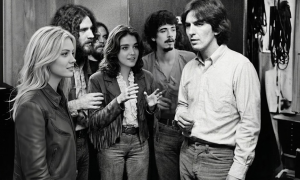
Mal Evans, the Beatles' longtime friend and roadie, was assigned to accompany Future Perfect and act as a passkey for entry into their world. It was decided they would meet at George Harrison's bungalow, Kinfauns, the next day at 3:00 PM. John, Paul, and Ringo were already expected; they wanted George to be just as surprised as they were.They arrived a half hour late and were met by Pattie Boyd at the door. She let out a screech of excitement, but Chloe quickly shushed her, putting an index finger to her lips.
"Let's surprise George," Chloe whispered.
"They're in the kitchen," Pattie whispered back, gesturing for them to follow. "John and Paul have been raving about a new group they saw at the Roundhouse. George is cross with me because I dragged him to a dinner party last night and he missed it."
Chloe smiled warmly. "Oh, not to worry. It probably wasn't as good as John and Paul are saying. They just want to mess with him."
Pattie seemed visibly relieved. "You're probably right. They are always punishing whoever wasn't there."
George had his back to the door when they entered the bright, cluttered kitchen.
John looked up and grinned. "You missed the show, so we brought the group to meet you. George... this is Future Perfect."
George turned around, a polite host's expression ready on his face. They seemed vaguely familiar—he met so many people these days—but as soon as Maya and Zack spoke, the illusion vanished. In an instant, recognition broke across his face, and the kitchen erupted into laughter, shouting, and warm hugs.
Standing near the counter, Xample took in the scene. Over a half a billion people are experiencing this right now, he thought to himself—an overwhelming, dizzying realization of scale.
Pattie broke into his thoughts, turning to him with wide, curious eyes. "How on earth did you meet them?"
To Be Continued...
 FOLLOW Blue Note Portal
and get notified whenever a new article published.
FOLLOW Blue Note Portal
and get notified whenever a new article published.
The Blue Note Portal: a garage-assembled '70s microcomputer relic, eternally portaling through jazz timelines with Serling-esque irony, hacking bebop anomalies into binary swing for the ultimate improvised reboot.
About The Beatles

Tags
PREVIOUS / NEXT

Become a Sustaining Member

Since 1995, All About Jazz has championed jazz as an art form and supported the musicians who create it. Over three decades, it has grown into one of the world's leading jazz resources, serving hundreds of thousands of readers, musicians, presenters and industry professionals each month.
Help Build the Future of All About Jazz
Your support helps us continue building All About Jazz for the next generation—expanding our editorial coverage, preserving jazz history, developing new community features and creating better ways to discover the music and the people behind it.
Become a sustaining member for as little as $20 per year and you'll immediately enjoy an ad-free experience along with access to subscriber features and future articles for a full year.
Together, we're not simply sustaining All About Jazz—we're building its future. Thank you for being part of the journey.