Home » Jazz Articles » The Blue Note Portal » The Beatles—Future Perfect, Part 12
The Beatles—Future Perfect, Part 12
Courtesy AI
Chapters
1 | 2 | 3 | 4 | 5 | 6 | 7 | 8 | 9 | 10 | 11 | 12 | 13 | 14Year 1969—Reno
Zack and Kyle quickly realized their upcoming WOOD set would never quite sit right without the proper tools. Zack needed a lap steel, and Kyle wanted a small warm tube amp that could handle the percussive, palm-muted thump of his Fender six-string tic-tac bass. Because the two of them were still the least recognizable faces in the wider circle, they volunteered for the errand and asked Mr. Gable where a pair of musicians might find what they needed.Without hesitation, Mr. Gable waved a hand toward the door. "You want Reno," he said. "Get yourself a cabbie from Reno—he'll know every pawn shop and music store worth knowing. You'll find what you need there. Want me to call you a cab?"
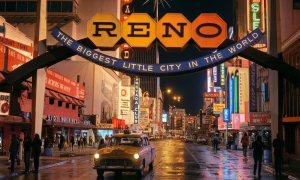
By the time they had finished breakfast, showered, and pulled on jackets against the mountain air, the cab was waiting outside the lodge. The driver introduced himself as Ray, a seasoned local with weathered hands, a dry wit, and the sort of absolute geographic confidence that came from thirty years of knowing every alley off Virginia Street. He took them down the mountain in a broad looping descent, through pine and granite and thinning cold, until the high stillness of Tahoe gave way to the valley floor and Reno's tighter downtown grid.
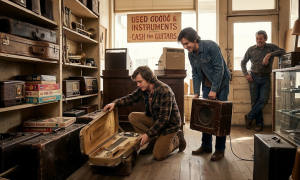
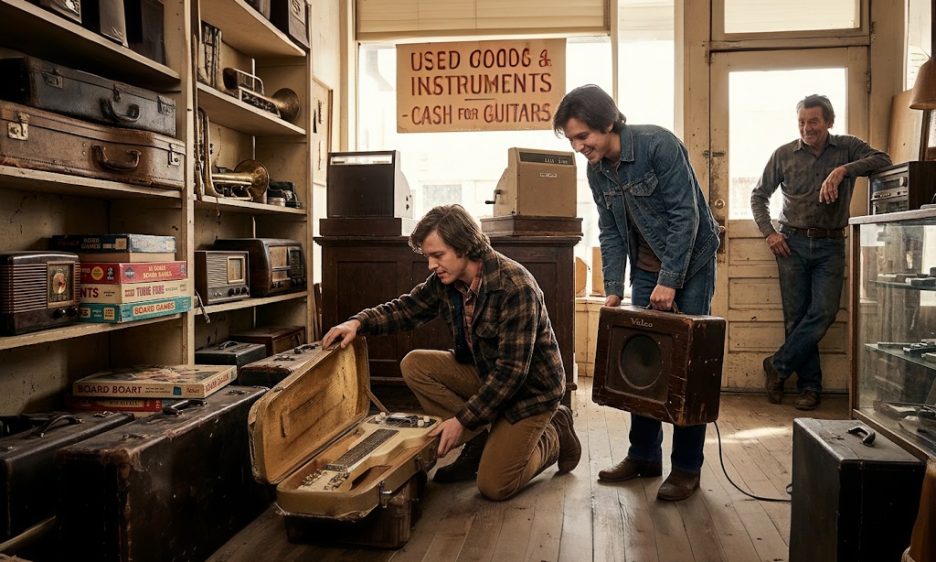
Before lunch they had worked through three pawn shops in succession, each with its own layered smell of old leather, stale tobacco, brass polish, and dust-warmed wood. Kyle found his amp almost immediately: a well-used 1950s Valco Oahu 66K tucked beneath a shelf of obsolete radios and dented trumpet cases. It was exactly the sort of overlooked thing that could sound glorious in the right room—dark through the mids, soft at the edges, and just powerful enough through its single ten-inch speaker to give the tic-tac bass a woody pulse without ever stepping on the acoustics.
Kyle plugged in a borrowed bass from behind the counter and hit a few muted root notes with the side of his palm.
Ray, lingering by the doorway, glanced over. "That little box any good?"
Kyle smiled without looking up. "More than good. Listen to that."
He hit a short run—thump, click, thump—then damped the strings hard and let the little Valco bloom for half a beat.
Zack nodded. "That's the sound. It doesn't bark, it just sits there and glows."
"Exactly," Kyle said. "Like a kick drum with a pitch."
Finding the lap steel took longer. It turned up in the third shop, near Commercial Row, after an hour of dead ends, warped student guitars, and cheap electrics that looked better than they would ever sound. Zack spotted the case first: battered tweed, frayed at the corners, half-hidden beneath a stack of old board games and an accordion with a missing strap. Inside was a 1955 Fender Champ lap steel, worn but intact, the sort of instrument no one in 1969 yet thought to treat as sacred. It was only fourteen years old—too old to be fashionable, too recent to be antique—and priced accordingly, like an unfashionable leftover from the 1950s Hawaiian craze.
Zack bought it on the spot, along with a matching 1958 five-watt Fender Tweed Champ amp that looked as though it had spent the last decade in a closet and would be happier for having something to do again.
While the clerk wrote up the receipt in careful longhand, a glass display case by the register caught their attention. Inside lay a small collection of Southwestern jewelry: heavy sterling silver, hand-stamped conchos, braided leather cords, and striking sky-blue stones set in darkened silver—authentic Navajo turquoise, the real thing, not the department-store imitation. What began as idle curiosity turned into ten full minutes of close inspection and low-voiced debate. By the time they were done, they had added several turquoise-and-silver bolo ties to the pile, along with two intricately worked silver cuff bracelets for the women back at the lodge.
Outside, Kyle looked at the growing stack in their arms and grinned at Ray."Now take us to the best Western wear shop in town."
Ray gave him a long sideways look in the mirror. "You boys serious?"
"Dead serious," said Zack.
Ray laughed and drove them to an old-school outfitter with creaking plank floors and a front window full of boots, hats, and hand-lettered signs. Inside, they found exactly what they hadn't known they were looking for: a rack of classic Grand Ole Opry-style pearl-snap Western shirts, tailored and sharp, with embroidered yokes and piped seams elaborate enough to be funny, but tasteful enough to actually wear. Not costume. Better than that. They bought a dozen.
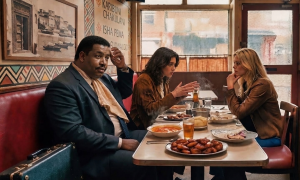
They finished the outing at a small Mexican restaurant Ray swore by, a place with chipped green paint, cold beer, and tamales good enough to justify all future exaggeration. Afterward, at Ray's insistence, they took a two-minute walk through a casino floor just to say they had done it. Bells rang. Coins clinked. Rows of half-hypnotized players fed silver into one-armed bandits beneath a permanent ceiling of smoke and stale optimism.
By the time the cab wound back up the mountain and pulled into the drive at Tahoe, the sun had already begun its slow slide westward through the pines.
Back at the lodge, Kyle dropped the shirts and gift bags in his room, then returned carrying his Fender tic-tac bass. Zack cleared the dining table and opened the old tweed case with something approaching reverence. One by one he removed the factory strings and began replacing them with heavier gauges from fresh paper sleeves.
The others drifted in naturally, drawn as much by the energy of the expedition as by any actual need for news from the outside world. In a place as secluded as Tahoe, even a trip to Reno came back with the aura of a field report from civilization.
George leaned over Zack's shoulder, watching him wind a thick string onto the tuning post.
"What's the story with the tuning?"
"Since I only use lap steel occasionally alongside my Dobro, it's easier for me to tune it the same way—high-bass open G," Zack said. "That's why I had to restring it. This Fender's only got a twenty-two-and-a-half-inch scale, much shorter than a Dobro, so regular light strings would feel too floppy under the bar. Heavier gauges keep the tension up and the notes crisp."
George nodded, following every word.
Across the room, Kyle had set the Valco on a chair and plugged in the tic-tac bass. Paul crouched beside the amp just as Kyle tested a line—tight, muted eighth notes, each one landing with a dry little thump.
Paul looked up. "That's clever. It doesn't sound like a bass guitar at all."
"That's the point," Kyle said, playing another short figure. "It lives halfway between bass and percussion. You don't lean on it—you feather it."
Paul listened closely as Kyle damped the strings and played a descending run.
"So instead of filling the bottom," Paul said, "you're sketching it."
Kyle smiled. "Exactly. It suggests the low end without crowding the room. On an acoustic set, that matters."
Maya and Chloe, who had remained behind while the boys disappeared into Nevada civilization, listened with an air of mild suspicion as the tales began—pawn shops, casinos, tamales, Ray's running commentary on Reno humanity. The antic spirit of it all only sharpened what they had missed.
Kyle noticed immediately.
"Don't think we forgot you two."
He reached into one of the bags and handed each sister a silver Navajo bracelet. Their melancholy dissolved at once into surprise and delight.
Xap, watching from the hearth, leaned toward Julian and murmured, "Women and jewelry. Across recorded history, absolutely undefeated."
Julian smiled but said nothing, watching the sisters turn the bracelets in the light with unaffected pleasure.
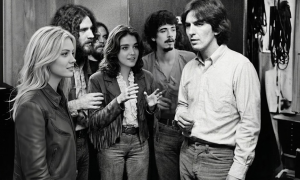
Then something passed between Maya and Chloe—a look first, then another between Chloe and Zack, then quietly on to George. Without explanation, the five of them slipped down the hall and disappeared into Kyle's room, shutting the door behind them.
The remaining group looked after them.
John frowned. "What's this, then?"
From behind the closed door came muffled laughter, a scrape of boots, and the sound of someone trying unsuccessfully not to laugh. Then Chloe's voice rang out in an accent so extravagantly Western it nearly collapsed under its own weight.
"Ladies and gentlemen, we'd like to introduce a young buck. When he's pickin,' you're grinnin.' Let's welcome—a Scouse in the house—George Harrison!"
The door flew open.
They emerged in a loose procession, all five of them wearing pearl-snap Western shirts, bolo ties, and cowboy hats tilted at varying degrees of absurd confidence. George, to his immense credit, committed fully to the bit.
For a second the room simply stared.
Then everyone broke.
Hard to say which side was laughing harder—the ones wearing the outfits or the ones looking at them.
Still grinning, they moved directly to their instruments.
Maya, adopting an even thicker frontier drawl than Chloe's, stepped to the front of the room as if addressing a Saturday-night radio audience.
"George wrote a new song," she announced, "and he's playin' it here for the very first time in public. What's it called, George?"
George tipped his hat with solemn dignity.
"'From Behind That Locked Door.'"
Zack handed Ringo the brushes. "We need your light touch on this."
Ringo gave them a little flourish. "I can be delicate when required."
Zack and Kyle began the introduction together, tracing the signature lonesome shape of the steel lines while Kyle set the soft pulse beneath it. George smiled to himself as the sound settled into the room. Chloe and Maya's guitars entered gently, wide and patient, opening the harmony without crowding it.
Then George sang.
By the second line, the joke had quietly vanished. What had begun in laughter now stood on its own terms—tender, unguarded, and deeper for the contrast. Zack's steel moved like a human voice at the edge of the lyric, never intruding, while Chloe and Maya's harmonies lifted the chorus into a space the song had always seemed to want but had not yet fully reached.
John turned to look at Paul.
Paul, however, had his eyes closed.
The arrangement wasn't flashy. That was what made it hit so hard. It had shape, restraint, and an emotional exactness none of them could dismiss. It was next-level work—haunting and unexpectedly beautiful. By the final line, the whole room had gone still.
When the last chord faded, no one spoke at first.
Then Maya said quietly, "That's one of the songs George wrote for 'WOOD'."
John looked at Paul, still taking in the Western shirts, the steel guitar, the sincerity of the performance, all of it.
"We need one of those shirts."
That finally broke the spell, and the room dissolved into laughter again.
Down the slope beyond the last stand of pines, two men stood motionless in the dark brush above the shoreline, where big bay windows shone like a stage set.
From their car they had watched the taxi leave and not come back. On their way to the shoreline they passed an old couple in a cottage at the edge of the lot. They were in pajamas watching television so loud they cold hear it from outside.
There were clearly no dogs.
Wade looked out over the lake for any boats. In the starlight his face was handsome in the ruined way some faces are—phony charm and physical damage. A white scar hooked from the corner of his mouth toward his jaw. Amateur tattoos crawled in blue-black shadows over the backs of his hands when he shifted them. Everything about him suggested danger.
Beside him, Willard breathing through parted lips and stared through the branches at the lit room as if he'd stumbled onto a private party thrown for his benefit.
"Look at that, Wade," he whispered. "Seven sittin' ducks and a couple of chicks for the takin.'"
Wade did not answer at once.
His mean streak feed off of envy, he was thinking of Reno. The two soft men with money loose in their pockets and no instinct at all for hiding it. The way they had stood too long at the jewelry case in the pawn shop. The cash. The silver. The vintage gear. The easy tipping at the Mexican place. The casual drift through the casino floor like men who had never once in their lives had to worry about who was watching. Coming out of the Western shop with bags, he was going to enjoy what was coming.
They had followed the cab out of town—they hadn't expected that. Up the mountain, an hour drive. It had made him angry. He'd smiled to himself as he's seen the cab pass their car as it left this empty back road.
Willard took silence for permission and kept going. "That one fella's got a guitar worth plenty all by itself. Bet there's watches too. Rings. Wallets. Maybe cash in the bedrooms."
Still Wade said nothing.
He was counting windows.
Counting bodies.
Seven men. Two women. Maybe more in the other house, but probably not many. Musicians, from the look of it. Traveling people. Soft hands. The kind who thought remoteness was privacy. The kind who never imagined that a road worked both ways.
In the bright rectangle of the bay window, one of the women—blonde, hat still tipped back on her head—threw herself into a chair laughing, silver catching at her wrist as she lifted a hand. Another leaned over to say something to the dark-haired one of the men. Unhurried. Safe.
Willard gave a low snicker. "Ain't even shut the curtains."
Wade finally spoke.
"Because nobody's ever taught 'em to."
His voice was quiet and flat, with the cold steadiness of a man who preferred his thoughts unshared until they were useful. A place like this looked isolated from inside. From outside, it looked contained.
By the time they're discovered, he thought, I'll be in Vancouver.
He receded back into shadows.
Willard glanced at him. "So what's the play?"
Wade looked once more at the glowing house above.
"We're done watchin'"
He rose into a crouch, every movement deliberate, and started up through the trees toward the road where their Fairlane waited in darkness.
Behind him, Willard followed.
To Be Continued...
 FOLLOW Blue Note Portal
and get notified whenever a new article published.
FOLLOW Blue Note Portal
and get notified whenever a new article published.
The Blue Note Portal: a garage-assembled '70s microcomputer relic, eternally portaling through jazz timelines with Serling-esque irony, hacking bebop anomalies into binary swing for the ultimate improvised reboot.
Tags
PREVIOUS / NEXT


Become a Sustaining Member

Since 1995, All About Jazz has championed jazz as an art form and supported the musicians who create it. Over three decades, it has grown into one of the world's leading jazz resources, serving hundreds of thousands of readers, musicians, presenters and industry professionals each month.
Help Build the Future of All About Jazz
Your support helps us continue building All About Jazz for the next generation—expanding our editorial coverage, preserving jazz history, developing new community features and creating better ways to discover the music and the people behind it.
Become a sustaining member for as little as $20 per year and you'll immediately enjoy an ad-free experience along with access to subscriber features and future articles for a full year.
Together, we're not simply sustaining All About Jazz—we're building its future. Thank you for being part of the journey.