Home » Jazz Articles » Building a Jazz Library » A Jazz Reading List
A Jazz Reading List

Courtesy AI Generated
In the long process of purging overcrowded bookshelves, a number of titles stood out as lasting sources of inspiration. This sampling of ten books is not in order of preference, and they are thematically varied. A few are lesser-known but well worth reading for their unique treatments or obscure subject matter. Each may have its flaws, but that seems appropriate for what Ted Gioia called The Imperfect Art (Oxford University Press, 1988). Even if these titles occasionally hit some clammed notes, they are all exhilarating in their passion for jazz.
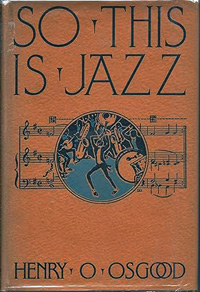 So This Is Jazz
 Henry O. Osgood
260 Pages
ASIN: B00085V484
Little Brown and Company
1926
In the frenzied atmosphere of the early 1920s, the untamed sound of jazz was igniting across the U.S. In 1926, against the backdrop of cultural upheaval, music critic and composer Henry O. Osgood wrote the first full-length book dedicated to this new phenomenon, titled with a phrase likely on the minds of many an inquisitive listener, So This Is Jazz. Osgood's most significant contribution is his contemporaneous reporting. He was present during a remarkable time. He writes not about distant legends, but about contemporary, active musicians. His portraits of figures like Paul Whiteman, the self-proclaimed "King of Jazz," are invaluable. While modern critics may debate Whiteman's credentials in jazz, Osgood rightly identifies him as the individual who effectively packaged and popularized this sound for mainstream white America.
Osgood takes the music seriously as a subject for intellectual inquiry, a radical notion at the time. He delves into the technical mechanics of jazz, analyzing its use of syncopation, blue notes, and improvisation with the ear of a trained classicist. He makes a decent, if clumsy, effort to trace the African and ragtime roots of the music, acknowledging, though not fully comprehending, its Black origins. So This Is Jazz is very much a product of its time, reflecting the racial and cultural blind spots of the 1920s. While Osgood acknowledges Black innovators like W.C. Handy, his focus remains overwhelmingly on white musicians and bandleaders like Whiteman, Ted Lewis, and George Gershwin, who popularized a sanitized version of jazz for a broad audience. The true revolutionaries, the Black artists in the clubs of Chicago and New Orleans, like King Oliver, Jelly Roll Morton, and a young Louis Armstrong, receive negligible attention. Osgood's jazz is often the polite, orchestrated jazz of the concert hall and the upscale ballroom, not the raw, polyphonic roar of a South Side speakeasy.
It is fair to criticize So This Is Jazz for what it is not; however, it misses its profound importance. It was the first book to stand up and declare that this was not a fad, but a significant cultural force worthy of serious documentation. The book captures the excitement, confusion, and sheer novelty of the Jazz Age. It is filled with lively descriptions of the music's energy, the popular dances it inspired, and the social frenzy that surrounded it. Although So This Is Jazz is long out of print, used copies are readily available online for music enthusiasts, cultural historians, and serious jazz geeks.
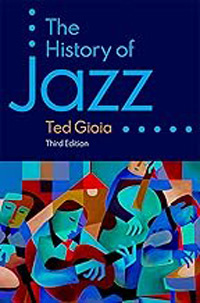 The History of Jazz
 Ted Gioia
608 Pages
ISBN: #0190087218
Oxford University Press
2021
Where Henry Osgood's So This Is Jazz is sorely lacking, Ted Gioia's The History of Jazz offers a decisive map of an expansive landscape. First published in 1997 and updated since, Gioia's work is widely regarded as the modern standard, the single most comprehensive and essential volume for anyone seeking to understand the epic story of this quintessentially American art form.
Gioia, a pianist, composer, and critic, brings a rare triple threat to the task: the technical knowledge of a practitioner, the analytical eye of a historian, and the engaging prose of a storyteller. The result is a book that is both monumental in its scope and remarkably accessible in its execution. He begins not in the brothels of Storyville, but in the ancient rhythms of Africa and the field hollers of the antebellum South, firmly and unambiguously establishing jazz's deep roots in the Black experience. From there, he constructs a clear, compelling narrative arc.
The book shines in its treatment of the swing era and the bebop revolution. Gioia doesn't just list names and dates; he explains the "why": the cultural, economic, and artistic forces that propelled the music from danceable pop to challenging art music. He deftly navigates the complex fragmentation of jazz post-1960, covering everything from the free jazz of Ornette Coleman and Albert Ayler to the fusion of Miles Davis and Herbie Hancock, and right up to the neo-traditionalism and global influences of the late 20th century.
Gioia places the African-American innovators at the very center of the narrative where they belong. The book is a powerful corrective to the earlier, whiter histories of jazz. The contributions of often-overlooked figures, Jelly Roll Morton as a foundational architect, Mary Lou Williams as a towering arranger and composer, the profound influence of Art Tatum are given their full and rightful due. Gioia convincingly argues that jazz's history is, in large part, the story of visionary artists pushing the boundaries of the form. In the century since the first book on jazz asked how to define this new music, Gioia has provided the definitive answer. It is a living, breathing, evolving tradition, and he has mapped its turbulent, celebrated journey with scholarship, passion, and clarity.
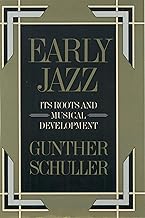 Early Jazz: Its Roots and Musical Development
Gunther Schuller
416 Pages
Oxford University Press
1986
Gioia's jazz history had a well-known predecessor. Published in 1968, Gunther Schuller's Early Jazz: Its Roots and Musical Development is not just a book about jazz; it is a landmark that fundamentally reshaped how the music is studied, understood, and appreciated. As the first volume in his monumental survey, The History of Jazz, Schuller's work set a new standard for jazz scholarship, combining the meticulous ear of a trained musician with the analytical rigor of a historian. Over half a century later, it remains an essential pillar in the library of anyone serious about America's seminal art form.
Schuller's most significant contribution is his method of close-reading the music. Before this approach, much of the writing on jazz was biographical, anecdotal, or impressionistic. Schuller, a composer and musician who seamlessly navigated both the classical and jazz realms, engaged deeply with recordings. He views jazz not as a primitive folk music but as a sophisticated and complex art form deserving of the same detailed musical analysis as a Beethoven symphony.
Schuller's chapters on Louis Armstrong and Duke Ellington are masterclasses. In the Armstrong section, Schuller doesn't just tell us that Armstrong was a genius; he shows how Armstrong's revolutionary sense of rhythm, harmony, and melodic construction single-handedly transformed jazz from an ensemble-based dance music into a vehicle for profound individual expression. Similarly, his analysis of Ellington's early compositions and arrangements reveals the intricate layers, novel harmonies, and masterful use of his orchestra's unique voices, elevating Ellington from a mere bandleader to a composer of the highest order.
Early Jazz is a demanding read. Schuller's prose is dense with musical terminology and includes numerous transcribed musical examples, which can be daunting for the non-musician. However, even for the layperson, skimming over the most technical passages still yields essential insights. It remains one of the most important books written on the subject.
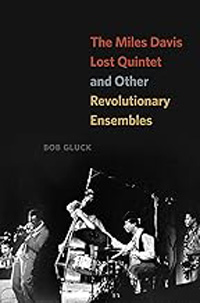 The Miles Davis Lost Quintet and Other Revolutionary Ensembles
 Bob Gluck
256 Pages
University of Chicago Press
2016
In The Miles Davis Lost Quintet and Other Revolutionary Ensembles, author, composer, and musician Bob Gluck takes on his subject matter in an original manner. His research reveals a deep understanding of the peripheral world around the Bitches Brew (Columbia, 1970) era of Davis' career. The original "Lost Quintet" consisted of Davis, saxophonist Wayne Shorter, Chick Corea on keyboards, bassist Dave Holland, and drummer Jack DeJohnette. Later, Keith Jarrett joined as a second keyboardist, and percussionist Airto Moreira was added. Shorter was replaced by Steve Grossman, who, in turn, was replaced by Gary Bartz, and Michael Henderson stepped in for Holland, all in the short span of one year. The "quintet" toured during the Bitches Brew period but did not record in the studio; years later, live recordings and bootlegs would surface.
Gluck's strength as a historian emerged with his first book, You'll Know When You Get There: Herbie Hancock and the Mwandishi Band (University of Chicago Press, 2012). More importantly, in The Miles Davis Lost Quintet and Other Revolutionary Ensembles, Gluck's own expertise as a composer and musician works hand in hand with his natural inquisitiveness to uncover the inner creative method of a band that was literally reinventing its music on a gig-by-gig basis. In the process, Gluck reveals more about Davis' techniques than previously understood.
We see, in the Lost Quintet, a group whose evolution, even over a very brief period, continually built on density and texture, electronics, rock, funk, and improvised jazz as they ushered in a new age of music. Davis' influences extended beyond those of cross-genre innovators like Ornette Coleman and Jimi Hendrix. Instead, the whole social fabric of the United States in the days of the counter-culture revolution, from civil rights to technology, to a flat-out desire for commercial success, all played a role in Davis' paradigm.
Though Gluck is an academician, his writing is accessible even at its most detailed. His insights are solidly supported by historical fact, quotes, and his firm grasp of the subject. As a result, The Miles Davis Lost Quintet and Other Revolutionary Ensembles unfolds as a compelling narrative of artistic ambition and human nature.
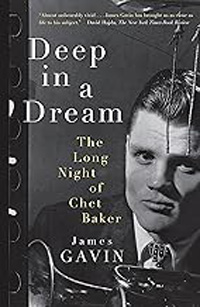 Deep in a Dream: The Long Night of Chet Baker
 James Gavin
472 Pages
Chicago Review Press
2011
It is hard to imagine a darker story than Deep in a Dream: The Long Night of Chet Baker. James Gavin chronicles the life of jazz trumpeter and singer from his rise to fame in the 1950s to his lifelong struggle with drugs and eventual death in Amsterdam in 1988. A well-researched and unflinching portrayal of Baker's self-destructive and often sordid life includes the artist's criminal behavior and tumultuous relationships, which contrast with his romanticized public image.
As Deep in a Dream archives Baker's career, it offers striking descriptions of music and performance, continually interrupted by the ugly details of theft, violence, and addiction. Gavin conducted hundreds of interviews and drew on previously untapped sources to create a harrowing account of Baker's life. It is a page-turning account of a troubled artist.
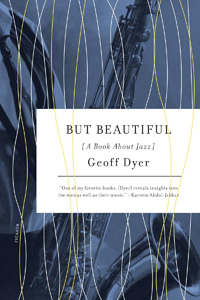 But Beautiful: A Book About Jazz
 Geoff Dyer
240 Pages
Picador
2009
Of all the books ever written about jazz, Geoff Dyer's But Beautiful: A Book About Jazz stands alone. It is not a work of history, nor a biography, nor a critical study, though it contains elements of all three. It is, instead, a work of profound and lyrical imagination, a series of extended prose riffs on the lives and music of some of jazz's most brilliant personalities. First published in 1991, it remains a work of art, a book that doesn't just describe jazz but embodies it.
Dyer offers a collection of portraits: Lester Young fading away in a hotel room, Thelonious Monk circling a silent piano, a blind and worn-out Art Pepper searching for a fix, and Duke Ellington holding his orchestra together on a long, exhausting road trip. These are not strict biographical accounts. Instead, Dyer uses the known facts of these lives as a springboard for a kind of literary improvisation. He enters their imagined consciousness, using a novelist's eye and a poet's ear to translate their sound into a stunning visual and emotional landscape.
Dyer's central theme in But Beautiful is the painful, beautiful incongruity at the core of jazz and the lives that created it. He shows us the devastation that was Chet Baker, but finds grace in his trumpet's fragile tone. He captures the immense, regal dignity of Charles Mingus, even as the bassist rages against a world that seeks to diminish him. Dyer is unflinching in his portrayal of the damage, the addiction, the racism, the mental illness, the sheer exhaustion of the road, but his gaze is never salacious or judgmental. He is searching for the transformation that turned this pain into something inspiring.
But Beautiful is not an introduction for jazz novices seeking a straightforward history. It assumes a basic familiarity with its cast of characters. Some purists may even pull back from its liberties, its merger of fact and fiction. But to focus on that is to miss the point entirely. Dyer is not trying to document what happened; he is trying to capture how it felt. In the end, But Beautiful: A Book About Jazz is poignant, unique, and vividly written books ever dedicated to an art form. It stays with the reader long after the final page.
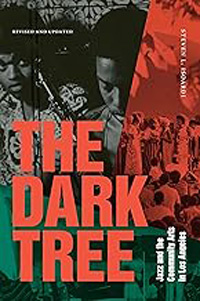 The Dark Tree: Jazz and the Community Arts in Los Angeles
 Steven L. Isoardi
456 Pages
Duke University Press
2023
Steven L. Isoardi's The Dark Tree: Jazz and the Community Arts in Los Angeles is a landmark work that documents the dynamic yet often overlooked community-based arts movement centered on pianist and composer Horace Tapscott. Isoardi, an independent scholar with expertise in West Coast jazz, provides a comprehensive account that goes beyond a simple biography. The book first establishes the historical roots of the community artist in African American culture and the Central Avenue music scene in Los Angeles. It then details the formation of the Underground Musicians Association (UGMA), and its performance wing, the The Pan Afrikan Peoples Arkestra.
Tapscott was renowned for his distinctive musical voice and dedication to using art for social empowerment. He played trombone and piano in the Lionel Hampton Band from 1958 to 1961. But Tapscott rejected the commercial music industry, believing that Black music (a term he preferred over "jazz") should educate and uplift the Black community. The Arkestra performed free concerts in parks, schools, and prisons, making art accessible to all.
The significance of The Dark Tree lies in its emphasis on an alternative ethos for artists. Instead of seeking individual fame and commercial success, Tapscott and his collective advocate for a model in which art is created for and supported by the local community. Isoardi frames this as a movement and documents a profound social and cultural mission. The narrative situates this community work within the context of key local events, such as the Watts Uprising of 1965, demonstrating how the Arkestra served as a cultural pillar and a source of resilience during times of social strife.
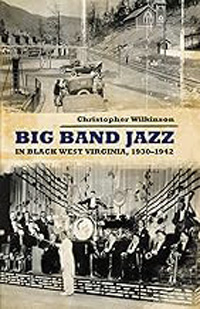 Big Band Jazz in Black West Virginia, 1930-1942
 Christopher Wilkinson
240 Pages
University Press of Mississippi
2012
Christopher Wilkinson's Big Band Jazz in Black West Virginia, 1930-1942 is a pioneering work of historical research that challenges long-held assumptions about American musical history. The book uncovers a largely forgotten chapter of the Swing Era, focusing on the African American communities in West Virginia's coal-mining regions.
Wilkinson's central thesis is that these communities experienced an extraordinary and sophisticated big-band culture during the 1930s and early 1940s. He compellingly argues that this phenomenon was not just a minor regional footnote, but rather a significant development driven by the state's unique economic conditions.
The book suggests that the stabilization of the coal industry through New Deal policies led to the formation of integrated unions and higher wages for Black miners. This economic prosperity gave these communities the disposable income to spend on entertainment, making West Virginia a lucrative stop for nationally renowned African American bands. This argument effectively challenges the rural-urban dichotomy often present in music scholarship, showing how a rural area became a cosmopolitan center of Black musical culture.
The narrow scope of Big Band Jazz in Black West Virginia, 1930-1942 could be seen as a limitation for readers seeking a broader overview of Appalachian music. It deliberately moves beyond roots music to focus specifically on the big-band phenomenon. Further, the story has a defined endpoint, as Wilkinson details how World War II and technological changes in the mining industry abruptly ended this era by 1942. Wilkinson has done an excellent service by excavating and meticulously documenting a rich musical culture that flourished in an unexpected place.
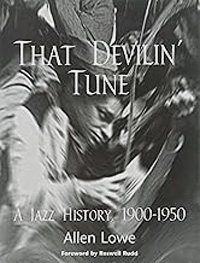 That Devlin' Tune: A Jazz History, 1900-1950
 Allen Lowe
310 Pages
Music and Arts Programs of America
2006
Allen Lowe's That Devlin' Tune: A Jazz History, 1900-1950 is an intentionally revisionist history that challenges traditional narratives by focusing on obscure recordings and undervalued artists. Published in 2001, it is designed as a companion to a massive 36-CD set. The book is a direct counterpoint to histories such as Geoffrey C. Ward/Ken Burns' Jazz: A History of America's Music (Knopf, 2000), which focuses on iconic figures. Lowe employs a bottom-up approach, arguing that broader musical movements and a host of lesser-known contributors drove jazz's evolution.
Lowe is a saxophonist, composer, and self-taught historian. He describes himself as a cultural outsider, a status that he infuses with many presumptive gatekeeping responsibilities. That Devlin' Tune offers an updated perspective, drawing jazz history out of artistic isolation and reconnecting it with the broader stream of American music, including blues, minstrelsy, and Western swing. Lowe is a knowledgeable and engaging writer who steers clear of academic rhetoric. He combines musical analysis and historical investigation into a coherent critical argument.
The challenge for readers lies in Lowe's persistent and strong condemnations of other scholars and critics. He frequently comes across as argumentative to the point of being overbearing, detracting from his otherwise insightful view of jazz history.
 The Jazz Loft Project
 Sam Stephenson
288 Pages
University of Chicago Press
2023
The Jazz Loft Project by Sam Stephenson and photojournalist W. Eugene Smith is not a standard narrative history. It is a unique cultural-archaeological project that brings to light an archive of photographs by Smith, an acclaimed photographer whose work appeared in The New York Times and Newsweek. From 1957 to 1965, in a run-down loft building at 821 Sixth Avenue in New York City's Flower District, Smith captured nearly 40,000 photographs and thousands of hours of audio tape. Stephenson's writing is the cornerstone of a massive documentary effort. He discovered Smith's forgotten archive in the 1990s and spent over seven years cataloging, archiving, and editing this immense trove of material.
The loft attracted both icons such as Thelonious Monk, Charles Mingus, and Bill Evans, as well as many lesser-known working musicians. The scene also drew in figures from other arts, including Norman Mailer, Salvador Dalí, and Diane Arbus. The Jazz Loft Project offers a fly-on-the-wall view of jazz history in the making. It shows legendary figures in informal, unpolished rehearsal; the candid, gritty, black-and-white portraits contrasting with the refined performances that followed.
Smith did not confine his lens to the room where it happened. His photos of everyday life on Sixth Avenue, taken from the loft's fourth-floor window, bring the Chelsea neighborhood and the music full circle, giving the reader a sense of being there. W. Eugene Smith was a quirky character, a celebrated, long-term Life magazine photographer in the midst of a personal and professional crisis. Leaving his family behind for this long-term commitment to The Jazz Loft Project became his obsession and his haunting masterpiece.
 FOLLOW Karl Ackermann
and get notified whenever a new article published.
FOLLOW Karl Ackermann
and get notified whenever a new article published.
New York based contributor. Author of: "A Map of Jazz: Crossroads of Music and Human Rights" and keynote speaker/host of Pearson Jazz Foundation's International Jazz Day event (2018, 2019)
Tags
PREVIOUS / NEXT


Become a Sustaining Member

Since 1995, All About Jazz has championed jazz as an art form and supported the musicians who create it. Over three decades, it has grown into one of the world's leading jazz resources, serving hundreds of thousands of readers, musicians, presenters and industry professionals each month.
Help Build the Future of All About Jazz
Your support helps us continue building All About Jazz for the next generation—expanding our editorial coverage, preserving jazz history, developing new community features and creating better ways to discover the music and the people behind it.
Become a sustaining member for as little as $20 per year and you'll immediately enjoy an ad-free experience along with access to subscriber features and future articles for a full year.
Together, we're not simply sustaining All About Jazz—we're building its future. Thank you for being part of the journey.