Home » Jazz Articles » New York Beat » The Pittsburgh Jazz Festival
The Pittsburgh Jazz Festival
Thursday June 18
A festival opening night concert at the Kelly-Strayhorn theater (after The MGM film star Gene Kelly and composer Billy Strayhorn) starring Sean Jones and his quartet launched matters. Interesting deconstructions of standards by arranger/pianist Orrin Evans were the order of the day with "How High" (from "How High the Moon") a featured selection. An original composition by Jones "We'll Meet Under the Stars" and his performance of Theo Charlier's classical trumpet study #2 highlighted the set. After the concert I wandered over to a jam session at the James St. Gastropub and Speakeasy led by Pittsburgh drummer Roger Humphries. The club features afternoon sessions where patrons can play their own vinyl sides while dining—a hip idea I'd love to see in Gotham rooms.
Friday, June 19
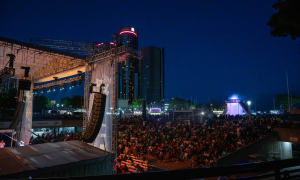
Producer/ historian Yvonne McBride presented "Crossroads"—an invaluable film tracing the the history of the city's Hill District jazz clubs of yore—Crawford Grill, The Hurricane, The Midway—where many of the aforementioned Pittsburgh jazz luminaries got started. Old-timers trumpeter Dr. Nelson Harrison and 92 year old pianist George "Duke" Spaulding provided memorable live music performances. The latter's delivery of "Misty" dedicated "to my old friend Errol Garner" moved a wet-eyed audience. The film was a triumph featuring anecdotal interviewees relating seminal moments in the Hill District's uncanny musical history. That evening the scene shifted to the downtown business district which was transformed into an outdoor festival with portable stages erected every block or so along Penn Avenue. Jazz fans could wander from stage to stage as groups played to audiences free of charge all evening long. DJ Nate da Phat Barber caught my attention paying Latin and standard jazz selections with equipment long thought to be exclusively utilized for commercial, rap, metal or turntable music. Further along Penn Avenue, I wandered into several new upscale restaurant/bars each showcasing a local jazz group and paused to catch bassist Sam Harris playing with Benny Banack's group at the Backstage Bar. The atmosphere along Penn Avenue echoed that of Bourbon Street with the sounds of bebop replacing those of Dixieland.
Saturday, June 20
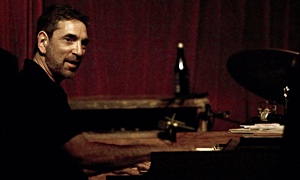
Back up to the Hill District to view the remains of a neighborhood that rivaled New York's 52nd Street or Philadelphia's North Side in jazz history annals. I visited the humble Olivet Baptist Church on Wylie Street where fewer than 10,000 mostly African-Americans now live. In 1933 when it been the Savoy Ballroom 2000 patrons from the population of 55,000 could be seen dancing to the bands of Fletcher Henderson, Cab Calloway, Jimmie Lunceford, Noble Sissle, Chick Webb, and Fats Waller. Earlier when the building had been the home of the Elmore theater in 1923, Ma Rainey and her "Paramount Flappers" had entertained the Hill Streeters. Further down on Wylie sits the second incarnation of the Crawford Grill where Art Blakey, Mary Lou Williams, and John Coltrane had once held court. On this day, a small group of locals entertained a busload of tourists seeking the sources of former jazz glory days. There was dismay on their faces as they now beheld a poor rundown neighborhood yearning for restoration. Over on Centre Street lay the abandoned New Granada Theater. The building once the home of the Pythian Temple had hosted Duke Ellington when he had been crowned "King Of Jazz" in a national radio broadcast in 1930. Despite a light but insistent rainfall an evening concert starring Joey DeFrancesco was the highlight of my visit. The wizard of the Hammond B3 started matters off with his usual pyrotechnics performing "Trip Mode" a burner displaying his dazzling technique and featuring unique call and responses with guitarist Paul Bollenbeck and drummer Jason Brown. A Nat "King" Cole hit "When you're Smiling" followed performed vocally. The organist's vocalizing has attained new dimensions of phrasing subtlety and whole note sustenance of late and the Pittsburgh audience many of whom were unacquainted with his singing roared in appreciation. Similar reactions ushered forth when DeFrancesco picked up his trumpet for "The Touch of your Lips" and offered up impressive improvisational sketches.
I came away from the festival with a new appreciation for the jazz history and environment that Pittsburgh possesses. The city is making a stunning effort to reestablish its jazz prominence of yore as it continues a remarkable cultural renaissance.
 FOLLOW Nick Catalano
and get notified whenever Nick has a new article published.
FOLLOW Nick Catalano
and get notified whenever Nick has a new article published.
Dr. Nick is a TV writer/producer and professor of Literature and Music at Pace University.
About Sean Jones

Tags
PREVIOUS / NEXT


Become a Sustaining Member

Since 1995, All About Jazz has championed jazz as an art form and supported the musicians who create it. Over three decades, it has grown into one of the world's leading jazz resources, serving hundreds of thousands of readers, musicians, presenters and industry professionals each month.
Help Build the Future of All About Jazz
Your support helps us continue building All About Jazz for the next generation—expanding our editorial coverage, preserving jazz history, developing new community features and creating better ways to discover the music and the people behind it.
Become a sustaining member for as little as $20 per year and you'll immediately enjoy an ad-free experience along with access to subscriber features and future articles for a full year.
Together, we're not simply sustaining All About Jazz—we're building its future. Thank you for being part of the journey.