Home » Jazz Articles » Interview » Jamile and Vinicius Gomes: Acoustic Thrills With Brazilian Twist
Jamile and Vinicius Gomes: Acoustic Thrills With Brazilian Twist
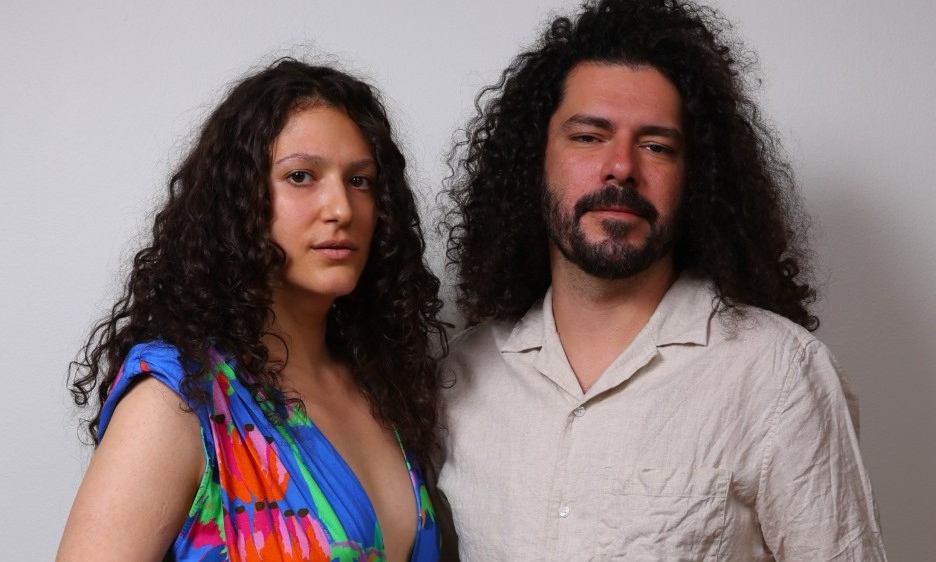
Courtesy Vinicius Carvalho
We became good friends. And good musical friends as well. We've been collaborating ever since.
—Jamile
It's been a popular style ever since, with people in North America discovering artists like Antonio Carlos Jobim, Joao Gilberto, Sergio Mendes and many others. Over the years, the music of South America and Cuba has maintained popularity through countless talented musicians, from longtime favorites like Eliane Elias and Duduka Da Fonseca to younger talents like Melissa Aldana from Chile and Gonzalo Rubalcaba from Cuba.
A stellar example of Brazil's imprint is coming from two natives of the country, singer Jamile and guitarist Vinicius Gomes. They both live in New York City, where they met, and the partnership is one to reckon with. On Boundless Species (La Reserve, 2026), the pair presents the spirit of Brazil, but with different twists on the songs and a different approach to what people think of as samba or bossa nova.
The tunes represent Brazilian composers, but there is also a big representation of Wayne Shorter and Herbie Hancock, whom Jamile and Gomes admire. In total, the recording brings refreshing, engaging music stamped by Jamile's striking voice and Gomes' amazing guitar work. Bassist Joe Martin adds a lustrous bottom to the all-acoustic outing.
"I think music is present in our lives very constantly in Brazil," says Gomes, who's from Sao Paulo. "It's a really musical country. The more I live abroad, the more I realize how musical it is."
An early dream of Gomes as a young player in Brazil was to accompany a singer. He loved vocalists like Elis Regina. One of the guitarists he admired was Lulu Galvao, "one of the most underrated guitarists in history," who accompanied singers like Rosa Passos. Another was Nelson Veras, "a Brazilian guy who lives in Paris. He's amazing as an innovator. I think people are still catching up with what he was doing 20 years ago."
He's met that goal in his career, accompanying singers in Brazil and now joining with Jamile (born Jamile Staevie Ayres from Cachoeira do Sul, a small town in southern Brazil). The collaboration is something he's excited about.
"I think we first met at a gig. We knew of each other's existence, and then at some point, he needed a singer for a gig, and I think he reached out to me," Jamile says. "From there, we figured we had a lot in common musically. We became good friends, and good musical friends as well. We've been collaborating ever since."
"I think she moved to New York a few years before me," says Gomes. "When I moved to New York, I started playing with her. All kinds of gigs. And we found this affinity."
Boundless Species brings Brazilian flavor to each tune, whether it's Hancock, Shorter and Stevie Wonder, or their countrymen Guinga, Milton Nascimento or Johnny Alf.
It starts with "Mar de Maracanã," containing a wordless vocal that displays Jamile's ability to sing as an instrument and as part of the trio with her esteemed colleague on guitar and Joe Martin's bass. Hancock's "Actual Proof" is full of rich harmonies riding off in different melodic directions. It is a new take concocted by the musicians, who revere the piano/composer icon. "Nós" is a sultry ballad by Brazilian composer Johnny Alf, where Jamile reins in technique in favor of letting the richness of her voice carry the song. Shorter's "Endangered Species" features intricate guitar work that is luxurious with Jamile's voice. Her expression of Esperanza Spalding's lyrics does justice to the fluctuations of the song and the genius of the composer. Throughout, the flight of Gomes' fingers over the acoustic guitar is magical.
"From the beginning, I was super into Wayne Shorter," says Gomes. "I still am. And Herbie. These guys, they had this bridge with Milton Nascimento's music. They played on many Milton records. And there's that super famous record, Native Dancer (Columbia, 1975). Wayne and Milton. That was a really important record for me growing up. It still is."
"I've been on a specifically Herbie kick for a couple of years," Jamile says, among her efforts being songs from his Sunlight album (Columbia, 1978), kind of trying to fit them into a more acoustic setting and trying to figure out how I can make them my own. Vinicius has always been very deep into Wayne. So it just made sense that we agreed on that. Especially these songs that have a lot of layers, like "Endangered Species." It has a lot of rhythmic strength to it. So to do it without drums is definitely a challenge. But I think we were able to reimagine it in a cool way."
As for Alf, Gomes says he's an iconic figure in Brazilian music history, who helped inspire the bossa nova movement but "didn't get the credit that he deserved because of social circumstances, because he was Black and gay. So he never became as famous as Jobim. Jobim really loved his music. He's a really influential guy."
The absence of drums on the album leaves the musicians "nowhere to hide," Jamile says. Voice, guitar and bass combine to make the proper bed beneath the strong melodies and intriguing harmonies. Throughout, the sounds of Brazil dominate. The result is from the hearts of Jamile and Gomes.
Gomes said he had the idea to record the two Wayne tunes for a few years now. "For instance, with Endangered Species, I really wanted to subvert the logic of the original recording. It's a super groove, heavy synthesizers and a bunch of stuff. It's a masterpiece. I've been listening to that since I was a teenager. And I was like, 'What if we did everything acoustic, acoustic bass, acoustic guitar?' When Jamile came in with Esperanza's lyrics, I was like, 'Wow, that would be amazing if we just did a completely different version of it.' Same thing with Some Place Called Where" from Shorter's Joy Rider album (Columbia, 1988). "I had this solo guitar arrangement for it already. I wanted to record it the way that we did."
The recording "kind of blurs the boundaries a little bit of what it means to be a Brazilian jazz musician. I feel that this record is an effort to take us out of the box of what is expected from a Brazilian musician. I'm really happy about how this record came out... It's drumless, and at the same time, it's trying to expand a little bit the palette of colors that you can expect from Brazilian musicians, or musicians who come from the background we come from... Your life experience becomes a melting pot, and that's what we wanted to represent on that record."
Of Jamile, Gomes says, "She has a really unique voice. Some singers go into the wind instrument direction. Delivering lyrics and storytelling with lyrics is not so much their thing. But Jamile kind of has both. She has the storytelling. She has the jazz sound. She has the range. She can go into a super low, deep voice. Her instrument is really complete, and she's an amazing interpreter. She swings fast. She just does astonishing things.
"There's no limit to the stuff that we want to try. It always works. It's really hard to pull off something like 'Endangered Species,' especially in the setting that we did it. It's really hard to do it. I like the fact that she did it so flawlessly. It's really astonishing."
Jamile is from a town surrounded by farmland. As a child, she sang in church and in school choirs. "Eventually, the teachers started to realize that I had a nice voice, that my pitch was good, so they started encouraging me. Little by little, as the years went by, I would get more opportunities within the school environment or the church, or even outside of those environments... So, it slowly started to grow, boosted by the encouragement of my teachers and people who knew more than me and saw potential. So for that, I'm very grateful, because it really did become a passion and it is my calling."
As a teenager, she heard Aretha Franklin and fell in love with her signature voice.
"I listened to her a lot. Wanting to sing like her, wanting to learn how she sings, was what got me into singing lessons." But she needed more help and took up singing lessons. "I came across her early records. They were all jazz. That was a totally different vibe. And I was like, 'Whoa, what is happening?' And I remember specifically listening to her version of 'Skylark.'" An internet search showed the song to be a jazz standard. That cleared a path to that genre.
"Then I just got deeper and deeper into the universe of jazz, and that got me deeper into every other type of music that interests me. After I moved to New York, I wanted to get even deeper into jazz. I also got much deeper into Brazilian music and found the songs that I really resonate with," she says.
In her homeland, she got a bachelor's degree in popular music. "There wasn't a lot of jazz information. They were covering a broader spectrum of music. Eventually, when I came to New York, I did my master's at City College," says Jamile.
In New York, "I wanted to learn from the greats, from the best. The best musicians in the world live in New York. I wanted to really dive deeper into the jazz language. During my undergrad, I think I was already jazz-oriented, but I didn't really know what I was talking about," she says with a chuckle. "I think I needed to mature a little bit more. Eventually, I gained so much knowledge just by experiencing other people playing and by learning things in school. It expanded my reach and my interest to every other genre that resonates with me. I was able to open up my mind to understand deeper things about other genres as well."
Jamile listened to various singers from Brazil and also got into Etta James, Jill Scott and Erykah Badu. "Then I encountered Carmen McRae. She has become my muse. Her phrasing and the way she conveys the lyrics are just so inspiring. I learned a lot by just investigating how she interprets the song and everything."
Jamile enjoyed various singers from Brazil and also got into Etta James and Jill Scott. Then she made the determination that her performance of songs didn't swing.
"I told my private teacher, 'Okay, here's the issue: I can't swing, and we need to change that.'"
Her instructor, Suzanne Pittson, had her transcribe McRae and Sarah Vaughan tunes for their phrasing and how they approach melody. "She was like, 'Learn how they did the song, then we can go from there and see if you can understand better where the pocket is and where the accents are. We need to understand certain things first. Then we're gonna focus on your own voice and finding your uniqueness.' Which is something that I live by to this day when I teach. So by studying Carmen, I got my shit together."
Jamile was focused in her studies and went to jam sessions. But it took her a while to be comfortable enough to venture further into performing. "If I don't think something is good enough, I'm gonna wait and work it out, and then I'll put myself out there. That's what I was doing during school. I just didn't feel like I had my shit together. So I focused on learning and hearing people and singing at jam sessions and trying to sing with people who were more experienced than me, so I could learn from them."
Jamile slowly made connections in the business and was building a reputation. More phone calls for work came in and her career blossomed. She is releasing an EP recording soon with songs written by her Brazilian idols and pianists Fred Hersch and Bill Evans. In the summer, Gomes and Jamile will have a release party at Joe's Pub in New York City for Boundless Species.
Gomes didn't come from a family of musicians. As a youngster, he started out on piano before switching to guitar. He played rock music, then ventured into the blues and, through that genre, to jazz. "And the jazz musicians were talking about Brazilian musicians. And I was like, 'Oh, shit.' It was a full-circle thing for me."
In Brazil, "there isn't a system, like in the U.S., where you spot talent and you nourish it. There's no clear path. So the idea of becoming a musician was very scary, especially because my father comes from a really simple upbringing and he didn't want me to go through the stuff that he went through. My family was really afraid of me actually being a professional musician," he says.
Gomes earned a degree in economics and was doing undergraduate work in economics at the same time that he was studying music in Sao Paulo. "I had a day job for a couple of years. It was terrible. Then I realized there was no alternative. I had to do it (music) because I just couldn't do anything else. It felt so unnatural to take any other path. I feel that it was like the most important decision I made in my life."
In the conservatory, now called EMESP Tom Jobim, he was taught by established musicians. "It was a school that had people from teenagers to people in their 40s, all professional musicians, all studying together, all taking classes together. So I started playing with people from a lot of different generations. That was something that really informed me and was really natural," he says.
"We were playing a lot of what we call—we don't call it Brazilian jazz in Brazil. We call it Brazilian instrumental music. Because we use the term jazz for straight-ahead jazz in Brazil. I played a lot of that. Naturally, I was playing a lot of music by the great composers, like Jobim and (Egberto) Gismonti and Hermeto (Pascoal)."
For jazz guitar influences, Gomes checked out players like Wes Montgomery, George Benson and Joe Pass. "I did the whole thing. I was really impacted by the Pat Metheny / Charlie Haden duo, that record called Charlie Haden & Pat Metheny: Beyond the Missouri Sky." And also pianists like Keith Jarrett and Bill Evans.
"I still love Wes. I was listening to a lot of Wes, especially for the tone and the hue and the joy. I remember Benson came to Brazil, and I went to see him. I was just blown away.
"And Metheny and all those guys. It actually took me a while to listen to the more modern guys, because I was just unaware of them. I was unaware of Kurt Rosenwinkel, unaware of Adam Rogers, like all those guys who are now in their 50s. Once I caught up with that, I got really into them, especially Kurt and Lage Lund."
In Brazil, Gomes played with many singers. He even toured with a circus and did Brazilian versions of Broadway tunes. "I also studied classical guitar in my 20s, in my master's program. That really helped me get to the sound that I have today. I played with many musicians that I still play with when I go back there, and many musicians that I admire. Recorded many records. My first album, (Resiliência), playing exclusively my music, was actually recorded in Brazil with a Brazilian band 10 years ago," he says.
His professional career in Brazil started to feel repetitive. Playing with musicians coming in from New York, he experienced that there was more focus and professionalism. He joined a program called Focus Year in Basel, Switzerland, "which is kind of like the European version of the Monk Institute." He got the chance to play with William Galison, and soon Liebman invited him to come to New York for a one-year teaching gig at New York University. The Covid pandemic interrupted it, but it was then he decided to stay full time in New York.
"Once New York started reopening, that's when I really started working a lot, doing all kinds of gigs, then gradually being able to kind of filter the more artistic stuff that I've been doing. Now, I feel really happy and honored to be playing with some of my heroes." He's played in bands with Guillermo Klein, Jon Cowherd, John Patitucci, Da Fonseca and Seamus Blake. This fall he will do a tour with Billy Childs, "a hero of mine."
The pairing of Jamile and Gomes is likely to have a life long enough to bring out more fine music with nuances their combined talents can create and give to their listeners. And both are based in a city they feel has the most fertile musical ground.
As Gomes admits, "I'm a case of someone who's really in love with the New York music scene."
 FOLLOW R.J. DeLuke
and get notified whenever a new article published.
FOLLOW R.J. DeLuke
and get notified whenever a new article published.
R.J. DeLuke is an indefatigable jazz fan and arbiter elegantiarum who aspires to ultimate hipness; also an upstate NY freelance writer for various media.
About Jamile

Tags
PREVIOUS / NEXT

Become a Sustaining Member

Since 1995, All About Jazz has championed jazz as an art form and supported the musicians who create it. Over three decades, it has grown into one of the world's leading jazz resources, serving hundreds of thousands of readers, musicians, presenters and industry professionals each month.
Help Build the Future of All About Jazz
Your support helps us continue building All About Jazz for the next generation—expanding our editorial coverage, preserving jazz history, developing new community features and creating better ways to discover the music and the people behind it.
Become a sustaining member for as little as $20 per year and you'll immediately enjoy an ad-free experience along with access to subscriber features and future articles for a full year.
Together, we're not simply sustaining All About Jazz—we're building its future. Thank you for being part of the journey.