Home » Jazz Articles » Live Review » The Rite Festival 2026 — Third and Final Day
The Rite Festival 2026 — Third and Final Day
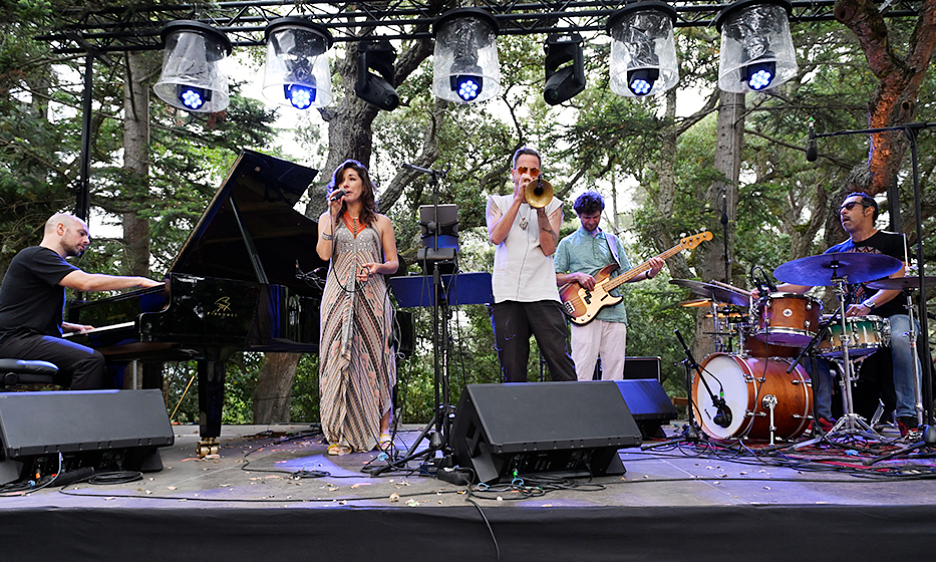
Courtesy Joan Cortès

Laboratori D'Arts Contemplatives
Llinars del Vallès
Barcelona
May 31, 2026
There are small miracles that happen daily and discreetly. They are of a prosaic and absolutely earthly nature, with no divine or supernatural intervention of any kind, and the vast majority of them tend to go completely unnoticed by the eyes of those who don't live those realities: from surviving a journey of thousands of miles to escape the most appalling misery toward a false promised land, to securing food for an entire family in an oversaturated refugee camp, to dodging shrapnel generated by devices aimed from an antiseptic distance, turning a home into an involuntary—and unrecognizable—battlefield.
Fortunately, not all miracles—let's keep calling them that, if only by assimilation of the concept rather than its origin—unfold under such terrible circumstances. Some enter the realm of the artistic, surfacing thanks to a fortunate combination of knowledge, talent, goodwill and economic tightrope-walking. And also, focusing on the case at hand, of a philosophical, ethical and contemplative underpinning, contributed by a Buddhist community called Casa Virupa: we are talking about El Rite (The Rite), a festival launched in 2023 that takes place in a privileged setting—an estate called Can Bordoi dominated by a beautiful 19th-century mansion, situated in the Montnegre-Corredor natural park, a few minutes from Barcelona.
When a lama's musical weakness turns into a festival
The Rite is framed within the multiple activities promoted by an entity conceived by the aforementioned Buddhist community: the so-called LAC (acronym in Catalan for "Laboratory of Contemplative Arts"), a refuge designed to offer artists and thinkers "a physical space, but above all a mental one, from which to resist the inertia and dispersion of our times," as they state on their comprehensive website. From creative residencies to spiritual retreats, through talks, podcasts, and concerts, the LAC's wide-ranging offer is open to Buddhists and to people with no religious beliefs alike, as long as they are involved in—or deeply drawn to—creation and thought. This has sparked genuine interest among artists—above all musicians, and many of them jazz ones—from around the world, some of whom, beyond participating in concerts and residencies, have become "ambassadors" of this non-biological but undeniably very living organism. Among them, within the territory that concerns us here, Shai Maestro, Tord Gustavsen and Oded Tzur must be mentioned, along with local talents with a solid international reach, like Rita Payés and Manel Fortià . Maestro, in particular—as already noted in Shai Maestro At Barcelona El Molino—maintains a constantly productive relationship with the center, having become a crucial presence in its packed activity calendar.But we were talking about a miracle—and while it's already clear that it's not the kind that requires a Pope's confirmation, it is equally necessary to explain the reasoning behind that qualifier. How else to account for the presence, in previous editions, at an event confined to three days, so far lacking public funding, private patronage and commercial sponsors, of figures—beyond those already mentioned—such as Michael Mayo, Björn Meyer, Avishai Cohen - Trumpet , Magnus Ostrom, Jan Bang, Eivind Aarset and Anja Lechner? And all of this at an incredibly affordable price, with zero echo in the local media—whether general or specialized—despite the efforts of its communications director and its curator of thought, Glòria Cagigal? Something is failing when the culture editors of a country's major traditional outlets—television, print, radio—ignore, whether out of obliviousness to their artists' relevance or, worse, out of the laziness of conducting even a minimal inquiry, an event whose lineup this year, beyond the already-mentioned Maestro and Payés, includes names of the caliber of Simon Moullier, Logan Richardson, Jon Balke, Jakob Bro, Antonio Sanchez, Thana Alexa and Michael League. Alongside them, a dozen more artists—not to mention, outside the jazz territory, the participation of flamenco guitar and dance stars, and of philosophers and writers who interspersed their reflections and experiences while the musicians prepared the next set.
As some may have noticed, an important thread connects several of the artists mentioned: their collaborations, to varying degrees, with ECM Records. A brief but very interesting conversation with the center's director, Lama Ngawang Norbu, shed light on our curiosity about the primary—though not exclusive—musical orientation of the festival's various editions. Norbu described himself as a jazz geek since adolescence, drawn most notably to the music produced under the very particular stylistic, aural, and visual lens of the label founded in Munich in 1969. Its meditative, remote, at times desolate aesthetic—which invites inquisitive elucidation—resonated immediately with his Buddhist principles, with which he quickly established multiple other connections, such as the necessary mindfulness required in both realms. Another key point was his discovery of the remarkable number of jazz musicians who practice Buddhism, with Herbie Hancock and Wayne Shorter as the best-known examples—less known, however, is the case of Buster Williams, who was crucial in introducing Hancock to this faith, as well as, directly or indirectly, those of Harold Land, Stanley Cowell and Steve Turre, who in turn acted as its disseminators.
Inevitably, the question of the festival's economic viability also surfaced in our conversation. Up against the already-cited absence of sponsorships and a reasonable media footprint—factors that can place its very survival on the tightrope—Lama Norbu stressed the importance of its creative independence against the commercial dictates of third parties, and the value of an enthusiastic word-of-mouth as the transmission belt of a secret that they prefer to keep well guarded. A hidden treasure that, obviously, needs a degree of success not to disappear, yet is sustained by the monumental effort of the Casa Virupa community, with a multitude of volunteers working on logistical tasks—from the exquisite attention at the various bars to the tending of the two stages and other repurposed spaces—and, in some cases, the selfless collaboration of the artists themselves, guided by their affinity with the principles that anchor this splendid project. To that must be added magnificent, crystal-clear sound reinforcement and sober, unobtrusive lighting—plus details such as the installation of canopies over the performance space to shield the audience from direct sunlight; an audience that also enjoyed two front rows of lounge chairs designed to encourage a state of suspension and sensory travel. It was apparent that attentiveness to its visitors is one of the house mottos.
Jon Balke's Siwan
It would be difficult to imagine a more idyllic backdrop for the festival's closing day: sunny and blessed with a benevolent pre-summer temperature, shaped by a gentle wind swaying the tree branches, lazily dispersing pollen and blossoms over the bandstand and its performers. Each act was introduced by an invitation to the audience to hold a brief but focused silence, and to maintain an open listening—unconditioned by prejudices, tastes, or patterns.Around midday, a reduced—but by no means lesser—version of Jon Balke's Siwan took on the task of initiating the long spell. Without the strings of Barokksolistene, Mona Boutchebak, Derya Türkan and Pedram Khavar Zamini—alongside the leader's piano and keyboards—assumed the role of unleashing a serene upheaval in the audience. Siwan charted a tonal geography in which the emotional fused with history and with the sovereign technique of its performers—its piercing, achingly beautiful proposition was at times so intense as to become almost unbearable, both for its creators (Boutchebak was visibly moved at certain points) and for an audience perhaps still unprepared to absorb such profound emotionality before lunch. Türkan's opening, alone, on his kemençe—a type of violin with virtually no fingerboard, its sonority as captivating as it is unsettling—established clearly that a cutting sadness would mark, not constantly but significantly, their commanding musical statement. Balke came across as warm and approachable, laboring with earnest Spanish to explain to the audience the provenance of the compositions and their texts, several of them based on centuries-old Andalusi poems. It is curious to see how the Norwegian—like a swallow in search of more southerly territories—has effected a musical migration that has led him from inhabiting the coldness so inherent to his beginnings to venturing into far warmer and more sensuous climes, yet without losing in the least that Nordic, contemplative gaze he wove into carefully studied moments. His piano, beyond the predictable ECM-like touch, also dispensed small doses of groove, vigorous ostinatos, and near-mainstream harmonies that spurred inspired solos—oscillating between the traditional and outside subtleties—from the transcendent kemençe of the Turkish master. Rhythmic accelerations and dance-like passages alternated with stretches of an imposing, grave quality, heightened by the seriousness of the performers' expressions—especially the very understandable gravity of Iranian Khavar Zamini, who only smiled after electrifying the audience near the set's end with a fabulous solo on his zarb—the Persian goblet drum—in which he layered diverse rhythmic patterns to chain hypnotizing percussive cascades.
One regretted not knowing Arabic, to catch the meaning of the lyrics rendered with singular refinement by Boutchebak. The Algerian shone in her delivery of "Mirada Furtiva," a song she composed setting to music a love poem by Ibn Zaydun, an 11th-century Cordoban poet, and in which the keyboardist accompanied her with ethereal electronic textures. Another Andalusi poem, "Ayshyn Raquin," resonated fully with the spirit of the festival and the place, as it deals with the contemplation of a mountain landscape at sunset, in the company of a glass of wine: Türkan soared over the flamenco-tinged passages shot through with jazz harmonies, and the vocalist pointed at the end to the birds that had joined her in song. They weren't the only animals to make a contribution: a worm slowly crossed the boards during the performance of "Ondas do Mar de Vigo," a number based on a poem by the 13th-century Galician poet Martín Codax, marked by a beautiful pianistic crescendo gently capped by Türkan. And there was still room for pleasure and fun—whether in "Enamorado de Júpiter," a galloping, luminous miniature, or in "Thulathyath," with its seductive rhythmic base over which a sensual Boutchebak's voice contrasted with the pure, almost ascetic sound of the kemençe. Finally, "Ala Dina," introduced by Balke as a rap (with lyrics by... Lope de Vega), closed with breezy joy—and with the effortful support of the audience's clapping—an hour of delicate musical and literary cross-pollination.
Alba Careta Group
After attending a podcast recording in which the concept of the party was examined through a Buddhist lens, and a necessary break for lunch, the Alba Careta Group took over the musical baton. Their performance was based largely on Panical (Segell Microscopi, 2026), an album produced by Maestro that stands as a well-crafted showcase of contemporary post-bop, built on the leader's excellent compositions and on others drawn from the Nova Cançó—a Catalan singer-songwriter movement that emerged in the late 50s under Franco's dictatorship, which became an act of linguistic, cultural, and political resistance. Alba Careta opened her set with a few words in which she expressed how honored she was to participate in The Rite, highlighting what she called its "incredible" character—from its idyllic location to its philosophy, through to its extraordinary bill.As for the musical proposition of her highly commendable quintet: it is fresh yet serious, cohesive yet diverse and, at times, spectacular. The leader combines a sharp creative drive with impeccable technical command—both of her primary instrument, the trumpet, and of an appealing voice she modulates with finesse, moving from an apparently innocent lyricism to a sweeping, well-reined power. On brass, she favors the middle and lower registers, full-bodied, frequently reaching back to some of the sonorities and phrasings that characterized the sorely missed Lester Bowie—not from a place of sarcasm or theatricality, but weaving them, in measured doses, into the marrow of her creations. So it was with "Elles," an evocative original she described as a difficult piece, conceived during the loss of two friends: its opening laments, built with moving harmonics, were exhaled under iron technical and emotional control; though some joy brightened in its central section, similar sonorities returned at the close—undoubtedly to recall their first cause.
This was not the only selection of the afternoon pitched in a feminine—or feminist—key. "Panical," which titles her most recent album, takes the name of a type of thistle—cardo, in Spanish, also used dismissively toward certain female body types—to flip the script and reclaim the untamed, self-proud side of those thus sadly labeled. Musically, that defiance was channeled through a sophisticated theme with dynamic mood shifts, attractive pauses and a dramatic interlude of Iberian character—where the double bass of Giuseppe Campisi especially shone, perhaps the most distinctive solo voice of the quintet alongside the leader's. "Nosaltres les dones" ("We, the women") pressed that conceptual line, this time through a song recorded in 1977 by Maria del Mar Bonet, one of the stars of the aforementioned Nova Cançó movement: Careta delivered her most lyrical vocals here, and Campisi came to the fore again, deepening the original's drama with his noble tone. But her most intense and surprising turn was "Liliana"—a powerful, unexpected duet between the sensational drumming of Jordi Pallarés and the naked yet defiant voice of a superlative Careta—strength, sensitivity and technical solidity allied to illuminate an ephemeral space of disturbing beauty. "GGG," with Roger Santacana's piano as its brilliant protagonist, and the closing "Blackbird" by the perennial Liverpool boys, furnished two cheerful bookends to an exceptional set in which each member of the quintet had their own moment in the spotlight—Lucas Martinez's tenor sax not least, asserting itself in "The End Of It." But it is Careta who dazzles, with her inspired songwriting and arrangements, and her concise solos—each note and timbre a considered choice. The Jazz a Vienne Festival, the Festival Grec de Barcelona, and the Circulo De Bellas Artes in Madrid, among many other stages, await her in the coming months.
Jakob Bro
Guitarist Jakob Bro's solo recital was perhaps the shortest of the day but simultaneously the most audacious, and the most demanding on part of the audience. The Dane appeared with his beautiful sky-blue guitar and a multicolored arsenal of pedals—some at his feet, others mounted at the height of his left forearm—and delivered a lengthy opening talk in which he explained that, following a first solo concert in Tokyo, he was "daring himself" to practice a format unnatural to him. The Copenhagen-born musician added that what was about to be heard would be something like watching him in the intimacy—not of rehearsal but of the "engine room" of his creative process—and that his usual way of playing live, which tends to be responding to the ideas of his colleagues, would here be subject to the unexpected outputs that the electronics would occasionally impose on him.His performance plunged into his most experimental side—a sonic and stylistic microcosm à la Bill Frisell (the inevitable reference), yet far more spare and somehow less predictable than that master's, whose very personal lateral drift (developed chiefly during his '80s ECM period) ended up becoming a convention in its own right, adopted by countless guitarists in formation or already consolidated. Returning to Bro: his fingerings alternated the pellucid with the imperfect, cultivating a kind of unstable minimalism in which loops—in the form of strange musical microorganisms governed by the rules of a distorted physics—evolved and mutated over hypnotic drones. Much of this was produced by the striking pedal arsenal, whose side-mounted units especially allowed the electrified flow to spill repeatedly without Bro pressing a single string—his right hand merely supporting the neck, his left trembling over the infinite possibilities of the technological paraphernalia at his reach, his feet purposefully working the pedals below. That firmly concentrated and stripped-down environment—yet rich in subliminal nuance—served as connective tissue to several of his pieces joined without interruption: "Gefion," "Returnings" (where crystalline sonorities combined with abrasive noise), "Oktober," "Heroines" (dedicated to many women, but most notably to "all the great singers of the jazz tradition"), "Dug," and "It Should've Happened a Long Time Ago" (written by Paul Motian, his former bandleader and later collaborator)—allowing many to sink, eyes closed, into a musical trance whose atmosphere was devoid of contours and defined lines.
That extended aural tapestry ended with an invitation for one of the weekend's featured artists—announced only for the first day but still in attendance—to step up to the platform. The unexpected partner turned out to be Avishai Cohen (the trumpeter), who performed two sharply contrasting numbers alongside the guitarist. The first offered Bro's most accessible, almost conventional instants: a suggestive musing on oneiric harmonies and near-absent tempo, with Cohen invoking the Miles Davis of Aura (Columbia Records, 2000)—both in his phrasing and sonority (that mute, maybe a Harmon) and in some very subtle early allusions to the Prince of Darkness' imperishable reading of Shorter's "Nefertiti." The second, in contrast—inspired by the urban landscape of Brooklyn—generated a new high-voltage discharge through a sonic accumulation of overwhelming intensity, with Bro once again probing the frontiers of noise—helicopter simulation included. That was the only encore of a concert radical in its very premise—solo guitar—through to its oblique stance: the enigmatic, utterly singular guitarist left, needless to say, no one indifferent.
Antonio Sánchez + Michael League, Thana Alexa, Shai Maestro
In sharp contrast, the day's closing set presented its most festive, accessible, and—up to a point—media-friendly face, with four illustrious expats based in Catalonia, whose names cross the borders of the jazz universe. Four-time Grammy Award winner Antonio Sanchez led a combo assembled for the occasion, featuring vocalist Thana Alexa, bassist Michael League—the de facto leader of Snarky Puppy—and the ever-present Maestro. A conjunction of fairly disparate spirits (Alexa and Sánchez excepted, linked by several musical and personal endeavors) that gelled surprisingly well, incorporating into a convincing whole the stylistic and interpretive particularities of each. Maestro's pianism was pivotal in that effort, displaying a supple versatility essential to harmonically blending the very disparate ideas on offer—where magnetic funky grooves, bop melodies, harmonic intimacy and electronically processed pop and folk were combined with the leader's killing drumming.The concert opened with a new League composition, very groovy and very much in the Snarky Puppy vein, with the audience committed from the first note. Maestro put on Hancock's sunglasses—with a touch slightly sweeter than the genius's—while Alexa, spurred by Sánchez's cross-rhythms, established the melody through a distinctive scat that mixed bebop inflections with her own very personal take on the technique. "Gal," a beautiful work by Maestro dedicated to his brother, provided what were perhaps the finest collective moments of the set. It began with the Israeli in a distilled, essential vein, giving way to an Alexa who sketched the piece's main motif gracefully before seizing control of her pedals and unfurling striking reverberations. Maestro responded with passages of soft Middle Eastern flavor—very definitive of his musical language—before subtly forging an almost unbearable crescendo, à la Hancock once more, while a towering Sánchez delivered, with that tensioned nerve that defines him, what felt like the aftershocks of an benign earthquake.
The Mexican took the microphone to say what, though obvious, was no less worth saying: "It is impossible not to feel good in this place." He used the occasion to joke about the all-star lineup before introducing the next number, "Gocta"—an original inspired by the Peruvian waterfall of the same name, which Alexa and he had visited at the invitation of a wedding. The musical translation of those experiences became an intense rhythmic exercise articulated over an irresistible League riff, colored by Alexa's timbral manipulations of her voice and by the leader's cymbal play, fleeting polyrhythms, and impactful accents. As if that weren't enough, Sánchez closed with an electrifying solo that at its end dissolved gently into the gathering dusk.
From there, the music entered a more lyrical and less strictly jazz-bound territory, with a beguiling Maestro-Alexa duet unwinding "Set Free"—one of her own, in which the pianist excelled in his rich elaborations, and the New York City-born artist delivered her finest moments as a vocalist, with a penetrating, heartfelt lyricism. On the other end of the spectrum, "She Said" embodied the set's lightest point—above all in terms of material: a sweet musical gesture from the singer toward "the female part" (Sánchez's words) of the aforementioned wedding party. Equally remote from jazz territory—but considerably more searching—was the version Alexa introduced of James Taylor's "Fire and Rain," a song that, as she herself explained, conceals beneath its apparent beauty a deeply tragic story. Her excellent arrangement lent the piece a depth à la Brad Mehldau, enhanced by delicate backing vocals built from her own processed voice. The shadow of Joni Mitchell and other grandes dames of the Laurel Canyon sound drifted over the platform, while Sánchez showed his most restrained side—within the margins of a measured forcefulness essential to the luminous dynamic ascent the band wove toward the song's end.
Groove returned for the closing selection, "Challenge Within"—Sánchez's first-ever recorded composition—in which League displayed his hilarious histrionics, as if every note plucked were a unique and memorable event in his life. That didn't prevent him from being fantastic in rhythmic support, facilitating Sánchez's delivery of another energetic lesson in percussive precision and creativity. A single encore, with Cohen once again as special guest, capped the set, the day, and the festival.
The Rite Of Spring
This chronicle would not be complete without expressing gratitude to Glòria Cagigal, for all the assistance provided for attendance at the festival, and to this article's photographer, Joan Cortès—photojournalist, essayist, and a well of musical knowledge, jazz wisdom above all—whose conversation on kindred topics could become eternal. We hope to encounter both of them again in a future, even more successful edition of The Rite. This, after all, is a festival that musicians and creators have claimed as their own. As evidence: the visit, in the 2025 edition, of Manfred Eicher, who came to witness in person that quiet but constant homage to his label; or the interest of one of the artists, a participant in the first day, in extending their stay to enjoy the performances of the following days and the vibrations emanating from the event. It was moving to hear Sánchez say, ... "a festival that has become a place for musicians from all over the world to come and share a destination." And even more moving to see Balke and Boutchebak attending—standing, discreetly tucked at the back of the stalls—the festival's closing concert, many hours after their morning performance. Another heartening factor was confirming that the majority of the audience was in their 20s and 30s, with a notable presence of middle age and a restless old age clearly in the minority—the reverse of what tends to happen at many jazz events in this country. All of this makes it impossible to find even the slightest note—not just negative, but discordant: neither organizational, nor technical nor, of course, conceptual and creative. May its path, then, remain open and be fruitful.Tags
PREVIOUS / NEXT

Become a Sustaining Member

Since 1995, All About Jazz has championed jazz as an art form and supported the musicians who create it. Over three decades, it has grown into one of the world's leading jazz resources, serving hundreds of thousands of readers, musicians, presenters and industry professionals each month.
Help Build the Future of All About Jazz
Your support helps us continue building All About Jazz for the next generation—expanding our editorial coverage, preserving jazz history, developing new community features and creating better ways to discover the music and the people behind it.
Become a sustaining member for as little as $20 per year and you'll immediately enjoy an ad-free experience along with access to subscriber features and future articles for a full year.
Together, we're not simply sustaining All About Jazz—we're building its future. Thank you for being part of the journey.
Near

Barcelona Concerts