Home » Jazz Articles » Live Review » OJKOS plays the Music of Tuva Halse at the Victoria Nasj...
OJKOS plays the Music of Tuva Halse at the Victoria Nasjonal Jazzscene
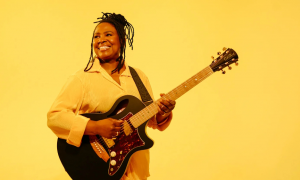
Courtesy Lise Lillebrygfjeld Halse
The Panorama composition commissioned from the young Norwegian violinist was a rare opportunity to discover the dramaturgy and humanity she brings to her work for large ensemble.
Victoria Nasjonal Jazzscene
Oslo
October 21, 2026
Mountain Jazz: Identity and Roots
In the steep valley of Eikesdalen, in the Norwegian municipality of Molde, wild hazelnuts fall from the tree in September or October. Every hazelnut is destined to fall once it is ripe, and the same holds true for Panorama, by Tuva Halse, who also comes from Molde. It was only a matter of time: it arrived on October 21, 2026, at 7:00 PM.The fruit was gathered by the Victoria Nasjonal Jazzscene in Oslo. The Victoria is a former cinema and theater with a pub atmosphere and a capacity of 270 people with the stage at the front and tiered seating at the back, a bar with a smartly chosen selection on the side and balconies above and a sound desk in the middle.
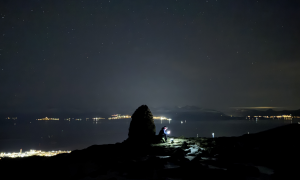
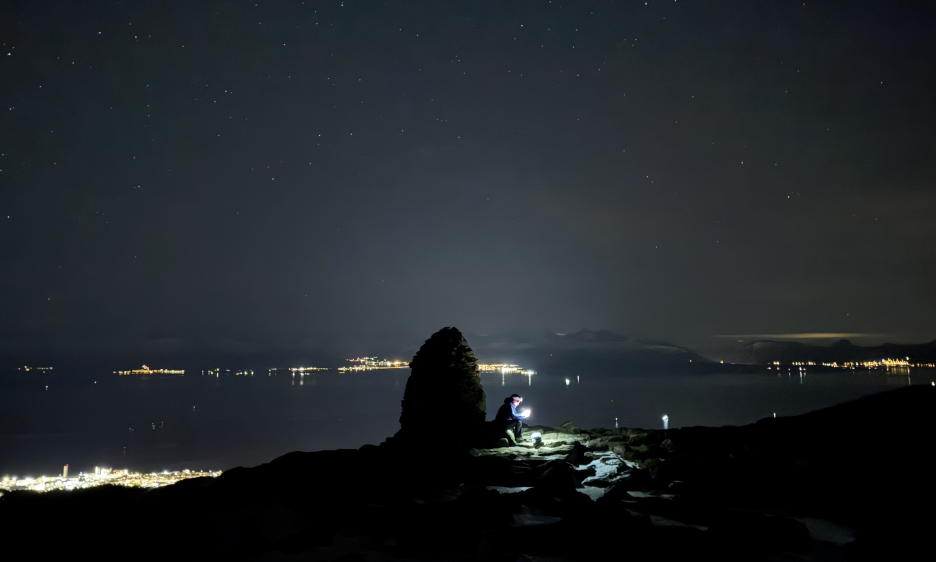
Why Panorama? For the inhabitants of the small coastal town, who marvel day and night at the mountains, the sky, the sun and the moon, the question does not arise. The Molde panorama has been ranked the 10th tourist attraction in the country by a popular travel website, with, according to the geographer and teacher Asbjørn Ørjavik, 222 mountain peaks visible from a viewpoint situated above the town, quite a performance for an altitude of only 400 meters (404 m according to altimetric measurements validated in 2023). In January 2018, the excellent local newspaper Romsdals Budstikke reported that the previous year, Halse, aged 18, was one of the people who had entered their name most often in one of the summit registers. She was already a regular visitor as a child, carried on her mother's shoulders, and even today it is not unusual to meet her there when her concerts allow her a break. Logically, Halse readily describes herself as a representative of mountain jazz.
Even so, Panorama does not describe a succession of physical peaks. As in Halse's earlier works, the composition starts from personal feelings, blossoms, and aims at the universal. Halse describes Panorama as "an image of identity and roots, but also of widening horizons and gaining new perspectives."
OJKOS
Panorama was commissioned by the Orchestra for Jazz Composers in Oslo / Orkesteret for Jazzkomponister Oslo (OJKOS) ensemnble, a highly selective ensemble in constant evolution. In September 2026, three positions were opened to around thirty candidate composer-improvisers aged 33 or younger, for five-year contracts.OJKOS is an incubator for young composers of contemporary jazz. Each composer is required to write two commissioned works during their time in the ensemble. Halse had presented Reconnection in November 2024, and some of its pieces were recorded by the Tuva Halse Quintet and released in January 2026 on the acclaimed album Reconnection (Jazzland Recordings, 2026). Panorama is a suite of eight pieces for which she invited Morten Georg Gismervik (guitar, cello) and Benjamín Gísli Einarsson (piano).
Familiar Mountains
The first pieces were "Familiarities I" and "Familiarities II." Every mountain range has its own identity, its color under the sun or the moon, its bends from which unexpected landscapes emerge, sometimes polar, sometimes Mediterranean thanks to the pines. Its view over the fjords, from where under the midnight sun one can almost see the curvature of the Earth, or over nothing at all in the middle of a blizzard. Its peat bogs and snowfields, its endless ridgelines, its cairns. Familiar landscapes, but sometimes unrecognizable too. "It is almost like a feeling of déjà vu, feeling something in a specific, exact place. Whether in the mountains or in life, these pieces are about the fact that it can feel like home. It can also feel far from home, everything is relative," explained Halse."Familiarities I" was first introduced on violin, then developed through the warm and majestic timbres of the brass and reeds, including a beautiful improvisation by Øyvind Mathisen, whose trumpet was draped in very high-pitched phrases from the violin.
"Familiarities I" morphed smoothly into "Familiarities II," a lively, cinematic theme. It was the ideal setting for Sol Léna-Schroll (alto saxophone), whose elegant dexterity steers clear of clichés. "When someone is needed to play fast, I am the one they ask," he said mischievously. Indeed, two years earlier, in Halse's commissioned work Reconnection, standing almost in the same place on stage, he had already delivered a scorching, high- speed solo. Beyond the quip, Léna-Schroll, one of the founding members of L'Autre Collectif/Det Andre Kollektivet (The Other Collective), is truly one of the most exciting European saxophonists of his generation (see the review of the Den Andre Festivalen #9, of which he is one of the organizers/artistic directors). At the front right of the stage, facing Halse at the front left, their rapport was a constant delight.
A Resonant Suite
In a mountain panorama, each mountain is singular, but on another scale, that singularity fades. Through the magic of tectonic forces and climate, the mountains become individual elements of Panorama, a coherent and harmonious whole. Halse embraces this duality: whereas Reconnection, her first work for large orchestra, was made up of finely chiseled, contrasting pieces, Panorama adds links and nods between them. The elements of the panorama resonate with one another.Thus, the theme of the next piece, "Throughout," continues the cinematic atmosphere as a kind of amplified echo of "Familiarities I." It was introduced by a solo from Martin Lee Thomson (euphonium), a Scottish musician whose rich universe had won over the same venue in 2025 with the program OJKOS Plays: Martin Lee Thomson and his composition Fraileach ("seaweed" in Gaelic), a world of marine algae vertiginously complementary to Halse's mountain world.
Gradually, the orchestra built in intensity, carrying on the rhythm of the cinematic ride over which Gismervik's crystalline guitar came to improvise. He is a guitarist well worth discovering. As it happens, his album Starfall (Purple Theory Records, 2026) had been released only a few days earlier.
The Return of Henry Purcell
The next piece, "Purcell," is dedicated to Henry Purcell, a recurring reference in Halse's music, to whom for instance she had already dedicated part of Air Music, a commissioned work for the Kongsberg Jazz Festival in 2025. Halse introduced Purcell to the audience as a superstar of his time, inviting them to rediscover him. "Purcell" goes straight to the baroque essentials. It is no pious act of reverence: Halse's familiarity with his work inspired a small composition reflecting the great man's charisma and conviviality, with a great freedom of tone. Thus Andrea Silvia Giordano (vocals, flute, electronics) introduced the piece with a vocal improvisation in Piedmontese, the language of the region Giordano comes from, which sounded more traditional than baroque. Giordano's second intervention, joined by Åsmund Perssønn Ødegård (guitar), flaunted a freedom fit to frighten the bourgeois, with noisy electronics, a distorted voice, and guitar verging on saturation. The wound was swiftly dressed with a respectable reprise of the theme, bringing the piece to a close.Shades of Grass
Halse's baroque inclinations run deep, but she is constantly exploring other musical forms too, readily drawing inspiration from them to broaden the harmonic palette of some of her compositions. Pop music is one of them, as the birds & the sun (Fjordgata Records, 2026), by the tuvahalseband, released in spring 2026, testifies: a gem of poetry and compositional intelligence. Also in 2026, Halse spent a great deal of time touring with the celebrated pop singer Susanne Sundfør, playing a bluegrass repertoire. "Something had to come of it," she says with mock fatalism. And so we moved on to "Greengrass," the spot in the panorama where the grass is greenest. Coming out of "Purcell," we had gone to the other end of the sociological spectrum, Halse remarked wryly."Greengrass" showed that Halse had taken a further step toward the dramaturgy already sketched in Reconnection.
The arrangement was once again cinematic, with particular care given to the counterpoints between the string, brass, and reed sections. A perhaps slightly orientalizing introduction by Jørgen Bjelkerud (trombone), accompanied by guitar, and at one point one might wonder where on earth the grass, whatever its color, could be hiding. Then the theme gently took shape, stated on the violin as it should be, propelled by the supple rhythm of Gard Kronborg (bass), a longtime fellow traveler of Halse, and the drive of Trym Saugstad Karlsen (drums). And the piece grew in scope. The dramaturgy worked tremendously well.
"Greengrass" was of course the moment of bravura for Halse the violinist, whom we had been waiting to see put to the test. For can one imagine that ever-refined, delicate violin, barely brushed by the bow, in the muddy ground of bluegrass? No! One cannot. And yet! The body of the violin gradually allowed itself to be splashed with bluegrass mud. But nothing too serious! Never quite inside bluegrass (some will no doubt be relieved), but clearly in its momentum, Halse stepped out of her comfort zone, broadening the palette of her style and then bringing it to a kind of apotheosis where no one expected it. Halse, that chameleon violinist.
In any case, she had no choice: she had to follow Karlsen's effective drive. Karlsen is one of the most solid drummers on the Norwegian scene. Both guide and guided, he truly frames the sound space of his little world with the full range of drums and cymbals at his disposal, particularly at ease when it comes to pushing soloists to their limits in their own tunnel. One remembers his monumental drive with Håkon Huldt-Nystrøm (bass) during an extraordinary fast-tempo solo by Aksel Rønning (tenor saxophone) in "Longyearbyen," from Reconnection. Social media carry the trace of it.
Baroque Spaces
As we have mentioned, in panoramas the mountains of a single range share the same fate. The next theme, "Promise," took up and continued "Familiarities I." Leaving the muddy boots off on the doorstep, it was time for the grace of the string trio formed by Andrine Dyblie Erdal (cello), Halse, and Gismervik (here on cello), and for improvisation spaces left to Kronborg's bass and Gísli's piano."Mindful" is a tune about the peace that comes from finding harmony with oneself, a state everyone reaches in their own way. Some through meditation, others by climbing the snowy slopes of Romsdal with their family and snowboarding back down. Snowboarding and baroque music: "Then I am at one with myself!" Halse clarified, for those who had not yet understood.
"Mindful" is thus a piece of earnestly avowed baroque inspiration, a kind of sketched dance with a serene atmosphere. It is well established that the great baroque composers and performers were also improvisers, and it is always a joy to hear how Halse places herself in this tradition. "Mindful" began with two baroque solos: a pizzicato introduction by Halse with Gismervik on cello, then the magnificent bowing of Erdal's cello. Baroque is also a story of flutes: those of Giordano and Sigrid Aftret were summoned, and Aftret delivered a solo in which thoroughly respectable jazz eventually melted into a purely baroque finale.
At this point, the idea of a perfect triangle came to mind. Aftret's and Giordano's flutes had colored several arrangements throughout the evening. If Gil Evans' arrangements occupy one of the triangle's vertices for their contribution to the use of flute color in the big band, the distinctly Japanese- inflected Lew Tabackin fits most naturally at a second vertex, in the context of the Toshiko Akiyoshi-Lew Tabackin Big Band. The third vertex then belongs to Halse, for the baroque-inflected color of the flute in the big band aesthetic.
Halse is fond of layered titles, which she justified by her wish for everyone to find something that touches them, a home port. She thus introduced the last piece, "Present," as "being present" (the main meaning), but also as "doing those things where you feel that you are most present," as well as a gift, which at the end of the concert had the feel of one last gift to the audience. One last piece of baroque inspiration, and one last turn around the track for the string trio and piano. And finally, to close the loop opened by "Familiarities I" and "Familiarities II," one last nod to "Familiarities II," followed by, as in the beginning, solos from Mathisen on trumpet and Léna-Schroll on saxophone, under the delighted gaze of Halse on the opposite side of the stage. The panorama tour was complete.
Life Chapters
Panorama is therefore a work of great richness, in which the pieces connected through echoes, callbacks, and contrasts. Bjelkerud and Léna-Schroll both emphasized the remarkable quality of the writing.Attending a Tuva Halse concert is always an experience that goes beyond the music. Radiant on stage, she impresses with her presence and concentration, her gaze and joy in playing, but also her generosity and humor. An aura of humanity permeates her works and her relationship with the audience. Her astonishing gift for artistic communication is the essence of art: turning an inner expression into a universal language. Since her first albums, and tonight for those fortunate enough to attend the premiere of her second work for big band, she has been writing chapters of the book of our lives, revealing their beauty, this evening in real time.
In November, the mice, squirrels, and birds of the Eikesdalen valley are busy, finishing their feast and scattering wild hazelnuts for the winter. From the very start of spring, the hazel trees will be in bloom: stay tuned!
Personnel
Tuva Halse: violin and composition; Andrine Dyblie Erdal: cello; Sol Léna-Schroll: alto saxophone; Sigrid Aftret: tenor saxophone, flute; Andrea Silvia Giordano: flute, vocals, electronics; Øyvind Mathisen: trumpet; Jørgen Bjelkerud: trombone; Martin Lee Thomson: euphonium; Åsmund Perssønn Ødegaard: guitar; Gard Kronborg: bass, vocals; Trym Saugstad Karlsen: drums. Guests: Morten Georg Gismervik: guitar and cello, and Benjamín Gísli Einarsson: piano.
 FOLLOW Daniel Mège
and get notified whenever a new article published.
Scientists search by day, musicians find by night.
About Tuva Halse

Tags
PREVIOUS / NEXT
Become a Sustaining Member

Since 1995, All About Jazz has championed jazz as an art form and supported the musicians who create it. Over three decades, it has grown into one of the world's leading jazz resources, serving hundreds of thousands of readers, musicians, presenters and industry professionals each month.
Help Build the Future of All About Jazz
Your support helps us continue building All About Jazz for the next generation—expanding our editorial coverage, preserving jazz history, developing new community features and creating better ways to discover the music and the people behind it.
Become a sustaining member for as little as $20 per year and you'll immediately enjoy an ad-free experience along with access to subscriber features and future articles for a full year.
Together, we're not simply sustaining All About Jazz—we're building its future. Thank you for being part of the journey.