Home » Jazz Articles » Live Review » Den Andre Festivalen #9
Den Andre Festivalen #9
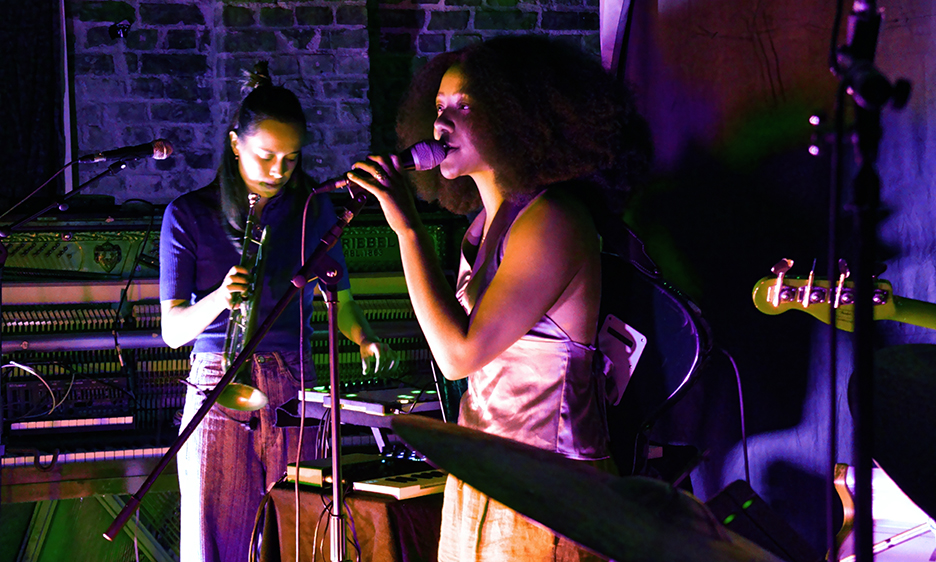
Courtesy Daniel Mège
Den Andre Festivalen is far from being a festival like any other: it is part of a genuine transnational project promoting a creative vision rooted in cultural activism.
Oslo, Norway
September 4-5, 2026
The Other Festival, The Other Collective, The Other Ensemble, Other Records: a unique binational initiative
L'Autre Festival/Den Andre Festivalen (in French and Norwegian; The Other Festival) is a unique jazz festival that grew out of a master's project at the Norwegian Academy of Music in Oslo. In 2019, five students from the Conservatoire National Supérieur de Musique (CNSM) in Paris founded L'Autre Collectif/Det Andre Kollektivet (The Other Collective). Numerous collectives were emerging at the time; this one brought together musicians who shared the same vision of jazz.The collective explored the combinations made possible by its musicians: duo, trio, quartet, quintet. Norwegian tenor saxophonist Sigrid Aftret was then a student at CNSM on an Erasmus exchange. The collective was made up of Sigrid Aftret, Sol Léna-Schroll (alto saxophone), Hector Léna-Schroll (trumpet), Clément Merienne (piano), Nicolas Zentz (bass) and Nino Baleyte (drums). The collective was thus binational from its very beginnings; in this respect, it followed in the footsteps of the quintet Ensemble Ensemble, founded by French pianist Eve Risser as early as 2018 and documented on Live At Atelier Du Plateau (BMC Records, 2025).
The following year, Sol Léna-Schroll and Merienne enrolled in the Master of Music Performance program, specializing in Improvised Music/Jazz, and proposed as their master's project the creation of a jazz festival aimed at highlighting the complementary nature of French and Norwegian musical approaches.
The festival initially alternated between France and Norway. The first L'Autre Festival took place at L'Arrosoir in Chalon-sur-Saône, France, in 2021, followed by Den Andre Festivalen at Kafe Hærverk in Oslo in 2022, two venues known for the quality of their programming. In 2023, L'Autre Collectif decided that the festival would take place every year in both France and Norway, with the enthusiastic support of the Institut français de Norvège (French Institute of Norway) and, depending on the year, funding from local, regional, and national Norwegian sources.
The musicians in the collective have varied over time, while maintaining a certain balance between French and Norwegian musicians around the core of the Léna-Schroll brothers and Merienne.
Above all, Covid proved to be a turning point for the jazz scenes in both France and Norway, ushering in a new generation of musicians whose musical approach makes innovative use of electronics and improvisation. This was accompanied by an acute sensitivity to concerns increasingly reflected in society: gender parity, inclusivity, the environment, and politics, all themes that gained momentum in the wake of the pandemic. There was also a determination among musicians to take their futures into their own hands by banding together rather than waiting for funding that is gradually drying up everywhere. "A kind of cultural activism," Sol Léna-Schroll says.
Autres Records (Other Records) followed. Thanks to Bandcamp, founded in 2008 and becoming much more widely popular from 2017 onward, there was already a distribution platform offering artists fair compensation. The new label, established in 2023, is dedicated to promoting the work of L'Autre Collectif and, more recently, has also supported musicians who share the same vision of jazz, such as the French group La Drave (La Drave, Autres Records, 2026) and the Norwegian group After Past and Present (Fanfare for Armageddon, Autres Records, 2026).
In addition to being a musical collective and a quintet, and running a festival and a label, L'Autre Collectif forms the core of L'Autre Ensemble/Det Andre Ensemblet (The Other Ensemble), an expanded orchestra bringing together several other musicians and conceived as a vehicle for composers invited to the festival: Eve Risser (2021), Kalle Moberg (2022), Matt Choboter (2023) and Fanny Ménégoz (2024). The members of the collective then began composing for the orchestra themselves, and that is what we heard this year.
The Orchestra for Jazz Composers in Oslo / Orkesteret for Jazzkomponister Oslo (OJKOS) is likewise made up of young musician-composers (recruited for five years, with an age limit of 33 at the time of recruitment). It is kindred in spirit with L'Autre Collectif and Det Andre Ensemblet, and in 2025 the two orchestras joined forces for both versions of the festival, as well as for three dates in France funded by the East Norway Jazz Centre.
Den Andre Festivalen is therefore far from being a festival like any other: it is part of a genuine transnational project promoting a creative vision that engages with the concerns of society.
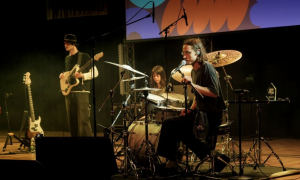
In 2026, Den Andre Festivalen lasted two days and featured five concerts. The Collective consisted of three founding members—Hector and Sol Léna-Schroll and Merienne—and two new members who are also members of OJKOS: Andrine Dyblie Erdal (cello) and Jørgen Bjelkerud (trombone).
The Gunpowder Factory (Day 1)
Getting to the Gunpowder Factory is an adventure in itself. There are several ways to get there, but taking bus 21 is a good idea. You ride to the end of the line, then find your way through the Etterstad neighborhood with a map. Once across it, you make your way into the small jungle surrounding the torrential Alna River and its roaring waterfall, cross a simple suspension footbridge and follow the river along its left bank. Then you cross another wooden bridge, walk uphill, turn right, continue past the sauna and eventually find yourself in the courtyard of an extraordinarily welcoming place: Kruttverket (the Gunpowder Factory), where, with a bit of luck, a few visiting musicians are sitting at a table. You do not arrive there by chance.Kruttverket is a brick building dating from 1906 with a tall chimney, built after the gunpowder factory, opened in 1850, had closed a few years later. The building hosted agricultural, artisanal, and industrial activities before being saved from dereliction by a community center run by Kroloftet, a creative collective whose various workshops benefit both jazz and local residents.
Kruttverket has several rooms spread across three floors and two bars. Downstairs, concerts take place every Sunday evening (Søndagsjazz), a series curated for a time by L'Autre Collectif and Aftret. The space also serves as a bistro. From there, one can reach a succession of wooden walkways and platforms built above the stream, with carefully designed lighting, where one can listen to music, have a drink, eat, and take a sauna. The concert hall is on the middle floor and opens onto the courtyard. Kruttverket is a place dedicated to the well-being of body and mind.
Victoria Oftestad and Signe Gjessing
It was in this setting that we began by listening to the voices of folk singers Victoria Oftestad and Signe Dorthea Krohn Gjessing. The former is known for building bridges with early music and is also an actress and recorder player; the latter is also an actress and dancer.Where is the jazz? Oftestad collaborates with jazz musicians: six days later, she found herself on stage with OJKOS, directed by guitarist Åsmund Perssønn Ødegård. Jazz, moreover, has always synthesized earlier and contemporary music. Scandinavia has played a particular role in this regard. Don Cherry, who settled in southern Sweden for several years at the start of the 1970s, had impressed Jan Garbarek with the way he incorporated the folk music of a Norwegian singer into his own music (Jazz Magazine 2024, 769, 15-18).
The transformation of melodies from the Østerdalen region, collected by musicologist Ole Mørk Sandvik (1875—1976), into the jazz repertoire by Torgrim Sollid (Østerdalsmusikk 1975, Plateselskapet MAI, 1975 and Østerdalsmusikk, NORCD, 2015), in which Garbarek also took part, would inaugurate a blending of folk and Norwegian jazz whose legacy is still very much alive.
In a somewhat similar way, Oftestad and Gjessing went hunting for old songs from the Oslo region and faced the same difficulties as Sollid: finding the melodies that go with the lyrics and, once they are written down, figuring out how to make them sound.
Each has her own repertoire, based on her own research, which they shared this evening with the Kruttverket audience. They even called on listeners to ask Oslo elders about rare, old songs that might otherwise be lost. Success: after the concert, a man approached Gjessing and gave her some leads for her and Oftestad to investigate.
Oftestad and Gjessing sat alone at the edge of the large stage, emerging from the dimness under the light of two or three small spotlights shining up at them from below, each on a chair with her songbook. Taking turns or singing together, they performed around fifteen songs, mainly written in østnorsk, the dialect of East Norway.
They are spellbinding storytellers: without leaving their chairs, their talents as actresses transformed each song into an imaginary film. And it mattered little whether one understood Norwegian or not. It was a universal spectacle, carried by superb, beguiling voices, with the touch of virtuosity and popular theatricality that suits this repertoire, which spans the last four centuries.
It was also a striking demonstration of the musicality of Norwegian dialects. A text hovering at the boundary between speech and song, about Oslo in the early 20th century after it had abandoned its Danish name Kristiania, demonstrated just how tenuous the passage from one to the other can be.
The first song was full of humor and innuendo, beginning with a cat and mouse in the miller's drying room. Next came a sailors' story; the tale of one of the many women charmed by Elias Tønnelsen, a burglar and safecracker at the start of the 20th century and a specialist in spectacular escapes; and a poem to a fly written by the criminal Gjest Baardsen, in which he laments his fate from the prison of Akershus Fortress, where he was sentenced to life imprisonment with forced labor in 1827.
They continued with the song of beautiful Elvira, who loses everything but sings no matter what happens—and things do happen to her! The next song, written by Hans Aleksander Hansen, was about the punishment that befell Oslo, which burned down in 1624 and was rebuilt a little farther away by Christian IV of Denmark-Norway (hence the new city name, Kristiania), followed by the bitter irony of a penniless poet when Oslo regained its medieval name exactly three centuries later.
Oftestad and Gjessing never really departed from a tone imbued with humor and derision. It remained light even in the sad song that invariably made Oftestad's great-aunt cry, in which Jesus is implored to bring her mother back. The concert ended with a rather lighthearted song about a Nicoline who enjoys the pleasures of life, followed by a song about love for the new city of Oslo.
The songs were sometimes interspersed with very brief explanations, creating a varied, picturesque, and intelligently structured panorama of stories spanning four centuries of the city. As for jazz, it was there in the possibilities these lively melodies and lyrics might open up for some Oslo improviser in a future we hope is near!
Sanyu
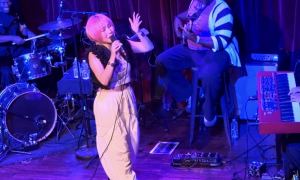
The second concert was given by Sanyu (Sanyu Christine Nsubuga, vocals, guitar, keyboards, electronics, percussion) and her regular band, consisting of Kristina Fransson (trumpet, guitar, electronics, vocals), Joachim Mørch Meyer (bass), and Rino Sivathas (drums).No one ventured to classify Sanyu's style. Her first release, the EP Now You Hear It (Overdue, 2024), was a lyrics-driven album (for which she received the Lyspunkt Award, "point of light/glimmer of hope," from the Norwegian Songwriters' Fund) in which the instrumentation discreetly showcased the voice. Some keywords beyond jazz might include soul, groove, rock and progressive rock, rap, electronica, and indie, but it would be futile to try to identify a dominant style among them. Asked about her favorite artists, Sanyu offered a long, non-exhaustive list spanning a variety of genres. What holds the group together is simply her own voice.
Most of the pieces played this evening came from the album Circumspect (Overdue, 2026), released a few months earlier. Circumspect, and therefore this concert, is about the world to come and the one we are preparing for future generations, as well as a few complicated love stories.
Generally speaking, the lyrics are complex and rather fierce, expressing revolt but also doubt and the difficulties of life. "Ironic," the seventh track on the album, opened the concert. It set the tone: Let's talk about life / Let's talk about death as we roll the dice.
And it is a tone of revolt.
The piece was introduced by a drum and tambourine motif, over which a few notes picked out by the bass were layered before giving way to Sanyu's voice. From the very first words, powerfully projected to the back of the room, the die was cast: what a warm and deep voice, what control, what rhythm! Within a few seconds, the audience understood that they were in for something serious.
"Ironic" barely over, the revolt continued with "Future Display": No highly esteemed being is dead or commemorated here/I had a dream that we were headed towards extinction / (... ) Nothing valued lives here.
The song began with a powerful groove driven by Meyer's solid bass and the enormous sound Sivathas is capable of producing. As demonstrated on Speak Volumes, his debut album released a few months earlier, Sivathas knows how to use all the colors afforded by the drums, cymbals, and his drum pad, with implacable polyphonic clarity. Here, he was the ideal drummer. The piece ended, however, with a gentle melody.
Sanyu followed with "Put A Fight," another revolt against the dominant discourse of society that tries to turn us away from reality: You see through your lens, but all you see is your lens.
But it was also one of the opportunities to discover Kristina Fransson. A little research reveals that Fransson is far from unknown. She is a member of the jazz-pop group LEAH, is part of the New Norwegian Big Band (Det Nye Norske Storband), works with Sinikka Langeland, and, above all, has her own group, Coincidences.
Fransson made a strong impression: playing trumpet and electronics, sometimes while also playing electric guitar, and contributing strong vocals, she is as comfortable with counterpoint à la Miles Davis as she is with hard-rock guitar. Her trumpet brings a decisive color to the group's sound, while her voice mirrors Sanyu's, whether in counterpoint, riffs, exclamations, or backing vocals.
After a first series of pieces that was clearly anything but restful, "Jenga" took us into the territory of difficult romantic relationships. Rest was still not on the agenda; we were simply changing registers. The melody was nonetheless soothing: a gentle, considerate voice, so calm after the storm that one could forget its transient nature, a serene step toward a possible—probable?—storm to come. Sanyu's voice was delicately accompanied by the guitars of Sanyu and Fransson, then by discreet electronics, with Meyer and Sivathas joining in.
The concert ended, after about ten pieces, with "Make Some Noise," a call not to remain silent, and "Blank Sheet," an introspection on the intellectualization of feelings. In both pieces, Sanyu delivered her long lyrics in rapid-fire rap, which her musicians, of course, transformed into something far more musically complex. It was once again a great pleasure to hear Kristina Fransson's economical interventions on trumpet—economical in the Miles Davis sense, though at times more raw.
The chairs that had been arranged throughout the room for the folk songs of Oftestad and Gjessing had been stacked away to let the audience dance. No one danced. Sanyu hypnotized her standing audience from the first note to beyond the last.
Sanyu is a great voice and a poet of great stature. The richness of her lyrics deepens with repeated listening (thanks to the album Circumspect). Lucid, and therefore rebellious, they calm down only to launch another assault on injustice, cowardice, and vulnerability. Her original band is exceptionally gifted, with the groove always ready to kick in at the drop of a hat. The alchemy between voice, trumpet, electronics, and guitars works perfectly. On stage, Sanyu has a luminous smile.
Pétrole
Why petroleum? A word that sounds good, says Hector Léna-Schroll. A rather soft touch and a deep blue; there is no need to look any further. Pétrole has released an album: The 5/4 thing (Autres Records, 2025).It is one of the flagship groups of L'Autre Collectif, comprising the brothers Hector (trumpet, piccolo trumpet) and Sol Léna-Schroll (alto saxophone), and Merienne (piano, synthesizers), joined by Ducret (drums). Merienne plays bass on a small keyboard when needed. The quartet plays its own compositions, with each member also a composer.
In Pétrole, the compositions usually seem fairly simple melodically but have complex rhythmic structures (was there ever a single moment in four-four time?), providing constraints that stimulate improvisation while requiring close coordination among the musicians. In a way, the improvisations are part of the compositions. The harmony of the pieces is whatever the improvisers make of it.
The first piece, fairly slow, was introduced on piano by Merienne with a thoughtful and economical approach. He cites the music of Benoit Delbecq as one of his inspirations, which is not hard to imagine. There are no frills in his playing, which avoids every easy option while remaining clear to the listener.
Then it was Sol Léna-Schroll's turn, followed by Hector. Sol gave the impression of being one of those musicians who have learned everything the better to forget it. Like Merienne, there is nothing easy in his playing. Rising above the melody of the piece, he began to explore its harmony as Steve Lacy did: contemplating the melody from a perch above it. Higher and higher, the lyricism then carried the notes toward a dimension closer to Ornette Coleman. Hector, meanwhile, has a hundred ideas a minute and develops them at the speed of light.
Pétrole's improvisations were often followed by carefully crafted transitional moments, typically a quiet dramaturgy built around a succession of piano chords framed by Ducret's drums, allowing each musician to begin a solo on a blank page.
In the second composition, the piano and winds tried to catch each other by the tail in a somewhat twisted counterpoint. A key emerged, the rhythm stabilized at six beats marked on the piano, and Hector Léna-Schroll began to improvise. After a restrained interlude by Merienne, Sol followed, and it seemed that in the meantime we had moved to a rhythm of five or ten beats. Yes, these guys really have a problem with four-four time!
It is a great pleasure to follow the Léna-Schroll brothers on their playground. Sometimes setting aside the trumpet for a piccolo trumpet, Hector uses the highest notes to produce a precise and supple sound capable of keeping pace with the speed of his ideas.
Merienne also doubled as the bassist, a role he took on in a fast third piece. The piece began with a bass motif played with the left hand on a small keyboard positioned atop the piano keyboard, the upper panel of the upright piano having been removed. Hector delivered a free-flowing solo, very much at ease with rapid phrases. Merienne's solo impressed with a right-hand improvisation in a supple and limpid style, completely independent of the left hand, which was entirely occupied with driving the groove over which Ducret's drums and cymbals danced. The piece ended with a very Monkian section, with a rhythm reminiscent of Thelonious Monk's composition "Evidence."
The title track of Pétrole's album, The 5/4 Thing, gave us a chance to discover the voice of guest vocalist Lou Ferrand, who plays with timbres in a poetic ballad without words. The last piece was announced by Hector as an arrangement by Sol of a Monk composition for us to identify, with a beer promised to whoever guessed it. Sure enough, here was "Evidence," the real one! Sparse, but unmistakably so, in Pétrole fashion. Misled by the third composition, AAJ had to pay for its own beer.
In the Pétrole setting, the drums cannot play the role of a regular timekeeper. Ducret consequently wore two hats, adopting a hybrid role as both flexible timekeeper and melodic voice, ultimately not so different from that of the other instruments. His playing revealed its richness and subtlety in the repeated statements of the themes, for example in "Evidence," turned into a contrafact and repeated many times.
The September 4 program was therefore about as diverse as three concerts could make it. From folk sources to the most refined jazz and Sanyu's style, which one could ultimately describe as "post-..." (post-something, post-everything?), the evening showed the essence of the music that we love.
The House of Artists (Day 2)
The setting of the House of Artists (Kunstnernes Hus), an art center dedicated to contemporary art, could hardly be more different from Kruttverket. Right in the center of Oslo, it is a stone's throw from the Royal Palace. King Harald V had died a few days before the concert. Greatly appreciated by his subjects for his humor, modesty, tolerance, unambiguous stances in favor of minorities, simplicity, and unifying role, he was also the 1987 world sailing champion. On the day of the concert, many Norwegians were still laying flowers at the foot of the monument to Karl Johan in Palace Square and everywhere possible around it.Harald V embodied qualities against which Norwegians like to measure themselves, and many jazz musicians were in mourning, some going so far as to cancel their concerts that day. Facing the Palace Park, the House of Artists opened its doors to jazz for the second day of Den Andre Festivalen.
Idiotek
Idiotek, whose debut album (IDIOTEK) was released the day before, is the trio of Kristian Enkerud Lien (guitar and compositions), Johannes Elnan (bass), and Trym Saugstad Karlsen (drums). The concert therefore featured compositions from the album.Like Pétrole the previous evening, Idiotek is a group that places rigor among its cardinal values. Its music perhaps goes even further, with a number of polyphonic compositions inspired by serialism.
This kind of chamber jazz, with minimal staging—Lien, the only one whose instrument allows mobility, remains in his chair—combined with Lien's humor to create an intimate atmosphere and a sense of complicity with the audience from the very first pause.
In Lien's compositions, time stretches and contracts at the whim of the polyphonies and polyrhythms. For example, the fourth piece of the evening, "Mon," began with a fairly standard eight-beat bass motif that clearly established the tempo. Lien then took over on guitar, accompanying Elnan's warm, rounded-sounding bass. He then shifted into septuplet chords: each time Elnan and Karlsen's tempo completed a cycle of eight beats, he played as though there were seven. This is an example of how the trio generates its sense of elasticity.
The following piece, "Noise Like Wings," highlighted Lien more as an improviser than as a composer. Here, we discovered his affinities with the tone and melodic sense of Ronny Graupe´s Spoom, but where Graupe is rather dreamy and often does not stray far from established jazz concepts, the treatment of the sound material here is more elaborate.
Lien cites Olivier Messiaen as one of his influences as a composer, which the following piece, "Alternum," helps to illuminate. Messiaen tried to reproduce birdsongs, giving rise to his ornithological works. Here, Lien recreated birdsongs that we can assume are imaginary. He dressed them in beautiful jazz finery, with, in particular, a superb solo from Karlsen at the end. Messiaen, who made no secret of his contempt for the rhythm of jazz, which he found poor and usurping, would doubtless—one might hope—have changed his mind.
"Aksiom" followed, a very syncopated piece that showed Lien to be an inspired improviser. Several times during the evening, the shadow of John Abercrombie loomed; he, too, was a master of the art of elastic time.
As on the album, "Seashell Eyes" closed the concert. Perhaps the most guitaristic piece, in the sense of the dreamy chords and catchy arpeggios that Pat Metheny knows how to produce, it contrasted with the rest of the program, which continually avoided easy hooks. But as a conclusion to the performance, it was very welcome, as was the addition of recorded tanpura and Indian percussion sounds throughout the piece.
Idiotek is an original group that displays inventiveness along paths rarely traveled. Another welcome surprise from the festival. Its vocation is to surprise us by illustrating the creativity of today's young jazz musicians—almost all, or perhaps all, belonging to the post-pandemic generation mentioned at the beginning—and Idiotek was a perfect fit.
Det Andre Ensemblet
L'Autre Collectif, five musicians in all, was joined by four others to form the 2026 L'Autre Ensemble/Det Andre Ensemblet: Lou Ferrand (vocals), Maren Sofie Nyland Johansen (accordion), Johannes Elnan (bass), and Emilian Ducret (drums). Six new compositions were performed: Jørgen Bjelkerud, Andrine Dyblie Erdal, Hector, and Sol Léna-Schroll each contributed one, and Clément Merienne contributed two.Pétrole, the evening before, had given us a small taste of the French approach we might expect from L'Autre Ensemble: complex tempos and polyphony, adventurous and perfectly placed improvisations. We had also briefly heard Ferrand, and Elnan just before in Idiotek. How would the three Norwegians influence the French course of events?
The added instrumentation—trombone (Bjelkerud), accordion (Johansen), and cello (Erdal)—was capable of drastically altering the sound of the French quartet of trumpet, saxophone, piano, and drums.
The concert began with a slow composition by Hector Léna-Schroll: "Dérive, Tresse et Croissance" (Shift, Braid and Growth), not a program so much as the combination of several ideas he had up his sleeve. It highlighted Erdal's bow in an improvisation full of sensitivity, in a spirit fairly close to 20th-century contemporary string music. Sol then unfurled his own improvisation. As on the previous day, there was that agility the alto specifically allows within the saxophone family, and that refusal to shy away from any harmonic audacity before landing back on his feet.
Then it was time for the two Norwegian compositions. The second composition, "Easy Going Easier," was by Erdal, "inspired by one of the great forces of the world, which is of course teenage girls," with a text read by Ferrand. The piece began entirely in gentle, nostalgic reverie on the accordion, before the text abruptly awoke under Ducret's drums and the rest of the rhythm section.
It was about a girl who, once school ended, refused to be a "sweet person." Unfortunately, with the rhythmic jolts covering the voice, it was not easy to follow the story to the end... but clearly, the young girl did not remain "sweet." Erdal's composition made full use of the contrasts afforded by the instrumentation, isolating different groups of instruments, with the winds and bass exploring the melody while the others improvised in a manner whose sweetness was only a distant appearance. But the composition was majestic.
Bjelkerud's composition emerged in a smooth transition from Erdal's, the end of the first dissolving into the beginning of the second. Bjelkerud offered a work with a rather unusual, somewhat enigmatic harmony, and only at the end of the piece did he explain that it was inspired by the raga Lalit ("Lalit #1"). Ah, so that was why he had brought out and played his shruti box on stage.
Lalit is a rather uncommon North Indian raga, original in several respects and, it seems, little used in attempts to blend jazz and Indian music, as Shakti did, for example. It creates a somewhat dark tonality that at times evokes certain slower pieces of Ethiopian jazz. Bjelkerud's composition was not itself in the raga style but clearly drew on the melodic patterns of the raga Lalit. Merienne delivered a very fine solo of long phrases in keeping with the curious harmony of the raga.
We then returned to the French composers. Sol Léna-Schroll presented a nervous composition with a stretched-out tempo, "Fever 40° Sol," inspired by the poem "Fever 103°" by Sylvia Plath. The poem was read by Ferrand and followed by an improvisation from Bjelkerud backed by Merienne.
Merienne's first composition highlighted Johansen's accordion, in particular the deep and very low layers of sound unusual for the instrument. Johansen laid out long, subtle chords that anchored the harmony without needing to resort to the conventions of folk music. We were as far from the Parisian bal musette as conceivable! We look forward to hearing more from her on another occasion. The piece also allowed us to hear a long solo from the voluble Hector Léna-Schroll on piccolo trumpet, on which he was decidedly convincing.
The concert concluded with Merienne's second composition, danceable and dressed in silky arrangements. We finally got a big band with a singer! Not that it had been lacking before, but it came as a surprise, and admittedly a very pleasant one. Sol Léna-Schroll, the extractor of harmonies, delivered a final, highly inspired solo.
As for our question about the differences between the Norwegian and French composers, it is perhaps possible to suggest, without wishing to generalize, that on this evening the Norwegian compositions appeared somewhat more intuitive and the French ones more conceptual. Two complementary approaches. As for the arrangements and improvisations, after four days of rehearsals, what emerged was a remarkable overall coherence, a successful alchemy.
We spoke at the beginning about the similarities in approach between L'Autre Collectif and OJKOS. Erdal, Bjelkerud, and Sol Léna-Schroll are all members of OJKOS, and, as with OJKOS, it is the members of the orchestra who take turns composing, adding musicians according to the needs of the music. By the end of the concert, it was clear that the two orchestras were following the same trajectory. Moreover, the end of the concert provided the occasion for a warm reunion between members of L'Autre Collectif and OJKOS.
Just as the sun changes the light depending on its height above the horizon, diffracts its rays differently through the rain, and changes the color of the clouds, Det Andre Ensemblet and OJKOS surprise us every time a new composer takes the reins. And since those reins are constantly changing hands, and the suns and clouds are essentially between 20 and 30 years old, these are two of the most exciting orchestras we are given the opportunity to hear today.
Ah, yes, one last word: Kruttverket, the gunpowder factory, became fully operational on July 20, 1850, under the name Nygaard Gunpowder Factory. It exploded on July 27.
"Christiania, 28th July. Yesterday there was an announcement in this paper that the Nygaard Gunpowder Factory near Christiania was now in full operation and in complete working order. At about 7 o'clock yesterday evening, this powder mill (... ) was blown into the air along with all its new fittings, furnishings, and equipment. The explosion was felt like an earthquake across the town" (Morgenbladet, July 29, 1850).
According to a report, the gunpowder produced was of very high quality, confirming the claims of its owners: "This factory, now in full operation, is equipped with a very complete inventory, by means of which it can supply all usable grades of gunpowder of the best qualities; it is warmly recommended (... )" (cited by Odd T. Fjeld, 2010, St. Hallvard 3-4, 62-73).
From an explosion of gunpowder to an explosion of jazz of the best quality in every conceivable grade, many years later: was L'Autre Festival not written in the stars?
 FOLLOW Daniel Mège
and get notified whenever a new article published.
FOLLOW Daniel Mège
and get notified whenever a new article published.
Scientists search by day, musicians find by night.
About Sanyu Christine Nsubuga

Tags
PREVIOUS / NEXT

Become a Sustaining Member

Since 1995, All About Jazz has championed jazz as an art form and supported the musicians who create it. Over three decades, it has grown into one of the world's leading jazz resources, serving hundreds of thousands of readers, musicians, presenters and industry professionals each month.
Help Build the Future of All About Jazz
Your support helps us continue building All About Jazz for the next generation—expanding our editorial coverage, preserving jazz history, developing new community features and creating better ways to discover the music and the people behind it.
Become a sustaining member for as little as $20 per year and you'll immediately enjoy an ad-free experience along with access to subscriber features and future articles for a full year.
Together, we're not simply sustaining All About Jazz—we're building its future. Thank you for being part of the journey.