Home » Jazz Articles » Album Review » Max Richter: While The Flood Rages
Max Richter: While The Flood Rages
Many discovered Richter probably around The Blue Notebooks (Mute Song Ltd, 2004). Few recall his halcyon days as part of Piano Circus, famously sampled by the electronic duo The Future Sound of London. Remember the standout, glimmering lay-by on the otherwise vehement and accelerating Dead Cities (Astralwerks, 1996), titled simply "Max?" None other. A proper send-off for the German composer came with Memoryhouse (Late Junction, 2002)—a neoclassical haze of an album, perforated with crackles, disintegrating Sebaldian tropes, and readings from Arseny Tarkovsky's poems. A strong string of subsequent releases solidified his position as the last romantic among the postminimalists, including Infra (130701, 2010)—a ballet score augmented by cinematic Journey pieces—and his first proper film score, Waltz with Bashir (Delabel, 2008), written for Ari Folman's groundbreaking animated documentary: the rare case where the audiovisual memory blends together so perfectly it resists being fractionated into images and music. If only for its duration, Sleep sent shockwaves a few years on, opening the door for no less conceptual humanitarian projects: Voices (Decca Music Group, 2020), Exiles (Deutsche Grammophon, 2021), and In a Landscape (Decca, 2024), all delivered against the "cosmic microwave background" of the pianist's soundtracking projects.
The new album fits both categories, adapting Wayne McGregor's 2024 ballet MaddAddam into a 71-minute fable, with its connecting tissue stemming from Margaret Atwood's trilogy. With this album, consumer habits are less of a concern, supplanted by further research into the human—non-human fringe, replete with electro-acoustic tensions, curbing technophilia while deploying a caring stance toward the global ecological crisis, matching that of Peter Gabriel's OVO (Real World Records, 2000). In this pursuit, slow accretion has always been a staple of Richter's composing method, frequently mentioned in interviews. Pieces come together at their own, almost geological pace, he says. Sketches for Sleep date back to 1994, well before the world ever heard The Blue Notebooks. Such an approach puts him in sync with the themes explored: deep versus capitalist clock time and the latter's distortion by climate change. Abandoning wistfulness infused into his early works, the composer makes each further release feel progressively more like a landscape to listen in.
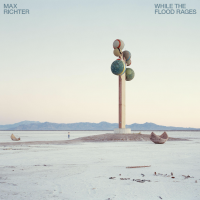
And quite a perturbed one at that. As with Infra, we do not receive the full ballet score but an anastylosis, with new pieces written to fill in for the transitions that worked for the stage but would not necessarily benefit a listening party. While The Flood Rages (Decca, 2026) embroiders itself with vivid imagery from Atwood without explicitly referring to the text, even though the musician never shied away from having voice actors read passages from Franz Kafka, Czesław Miłosz (both on The Blue Notebooks), or Virginia Woolf (Three Worlds: Music From Woolf Works (Deutsche Grammophon, 2017)). Instead, it is the post-apocalyptic landscape of a "waterless flood" on the cover, a brush between organic and industrial samples, and the tightrope connecting woodwinds with manipulated gunfire clips that envelop the audience within the tale. Here is a 21st-century requiem for times out of joint and a humanity caught up in recursive loops of its past mistakes.
But Richter digests Atwood's environmental activism organically. Like the ballet, the record begins with a beach scene ("Wave After Wave"). "While the Flood Rages" has been endowed with enough main-theme capacity to stand out as the recurring motif. The lone piano and a persistent phrase played on the violin give it a solemn if apprehensive air. "The City Was a Chaos" sets the scene with a reverberating metallic snippet for a mild Einstürzende Neubauten impersonation, recalling the early-1990s industrial sound, just before the string section's attack. The electronic backbeat never leaves the scene, turning the composition into a compact film score in which a burlesque City Symphony struggles with machine repetition. Imagine Paul Auster's In the Country of Last Things (1987), adapted by Tim Burton and sandwiched between the two Batman movies—given the level of cartoonish evocationism. And does not "Quiet" almost sound like a refitting of Kraftwerk's "Neon Lights" for a cushioned living room?
The bucolic "Tell the Bees" opens with the sound of insects, taken over by acoustic guitar strumming, followed by a gentle string townscape with bells. Buzzing bees are fended off by data ballistics in a portentous tech thriller that could still make it onto an Underworld mixtape. Palestrina tames the urban throbbing on "Oh Let Me Not Be Proud," yet relaxes his grasp on "A Sweet Air," which reprises the comforting "Sensorium." Unlike In a Landscape, this record's fluctuations clamor for attention. Anodyne Sleep "outtakes" are undermined by harsh beats. Together, they loosen this album's flooded-in soil.
Witold Lutosławski's ghostly choirs are brought in to great effect in the third act ("Amniotic"). In this company, "Dawn" seems culled straight out of the academic playbook, reflecting on past illustrations of sunrise with its build-up, from Edvard Grieg's "Morning Mood" in the Peer Gynt Suite to Benjamin Britten's "Dawn" from Four Sea Interludes. Richter operates effortlessly, as much on the domestic scale ("Quiet") as on the cosmic ("Background Radiation"), yet the whole record slouches toward the cathartic "Now We Can Sing," whose grand theme strives for "On the Nature of Daylight" and other Spotify favorites, lending the 11-minute-plus composition a brawny, unequivocally majestic bearing, with slight glimpses of Johann Pachelbel's Canon in D. A closing-credits sequence in full color.
Still, nostalgia's sweep, previously reinforced by quotes from Kafka and Haruki Murakami, is almost untraceable on the new Decca double LP. While the Flood Rages is suffused with an intensified dramaturgy and a broadened vocabulary. Even without the source text, its central conflict between the natural world and capitalist progress is well articulated, turning it into an implicit parable for a collapsing society harrowed by runaway technocracy and grieving over the habitat driven into ruin. For this occasion, an audio storybook to place between the 24 postcards and the cure for sleeplessness.
 FOLLOW Maciej Stasiowski
and get notified whenever a new article published.
A jazzophile, although open to all sort of cross-pollinations with rock, ambient, new classical.
Track Listing
Wave After Wave; Their Eerie Music; While The Flood Rages; The City Was A Chaos; Sensorium; Quiet; Tell The Bees; Data Ballistics; O Let Me Not Be Proud; A Sweet Air; Amniotic; Dawn; Background Radiation; My Body Is My Earthly Ark; Now We Can Sing;
Personnel

Max Richter
keyboardsNigel Short
pianoMatthew Lynch
pianoLouisa Fuller
violinNatalia Bonner
violinJohn Metcalfe
violaIan Burdge
cello
John Parricelli
guitar, electricEloisa-Fleur Thom
violinAlbum information
Title: While The Flood Rages | Year Released: 2026 | Record Label: Decca Records
About Max Richter
Tags
PREVIOUS / NEXT
Become a Sustaining Member

Since 1995, All About Jazz has championed jazz as an art form and supported the musicians who create it. Over three decades, it has grown into one of the world's leading jazz resources, serving hundreds of thousands of readers, musicians, presenters and industry professionals each month.
Help Build the Future of All About Jazz
Your support helps us continue building All About Jazz for the next generation—expanding our editorial coverage, preserving jazz history, developing new community features and creating better ways to discover the music and the people behind it.
Become a sustaining member for as little as $20 per year and you'll immediately enjoy an ad-free experience along with access to subscriber features and future articles for a full year.
Together, we're not simply sustaining All About Jazz—we're building its future. Thank you for being part of the journey.