Home » Jazz Articles » Live Review » Floating with Emile Parisien at 1000jazz 2026
Floating with Emile Parisien at 1000jazz 2026
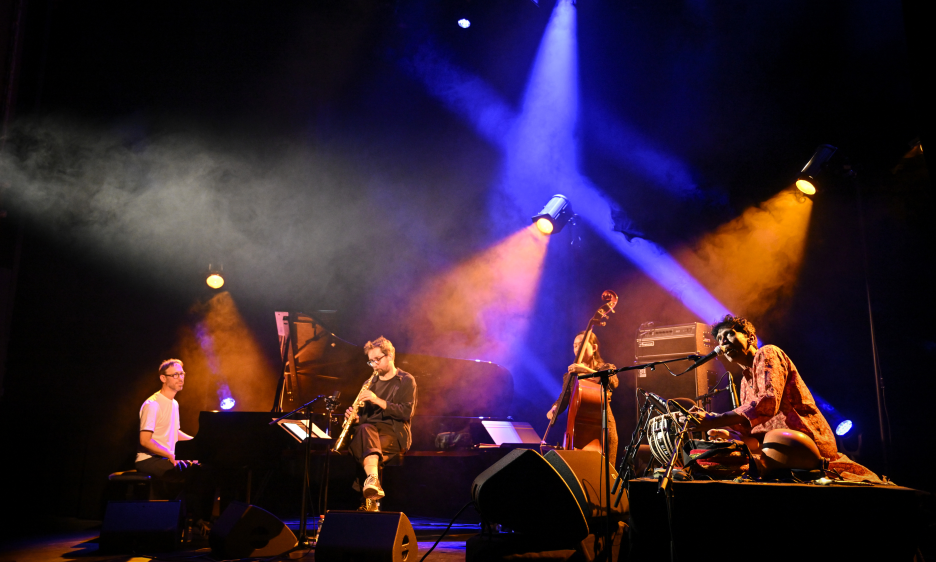
Courtesy 1000jazz/Xavier Voirol
Théâtre de l'heure bleue
1000Jazz, Third Edition
La Chaux-de-Fonds, Switzerland
October 25, 2026
"If you did not like this, the record is really different!" quips Emile Parisien in a mock-desperate attempt to promote Floating (ACT Music, 2026), released the month before (reviewed by AAJ). Fair enough, but what if we did like?
It is true that the concert ran almost twice as long as the digital and CD editions, which themselves include two more tracks than the vinyl.
1000Jazz
The concert was the last of the 2026 1000Jazz festival, the third edition of this biennial event. Since 2019, the region had been without the Auvernier Jazz festival. In the eponymous village on Lake Neuchâtel, financial woes and then the COVID-19 pandemic had knocked the festival flat. Nature abhors a vacuum, in Switzerland as elsewhere.Thus 1000Jazz was born in La Chaux-de-Fonds, in the Swiss Jura, near the French border, with the support of numerous sponsors, a sign that the festival's appeal extends beyond the small circle of a few dedicated enthusiasts.
The 1000Jazz lineup was bold, presenting contemporary jazz performed by musicians based within relatively easy reach (Switzerland, France), yet with a distinctly international flavor. The festival set out to bring jazz to people who think they do not like it. The Théâtre de l'heure bleue is an Italian-style theater with more than 500 seats, and it seemed well filled.
One might remain unimpressed by the figure of 1,100 to 1,200 people for the 2026 edition. But this is not the number of tickets sold, and the goal for the first edition was set at 600 to 1,000 people, while the second edition drew fewer than 1,000: the momentum is positive. Let us not forget, either, that we are in the middle of the Jura Mountains, where humans account for only 48% of the large mammals; nobody knows how many cows, horses, sheep, pigs, and goats attended.
Floating above the borders
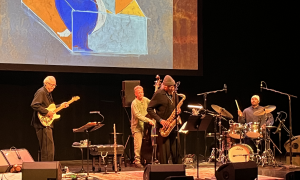
The international and diverse character of the festival was wonderfully illustrated by the band that Parisien (soprano saxophone) had assembled for the Floating album tour. It featured Yaron Herman (piano), an Israeli musician who long ago unpacked his bags in France; Linda May Han Oh (bass), born in Malaysia, raised in Australia, and now an associate professor at Berklee; and Prabhu Edouard (percussion, tabla, vocals), a Parisian musically trained in North India.Why do the first notes from Parisien's saxophone always seem to change the color of the world? The stage lighting, particularly well done, undoubtedly helped. But Monty Alexander said a few weeks earlier: "When you play music, you are not giving a concert. You play so that people feel good," and there we are.
Parisien was born hard of hearing, and perhaps the power of his music has something to do with the energy he devoted to overcoming the limits set by fate, channeled into absolute musicality.
Floating (meaning "above the borders," says Edouard) began as a one-off, accidental project at the Cité Internationale Universitaire de Paris (an international university campus). With it, Parisien set out to create calming music with this outstanding band.
The concert opened with "66," a composition by Parisien, introduced here by a soprano solo. Parisien took the audience aboard right away, into the shimmering atmosphere of his long, spiraling phrases, which gradually reached the far ends of the melody. And indeed, the album is very different: it has no introductory solo, and "66" is not even on the vinyl.
"Bonbon" featured Herman's first piano solo, but there were more to come; above all, it highlighted Edouard's percussion and tabla throughout the piece, even without a dedicated solo. The tune raises the question of the place of percussion in an ensemble compared with the drums. In a fundamentally jazz-based ensemble like this one, percussion often reinforces the drums, adding a coloring, a scent, an accent. Here, the drive became lighter and allowed the music to soar higher.
"Olive Branch" was the first of Herman's compositions to be played during the concert. The pieces were written specifically for the Floating project with, he says, the idea of creating songs that would stay in people's heads for a long time. "Olive Branch," a symbol of peace, is a composition whose melody sits comfortably in several musical traditions: European, Middle Eastern, and even, according to Edouard, Indian.
This melodic insistence found an echo in the improvisation Herman delivered on this piece, and even more so in "Badhra." There, Herman, with his sense of structure and total melodic control, became particularly Keith Jarrett-like, right down to his piano touch and the repetitive bass motif, though without the master's vocalizations. "Badhra" is a composition by Anouar Brahem, by now quite an old one, released on Thimar (ECM Records, 1998) and brought into the Floating repertoire by Parisien. It is a theme of particular importance to him, first because he was drawn to its melody and its joyful and sad character, which give it a particular atmosphere. But perhaps it matters even more because of John Surman's playing on Thimar, whose legacy he acknowledges in part. The Floating band provided a welcoming context for this composition: Oh's deeply anchored bass, ideally served by Edouard's Eastern percussion.
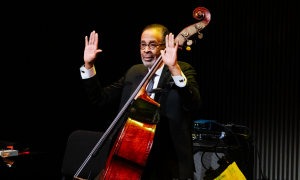
"Badhra" was preceded by a long unaccompanied bass solo by Oh, "As It Comes and as It Goes," composed by Parisien (and absent from the vinyl). On stage, we discovered the musician whose name has been circulating around the globe for almost a decade. Her sound can be defined in three words: fluid, melodic, and agile, its rhythm occasionally punctuated by percussion on the body of the instrument. The melodies traveled evenly across the whole range of the bass, with no attempt to impress through extreme feats of virtuosity. The miracle of the concert was hearing Oh converse with her bass twice as long as on the album.
"El Toro," another composition by Herman, is a very rhythmic piece in which Edouard's Indian recitation technique was brought to the fore, framing a passage of collective improvisation in the form of a soothing drift.
The next tune was No. 40 from Gurdjieff's "Asian Songs & Rhythms," another opportunity, always welcome, to hear an unaccompanied solo by Parisien.
"Portal," composed by Herman and Parisien, is a piece dedicated to Michel Portal, who passed away eight months earlier and with whom both musicians had played. Edouard was also a friend of his. Portal was always a mind on the lookout for new experiences. He occupied an immense place in European jazz for more than half a century (Echoes of a Master), as comfortable with free jazz and traditional music as with Mozart (on clarinet). As might be expected, "Portal" is a fast, very melodic piece in a minor mode that is, to put it plainly, possessed, just as Portal himself could be when improvising. Edouard and Parisien thus cut loose while Herman and Oh held down the groove.
"Portal" was supposed to close the concert, but the standing ovation that followed drew an encore. It was "Nusrat," a composition by Herman whose structure, drive, and funky groove, carried by the two soloists, Herman first and then Parisien, evoked the qawwali master Nusrat Fateh Ali Khan. Khan was a leading performer of Sufi devotional music, brought to fame in the West by "Mustt Mustt," a fusion track released on Peter Gabriel's Real World label.
A second standing ovation, and a second encore: "Arco," played as a duo by Herman and Parisien, a meditative, soothing piece, and therefore very much in keeping with the peaceful spirit of the project, if perhaps slightly sad.
The audience was undeniably delighted, as the two ovations showed, and even more so after the announcement that the bar upstairs would stay open for quite a while longer.
A success, then, for the closing night of the third edition of 1000Jazz, run by a humorous, enthusiastic, helpful, and efficient team of volunteers.
But the final pieces played cast a shadow over these strange times. Portal is gone. He was a fragment of European jazz history at its most alive, energetic, and incisive, curious and generous, embodying the urgency of playing in the moment. Khan, who died at 48, barely half Portal's age, had the same voracious appetite for playing, perhaps even more so, to the point of neglecting his health, with tragic consequences. Two very different figures, iconic musicians whose lives were devoted to relentlessly creating beauty and happiness.
"Mustt Mustt" translates as "Lost in His Work." What lessons can these departed giants teach us today? What price must be paid for art? In any case, that evening, beauty floated above the borders and, with its "Olive Branch," brought peace.
 FOLLOW Daniel Mège
and get notified whenever a new article published.
Scientists search by day, musicians find by night.
PREVIOUS / NEXT

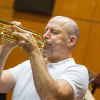
About Emile Parisien
Tags
Emile Parisien Concerts

Become a Sustaining Member

Since 1995, All About Jazz has championed jazz as an art form and supported the musicians who create it. Over three decades, it has grown into one of the world's leading jazz resources, serving hundreds of thousands of readers, musicians, presenters and industry professionals each month.
Help Build the Future of All About Jazz
Your support helps us continue building All About Jazz for the next generation—expanding our editorial coverage, preserving jazz history, developing new community features and creating better ways to discover the music and the people behind it.
Become a sustaining member for as little as $20 per year and you'll immediately enjoy an ad-free experience along with access to subscriber features and future articles for a full year.
Together, we're not simply sustaining All About Jazz—we're building its future. Thank you for being part of the journey.