Home » Jazz Articles » Live Review » The Charles Lloyd Quartet at the New Jersey Performing Arts Center
The Charles Lloyd Quartet at the New Jersey Performing Arts Center
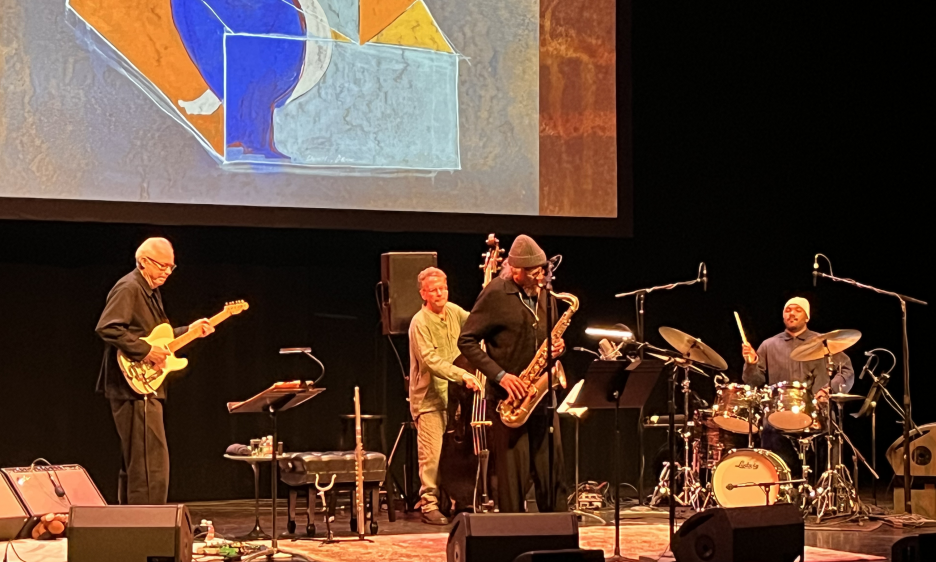
Courtesy Paul Reynolds
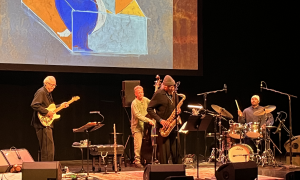
The 90-minute set was spacious and mostly serene, making it a perfect fit for a weekend matinee event.
The New Jersey Performing Arts Center
TD James Moody Jazz Festival
Newark, NJ
November 21, 2026
To be at the Victoria Theater at the New Jersey Performing Arts Center on Saturday afternoon was to see an artist transported by the music he and his colleagues were making.
During his entrancing—at times, almost trancelike—set, 88-year-old Charles Lloyd was a charismatic figure. He would dance, albeit gently and carefully, as his trio played. Dressed in shamanlike clothing, he occasionally punctuated his soft-shoe shuffling with arm poses, seemingly drawn from Tai Chi or another of the martial arts. At other times, following one of his own solos. he sat at center stage, following the music closely and smiling or even emitting a chuckle in acknowledgment of an especially deft or surprising solo turn from another member of the group.
As the tenor player and flutist enters his seventh decade as a performer, Lloyd's longevity and vitality is aided by a style that is less intense, and so perhaps less physically demanding, than most tenorists. On Saturday, his solos naturally reflected some of the hard bop influences of a tenor player who came of age in the early 1960s. But, as usual, Lloyd eschewed harshness or aggression, instead sustaining a warm, burbling and conversational approach. He is that rare tenor player whose playing never jars, yet also consistently engages with its diverse flow of ideas and influences—from modal jazz to blues to flashes of avant-garde dissonance.
His playing was more approachable still—and yet, similarly, never predictable— when playing flute, as he did for several pieces within the 90-minute set.
Plenty of veteran players—think Sonny Rollins, as one example—spend their final decades on stage with accompanists that are relatively unvarying. Lloyd takes a different tack, with no one primary ensemblle. He does work fairly consistently with select sidemen, including Larry Grenadier, who joined him at the NJPAC event. (It's easy to see why Lloyd favors this bassist, who on Saturday matched Lloyd's willingness to leave space in the sound, never overstuffing his bass lines, and yet sustained a gentle pulse as needed, in a rich and woody tone that suited the set's chamberlike air.)
Otherwise, Lloyd favors a host of occasional collaborators that rotate in and out of his ensembles—of late, mostly quartets but also occasional trios, quintets, and even duos. The rotations presumably provide him with the challenge and stimulation of varying musical contexts and approaches.
The two other band members on Saturday were drawn from this contingent. No pianist was present, even though Lloyd frequently favors a piano trio, typically featuring Gerald Clayton or, as in a 2025 New York double bill of Charles Lloyd and Branford Marsalis at The Blue Note Jazz Festival, his Blue Sky Quartet, featuring Jason Moran.
Lloyd has a long history of working with guitarists too, dating back to his seminal days in the early 1960s as a member of the Chico Hamilton Quintet, which included the Hungarian guitarist Gábor Szabó. Saturday saw Lloyd working with occasional six-string collaborator Bill Frisell. Always a subtle and customarily quiet player, the guitarist's contributions were more ethereal even than usual at NJPAC, framing Lloyd's solos within pillows of chords and occasional echoes of the leader's lines. Frisell's presence helped steer the set even further toward a spacious serenity—making it a perfect fit for a weekend afternoon.
It's easy for a drummer to overplay in such a musical setting, yet Kweku Sumbry never did. His style is unique, much influenced by his unusual grounding in the drumming of Ghana and Nigeria (he doubles as the artistic director of a West African drum-and-dance troupe in his native District of Columbia). For much of the set, Sumbry sustained a pulse that was restrained in volume, with occasional loud punctuations—including snare drum cracks and spirited cymbal crashes. His mid-set solo, played alone, was a marvel of polyrhythmic invention that never leaned on loudness to sustain attention.
The crowd included vocal Lloyd aficionados and, for his encore, the tenorist acceded to calls to play "Forest Flower," the lilting composition that's been a mainstay of his repertoire since his earliest years as a leader in the early 1960s. His warm reading was a fitting conclusion to a set that felt as much a celebration of Lloyd as a generous, continuing presence as it was of the man's music.
 FOLLOW Paul Reynolds
and get notified whenever a new article published.
Journalist and programmer in jazz, folk, country and other musics
PREVIOUS / NEXT

About Charles Lloyd
Tags
Become a Sustaining Member

Since 1995, All About Jazz has championed jazz as an art form and supported the musicians who create it. Over three decades, it has grown into one of the world's leading jazz resources, serving hundreds of thousands of readers, musicians, presenters and industry professionals each month.
Help Build the Future of All About Jazz
Your support helps us continue building All About Jazz for the next generation—expanding our editorial coverage, preserving jazz history, developing new community features and creating better ways to discover the music and the people behind it.
Become a sustaining member for as little as $20 per year and you'll immediately enjoy an ad-free experience along with access to subscriber features and future articles for a full year.
Together, we're not simply sustaining All About Jazz—we're building its future. Thank you for being part of the journey.