Home » Jazz Articles » Live Review » Jazzfest Berlin 2026
Jazzfest Berlin 2026
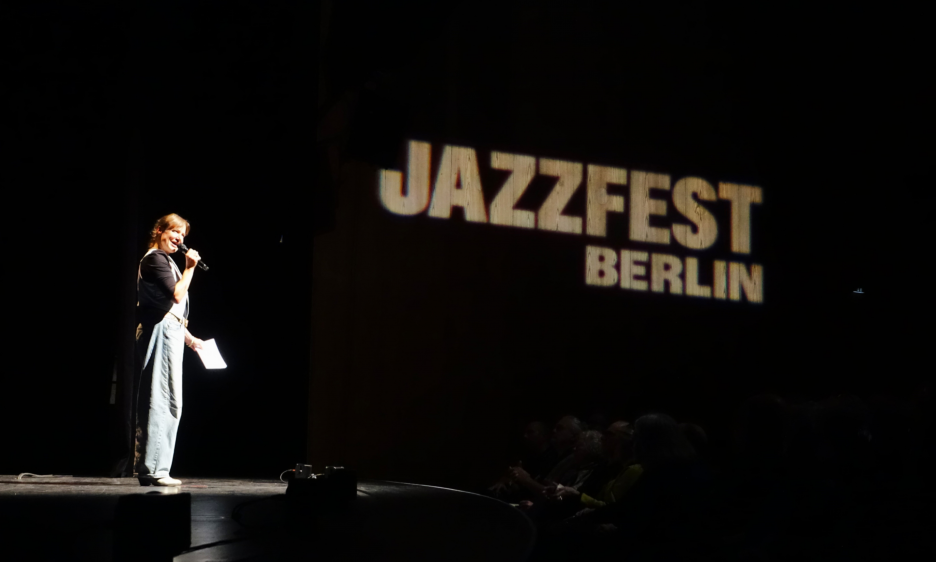
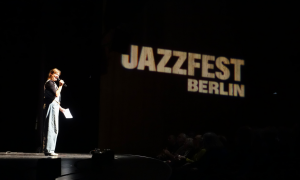
Courtesy John Sharpe
The combination of adventurous programming, excellent sound, outstanding venues and meaningful community engagement makes Jazzfest Berlin a compelling model for what an international jazz festival can achieve.
Haus der Berliner Festspiele
Germany
October 29-November 1, 2026
Intro
Jazzfest Berlin remains one of the world's most prestigious jazz festivals. It brings together historical continuity, contemporary experimentation, international collaboration and community engagement, while retaining a substantial audience.The 2026 edition maintained that breadth, presenting 135 musicians from more than 25 countries in 23 concerts, several featuring world or European premieres. Among the highlights were landmark appearances by the Globe Unity Orchestra and Anthony Braxton's Septet. Alongside them were established working groups including Otomo Yoshihide's New Jazz Quintet, Chicago Underground Duo and Ingebrigt Håker Flaten's (Exit) Knarr, as well as adventurous large-ensemble projects led by Camila Nebbia and Alexander Hawkins.
Most concerts took place at Haus der Berliner Festspiele, with additional shows in nearby clubs and the iconic Kaiser Wilhelm Memorial Church. Simultaneous programming across multiple venues made comprehensive coverage impossible, requiring some devilish choices. Film screenings and participatory community events involving festival artists in the ethnically diverse district of Moabit further expanded the dimensions of an already ambitious program. The result was a festival whose reach extended well beyond the concert hall.
Globe Unity Orchestra
Almost 60 years ago to the day, the Globe Unity Orchestra's debut at the Berlin Jazztage (the predecessor of the Jazzfest) under the leadership of pianist Alexander von Schlippenbach signaled a major upheaval in European jazz. It pulled together fresh voices from across the continent. Few of the original cohort survive: Schlippenbach apart, the only other founder member on hand was trumpeter Manfred Schoof. Joining them were luminaries from later incarnations including English saxophonist Evan Parker, drummer Paul Lytton and American trombonist George Lewis (more commonly heard as a composer and electronicist these days), alongside stalwarts of the contemporary German scene.The single work—titled "Apokalyptische Nabelschau" (which translates as "Apocalyptic Navelgazing"), a phrase used in a contemporary review that panned the 1966 concert—was a structured improvisation based on a graphic score. It set up a string of features for everyone in the 15-strong ensemble, sometimes overlapping, sometimes unaccompanied, separated by multi-hued orchestral tutti or smaller subsets. These included the annunciatory trumpet trio which introduced a tender ballad duet between Schoof and the pianist. Schlippenbach's partner Aki Takase shared the bench for some delightful four-handed pianistics and also took on some of the conducting duties.
Parker's soprano saxophone was the first to emerge from the throng, characteristically serpentine, coiling ever tighter around itself in a nonstop outpouring. Other striking contributions came from Lewis, alternately woozy and stuttering, trumpeter Axel Dorner, Rudi Mahall mischievously squawking on bass clarinet, and trombonist Christof Thewes expressively exploiting a mute. Despite its rambunctious energy, the performance never lost its structural focus.
At the final event on the main festival stage, a palpable sense of occasion persisted. This might be the last time this fellowship gathers. Indeed, the music garnered a deserved standing ovation—the only one of the entire four days.
Anthony Braxton Septet
Saxophonist and composer Braxton's participation generated similar historic echoes. He first entered the spotlight here in 1976, as partly documented on The Montreux/Berlin Concerts (Arista, 1977). Now half a century later, he returned with a septet comprising four saxophones and three tubas to debut "Composition 447," the first example of what Braxton terms "Air Music." As alto saxophonist Silke Eberhard revealed in the pre-concert talk, she received the 117 pages of the score two weeks beforehand. Neither she nor regular Braxton collaborator saxophonist James Fei had any inkling of what lay behind the new system, but fellow panelist pianist Hawkins offered a potentially illuminating anecdote. Touring with Braxton a few years before, he had exited a flight to be accosted by Braxton enthusing about modulations in airplane engine noise. Air music perhaps? Although there was no indication this was the actual inspiration, it illustrated Braxton's openness to deriving potential from the most unlikely source.Fortunately, the performance was far more nuanced, although series of atmospheric, overlain long tones regularly occurred during the undulating chamber drift, while Braxton's electronics supplied a crackling, whistling underpinning. As Braxton guided the group through the score, brief improvisatory pockets constantly surfaced between the gaunt unisons and garrulous fluttering. It was impossible to know if some of the intermittent percolating suspensions were due to unfamiliarity, or purposefully notated. Braxton largely confined himself to conduction, only taking up his soprano saxophone for a couple of brief flurries. Identities were largely subsumed, so it took a while for the personalities of the other performers to assert themselves.
Unsurprisingly, Fei's experience with Braxton's oeuvre meant that he imposed himself most fully, his strangulated shrieks on soprano and sopranino saxophones particularly characterful. Taking their lead from him, Anna Webber's gruff tenor saxophone overtones and Eberhard's switches from sunshine to squalls became more prominent, as did the deep throb of tubaist Berlinde Deman and the bucket-muted chunterings of fellow low brass specialist Matthew Bookert. Finally, after a period when he sat down and ceased conduction, during which the music proceeded unabated, Braxton cued an emphatic ending to enthusiastic applause.
It wasn't the end of his involvement in the festival, though. During the preceding week he coached a student ensemble from the Berlin Jazz Institute through an earlier work—"Composition 151," dating back to 1990. The final presentation the next day coincided with other concerts, but by all accounts proved a tremendous success and a transformative experience for many of those taking part, some of whom had never heard of Braxton at the outset.
Otomo Yoshihide's New Jazz Quintet
Japanese guitarist Otomo's New Jazz Quintet played a blistering mix of anthemic themes and all-out skronk. Although regular trombonist Imagome Osamu was absent, Berlin-based US transplant saxophonist Chris Pitsiokos ensured he wasn't missed. In an otherwise unchanged lineup, drummer Yoshigaki Yasuhiro's amalgam of disjointed bombastic tattoos and astute use of space powered the ensemble to ever greater heights, alongside bassist Hiroaki Mizutani, who furnished an unobtrusive but sturdy foundation. In the front line, trumpeter Shinpei Ruike interweaved fiery gobbets with Pitsiokos' choked gusts. The leader scrubbed at his fretboard, assaulted his guitar with a metal "U"-bend, and sometimes even picked the strings, weaving a formidable tapestry of noise, feedback and lyricism. But for all his bravura antics, Otomo demonstrated his love for a good song and the jazz canon in his selection of material. This included Chilean singer Victor Jara's "El Derecho De Vivir En Paz," Eric Dolphy's "Straight Up And Down" and Albert Ayler's "Ghosts" among other pieces. But he seldom kept to the straight and narrow.For the encore, Otomo responded to an audience request for Jim O'Rourke's "Eureka." It was a great choice. He picked out the lovely folky theme, whistling it at the same time, accompanied only by Mizutani's bowing. Yoshigaki inserted rustles and clatter. At each reiteration everyone got increasingly worked up. Trumpet and saxophone delivered the serene melody, as Otomo ferociously scraped his guitar. Feverish drum explosions became more frequent. As the volume and intensity inexorably rose, you wondered how much longer this could be sustained. Longer than you could ever imagine, it turned out, until calm gradually prevailed, the tune continuing until everyone eventually stopped. Then it was the turn of those listening to erupt. Awesome.
Ingebrigt Håker Flaten's (Exit) Knarr
Norwegian bassist Håker Flaten's (Exit) Knarr Septet also combined riffing themes with unruly spirit and energetic purpose in a near unbroken set from the Quasimodo club. Placement of Olaf Olsen's drums front and center of the bandstand, flanked by the leader's bass and Marta Warelis' piano, signaled intent from the off, with horns and guitars massed to the rear. Håker Flaten's sweat-soaked brow bore testament to the supercharged pulse, but having packed his band with disruptors, he also granted liberty for more textural exchanges: churning guitars, bat-bothering saxophonics and wayward piano excursions.Warelis grasped the opportunities with both hands, displaying close control whether marauding along the keyboard, hammering out close intervals or in animated dialogue. Amalie Dahl's alto saxophone also impressed, both alone and in incendiary tandem with Karl Hjalmar Nyberg's tenor. Guitarists Karl Bjorå and Jonathan Horne worked to give each other room, with the former especially flitting surefootedly around the latter's smears and FX. The band made cutting between composed elements and freedom seem a decision in the moment, something organic and natural.
Large Ensembles
Pianist Hawkins presented some of the cream of younger UK improvisers with colleagues from Berlin and elsewhere in what he termed "Willow Music." The realization eased between big-band sonorities and something more democratic, and occasionally even anarchic. Snappy tunes that recalled Ornette Coleman, and even Braxton in post-bop mode, veered in and out of polyphony over staggered cadences. Hawkins divided himself between conducting from the front and time on the piano stool, where his interventions were typically razor-sharp. All the soloists were gripping, but Marco Colonna's sinuous clarinet, George Crowley's driving tenor saxophone, and Charlotte Keeffe's trumpet splutters, bleats and slurs especially caught the ear. So did German trombonist Matthias Müller, who fashioned a wonderfully cogent unaccompanied statement from bustling chortles, warm multiphonics and percussive rattling on the bell of his horn. However, the most memorable number featured Hawkins alone at the keyboard, setting somber halting chords in silence, before being enveloped in an elegiac woodwind chorale.Berlin-based Argentinean saxophonist Nebbia premiered a ten-piece large ensemble, guiding them through a multifaceted audiovisual work inspired by her maternal great-grandfather's memoir of his migration from Lebanon to South America. She charted a path between dense timbral swirls, incisive unisons, angular string counterlines, and wistful floating melodies in a captivating journey interrupted by only sporadic lulls. This was largely a group music, although the blend of extemporization and notation included scope for individual expression. In one of several solos, Nebbia navigated a middle register of staccato leaps, chiseled shapes and skittery flickers before leading smoothly into a big-band line. Later trombonist Weston Olencki came to the fore, all plosives, exhalations and brays over the eddying vortex of Joanna Mattrey's viola, Julia Bilat's cello and Kit Downes' organ, while guitarist Arne Braun smoldered atop slinky patterns traced by drummer Lesley Mok.
The Chicago Underground Duo
Trumpeter Rob Mazurek and drummer Chad Taylor performed material from their Hyperglyph (International Anthem, 2025) album. Mazurek supplemented his brass with synths, voice and percussion, leading to a group sound which belied the numbers. Mazurek prowled the stage, increasing their physical imprint too, while a black-and-white abstract back projection added yet further visual presence. Taylor's panoply of rhythms, accomplished with hands, sticks, mallets or mbira, guaranteed an expansive sonic landscape, whether embroidering the synth bass and percussion tapes or relaying an uncluttered barrage alone. Mazurek's poised trumpet exhortations at times evoked his mentor Bill Dixon in their placement and gravitas, and the whole set possessed a ritual feel to it.Tomeka Reid Quartet
After more than ten years of existence, cellist Tomeka Reid's Quartet resembled a finely tuned machine. All the parts interlocked superbly, and it purred effortlessly through charts from the band's fourth outing Dance! Skip! Hop! (OOYH, 2026). Huddled in an intimate central conclave, they exuded finesse, epitomized by the simultaneous infectious bounce and tightness of the title track from the album. Drummer Tomas Fujiwara set up an elegantly brushed groove, over which Reid and guitarist Mary Halvorson traded theme and variation. Then all broke free, Halvorson intermittently hinting at the head amid the chaos, before Fujiwara reinstated order.Such dynamic switchbacks animated the set. On one piece, bassist Jason Roebke rubbed a cassette player on his strings while Fujiwara mined percussive texture, before they cohered into a kinetic vamp. On the dreamy "Under The Aurora Sky," Reid's cello suggested the logic of a Bach sonata, before unleashing a maelstrom of FX. Throughout, there was a joyous feel of a band exalting in both the material and what they could do with it.
Amir ElSaffar's New Quartet
Chicago-born trumpeter Amir ElSaffar's New Quartet fashioned some of the repertoire showcased on its acclaimed New Quartet Live At Pierre Boulez Saal (Maqam, 2025) into an unbroken suite. With an instrument tuned outside the tempered Western scale, Greek pianist Tania Giannouli's microtonality complemented ElSaffar's command of Arabic maqam modes, lending the music a distinctive air. ElSaffar marshaled his resources to orchestral effect, coloring with electronic washes, evocative vocal incantations and the santur—a type of hammered dulcimer. In the absence of a bass, Fujiwara's savvy momentum in consort with the pianist's left-hand gravity anchored the forceful rhythms, creating a platform for the loosely entwined horns of Ole Mathisen and ElSaffar. Their well-honed interplay surged and receded like the tide, conjuring realms variously brooding, mysterious and ultimately ecstatic.Georg Graewe Trio
Vienna-based German pianist Georg Graewe reunited the livewire trio with drummer Hamid Drake and bassist Brad Jones, responsible for More Than Anything (Random Acoustics, 2025) in a fast-flowing exhibition of collective invention. Graewe refracted both the post-Cecil Taylor avant-garde and classical maneuvers through an improvisatory lens to create something unmistakably personal. He juxtaposed Morse-coded attacks, florid Bud Powell-like runs and fitful scampers. Drake constantly flexed time to knit Graewe's shifts together, affirming their longstanding connection, while Jones often took the contrary route, contrasting unhurried pulsation against hectic dash. The bassist also proved adept at turning the threesome onto new paths. Gestures like a sudden thrum drew a line under the preceding business and allowed a reset in which the three musicians' empathy seemed to grow before our eyes.Elsewhere
Other notable acts included Brazilian drummer Mariá Portugal's EROSÃO Trio, in which the three percussionists startled with their precision and dynamic range alone and in accompaniment to the leader's stark vocals. Immanuel Wilkins' Quartet moved through the gears in a fluent state-of-the-art set, which only hit the heights in the encore. Norwegian singer Karoline Wallace's post-genre quintet at Quasimodo morphed from noise to folk to improv, with saxophonist Signe Emmeluth electrifying. Slightly less engaging, Matthias Muche's BONECRUSHER extracted monumental drones and wavering sound masses from a front line of twelve trombones in the Kaiser Wilhelm Memorial Church, while drummer Christian Lillinger's Open Form For Society II tentet explored microtones and fragmented beats.Outro
Artistic Director Nadin Deventer and her team once again delivered an impressively daring program, with almost every concert sold out. That achievement is all the more remarkable given the festival's willingness to challenge its audience rather than court the lowest common denominator. The combination of adventurous programming, excellent sound, outstanding venues and meaningful community engagement makes Jazzfest Berlin a compelling model for what an international jazz festival can achieve. At a time when cultural institutions face mounting pressures, its commitment to artistic exploration and accessibility is particularly welcome.
 FOLLOW John Sharpe
and get notified whenever a new article published.
John first fell under the spell of free jazz in the 1970s when he wistfully regarded the loft jazz scene from across the Atlantic
About Alexander von Schlippenbach

Tags
PREVIOUS / NEXT
Become a Sustaining Member

Since 1995, All About Jazz has championed jazz as an art form and supported the musicians who create it. Over three decades, it has grown into one of the world's leading jazz resources, serving hundreds of thousands of readers, musicians, presenters and industry professionals each month.
Help Build the Future of All About Jazz
Your support helps us continue building All About Jazz for the next generation—expanding our editorial coverage, preserving jazz history, developing new community features and creating better ways to discover the music and the people behind it.
Become a sustaining member for as little as $20 per year and you'll immediately enjoy an ad-free experience along with access to subscriber features and future articles for a full year.
Together, we're not simply sustaining All About Jazz—we're building its future. Thank you for being part of the journey.
Near

Berlin Concerts