Home » Jazz Articles » Profile » In From the Beginning: New Orleans Music History with De...
In From the Beginning: New Orleans Music History with Deacon John Moore
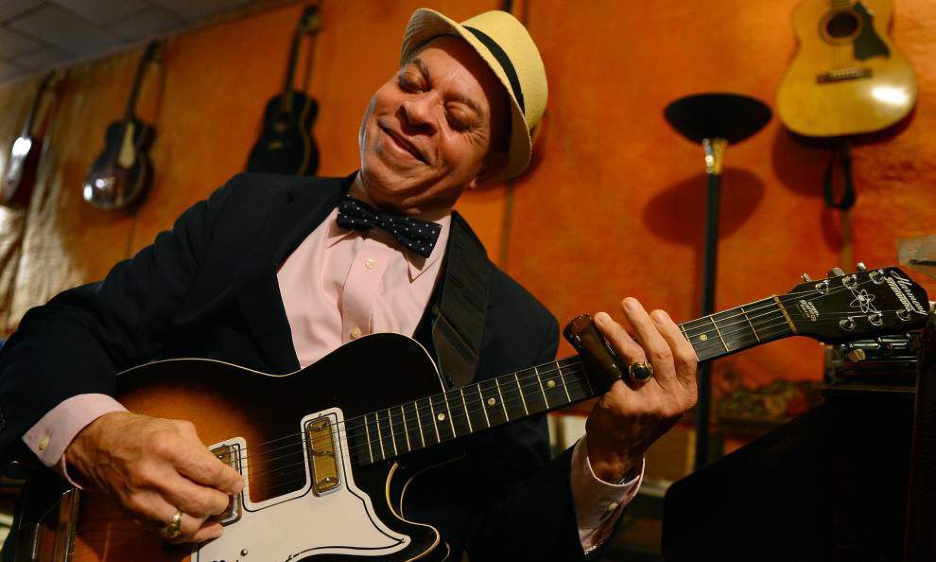
Courtesy nola.com
When I’m home and relaxing, I still listen to what got me started with all this – the roots or foundation of r&b. A tree without roots is dead, man, and while I’m still around, I ain’t gonna let that happen!
—Deacon John Moore
Aside from classical music and opera, my mother liked popular music as well as a little country music too. Like many of her generation, she was not big on rhythm and blues or rock and roll. But after some time, she did learn to love B.B. King. And she adored Satchmo too. I recall taking her and her mother to see Louis Armstrong when he made one of his rare appearances in New Orleans—one of the big thrills of my lifetime.
She remembered all the jazz greats, as her father had been a traditional jazz banjo player who played with many of the greats around town at that time playing locally on weekends. He never travelled to play or anything like that as, by day, he was a "boot black" at a local barbershop downtown. And his wife—my maternal grandmother originally from Zachary, Louisiana—was a domestic, working in white people's kitchens cooking and cleaning, and caring for their children. They lived in poverty but were very religious people.
My mom had it all—brains, beauty and talent too. In spite of all that with 13 kids, her first duties were to the family and taking care of the children. Still, she made the time to sing in the church, and became director of the choir. Still, she made time at the church and after most of us were grown up, she became a church organist and choir director. Additionally she was often asked to sing at wedding receptions as well as church events. She knew many nuns and priests—some of them had been her African American classmates who later joined the Sisters of the Holy Family in New Orleans.
While my father loved music also, and his sister taught toe tap and ballet, founding the very first dance school for creoles in the state of Louisiana. As a dancer herself, many affluent Creole families in New Orleans came under her tutelage including my older sister. So music and entertainment was part of our family from the very beginning.
When I was still in elementary school, I became the principal soloist in the boys choir and for sure the loudest! I sang for a lot of funerals and seasonal church services. Everything was in Latin back then and I knew all the liturgy for the special masses. When they had a funeral going on in the middle of the week and the regular guy was only available on the weekends, they would pull me out of class to sing. I practiced a lot with my mother as when I was a little boy, she would invite her friends over and get me to sing for them while she was playing piano. I was shy, and didn't really like it, but she would give me a nudge of encouragement to continue and get through it.
My father's sister who had the dance school organized the annual revue with all of her students. The program always began with my mother playing piano and me singing; all her friends came on over to watch and listen. Once, when one of her friends gave me a silver dime, I was real happy, thinking to myself "I don't mind singing if I can get paid like this!" The audiences were mostly African Americans and people of color of course, and sometimes I'd be up there singing and they'd start throwing pennies and nickels up on the stage. Afterwards, I'd pick them all up, thinking to myself this was much better than singing with the choir; the altar boys might get tips but not us choirboys!
While in elementary school, I joined a little r&b band but didn't play an instrument. That little band had a guitar, a couple horns and drummer, and we put it all together with me and another classmate singing. We tried to cover some of the top 10 hit records you'd hear on the radio, and played at sock hops, school dances, skating rink parties, picnics or proms. I also entered some talent shows with my mother playing piano and me singing, which I often won.
As my sisters were growing up and going to high school, there were many school dances given to raise money for the church and for the school too. As my mother was so busy and could not find the time to be their chaperone, she told my older sisters, "Take little John with you!" And they did, which was where I first heard and saw live r&b music and those guitar players who all fascinated me. Upon entering the dance hall, I'd run up to the stage, looking up at those guys all night, studying those guitars and how they were playing them.
As it turned out, one of those guitarists was Snooks Eaglin! I could never figure out how a blind guy could play guitar but he could! He'd play the bass line and the chords at the same time as if playing a piano, singing the whole time like Ray Charles. That group was called the Flamingos, and featured Allen Toussaint on the piano too. Another popular local band was The Hawkettes, featuring Art Neville; they were playing around town at that time as well. These were the main bands hired for the black teenage get-togethers, school dances and parties along with Sugar Boy Crawford, Tommy Ridgley and Dave Bartholomew.
I could not take my eyes off those guitar players though; it was what I always wanted to do too. You might say I had a genetic predisposition for stringed instruments as my grandfather was a banjo player, my mother on piano and one of my older sisters played viola and some of my brothers were interested in guitars also. We were literally a family of string players!
Then, of course, like all little boys will do, I figured out how I could hear more of that music. I bought myself a crystal radio with earphones and tuned into WLAC to hear more blues as well as r&b music, some of it introduced by Wolf Man Jack. That station was blasting out of Nashville at the time and everyone throughout the South was probably listening. I heard all these people playin' that early stuff, like Big Mama Thornton singing "Hound Dog" as well as Muddy Waters and Howlin' Wolf—I was simply fascinated by it all.
Around town, people like Shirley and Lee, Roy Brown, Dave Bartholomew and others got air-time on local stations and were actually playing around town too. That was back in early '50s, I was still really young.
We lived in one half of a double "shotgun house" in the city's 8th Ward. Extended family lived in the other half and my cousins would go out to buy 78rpm records and bring them home to play. My family could not afford a record player, but I heard my cousin spinning all sorts of tunes as the walls were so thin in those old shotgun houses at the time. I'd hold up a glass to the wall to amplify the sound and remember hearing all kinds of r&b songs of the day comin' through those walls.
At night, I'd turn out the lights to go to sleep, go get that crystal radio set of mine and tune into regional stations from all over the place that were playing blues and r&b. On the New Orleans stations, I'd also hear local rhythm and blues with lots of disc jockeys including Larry McKinley, Poppa Stoppa, Ernie the Whip, OK Dokey, Groovy Gus Lewis and Jack the Cat, spinnin' all kinds of great tunes. Aside from those guys, too often you'd hear sad imitations of r&b. Instead of playing Little Willie John belting out "Fever," some stations chose to play Pat Boone and Peggy Lee records instead!
When I was in high school, I taught myself how to play from listening to records on the radio, and getting method books from the local music store where you could buy instruments. But most of it came from teaching myself, just listening to the records on the radio, and then you get a little at home learning the chord changes. Most of the rhythm and blues songs share recognizable patterns, as many of the songs are somehow similar.
Then I began meeting not only guys who could play r&b, but ones who were into jazz also. I soon discovered there was a real hierarchy of musicians in town and started hanging with cats like Papoose Nelson and Roy Montrell. I even went over Montrell's house and he'd show me some stuff; he gave lessons to supplement his income earned from playing with Fats. He taught me how to play the hip chords and exactly which method books to buy. I learned more than just the elementary stuff from some of those books he recommended.
I met Justin Adams along with Placide Adams and Gerald Adams—they were top-flight musicians too and got to know a lot of the other really top musicians around town. You'd meet one, then you meet another one, and find out which ones are playing on which records and where they were hanging out. They were traveling and playing with this band or that band, and most had hit records—and would end up showing you stuff that's not in the books.
I liked Les Paul and enjoyed hearing him play accompanied by his wife, Mary Ford on vocals. Then I discovered Mickey Baker, he was the number one guitar session player in New York City who did "Love Is Strange." He produced method books on how to play jazz guitar and was the first guy anyone called for recording sessions, including Ray Charles—one of the hippest cats in New York. I never got to meet him, but learned all sorts of stuff from his method books. I immediately went down to the music store when I could; he produced books for beginners, and advanced players too. He spelled out everything including how to do all the hip chords and changes, how to do the inversions and more. I had to get his books, and get rid of those Mel Bay books.
During my formative years, I discovered Wes Montgomery and upon finally listening to him, I felt like giving up completely. Oh my god—I knew I would never be able to play like him—guitar solos with a block chord solos—he could play anything. I bought his 33rpm records and kept at it, receiving a few pointers from a friend of mine. And wouldn't you know it, pretty soon I was playing something I could imagine was sort of like him!
I looked up to a lot of guys, especially Hubert Sumlin, Howlin' Wolf's guitarist. Along with the guys who played all that Chicago blues stuff, like Muddy Waters, I eventually met some of those cats later on in my career who played on "Sweet Home Chicago" later in my career.
Then Elvis became a big deal, but black people really did not listen to him very much. But you can't get away from him if you grew up in the 50s with the very beginning of rock and roll. Still I preferred Big Mama Thornton's version of "Hound Dog" with Pete "Guitar" Lewis along with Johnny Otis Band. I thought it was the funkiest blues thing I'd heard in my entire life. Then I heard Bill Doggett's "Honky Tonk" with Billy Butler on guitar—my goodness—these guys could play! I tried to learn it note for note—you had to be able to play it in order to get any respect at all. A story I heard goes like this—one night after a gig, Doggett's band members, including Butler, were in a hotel room and started jamming. Doggett passed by that room, heard what they were doing, went back to his room, charted it out and copyrighted it the next day. Over night it became his, not theirs! That's a true story!
Of course, Chuck Berry was another of my heroes, and started out as a blues guitarist with the Johnny Johnson Trio. Later on, Johnny appeared on Berry's hit songs, always featured on piano but few know it was originally his band. "Deep Feeling" was one of my favorite songs, with a sound like a Hawaiian guitar. I always tried to play that but couldn't quite get it; he had a special tuning going on, something I did not realize at the time. Curtis Mayfield did something different with his guitar too, playing with an open F sharp tuning to create his own trademark sound.
Chuck Berry combined blues music with an element of country music, because country music is the white man's blues—that's what Ray Charles said anyway. With Berry's first big hit, "Maybelline," you saw white people clapping their hands, getting up and dancing; white people could identify with that music. With the demise of the big band swing era, and the very beginning of boogie woogie / rock 'n' roll along with the blues, it was perfect timing for rock 'n' roll songs about cars and girls—he was the poet laureate for an entire generation of teenagers!
Aside from writing all those clever songs, he was a smart guy too and figured out to keep his publishing rights. By doing that, he got rich. How else could he afford to buy all those Cadillacs? Dave Bartholomew gave me that same advice long ago. Earl King was another one who talked about that kind of stuff. If you wanted to be a musician and successful, you had to know about the business end of it all because wherever you see fast money come in, there's always going to be a lot of crooks hanging around. Chuck Berry and a few others understood that, right from the beginning.
The evolution of the sound in popular music is interesting. Big Joe Turner singing those songs accompanied by that piano played by Pete Johnson created the first rock and roll sound—a spinoff of the big band sound from the late '30s directly evolving into "jump blues" with an easy transition to full blown rock 'n' roll, rather than tracing its origins to Bill Haley as some people like to do. From boogie-woogie piano, saxophone solos became essential to the music. King Curtis, who played a lot of that stuff, actually copyrighted all his solos and that's how he made even more money!
Here in New Orleans, Allen Toussaint, too, realized that you had to have a strong tenor man in the band. Many of Fats Domino's songs featured saxophone solos by Lee Allen and Herbert Hardesty. And who was the tenor man playing most of them here in town? Melvin Lastie. He ended up taking the lead from King Curtis, copyrighted his solo on the first hit by Barbara George. He was on all those early sessions with Toussaint, which often featured me on guitar.
I played with all those guys including Lastie, Alvin "Red" Tyler and the Gyros{ on baritone sax, Wendell Eugene on slide trombone and Chuck Badie on the upright bass. No one actually ever used an electric bass until Walter Payton came along. Even Toussaint realized that the piano was taking a back seat 'cause as the guitar revolution was just starting, and guitar players suddenly became important to the New Orleans sound too. At that time, Allen started using two or three guitars to sell records, asking Cosimo to turn up the volume on all of them.
I knew all those session players including Melvin Lastie and Harold Battiste who eventually formed AFO Records. They were all tired of playing sessions for white record companies that were making all the money and figured out they could do the same thing for themselves. All the session musicians including Roy Montrell, Harold Battiste, Chuck Badie, Melvin Lastie and John Boudreaux along with Red Tyler were the face of AFO Records and represented it well. By the way, John Boudreaux was my cousin and a damn good drummer too. They came up with their first big hit record, "I Know" by Barbara George, that brought AFO all the fame and fortune. And before her was one by Prince La La, Papoose Nelson's brother—"You Put the Hurt on Me." The second black record company based here in town was NOLA Records, started up by Wardell Quezergue.
The formula for success in the music business had three very distinct parts—you had to have someone write and play the music, one guy with the money to produce it all and finally, you had to have someone to actually play the records on the radio. You had to know a disc jockey and that's how Larry McKinley became important—he played and promoted all the hits comin' out of this town, including Aaron Neville's "Tell It Like It Is." Everyone heard it on the radio first and then went out and bought it.
Joe Banashak followed the same formula for songs on the Minit Records label, with McKinley spinning all those tunes on the radio. Instant Records hired Toussaint to produce their hits, including Chris Kenner's "I Like It Like That," recorded at Cosimo's studio, again passing it on to McKinley to play.
Matassa had the best studio in town; it was really the only studio to record the hits that came out of this town. It all started out with only one track, very primitive by today's standards. But we worked with it, positioning players around the studio and placing baffles in front of certain instruments to get a good sound. It might take all day, but it worked. Of course there were issues with maybe the bass lines bleeding into the drum tracks that might then start bleeding into the vocals. Cosimo got the bright idea to build a booth for the singer, something like a telephone booth and soundproof it. Ernie K-Do would be in that booth, dancin' and singin' and we'd have to stop because the sound of his shoes was bleeding into the mike! Cos had to tell him to stop that dancing, and just stand still and sing! Eventually they graduated to two tracks and the singer would come in alone to lay down the vocal track. Sometimes we actually had no idea who we were playing for as backups!
With the start of multiple tracking, I always felt the spontaneity of a song was compromised even if the finished product was somehow enhanced. When he moved off of Rampart to Camp St with a much larger studio, the music lost some of that magic created by the intimacy of the old studio. Even though it was better and bigger, with multi tracks, the intimacy was gone. Some great songs came out of that studio with me as the 'ghost guitarist,' including "Fortune Teller," "Working in the Coal Mine," (Lee Dorsey), "Ride Your Pony," "It Ain't My Fault" (Smokey Johnson) and the regional hit, "Teasin' You" by Willie T.
This was all going on before the Rampart St. studio had any air conditioners; you'd be sweating your ass off in there. But Cos had a solution—he cut a hole in the wall, placed a tube in there with a big block of ice and had a fan blowing on it from the other side. It was pretty quiet and helped quite a bit but still, if you had a choice, you'd record at night when it was cooler.
I primarily focused on putting together a performing band—people who were around at that time say I had the tightest, most professional performing band in town. But in 1962 I recorded one single with Rip Records, owned by Rip Roberts and a couple more later on with Wand Records. Roberts had a gambling house and was a music promoter too. Wardell Quezergue produced "I Can't Wait" but it went nowhere, even though everyone had high hopes.
Lately I've been thinking—maybe I should try sneaking one of those old songs into one of my shows to see what happens? No one has heard them in years!
The British invasion definitely changed things. The thing I didn't like was it put real r&b in the back seat, even though rhythm and blues was the foundation of their music. They sanitized it and white-washed it with their own take. After that I remember someone telling me about Jimi Hendrix. I had never heard of him before then but I looked him up and listened and soon started playing that British stuff along with some of Hendrix's material too. My friend was right—I crossed over into a whole new market of music fans looking for that "black Beatles band" and my phone started ringing again. Aside from playing The Temptations or James Brown, I could play "A Hard Day's Night," "Satisfaction" and Hendrix—it provided an entirely new avenue for me to make some money, playing frat parties at Tulane, high school proms and more. You can't imagine how many people I know today whose high school proms I played at, people like Johnny Vidacovich, Ben Jaffe and more. If you didn't have hit records and your reputation was based on performances, you had to reinvent yourself to get gigs.
I always tried to have the best musicians, and even had James Booker at one point, but that didn't last too long. He was on his own schedule and did his own thing—his own style of playing—you just had to accept it, take it or leave it. If you're playing a Chuck Berry song, you don't want anybody doing something that didn't fit in.
Aside from not liking to rehearse, more important he sometimes wouldn't even show up for a gig! This was during a time when we had a piano and two guitars with no bass as the upright bass just was not loud enough. You had to detune the first four strings down on one of the electric guitars to make it sound like bass guitar. That was commonly done at the time—there was actually no bass guitar on Art Neville's "Mardi Gras Mambo"! So without Booker showing up for gigs—that was really just too much, and I had to let him go and get somebody else. It's like what Woody Allen is supposed to have said—90% of success is just showing up!
James Rivers is another one from the early days who played with me. He used to be with a band called Robert French and the Continentals but it broke up for some reason and he became available. In those days, to play at certain dance halls, you had to have a 10-piece band, and had to augment it to play certain kinds of gigs. I needed a bigger horn section and had heard him playing with other bands on the same circuit I was—lord, could he blow! With him free to perform with anyone, I asked Rivers to join up and, at the same time, snagged Sam Alcorn too, another one of the best horn players in town.
James started playing harmonica and flute together and could play harp like Jimmy Reed; he would tear the house down! I told him you're too good to be playing with me. He is kind of shy, but finally took my advice and formed the James Rivers Trio. I learned a lot from him over the years and, aside from just being in the band, we became great friends.
James often uses a phrase from ' "I'm Wise"—an Eddie Bo song—to describe what he was up to in the early days: rippin' and runnin' around the country. Little Richard got it from Eddie Bo but changed the title to "Slippin and Slidin." He had a huge record with it when he rocked up the beat, but it still had the same melody. The lyrics sort of typified black English that was used in the 'hood to express certain things.
Slippin' and a slidin,' peepin' and a hidin' I'm so glad I got wise rippin' and a runnin' drinkin' and a funnin' baby I got hip to your jive you slippin' and a slidin' peepin' and a hidin' I caught you in the act last night
Its' about getting hip to a woman who was cheatin' on her man. It's what you do when you're cheatin' on someone, you're rippin' and runnin' to hide yourself. It's a great song featuring David Lastie on the alto sax solo. Little Richard just rocked it up and simplified it a bit too.
James is another one who would hang down at the Dew Drop Inn; everyone did in those days due to segregation. You couldn't go anywhere else! It was one of the few clubs in town where blacks could freely go and enjoy a "floor show." You had to get dressed up for those shows, with a suit and tie, attracted the upper middle class black people as it was a place for the black stars who were traveling through, including people like Otis Redding, Sam Cooke, Ray Charles, and James Brown. The guy who ran it all, Frank Pania, was smart; he had it all together. He'd say to them, "Look, I can put you all up and give you all a job playing some music at my club, and my brother's got a restaurant in the back!"There was even a barbershop / beauty salon attached to the place; it was a one-stop-shop kind of place. A mecca for black culture as a gathering place for anybody who was trying to be somebody, it was where everyone met to hang out, sit in and network with one another. Big time celebrities and politicians used to come around that place too, guys like Adam Clayton Powell and Nat King Cole as well as some movie stars including Robert Mitchum. But he was arrested there; he didn't know it was against the law for a white man to go into a black establishment. The law was called the 'mingling statute' and he was put in jail! Can you believe that?
Only now recognized as an important landmark, the Dew Drop is in the process of being restored and renovated, perhaps to host great musicians once again? We can only hope.
Keeping the races separate was a big deal back in those days though; it was really scary sometimes because you had to worry about the police. They almost killed James "Sugar Boy" Crawford up near Monroe, Louisiana. He got pulled over as some of the musicians had been drinking a bit too much and said something smart to the cops. They knocked him on the head and took him to jail with no immediate medical attention. He had to have a plate put in his skull and was never quite the same after that.
Joe "Mr. Google Eyes" August was another one. He was dating a Bourbon St. stripper and was quite open about it. One night he was arrested as a prowler trying to break into her house, brought to court and got off only because his clothes were hanging in her closet, and how could anyone say he was trying to break into her place—he actually had the key to her front door in his pocket! There were lots of stories like these that never made it into the newspapers at that time.
Earl Turbinton opened up a jazz club down in the Quarter on Decatur St and went out of his way to make sure both white and black musicians were playing, sometimes together too.
Eventually integration actually played a big part in the demise black owned businesses (like with the decline of the Negro Leagues after Jackie Robinson made it with the Dodgers). I saw that happen, 'cause people started exercising new found freedoms, patronizing the white establishments that were denied to them for so long. Suddenly you could go to the Blue Room to hear music. Before that, you couldn't go to Bourbon St and listen to Al Hirt, you couldn't go to this place and that place to eat—it was against the law. But all of a sudden, with the Civil Rights Act of 1964, black people could even go to the Commanders Palace, or anywhere else they might want, maybe thinking to themselves "To hell with the Dew drop, I'm going some place where white people will be waiting on ME!"
Sometimes opportunities are not available to certain people, coming in the wrong place at the wrong time. I like to see true talent make it. That's why I'm so glad James Rivers has done what he's done. He's like me—he's never had a day job either! The first time I met Professor Longhair, he was working in a store, rather than making music and selling records! They'd send him out to run errands to bring food and drinks back to the shop. Now that was a sad scene. Thankfully, Quint Davis gave him an opportunity to become the godfather of New Orleans rhythm of blues—an icon whom we all love. Smokey Johnson is another one who didn't quite get what he was due; that man could play! Sure, Motown got a hold of him but when he left, they figured out they had to have two drummers to fill out what he was doing by himself, he was that good.
Nowadays, I understand what's going on with the music. You gotta look back and see where all this stuff started, how it progressed and integrated with different elements and got to be what it is. Little Richard combined gospel music with blues and came up with rock 'n' roll. In his magic ball, Berry did the same with country music and the blues. Then Aretha combined the church music with rhythm and blues. All this music reflects the history of this country. With the great migration north, music moved from its rural roots to urban centers ... like from picking cotton in the fields off to the bar rooms on the south side of Chicago. Bottom line, if you study and see how all our music came to be, it starts with blues, the legitimate parent of all jazz too. When I'm home and relaxing, I still listen to what got me started with all this—the roots or foundation of r&b. A tree without roots is dead, man, and while I'm still around, I ain't gonna let that happen!
 FOLLOW Thomas Cole
and get notified whenever Thomas has a new article published.
FOLLOW Thomas Cole
and get notified whenever Thomas has a new article published.
A world traveller in the past, and now... an obsessive writer and observer of life.
About Deacon John Moore

Tags
PREVIOUS / NEXT

Become a Sustaining Member

Since 1995, All About Jazz has championed jazz as an art form and supported the musicians who create it. Over three decades, it has grown into one of the world's leading jazz resources, serving hundreds of thousands of readers, musicians, presenters and industry professionals each month.
Help Build the Future of All About Jazz
Your support helps us continue building All About Jazz for the next generation—expanding our editorial coverage, preserving jazz history, developing new community features and creating better ways to discover the music and the people behind it.
Become a sustaining member for as little as $20 per year and you'll immediately enjoy an ad-free experience along with access to subscriber features and future articles for a full year.
Together, we're not simply sustaining All About Jazz—we're building its future. Thank you for being part of the journey.