Home » Jazz Articles » Interview » The Art of Swing: A Conversation with Champian Fulton
The Art of Swing: A Conversation with Champian Fulton
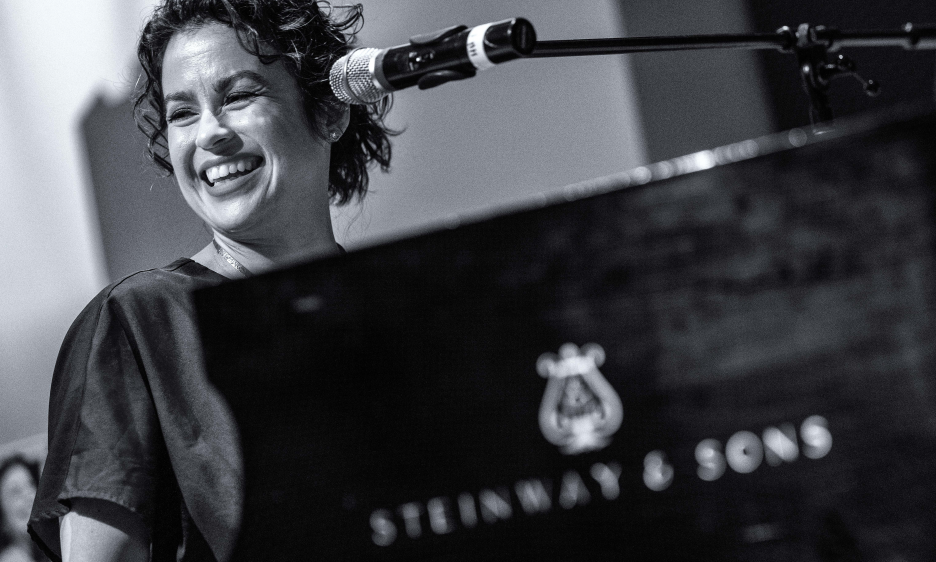
Courtesy Mark Robbins
I vividly remember a girlfriend giving me a Spice Girls cassette when I was in sixth or seventh grade. They had a hit song that I thought was pretty catchy, but once it was over I remember thinking, Okay, now I'll put Duke Ellington back on. I never really wanted to listen to anything else.
—Champian Fulton
Born in Oklahoma, Champian grew up surrounded by music. Her father, jazz trumpeter and educator Stephen Fulton, introduced her to the music at an early age, and that early foundation has grown into an international career. Today, she's a familiar presence on stages around the world, from intimate jazz clubs to major festivals, and her recordings continue to earn praise for their musicianship, warmth, and authenticity.
Champian and I sat down at a local restaurant before her gig with bassist Jimmy Masters, drummer Frank Russo and special guest saxophonist Klas Lindquist to talk about her musical journey, the artists who continue to inspire her, what she looks for when interpreting a standard, and why this music still has so much to say. We also talked about life on the road, recording and what continues to inspire her every time she sits down at the piano.
Champian, it's great to have you. Thanks so much for taking the time to chat.
All About Jazz: Your father, Stephen Fulton, was a wonderful trumpeter and flugelhornist. During the pandemic, it was a real treat watching the two of you perform online together. Were there other musicians in your family?
Champian Fulton: We loved playing together. During the pandemic we released an album called Live From Lockdown, and making that record was a wonderful experience. Music has always been part of my family. My grandmother, Christiana, made her living as a pianist. She was the musical director at her church and also gave private piano lessons, so she was my first teacher before my father took over.
AAJ: Which came first—the piano or singing?
Fulton: We had a piano in the house, and I loved both playing and singing. My father was very insistent that I learn instruments, so I actually started on trumpet and played it all the way through high school. I also tried drums and bass, which I enjoyed, but neither one really drew me in. Piano was different. I liked having complete control over the music and loved its orchestral possibilities. Singing while playing always felt natural to me. My dad would say, "Louis Armstrong sings and plays, too." He was right, but piano was simply the instrument that spoke to me.
AAJ: Do you think of yourself as a singer who plays piano or a pianist who sings?
Fulton: That's a difficult question because the answer changes from day to day. Most of the time I think of myself as a pianist who sings, but there are days when singing feels more important. They represent different sides of my personality.
AAJ: When did you decide this was what you wanted to do?
Fulton: When I was about four years old.
AAJ: Really?
Fulton: (Laughs.) Yes, that was a long time ago. I knew very early on that I wanted to be a musician—specifically a jazz musician—because that's all we listened to at home. I grew up with Count Basie, Dinah Washington, Miles Davis, Duke Ellington and Louis Armstrong. I loved listening to that music and learning about it, so becoming a jazz musician just seemed like the obvious thing to do.
My father was also close friends with Clark Terry. I met Clark when I was only two weeks old, and he became like a grandfather to me. He was elegant and successful, traveled the world, dressed beautifully and always seemed to be having a wonderful time. As a child I remember thinking, "Why would anyone want to do anything else?" I was completely immersed in jazz from a very early age.
AAJ: Who else were you listening to growing up?
Fulton: At first, the musicians I just mentioned were my biggest influences, especially Dinah Washington. I listened to her constantly.
As I got older and started playing block chords in high school, I became fascinated with Red Garland. Then I discovered Wynton Kelly, and when I was around fourteen I completely fell in love with Erroll Garner. Of course, I was also listening to Billie Holiday, Sarah Vaughan and Jimmy Rushing from all those Count Basie recordings. I loved Fats Waller, too. My father had a huge record collection, and I spent countless hours listening to it. I also went through intense Sonny Clark and Hampton Hawes phases. Erroll Garner remains one of my biggest influences.
AAJ: Did you ever venture outside jazz as a listener?
Fulton: (Laughs.) I vividly remember a girlfriend giving me a Spice Girls cassette when I was in sixth or seventh grade. They had a hit song that I thought was pretty catchy, but once it was over I remember thinking, "Okay, now I'll put Duke Ellington back on." I never really wanted to listen to anything else.
AAJ: You mentioned Erroll Garner as a major influence. Were there other pianists who shaped your style?
Fulton: Absolutely. Red Garland, Count Basie and Erroll Garner are probably my three biggest influences, and they're all very different.
Basie and Garner both have roots that reach back before bebop, although Erroll was definitely influenced by Bud Powell. His block-chord style reflects that unique place he occupied between generations. What I love most about those players is their sound.
Red Garland and Count Basie also represent what I think of as a Midwestern—or even Southwestern—approach to jazz, especially if you're talking about Texas and Oklahoma. Coming from Oklahoma myself, there was something about that sound that spoke to me culturally as much as musically.
AAJ: What has been the biggest challenge in accompanying yourself?
Fulton: These days I'm very comfortable doing it because I've been accompanying myself for about thirty years. In the beginning, though, it was a completely different experience.
I think of it in terms of brain capacity. At first, about 90 percent of my attention went to singing and only 10 percent to the piano, which meant my piano playing was mostly by rote rather than creative. As I became more comfortable, the balance gradually shifted—80/20, then 70/30, until eventually it reached 50/50. I remember thinking, "Wow, this feels great."
Then, sometime after I turned thirty, something unexpected happened. It felt as though my brain capacity had doubled. Suddenly I could devote 100 percent of my attention to my singing while also giving 100 percent to my piano playing. Since then, accompanying myself has felt much more natural and comfortable.
AAJ: Do you ever have a song in your head one way, then sit down at the piano and realize it needs a completely different arrangement?
Fulton: That definitely happens. Usually, I fall in love with a song because I've heard someone else perform it—either live or on a recording. I'll think, "That's a beautiful song. I want to learn it," and then I'll go home and start working on it.
Sometimes the arrangement comes to me immediately, almost like a light bulb going off. Other times I have to live with the song for a while, maybe even play it on a few gigs before I discover the right approach.
For me, tempo and key are the two most important decisions. Once you've found the right combination, whether you're singing or just playing piano, the arrangement tends to reveal itself naturally.
AAJ: How much does the audience influence you during a performance? Do you work from a set list, or do you call the tunes as you go?
Fulton: I call the tunes as we go, so the audience has a tremendous influence on what we play.
You can usually sense what people are responding to, but there's also something less tangible. We're all sharing the same room and creating the music together, so the audience's energy, emotions and expectations become part of the atmosphere. That affects what I choose to play next as much as anything. They're very much part of the performance.
AAJ: We're all familiar with the Great American Songbook. Are there any composers you feel deserve more attention?
Fulton: That's an interesting question because I don't really think in terms of composers. I tend to choose songs because I've heard another musician perform them and they've stayed with me.
Lately we've been playing a few lesser-known Louis Armstrong songs that I really enjoy. I'd also love to record an album devoted to Fats Waller. On the other end of the spectrum, I think Wayne Shorter wrote some extraordinary songs.
A lot of attention naturally goes to Cole Porter, George Gershwin and the other major Songbook composers, so I'm not sure I'd say anyone has really been overlooked. There are just so many wonderful songs to discover.
AAJ: I sometimes think that, eventually, there'll be a new Great American Songbook made up of today's composers.
Fulton: I agree. I think it's important to perform original music and the work of our contemporaries.
Nicole Zuraitis, for example, is a wonderful pianist and singer. We worked together on a recording project last year, and she's created the Modern Songbook Society, which encourages musicians to perform more contemporary songs. I think that's a terrific idea.
Personally, every composition I've written has been instrumental because I'm just not very good with lyrics. Klas Lindquist—who's playing with us tonight—is always encouraging me to write words for his melodies, and I keep telling him that's not really my strength. But it's something I'd like to explore eventually.
AAJ: What performances do you have coming up?
Fulton: We're playing the Jersey City Jazz Festival, then we're off to Southampton. After that I'll be spending most of the summer in Europe, with dates in Italy and Scandinavia.
The biggest news, though, is that I've just finished recording a new nonet project with eight other musicians. We're mixing it now. We spent a month performing the music at Birdland last fall before going into Power Station Studios in New York to record it.
It's something very different for me. Most people know me from my trio, quartet or duo performances, but I actually began my career playing in a big band. This nonet project brings me back to those larger ensemble sounds, and it's going to be a major focus over the coming season.
AAJ: You mentioned starting out in a big band.
Fulton: Yes. I played with David Berger when the band was known as David Berger. It's now the David Berger Jazz Orchestra.
The first album I ever appeared on was with David. Since then I've released twenty albums as a leader, which is something I'm really proud of. At this point in my career, I feel like I'm in a very good place.
AAJ: Are the arrangements on the new nonet album your own?
Fulton: Klas wrote all of the arrangements for the nonet album. Some of them are based off of my piano arrangements, but he took them and made them for 6 horns and put pen to paper. The original composition is also Klas' song.
I've made an album entirely of my own music—Speechless—but composing has never been my primary focus, even though I enjoy it. I think that record came out in 2017.
A lot of my albums are built around themes. Bird Song celebrated Charlie Parker, while After Dark focused on the music associated with Dinah Washington.
AAJ: How do you decide on those themes?
Fulton: It usually reflects whatever is inspiring me at the time.
Bird Song grew out of Charlie Parker's centennial—I wanted to celebrate his music. After that, Klas and I recorded a duo album simply because we love playing together.
Duo is actually my favorite format. As a pianist, it gives you tremendous freedom. You can use the entire keyboard and move wherever you want harmonically without having to think about bass and drums.
The duo album, House Party, is a live recording. Last year was a milestone birthday for me, and it was also my twentieth album, so I wanted to capture the feeling of records like Dinah Jams—great musicians in one room, with food, drinks and everyone simply enjoying themselves while making music. That was the inspiration behind the album.
The new nonet project came from a completely different idea. Suddenly I had six horns plus a rhythm section, so I chose material that I thought would really benefit from those colors and textures.
I should also mention Flying High, which has actually become two albums over the past five years. Bria Skonberg is one of the featured vocalists. I play piano throughout and served as the musical director, but the albums spotlight several different singers.
That project came about because accompanying singers has always been one of my favorite things to do, but no one was really hiring me solely as an accompanist. So I thought, "Why don't I hire the singers?" It became a celebration of songs from the big-band era—pieces like "Sentimental Journey" and "Posin.'" Curating those recordings was a lot of fun and gave me the opportunity to do something a little different.
AAJ: Would you ever make a strictly vocal album, like Bria Skonberg recently did with Indigo?
Fulton: I don't think so. Speechless, the album of my original compositions, is entirely instrumental because I don't write lyrics. It's a piano trio record, and I really enjoyed making it.
I don't see much appeal in singing without playing. I'd much rather make a solo piano album. One of my favorite records is Hank Jones' 1976 solo piano tribute to Duke Ellington.
This summer Jeremy Siskind, who's a wonderful pianist, is putting together a book of solo piano arrangements for Hal Leonard Publishing, and he invited me to contribute one. I had so much fun working on that arrangement that it made me think I should spend more time writing for solo piano.
That's definitely an album I'd like to make someday. But a record where I only sing? No. I'd be miserable. (Laughs.) People ask me all the time if they can hire me just to sing, and my answer is always, "No!"
AAJ: If you write a solo piano arrangement and later decide you want to sing it as well, do you have to rethink the arrangement?
Fulton: Usually, yes. The first thing I'd probably have to change is the key. There are also pianistic ideas that work beautifully as an instrumental but don't necessarily support a vocal. The arrangement I wrote for Jeremy, for example, definitely isn't designed to be sung.
AAJ: Who are you listening to these days?
Fulton: I still go back to my favorite records all the time. Lately that's been a lot of Hank Jones. I've also been listening to quite a bit of Dexter Gordon because I'm preparing to teach a class on Lou Donaldson for his centennial. Lou was one of my closest friends.
AAJ: Before we have dinner, I'm going to ask you four quick questions. Just give me the first answer that comes to mind.
Fulton: (Laughs.) Is this pass or fail?
AAJ: You can only pass. Ready? Favorite jazz standard to perform?
Fulton: Right now? "But Not for Me."
AAJ: A song you wish you'd written?
Fulton: "You Were Always on My Mind."
AAJ: Most underrated jazz album?
Fulton: The Hub of Hubbard by Freddie Hubbard.
AAJ: One musician—living or dead—you'd most like to play with?
Fulton: Art Blakey. Did I pass?
AAJ: With flying colors. I can't thank you enough for taking the time to do this. Now, I think we should go eat!
Fulton: Thank you, it was fun.
 FOLLOW Mark Robbins
and get notified whenever a new article published.
FOLLOW Mark Robbins
and get notified whenever a new article published.
I hope one can experience the music through my photographs
About Champian Fulton

Tags
PREVIOUS / NEXT

Champian Fulton Concerts
Become a Sustaining Member

Since 1995, All About Jazz has championed jazz as an art form and supported the musicians who create it. Over three decades, it has grown into one of the world's leading jazz resources, serving hundreds of thousands of readers, musicians, presenters and industry professionals each month.
Help Build the Future of All About Jazz
Your support helps us continue building All About Jazz for the next generation—expanding our editorial coverage, preserving jazz history, developing new community features and creating better ways to discover the music and the people behind it.
Become a sustaining member for as little as $20 per year and you'll immediately enjoy an ad-free experience along with access to subscriber features and future articles for a full year.
Together, we're not simply sustaining All About Jazz—we're building its future. Thank you for being part of the journey.