Home » Jazz Articles » Live Review » Samara Joy and Christian McBride at Summerstage
Samara Joy and Christian McBride at Summerstage
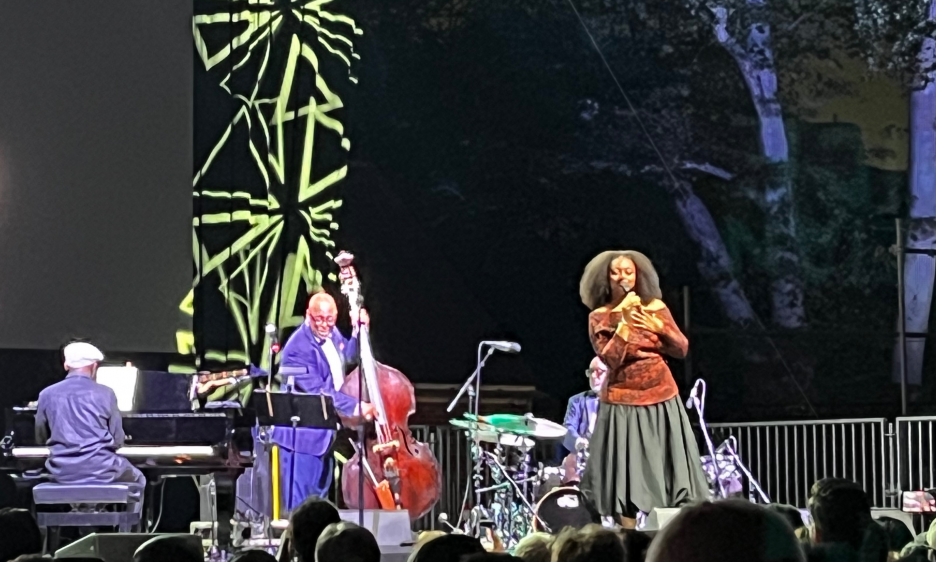
Courtesy Paul Reynolds
Fittingly for a company founded in part to give a home to marginalized musicians, the evening's tribute to Verve Records largely honored the label's extraordinary roster of women singers.
Summerstage
Verve's 70th Anniversary Celebration
New York NY
September 2, 2026
Founded 70 years ago, Verve Records was launched in part to treat female jazz artists with respect, who too often had been shortchanged within a music community that was male-centric to an extreme. It's fitting, then, that a concert held to honor the label's milestone birthday primarily showcased Verve's women singers over the years.
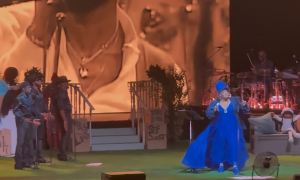
The main event of the show—held outdoors at Summerstage in New York's Central Park—featured jazz's emerging mainstream artist of the moment, Samara Joy (who happens to record for the still-thriving Verve), paying tribute to Ella Fitzgerald, the label's biggest star from its inception to the mid-1960s, and to other women who sang for Verve.
Opening the program, which proceeded under dry skies after an often-rainy day, was another female artist Mei Semones, from the Brooklyn indie scene, who fêted Verve's best-selling album Getz/Gilberto (Verve, 1964)—which featured the distinctive singing of Brazil's Astrud Gilberto.
Joy is more than a label-mate to Fitzgerald; the iconic vocalist is among the young singer's key influences. That connection showed in Joy's readings of several songs from Fitzgerald's repertoire. In "You'd Be So Easy to Love," singing over McBride's driving bass, Joy displayed, almost effortlessly, some of Fitzgerald's fluency in riding atop the rhythm while also effortlessly altering melody and varying phrasing.
Joy also paid tribute to two other women singers from the Verve stable who also helped shape her singing. While Joy's readings of their songs were sure-footed, neither artist was an obvious musical soulmate of the young singer.
First up for recognition was Abbey Lincoln, whom Joy described as "a complete inspiration" to me, if an unexpected one. Where Joy's work is apolitical, at least outwardly, Lincoln created much work—beginning with the We Insist! Freedom Now Suite (Candid Records, 1961), her collaboration with Max Roach—that was overtly radical. And where Joy's singing is dense and virtuosic, Lincoln—especially in her later career, when she recorded with Verve—sang in a spare and understated, even minimalist, style.
For what it's worth, Joy eschewed restraint and took a characteristically rococo approach to "Up Jumped Spring," the Freddie Hubbard instrumental for which Lincoln wrote lyrics and included on her superb 1991 album. You Gotta Pay The Band (Verve, 1991),
The set closed with a blues selection from the repertoire of Carmen McRae, another Verve singer who was more restrained in vocal style than Joy. The McRae piece proved to be the set's highlight, in revealing a looser, warmer side of Joy's singing, which can tend more to disciplined virtuosity than relaxed deep feeling.
Joy didn't mention Sarah Vaughan—who never recorded for Verve, at least directly—but the singer's legacy lies deep within the musical DNA of the younger singer—of whom actress and director Regina King once said that "it seems like Sarah Vaughan and Ella Fitzgerald are both living in her body." Joy's vocal range is closer to Vaughan's than Fitzgerald, and Vaughan's influence was evident in Joy's occasional swoops from contralto to sustained and dazzling soprano lines.
The evening's emotional highlight was its first and most intimate performance, and the one with no association to Verve. Coming on alone to start the show, bassist and bandleader Christian McBride noted the death earlier in the day of singer Cassandra Wilson, and paid tribute to her by playing a solo piece. His choice was a heartfelt, seemingly improvised blues, which he introduced by noting that "Cassandra was from Mississippi, and she knew the deep, gut southern blues, not the northern blues we play here."
McBride then brought on bandmates pianist Marc Cary and drummer Carl Allen, who joined him for a brief set before the trio began to accompany Joy. The ensemble paid tribute to two pianists closely associated with Verve, with lively, precise versions of "Shaw 'Nuff" and "Night Train," pieces from the Bud Powell and Oscar Peterson canons respectively.
There was deep feeling, too, in remarks from Nick Getz, by way of introducing the tribute performance to the collaboration (recorded in 1963, and released in 1964) between his father Stan Getz and Joao Gilberto, the Brazilian singer and guitarist.
The young Getz choked up as he described the tireless efforts by his mother, Monica Getz, to have Verve get behind the album, after she and her his father were told, as Getz describes it, that the popularity of Brazilian jazz had peaked and the genre was now uncommercial. Getz/Gilberto went on to rack up huge sales and win the 1965 Grammy for Best Album, one of only two jazz albums to capture the honor (the other being River: The Joni Letters (Verve Music Group, 2007) by Herbie Hancock).
Though not associated with the jazz community, Semones proved to be a perfect choice to interpret Getz/Gilberto, the perennially popular proto-world-music album. The Brooklyn-based indie-pop artist, it turns out, is deeply steeped in—and adept in playing—the delicate lilt of bossa nova, the American-Brazilian musical hybrid that Getz helped create on such albums as Jazz Samba in the early 1960s. Semones's mastery includes her skill in creating fluid guitar solos, and her small, vibratoless voice, which proved to be perfect for interpreting the vocals sung by Astrud Gilberto—Joao's wife—on the 1964 album.
The core five-piece ensemble included violin and viola, which added fluttering string arrangements to the spare sound of the 1963 recordings. Notably, no saxophonist was present to reproduce Getz's recorded solos. Instead soloing duties fell mostly to Semones as well as capable violist Noah Leong.
In addition to interpreting at least half of the selections on Getz/Gilberto, Semones and her musical friends performed a number of originals. They blended seamlessly into the set, being remarkably sympatico with the style and sound of the album.
 FOLLOW Paul Reynolds
and get notified whenever a new article published.
FOLLOW Paul Reynolds
and get notified whenever a new article published.
Journalist and programmer in jazz, folk, country and other musics
About Samara Joy

Tags
PREVIOUS / NEXT

Samara Joy Concerts
Become a Sustaining Member

Since 1995, All About Jazz has championed jazz as an art form and supported the musicians who create it. Over three decades, it has grown into one of the world's leading jazz resources, serving hundreds of thousands of readers, musicians, presenters and industry professionals each month.
Help Build the Future of All About Jazz
Your support helps us continue building All About Jazz for the next generation—expanding our editorial coverage, preserving jazz history, developing new community features and creating better ways to discover the music and the people behind it.
Become a sustaining member for as little as $20 per year and you'll immediately enjoy an ad-free experience along with access to subscriber features and future articles for a full year.
Together, we're not simply sustaining All About Jazz—we're building its future. Thank you for being part of the journey.