Home » Jazz Articles » Live Review » Festival International de Jazz de Montréal 2026
Festival International de Jazz de Montréal 2026
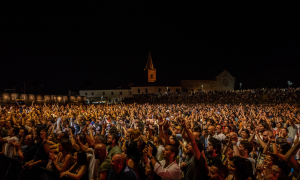
Courtesy Victor Diaz Lamich
Various Venues
Montreal, Canada
June 30-July 4, 2026
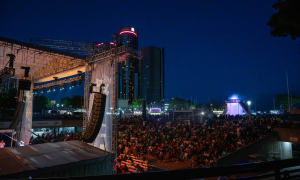
The 46th edition of the Festival presented over 350 shows, two-thirds of which were free. The festival organizing team highlighted performances by legendary jazz-funk band The Headhunters, the Charles Lloyd Quartet, St. Vincent Symphonique (a series of orchestral concerts featuring her repertoire), Kamasi Washington, French-Haitian vocalist Naïka, French-Lebanese trumpeter Ibrahim Maalouf, and vocalist Melody Gardot.
This year's honorees were Patrick Watson (Montreal Jazz Festival Spirit Award), Christian McBride (the Miles Davis Award for contributions to jazz), the band KOKOROKO (the Antônio Carlos Jobim Award for contributions to global music), Cecile McLorin Salvant (the Ella Fitzgerald Award for jazz vocals), and Najib Fenaoui (the Oliver Jones Award for young musicians at the university level who identify as members of visible minorities or Indigenous communities).
The series of Académie Masterclasses continued this year, allowing attendees to interact with musicians in an intimate space. Artists included Kid Koala, Joshua Redman, Victor Wooten and the Wooten Brothers, Coltrane @ 100 (world premiere selections of the mythical Tiberi tapes with Ken Druker), Alchemist, harpist Brandee Younger, and bassist Christian McBride.
June 30
Michel Cusson
Canadian Michel Cusson is a virtuoso guitarist and the founder of the jazz-rock group UZEB. The documentary UZEB en Fusion also debuted at the Festival. After making his mark on the music scene, he turned to composing for film and television in the early 1990s. For this performance, he presented his new project, the trio Voltage. Cusson was joined by double bassist Olivier Babaz and drummer Jean-Daniel Thibeault-Desbiens. As the band name implies, they are capable of intense fusion playing (despite having a double bass rather than an electric bass guitar). On the faster tunes, Cusson demonstrated blazing chops during his solos: he can execute fast lines with the best of them. But he also employed spacey, echoing harmonics over a reggae rhythm at one point, and sometimes generated a background soundscape as he played. The aptly titled "Hey Jimi" from Momentum: Michel Cusson au Studio Lombard (Self Produced, 2021) opened with a riff reminiscent of Jimi Hendrix's "Voodoo Child," and he doubled down with a "Purple Haze" quote during his solo. "Drowning Memories" from Solo (Self-Produced, 2016) was a gentle ballad that emphasized the trio's jazz aspect: the drums were played with brushes, and Babaz played a lovely solo.Craig Taborn
Pianist Craig Taborn played with double bassist Thomas Morgan and drummer Tim Angulo on one of the free outdoor stages. He began by introducing his bandmates, then started playing spacey, plinking passages that moved into a driving, odd-metered groove before transitioning into a blues. His solo went further and further "out," before landing on a jerky unison pattern with the entire trio. Despite music that was sometimes both abstract and dissonant, it was greeted with warm applause: proof that the band's delivery somehow made it accessible. About an hour into the set, Taborn paused for announcements. He noted that the group was playing some old material, especially for him and Morgan (they have been playing together for 20 years). Several of the tunes came from Chants (ECM, 2013): "Beat the Ground," "All True Nights/Future Perfect," and "Hot Blood." Others were, at time of writing, unrecorded. Morgan was featured quite a bit in the rest of the set, including a long solo that still kept the audience locked in. Taborn ended the set with additional band introductions.July 1
Brandee Younger Masterclass
Harpist Brandee Younger began her Masterclass by playing her arrangement of "Lift Every Voice and Sing" as the audience members found their seats. She wished everyone a Happy Canada Day, noting that it is also her birthday. So the audience sang "Happy Birthday." She outlined a brief history of her musical life: singing in the church choir, followed by flute, then trombone (which got her into marching band, a huge Black tradition). She played harp outside of school and had private lessons in classical French technique. She got permission to play pop tunes and heard Alice Coltrane and Dorothy Ashby (via samples in hip-hop tunes). After keeping her musical lives separate, she decided to go all in on her personal approach to the harp.The next part of the presentation involved answers to Frequently Asked Questions. Amplifying the harp: microphone in the sound hole plus contact mic. Current electronic effects include reverb, reverse delay, and digital delay (with tap tempo). She discussed extended techniques, including Alice Coltrane's two-finger glissando. Audience questions began with the kora (the West African harp-lute): it employs a much different playing technique, but she enjoyed playing with a kora player on a Lauren Hill album. A lever harpist asked how the approach differed from her pedal harp (this was one of the places where she apologized for being a "harp nerd," although she was completely charming the entire time). She was asked about contemporary harpists she admires, and was happy to say that there are many. What about being a Black harpist? Often difficult, but much easier than it was for harpists who are as little as five years older than her.
Christine Jensen Sextet
Canadian saxophonist Christine Jensen led a sextet in a program titled "Modes of Coltrane." Her arrangements were faithful to the spirit of the originals, without being literal copies. "Blue World" from Blue World (Impulse! Records, 2019) revisited a tune originally recorded in 2019 for a film soundtrack. "Equinox" from Coltrane's Sound (Atlantic Records, 1964) featured a collective horn improvisation as a coda, which Jensen repeated later. She introduced the band: trumpeter Lex French, tenor saxophonist Andre Leroux, pianist Francois Bourassa, bassist Rémi-Jean Leblanc, and drummer Jim Doxas. "Moment's Notice" from Blue Train (Blue Note Records, 1958) was next, a challenging harmonic progression. "The Drum Thing" from Crescent (Impulse!, 1964) featured drummer Doxas. "Loomotion" revisited "Blue Train" and featured Jensen on soprano saxophone. "After The Rain" from Impressions (Impulse!, 1963) was begun (ironically) just as a rainstorm began.Béla Fleck, Edmar Castañeda & Antonio Sanchez
American banjo virtuoso Bela Fleck, Colombian harpist Edmar Castaneda, and Mexican drummer Antonio Sanchez called themselves the BEATrio on their eponymous debut recording (Béla Fleck Productions / Thirty Tigers, 2025). Sanchez described them as "the world's weirdest jazz band." The unusual instrumentation began when Sanchez invited Fleck to join him on a duets album. Fleck suggested that Castañeda complete a trio. It is certainly a unique instrumentation, but the players make it work through virtuosity and an obvious joy in playing together. The band is a democracy, with all of the members contributing tunes. The set had opened with "Archipelago" and "Pelucidar," along with an earlier Fleck song called "Throw Down Your Heart." Sanchez's tune "Kaleidoscopes" was followed by Castañeda's commentary. While he was suffering from a badly broken hand—and wondering if his musical career was over—he composed "Whispers of Resilience" (with one hand). It was an appropriately solemn tune, with pitch-bending during an unaccompanied solo section. Fleck's unaccompanied solo featured his arrangement of George Gershwin's "Rhapsody in Blue." His composition "Cloak & Dagger" started out as a tango; Castañeda said it was a cha-cha; Sanchez said it was a danza. But audiences said it was a samba! It is certainly some kind of Latin spy theme, and a catchy one at that. The encore was a banjo feature, alternating solo passages with chords.July 2
Taj Mahal and the Phantom Blues Band
For over 50 years, veteran musician Taj Mahal has embodied the American blues tradition while enriching it with roots music from around the world. He revisited repertoire from his entire career with a crack band. "Strut" from Dancing the Blues (Private Music, 1993) featured his electric guitar solo with vocal doubling (like George Benson). "Chevrolet" from Happy Just to Be Like I Am (Columbia, 1971) found him playing blues harp, while "Wild About My Lovin'" from Time (Resonatin' Records/Thirty Tigers, 2026) was a reggae tune on which he played a small acoustic guitar. On "Dust My Broom" from Taj Mahal (Columbia, 1968) he played the famous slide guitar lick on the harmonica. Dobro appeared on "Queen Bee" from Señor Blues (Private Music, 1997) and on "Fishin' Blues" from Giant Step/De Ole Folks at Home (Columbia, 1969). At one point, he picked up a banjo as well. He was proud that his song "She Caught the Katy (And Left Me a Mule to Ride)" from The Natch'l Blues (Columbia, 1968) was used in the soundtrack of The Blues Brothers movie. He introduced the band members, said this was the first show of their tour, and led the audience in a sing-along of "Way Back Home." At age 84, he has not lost a step: he still puts on a great show.Tortoise
Chicago-based post-rock band Tortoise went right into it. That describes the entire set: a continuous flow with no announcements (and no vocals). They seemed completely dialed in, moving seamlessly from one high-energy repetitive groove to the next, sometimes switching instruments during the same song. The set included: "Layered Presence," "Prepare Your Coffin,'" "Dot/Eyes," "Axial Seamount," "Monica," "In Sarah," "Mencken," "Christ and Beethoven," "There Were Women and Men," "A Title Comes," "Ten-Day Interval," "The Equator," "I Set My Face to the Hillside," "Gesceap," "Night Gang." The band returned for an encore: they performed "Tin Cans & Twine" from Millions Now Living Will Never Die (Thrill Jockey, 1996), followed by "Crest" from TNT (Thrill Jockey, 1998), which was preceded by the atmospheric "Lithium Stiffs" introduction. The band consisted of John Herndon—drums, vibraphone, keyboards, sequencing, electronics; Doug McCombs—bass, guitar, lap steel guitar; John McEntire—drums, guitar, keyboards, electronics; Dan Bitney—drums, percussion, vibraphone, keyboards, bass, guitar, electronics; and James Elkington (standing in for Jeff Parker) on guitar and percussion.Rémi Cormier Quintet
This was a special event. The Rémi Cormier Quintet revisited/reinterpreted the famous Miles Davis soundtrack to the Louis Malle film Ascenseur pour l'eschafaud(Elevator to the Gallows) in real time with the film projected behind them. Trumpeter Cormier's quintet included pianist Willy Soto Barreto, guitarist Nick Di Giovanni, electric bassist Levi Dover, and drummer Louis-Vincent Hamel. Since the original quintet consisted of trumpet, tenor saxophone, piano, double bass, and drums, there was clearly no intention to reproduce the original soundtrack exactly. Guitar and bass also used effects pedals, which further modernized the sound. It was fascinating to witness the band filling in the soundtrack cues under Cormier's direction. The film ended, and Cormier introduced his bandmates with "FIN" on the screen.July 3
Alain Caron Trio with the ESCA Quartet
Canadian electric bassist Alain Caron is another UZEB alumnus (along with guitarist Michel Cusson, who also performed at the festival). This concert featured the ESCA string quartet along with his jazz trio. Caron plays a six-string fretless bass guitar, giving him a wide palette of sounds for soloing and accompanying. He began the first tune (which turned out to be Stevie Wonder's "Overjoyed") with a lyrical, rubato solo. "Simple Pleasures" had a great coordinated ending for the whole ensemble, while "Secrets" featured a cello solo. Classically trained string players are often accused of not being able to swing, but swing was no problem for this quartet, as they demonstrated playing the up-tempo bebop of an Oliver Jones composition. Caron introduced his pianist and drummer, plus violinists Amélie Lamontagne and Edith Fitzgerald, violist Sarah Martineau and cellist Julie Dessureault. The encore was a tango, including a bass solo accompanied by pizzicato strings.Isaiah Collier
Saxophonist Isaiah Collier began the show dueting with his pianist on Billy Eckstine's "I Want To Talk About You," concluding with an extended virtuosic unaccompanied saxophone coda. Then the rest of the band entered and began playing the music from John Coltrane's album A Love Supreme (Impulse!, 1964), the music to which the concert was dedicated. "Acknowledgment" introduced the four-note double bass motif that is the foundation of the piece, as well as the chant that gave the album its name. The band was not doing an exact recreation of the original, but it had the same energy. "Resolution" began with unaccompanied drums and included a long saxophone/drums burnout. "Psalm" (the final movement) was played with the same "musical narration" feel as the original, following Coltrane's devotional poem in the original liner notes. Collier introduced his bandmates: drummer Tim Regis, bassist Conway Campbell Jr., and pianist Davis Whitfield. He talked about honoring Coltrane's legacy. This was music borne of depression and oppression, human music in spite of the struggle. He called Coltrane the Beethoven of Black Classical Music and noted that this was not an easy piece to perform. For the encore, he chose a debut performance of a tune titled "Thirty Pieces." It was a modal jazz piece that fit right in with Coltrane's music.Ron Di Laurio Sextet
Canadian trumpeter Ron Di Laurio led a sextet in "Kind of Blue—Tribute to Miles Davis." Many of the tunes on the album have been covered over the years—as well as being staples at jam sessions—but it is still thrilling to hear the iconic album played in full, in running order. "So What" ended with a bass solo. "Freddie Freeloader" broke the arrangement down into tenor and alto saxophone solos, accompanied only by double bass, and a bass solo, accompanied only by drums. "Blue in Green" featured muted trumpet, along with a tenor saxophone solo. "All Blues" was taken at a brisk tempo. The alto saxophonist quoted "Willow, Weep for Me" during his solo, and the piano solo also included a quote from "Willow" (he looked at the alto saxophonist and smiled). "Flamenco Sketches" again featured muted trumpet. DiLaurio introduced the band: alto saxophonist Jean-Pierre Zanella, tenor saxophonist Yannick Rieu, pianist Taurey Butler, bassist Mike De Masi and drummer Martin Auguste. They immediately launched into "Milestones" as an encore, an appropriate modal lead-in to the "Blue" music.July 4
Hania Rani: Non Fiction
Polish composer/pianist Hania Rani presented her piano concerto Non Fiction. But she first performed a composed solo piano piece, which she described as a work in progress. It was an episodic composition, minimal but rhapsodic. It included pattern repetition that recalled Steve Reich or Nik Bärtsch, as well as gentle melodies and drones. The concerto began with Rani playing an upright piano over a wash of strings. Special guest Jack Wyllie played a soprano saxophone obbligato that consisted mainly of long tones. Rani moved to the grand piano, playing over shifting sounds from strings, horns, and percussion. The second movement included trilling strings that sounded like a swarm of angry bees, and a delicate texture with pizzicato strings and harp. The third movement began with timpani rolls and tremolando strings, leading into a melodic piano part. The fourth (and final) movement featured some of the most classic pianism of the piece, building to a crescendo but ending on a gentle note. A second pianist joined Rani for a brief encore. Rani thanked the audience, musing that it was odd being part of a jazz festival, since "my music has nothing to do with jazz." Except for possibly being fellow musical renegades.Christian McBride & Julian Lage
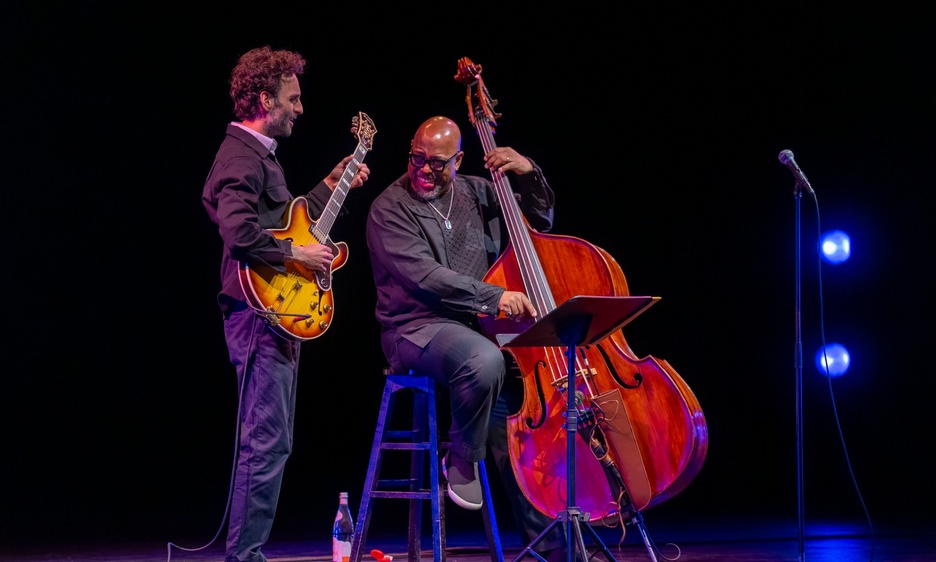
Double bassist Christian McBride and guitarist Julian Lage began their duet recital with one of Lage's compositions, then moved on to the standard "I Hear a Rhapsody." McBride said he met Julian about 25 years ago, and now they are neighbors in New Jersey. He kidded Julian about his upcoming gig in Bob Dylan's band, saying he hoped Lage would remember his jazz friends. They played another Lage original, "After All," Thelonious Monk's "Bye-Ya," Wayne Shorter's "Footprints," and "The Star Crossed Lovers" from Duke Ellington's suite Such Sweet Thunder (Columbia Records, 1957). The Ellington tune featured a lovely arco bass solo. But the duo played at such a high standard—and with such ease and joy—that picking out highlights is almost impossible. "East of the Sun and West of the Moon" was next, followed by John Coltrane 's "Equinox" from Coltrane's Sound (Atlantic Records, 1964), their contribution to the Coltrane Centennial. At this point, the show paused for the presentation of the Miles Davis Award by retired Festival co-founder André Ménard. As a longtime performer at the festival, McBride was surprised and delighted to see him. The duo played Miles Davis' "All Blues" and returned for an encore dedicated to the recently departed saxophone great Sonny Rollins.
 FOLLOW Mark Sullivan
and get notified whenever a new article published.
FOLLOW Mark Sullivan
and get notified whenever a new article published.
Freelance journalist & musician. I love improvisation & live electronics, in jazz and experimental music of all sorts.
About Julian Lage
Tags
PREVIOUS / NEXT

Julian Lage Concerts

Become a Sustaining Member

Since 1995, All About Jazz has championed jazz as an art form and supported the musicians who create it. Over three decades, it has grown into one of the world's leading jazz resources, serving hundreds of thousands of readers, musicians, presenters and industry professionals each month.
Help Build the Future of All About Jazz
Your support helps us continue building All About Jazz for the next generation—expanding our editorial coverage, preserving jazz history, developing new community features and creating better ways to discover the music and the people behind it.
Become a sustaining member for as little as $20 per year and you'll immediately enjoy an ad-free experience along with access to subscriber features and future articles for a full year.
Together, we're not simply sustaining All About Jazz—we're building its future. Thank you for being part of the journey.