Home » Jazz Articles » Album Review » Albert Marquès / Rachel Therrien: Dialogue (Vol. I & II)
Albert Marquès / Rachel Therrien: Dialogue (Vol. I & II)
The Expat and the Deported
If anything binds two spirits as seemingly disparate as Albert Marquès and Rachel Therrien— beyond their shared interest in the slippery realm of improvisation—it is their wide-ranging aesthetic curiosity, grounded in multiple approaches and stylistic appetites, as well as their outspoken musical activism. And, naturally, New York City also unites them: the quintessential city welcoming musical expats from five continents. Marquès, born in Granollers near Barcelona, left home to eventually become yet another Brooklyn resident after an extensive life journey around the planet, striving—in his own words—to "repay the Black community some of what they had given us with their music." Therrien, a Quebec native and an effective catalyst of musical influences from, primarily though not exclusively, the Three Americas, had also made the five boroughs her base for fifteen years, until mid-October 2025, when she was deported to Canada for allegedly misusing her artist visa upon landing in Miami after a flight from Cuba. Thus, among many other consequences, the New York release show for Dialogue had to take place with her joining via Zoom. Troubled times seem to be looming for anyone who doesn't fit neatly within the new order of things.Marquès is a generator of projects that go beyond the strictly musical, a builder of artifacts like Freedom First (Say It Loud Records, 2022) or Mir Zaynen Do (La Casa Rosa, 2025), where voices as diverse as that of a death-row inmate in the former or an almost centenarian survivor of a Nazi concentration camp in the latter, merge their stories with the musical textures conceived by the keyboardist, thereby bearing witness to injustices and cruelties that, though well-known, still need to be disseminated and remembered. Therrien, for her part, pairs spectacular technique on trumpet and flugelhorn with exceptional insight in mixing styles as disparate as hard bop, contemporary electric fusion and Latin jazz with ethnographic hues. With a tone that suggests traces of Art Farmer, Tom Harrell and Dave Douglas, she succeeds in ensuring that her musical landscape, far from becoming a blurry confluence, coheres into a distinctive amalgam where each musical nutrient retains its most defining flavors. Proof lies in her highly celebrated Vena (Bonsai Music, 2020), nominated for Best Jazz Album at the 2021 JUNO Awards, and in the two parts of the acclaimed Mi Hogar (Outside in Music, 2023 and Self Produced, 2025).
Though Therrien and Marquès have known each other for about ten years and have played together on various occasions, Dialogue marks their first joint foray into a recording studio, governed by the complicity essential to undertake a challenge of these characteristics: a two-voice conversation, proudly naked, in which they question and respond to each other, seduce and distance themselves, but also play and have fun, avoiding the abstruse while reveling in a festive avant-garde—at times in a line reminiscent of the Clusone Trio—that breaks the seriousness inherent in a tremendously demanding format not commonly found in the jazz realm. Certainly, there are illustrious precedents, the first—as a whole album—being the duets of Ruby Braff and Ellis Larkins, recorded in 1955. Over the years, they would be followed by luminaries of both instruments such as Oscar Peterson, Paul Bley, Enrico Rava, Kenny Wheeler and Dave Douglas—fittingly these last two musicians are among the most palpable influences on Therrien's sound and language.
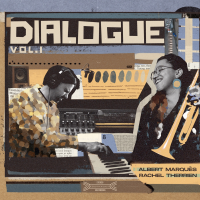
Dialogue is structured in two volumes, the first released in November 2025 and the second in late January 2026. Volume one is based almost entirely on ideas born on the spot, while the second is composed mostly of standards and some original pieces by both artists, although improvised sections continue to play an important role.
Vol. I
"Every track is a story that we did not know we were going to tell until we started playing," states Marquès, referring to the first disc. This is especially evident in numbers like "Eight," its opening miniature, or the engaging "Dialogue," in which atonality transmutes into something resembling a warped pasodoble, with the Canadian displaying melodic inventiveness while summoning echoes of Douglas. The same atmosphere of spontaneous composition permeates "Bell's Ring," a thoughtful exploration where the two sketch an ephemeral motif before diving into uncharted waters, Therrien briefly channeling the most adventurous Wheeler. "Meditation," its exact replica, is more likely to be seen as a simple sequencing error than as a sophisticated challenge aimed at the sharp-eared listener.A step below that level of formal and conceptual abstraction, we find several works that are structured from inspiration radiating from specific places. "Brooklyn Bridge" is the first, marked by a clear melodic profile and a gentle cadence from Marquès, almost pastoral, under which the spirit of Manuel de Falla's "Danza del fuego fatuo"—or, if one prefers, Miles Davis' and Gil Evans' "Will O' the Wisp"—is quietly invoked. "CUBAAA," on the other hand, is Therrien's terrain: she unleashes a moderately fierce strain of atonality framed in a distorted Latin context—it is inevitable to wonder how this take might have sounded had it been recorded after her deportation, which also uprooted her Cuban partner. "Gaza," inevitably, is a desolate lament voiced by both instruments, a gaze that begins somberly, with Therrien gradually transforming her instrument into a ney that arduously rises above the unspeakable devastation surrounding it. A similar breath animates "On Living," an idea originating in Freedom First that she develops masterfully over the pianist's suggestive harmonic cushion.
The most accessible section of this first volume consists of pieces where humor or an uninhibited orthodoxy—one that does not shy away from irony—prevails. "The Kiss" remains in the speculative realm, but the array of onomatopoeias Therrien explores with her embouchure—turning breath itself into another ingredient of the aural cocktail— radiates a playful transgression. The aptly titled "Pop Song" shows a faint nostalgia for Davis' once-famous readings of Cyndi Lauper tunes, here redirected to darker and more exploratory terrain, with Marquès shining in one of his best solos. "MTA" channels Thelonious Monk's teachings with both musicians brimming with ideas and charmingly unrestrained, while "Supreme Love" is more mischievous than furious, its vigorous atonality framing a lively interaction in which Therrien sonically swings from Lester Bowie to Anthony Braxton... to contrabass clarinet. Finally, two takes based on popular themes forcefully command attention. In "New American Salute," the Canadian deconstructs the martial call of reveille, skillfully playing outside over the harmonic and rhythmic shifts progressively introduced by the pianist, thus giving it disconcerting qualities far removed from its original form and meaning. Something similar—though in an opposite sense—occurs in "Twinkle," a tender reimagining of "Twinkle, Twinkle, Little Star" with its chords delicately manipulated, revealing, in its closing gestures, Marquès at his most mainstream.
Vol. II
The second disc is articulated mainly from very well-known standards, thereby establishing a familiar concreteness from its outset, although it also includes some original compositions signed by each of the artists. As for the former, an inventive reworking prevails over reverent rendition: the emphatic and explicit now take priority over the suggested and atmospheric, although the deep lyricism that permeated the first volume is not abandoned. There is therefore a change in register, but without losing any of the album's homogeneity."A Night in Tunisia," "Caravan," and "I Mean You" stand out as vigorous revisions of emblematic masterpieces. The first is approached with a panoply of fresh ideas: Marquès plays with dynamics, metrics, and that unforgettable melody while unveiling his carefully measured solo facet, here endowed with an attack that marries McCoy Tyner with Cecil Taylor. Therrien, in turn, excels with a discourse that seems infused with the spirit of Lee Morgan, under which the pianist supplies a veiled Latin pulse, perfectly in keeping with the original theme. The second, Duke Ellington and Juan Tizol's imperishable classic, would not be recognized by them in its first measures. Once the motif is clearly defined, a playful Marquès subjects it to strong rhythmic treatment, which becomes flamenco-inflected in his brief solo. He is preceded and followed by an explosive Therrien, whose shock wave reaches stratospheric levels. And as for Monk's famous interpellation, it begins with a categorical exposition, with the Catalan perspiring inspiration. The trumpeter enjoys evoking precursors like Clark Terry, Roy Eldridge or Louis Armstrong himself, flanking the diaphanous, highly percussive elaborations of Marquès, who delivers a groovy solo. Though perhaps not as brilliant, the opening "Watermelon Man" is also relevant: Therrien picks up the quirky percussion of The Headhunters' electric version, then, with the support of its unavoidable harmonic riff, sculpts its melody. The pianist delights in his solo with mischievous rhythmic figures, and she festively extracts refreshing ideas from the juicy material.
Four cuts, three of them particularly striking, delineate an intangible space seemingly dedicated—again—to the memory of Davis, or more precisely to that of his two great quintets. "My Funny Valentine" is subverted with that layer of dark fatality with which the Prince of Darkness varnished it in his unmatched version at New York Philharmonic Hall. Marquès clothes it in grave classicism, and after a spontaneous exchange of proposals, Therrien finally returns it to the light. "On Green Dolphin Street" inevitably brings the Davis of the '50s to mind, this time under an unusual rhythmic treatment, strongly syncopated, which does not prevent the trumpeter from dazzling with her mastery. And "Solar"—a composition indelibly associated with the genius from St. Louis—surprises with its rhythmic approach, now in rubato. It begins with a long note sustained by Therrien over which the pianist evolves à la Brad Mehldau. Subsequently, the Quebec-born musician declaims some of her best phrases on the record with the flugelhorn, traversed by a piercing melancholy that her velvety sound neither manages nor intends to disguise. Certainly, a fantastic way to close the album.
But there are many more moments in this second volume that tap into that fertile lyrical vein. "Abraham Lincoln Brigade" (nothing to do with John McCutcheon's homonymous theme) is a ballad signed by Marquès and swollen with contemplative pain, recovering the ethereal tone most present in the first disc. Its occasional Iberian airs refer us, in the keyboardist's words, to the "group of volunteers from the United States who served in the Spanish Civil War fighting for Spanish Republican forces, to help the cause of freedom and democracy." In contrast, Jerome Kern's "Yesterdays" begins deconstructed both rhythmically and melodically, and after a compelling interplay resolves into an evocative ending in which the contours of the original dissolve under the fine but relentless drizzle of the past. In a similar but unexpected manner, "La Cucaracha" receives a lullaby treatment, again in free time: Therrien hints at the melody until Marquès steers it toward a different harmonic landscape than expected, without the predictable Spanish tinge, where both musicians converse relaxedly until the unmistakable original motif emerges.
Fade to Silence
In strict duo releases, it is not uncommon to read reviews that point to a "clash of egos," alluding to disconnection between the discourses of both performers: the supposed dialogue sometimes becomes a disjointed superposition of monologues, with consequent damage to the musical result. Nothing could be further from the truth regarding Dialogue: its two sensational musicians show an intense—and jovial—degree of empathy, a rapport that benefits all its cuts, whatever their degree of inspiration and success in resolution. In parallel, a subtle balance runs through the entire album: from the carefully weighed combination of abstraction and concreteness to the wise compensation that the keyboardist effects for the obvious 'disproportion' between both instruments—aware of the piano's sonic, harmonic and rhythmic preponderance, the solo spotlight falls mostly on a Therrien who, like her compatriot Ingrid Jensen, must be considered one of the most technically complete and creatively keen current trumpeters. Marquès, for his part, exhibits wise restraint, skillful use of dynamics and a highly personal stylistic approach, concentrating on intelligent harmonic and rhythmic comping above individual displays. Finally, one must highlight a recording that provides gratifying immediacy, allowing appreciation of all the nuances of Therrien's sonority or vibrating with the emphatic presence of keys struck energetically by the Catalan.All of this makes Dialogue a splendid album as a whole and magnetic in a multitude of its moments, in which experimentation and tradition ally under the relatively young but already very expert hands of its figures—egocentrism is abolished and monotony remains forbidden, but imagination and passion pulse, joyously, in every second of its generous running time.
 FOLLOW Artur Moral
and get notified whenever a new article published.
FOLLOW Artur Moral
and get notified whenever a new article published.
An Absolute Listener
Track Listing
Volume I: Eight; The Kiss; Dialogue; Pop Song; MTA; Supreme Love; Brooklyn Bridge; On Living; New American Salute; Meditation; Twinkle; Bell's Ring; CUBAAA; Gaza; Good Memories. Volume II: Watermelon Man; On Green Dolphin Street; I Mean You; Papa; A Night In Tunisia; Yesterdays; Formentera; Caravan; La Cucaracha; All Blues; Abraham Lincoln Brigade; My Funny Valentine; Solar.
Personnel

Albert Marquès
piano
Rachel Therrien
trumpetAlbum information
Title: Dialogue (Vol. I & II) | Year Released: 2026 | Record Label: Chronograph Records
About Albert Marquès
Tags
PREVIOUS / NEXT


Become a Sustaining Member

Since 1995, All About Jazz has championed jazz as an art form and supported the musicians who create it. Over three decades, it has grown into one of the world's leading jazz resources, serving hundreds of thousands of readers, musicians, presenters and industry professionals each month.
Help Build the Future of All About Jazz
Your support helps us continue building All About Jazz for the next generation—expanding our editorial coverage, preserving jazz history, developing new community features and creating better ways to discover the music and the people behind it.
Become a sustaining member for as little as $20 per year and you'll immediately enjoy an ad-free experience along with access to subscriber features and future articles for a full year.
Together, we're not simply sustaining All About Jazz—we're building its future. Thank you for being part of the journey.