Home » Jazz Articles » Album Review » Norman Granz: The Sound Of America
Norman Granz: The Sound Of America
To say that he moved the music from the dance hall to the concert hall is something of an understatement. How many were fortunate enough to attend a Jazz at the Philharmonic concert, some as late as 1967, after Granz had been at it for more than twenty years? Critical assessments would inevitably vary from Lester Young's "flying plantation" to "a miracle." And Granz's record as a promoter and defender of racial equality was realized with a philosophy of "only performance matters." Granz heard and saw talent, not color, a reminder that the music may have Afro-American roots but really belongs to everybody.
Granz made a handsome fortune as well, showing that you could make a living playing jazz or promoting it under the right circumstances. It took sophisticated audiences, but Granz knew where to find, attract and entertain them. He may have been abrasive, as pushy people often are, but Granz was not simply in it for himself. This welcome collection The Sound of America affords yet another generation a chance to hear some of the true magic that Norman Granz could conjure.
The collection is available on vinyl and CD, and this review must be limited to what the CDs bring. Here there are two discs, and for certain, there will be few who do not hear something new—or, at least new to them.
One of the most remarkable tracks is, fittingly, by Coleman Hawkins. The recording is drawn from The Jazz Scene (Mercury Records, 1950), a multi-record compendium that Granz intended less for commercial purposes than as a display of the range of artists and styles that Granz saw as constituting the essence of the music then. The musicians were given complete freedom to record what they wanted and in the way that they wanted, something immediately evident in Hawkins' recording, "Picasso." It is unaccompanied tenor that runs for 3:17, and while hardly atonal, seems to have no formal shape per se, although that may be deceptive. On first hearing, a reaction may be "Hey, that is Sonny Rollins." The more banal "I did not know that Hawkins could play that way" is not unjustified either.
Its shrewd placement at the opening of the collections should entice any curious listener, although "JATP Blues" appropriately enough takes that honor. Why more staid critics, musicians and early venues turned away from the entire concept of JATP is pretty obvious from "Blues," with honkers and squeakers on full display; a "chase" between Nat King Cole and Les Paul redeems the session. And as Buddy DeFranco was to remark, a nice paycheck typically resolved a skeptic's doubts.
Oscar Peterson then trails octaves through "Tenderly" to lovely effect. This was Peterson's debut to audiences in the United States, much more than a display of the astounding technique for which he was often criticized. Other favorites: "Ballad Medley"; featuring Charlie Parker, Ben Webster, Johnny Hodges, Flip Phillips and Benny Carter(!); Roy Eldridge doing "Dale's Wail" and Anita O'Day's "Lullaby of the Leaves." Listening to Ella Fitzgerald rehearse "Chelsea Bridge" is another rare pleasure. Even if someone does not care much for Fred Astaire's singing, it has a certain novelty value and can be found here.
As far as novelty goes, there is also spoken word: Jack Kerouac reading from his work; Shelly Berman doing his telephone shtick; Jonathan Winters, a kind of direct ancestor of Robin Williams; and a genuinely funny Mort Sahl. All of these offer insight into the psyche of the United States in the 1950s, and they fit into Granz's panoramic view of American life.
Ultimately, Granz decamped to Europe, where, despite the obstacles, he was equally successful as a jazz producer. It may well have been that the distinctly swing bias of Granz's presentations simply ran out of a domestic audience, although considering the spectacular level of talent he could assemble, that seems a bit difficult to believe. He also had competition in the United States from George Wein and the Newport Jazz Festival. There was no love lost between the two figures, but in a way, Wein was more representative of the future of the music, or, at least, its primary exponents.
The liner notes by Tad Hershorn are as full as anyone could reasonably expect, although they are a bit difficult to read—at least to ageing eyes. Really, the best thing one could do is to go to Hershorn's definitive biography of Granz, Norman Granz. The Man Who Used Jazz for Justice (University of California Press, 2011), where Granz's thinking is explored in detail, and in which the context for selecting the music from his enormous oeuvre is much clearer.
While there may be, to an older generation of listeners, at least some overlap with what it listened to over the years (e.g., The Verve Story, 1944-1994 (Verve, 1994), this collection is a splendid way of introducing younger listeners, perhaps an entirely new audience, to the work of a pioneering figure in American jazz who did not play a horn.
 FOLLOW Richard J Salvucci
and get notified whenever a new article published.
Richard is an emeritus professor of economics at Trinity University.
Track Listing
CD1:
Blues; Picasso; Tenderly; Like Someone in Love; New Basie Blues; Castle Rock; Con Poco Coco ; Louise; Taking a Chance on Love; Easy Living; Flamingo; You Won’t Be Satisfied (Until You Break My Heart); I’ll Never Be the Same ; Dale’s Wail ; That Old Black Magic
CD2:
Laura; Session #1 — Ballad Medley: All the Things You Are/Dearly Beloved/The Nearness of You/I’ll Get By/Everything Happens to Me/The Man I Love/What’s New?/Someone to Watch Over Me/Isn’t It Romantic; Thou Swell; Cocktails for Two; Why Was I Born?; On the Street Where You Live; Lullaby of the Leaves; Blue Room I Thought About You ; Chelsea Bridge — rehearsal; No Strings.
Personnel
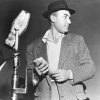
Norman Granz
producer
Modern Jazz Quartet
band / ensemble / orchestra
Dizzy Gillespie
trumpet
Benny Carter
saxophone, alto
Teddy Wilson
piano
Lester Young
saxophone
Oscar Peterson
piano
Coleman Hawkins
saxophone, tenor
Stan Getz
saxophone, tenor
Lionel Hampton
vibraphone
Johnny Hodges
saxophone, alto
Charlie Parker
saxophone, alto
Joe Williams
vocals
Count Basie
piano
Buddy Rich
drums
Woody Herman
band / ensemble / orchestra
Mel Torme
vocals
Anita O'Day
vocals
Billie Holiday
vocals
Ella Fitzgerald
vocalsAdditional Instrumentation
Bud Powell; Louis Armstrong; Art Tatum; Roy Eldridge; Sonny Rollins; Sonny Stitt; Jack Kerouac; Mort Sahl; Jonathan Winters; Shelley Berman; Spike Jones and His City Slickers; Rose Murphy; Margaret Whiting; Bing Crosby and Buddy Bregman; Fred Astaire.
Album information
Title: The Sound Of America | Year Released: 2026 | Record Label: Verve
About Norman Granz
Tags
PREVIOUS / NEXT
Become a Sustaining Member

Since 1995, All About Jazz has championed jazz as an art form and supported the musicians who create it. Over three decades, it has grown into one of the world's leading jazz resources, serving hundreds of thousands of readers, musicians, presenters and industry professionals each month.
Help Build the Future of All About Jazz
Your support helps us continue building All About Jazz for the next generation—expanding our editorial coverage, preserving jazz history, developing new community features and creating better ways to discover the music and the people behind it.
Become a sustaining member for as little as $20 per year and you'll immediately enjoy an ad-free experience along with access to subscriber features and future articles for a full year.
Together, we're not simply sustaining All About Jazz—we're building its future. Thank you for being part of the journey.