Home » Jazz Articles » Book Review » The Majesty of Chicago Jazz: Twenty-Five Visionaries Who...
The Majesty of Chicago Jazz: Twenty-Five Visionaries Who Define the City's Sound
Chicago audiences embraced these groundbreaking musical expressions, propelling these visionaries to global fame.
—Howard Reich
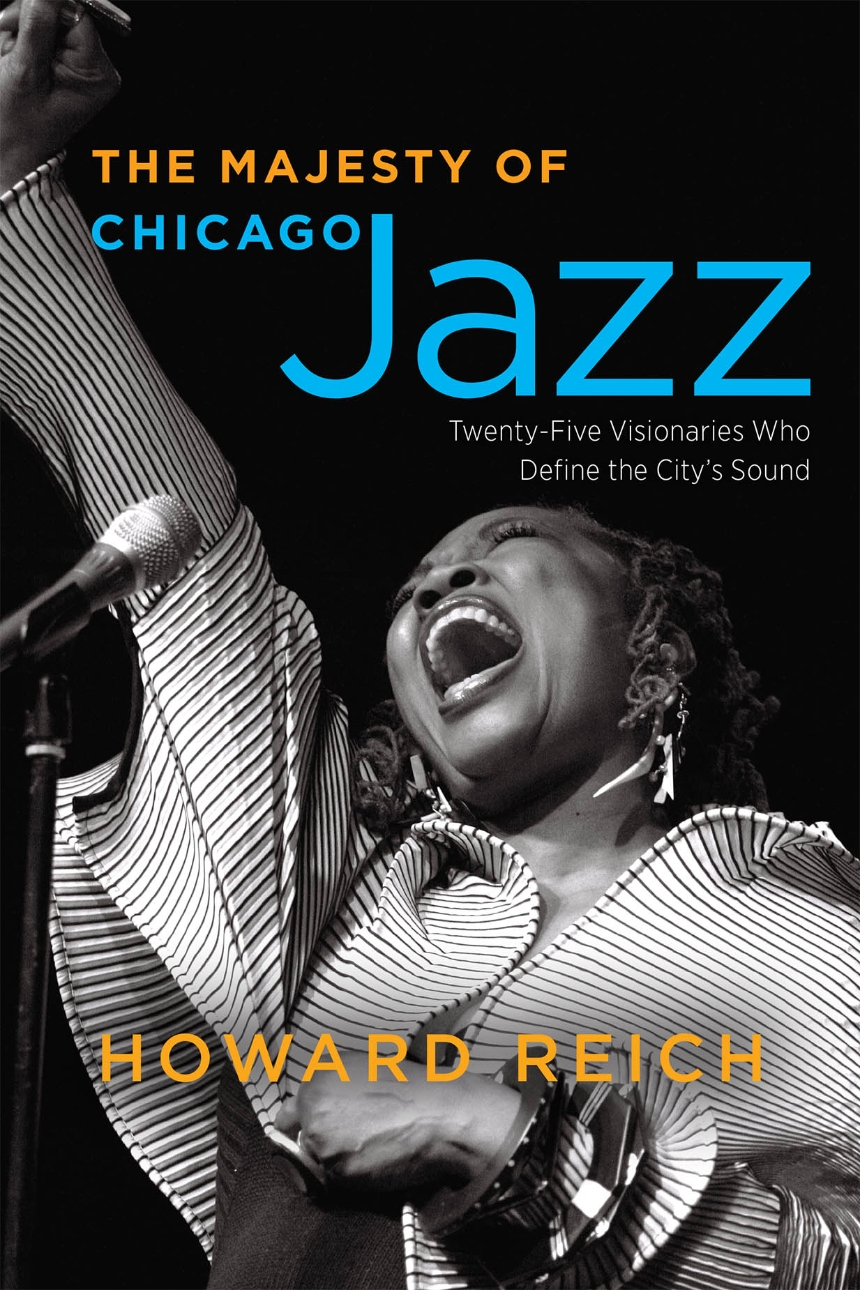 The Majesty of Chicago Jazz: Twenty-Five Visionaries Who Define the City's Sound
 Howard Reich
288 Pages
ISBN: #978-0-226-84644-6
University of Chicago Press
2026
Jazz may have been born in New Orleans, but it came of age in Chicago. In The Majesty of Chicago Jazz: Twenty-Five Visionaries Who Define the City's Sound (The University of Chicago Press, 2026), Howard Reich demonstrates why Chicago became one of jazz's great creative laboratories through twenty-five portraits that illuminate both the music's history and the broader American experience. He looks at the city's revolutionary jazz movements from Louis Armstrong and Jelly Roll Morton to the Association for the Advancement of Creative Musicians (AACM).
Reich joined the Chicago Tribune in the 1970s and became its principal jazz critic in 1989, a role he would hold for decades. His tenure coincided with major shifts in jazz—from the post-bop and avant-garde movements to the rise of neoclassicism and the institutionalization of jazz education. He is particularly important in documenting Chicago's jazz ecosystem and treating the city not as a secondary market to New York, but as a major creative center in its own right. Reich consistently looks beyond the music itself. That perspective shapes the entire collection. His essays coalesce into a history in which musicians, clubs, neighborhoods, social movements, and economics continually intersect.
Reich begins where Chicago's jazz identity took shape. His opening portraits of Jelly Roll Morton and Louis Armstrong establish two themes that recur throughout the book: artistic innovation and the often painful disconnect between genius and recognition. In Jelly Roll Blues: Part 1 (co-authored with William Gaines in 1999), Reich tells of a finding that led to a brief rediscovery of Morton as a composer. Boxes of compositions, decades old, were found in a French Quarter apartment. They would prove to be Morton's final works to be heard for the first time in New Orleans.
Reich describes the lost cache as "strange, exotic and mystical" and myth-busting in its splintering of conventional views of Morton. He argues that Morton's rediscovered compositions sound less like artifacts than predictions. These late-1930s pieces reveal an imagination undiminished by the poverty and professional isolation that marked his final years. By then, the architect of early jazz had no working band, no recording contract, and virtually no audience for his music. The contrast is striking: a flamboyant celebrity who had once enjoyed extraordinary success in Chicago ended his life pawning his possessions for food, largely abandoned by the very industry he had helped build.
If Morton illustrates how the music industry could neglect even its greatest innovators, Reich's portrait of pianist Art Hodes (1904-1993) explores another form of historical inequity: how exceptional musicians can become overshadowed because they preserved rather than transformed a tradition. Many historians regarded Hodes as the greatest white blues pianist in jazz history. Though he worked with Armstrong, Sidney Bechet, and Benny Goodman, he was not as well known outside the business. Hodes became one of jazz's great preservationists, while Armstrong fundamentally altered the language of the music. Their contrasting legacies illustrate Reich's larger point that influence is measured in various ways.
Reich is equally compelling when he explores the personal costs behind artistic achievement, and few stories demonstrate that better than Anita O'Day's. Reich draws a compelling parallel between O'Day and Billie Holiday, suggesting that each transformed profound personal hardship into artistic expression. O'Day's own struggles with heroin addiction and life on the margins gave her an intimate understanding of the emotional depths from which Holiday sang. Rather than romanticizing addiction, Reich presents resilience as the defining quality: O'Day viewed survival itself as inseparable from her artistry, believing that enduring life's darkest moments ultimately deepened the authenticity of her music.
From vocal interpretation, Reich turns to one of the most original pianists ever to pass through Chicago. Ahmad Jamal's years in the city were comparatively brief, yet Reich convincingly argues that their impact on modern jazz has been immeasurable. Reich suggests that later piano visionaries such as Jason Moran, Vijay Iyer, and Matthew Shipp may have had their ears opened by Jamal. His first recordings came in 1951 for the Okeh label with what would become his namesake trio. His most celebrated recording, At the Pershing: But Not for Me (Argo, 1958), was recorded at the Pershing Hotel in Chicago; Jamal's trio would come to be recognized as a pivotal force in the history of jazz. Reich describes his unique playing style as "jagged shards of melody, striking chord clusters, abrupt silences, open spaces... " He credits Jamal as having "introduced radical new ideas on the use of rhythm, meter, space, texture and gesture." By 1964, Jamal had moved on to New York following a tour of North Africa.
The AACM is the heart of The Majesty of Chicago Jazz. If Jamal expanded jazz through understatement and space, the musicians of the AACM exploded conventional expectations altogether. Reich devotes several chapters to this movement, reflecting its central place in Chicago's musical identity. Art Ensemble Of Chicago percussionist Famoudou Don Moye in the 1997 interview Neglected at Home reflects on the uneasy relationship between Chicago's most celebrated avant-garde musicians and the city that produced them.
Moye and saxophonist Roscoe Mitchell are—as of 2026—the only surviving members of the original AEoC, and both remain active in music. Moye addresses the group's apparent home-field "disadvantage" compared with healthier concert attendance in locations such as New York, California, and Europe. In answer to Reich's questioning of a lack of local performances for a group so "revered," Moye answers with another question: "Is that revered or feared?" Reich expands on Moye's point by placing the AEoC's experience within the broader history of the AACM. During the late 1960s and early 1970s, the group's pioneering musicians often accepted poorly paid engagements simply to keep performing. Decades later, although Chicago offered no shortage of venues, the city's major concert halls, with the financial resources and technical support befitting artists of their stature, remained largely reluctant to present avant-garde jazz.
The AACM story extends beyond the Art Ensemble of Chicago. In his exploration of its ongoing influence, Reich highlights notable figures from later generations, such as composer and educator Kahil El'Zabar. Reich's 2003 essay Still Pushing Boundaries presents the Chicago native as a percussionist and activist. He describes El'Zabar as an artist who skillfully blends tradition with innovation, merging ancestral rhythmic practices with the adventurous harmonic language of the avant-garde. Equally important is the artist's role as an advocate for fellow musicians. Reich argues that jazz musicians must cultivate entrepreneurial skills and take ownership of the business aspects of their careers to sustain their creative work.
The Majesty of Chicago Jazz succeeds because it is more than a compilation of previously published newspaper articles. Read together, these twenty-five essays become a coherent portrait of a city whose influence on jazz rivals that of any in the world. Reich writes with the authority of a veteran reporter, the curiosity of a lifelong listener, and the empathy of someone who understands that music is inseparable from the people who create it. His subjects range from internationally celebrated figures to artists who deserve wider recognition, yet each contributes another facet to Chicago's remarkable musical identity.
For longtime jazz enthusiasts, the collection offers fresh perspectives on familiar legends. Most importantly, Reich reminds us that Chicago jazz has never been a historical footnote to New Orleans or New York. It has been, and remains, one of the music's great engines of invention. The Majesty of Chicago Jazz: Twenty-Five Visionaries Who Define the City's Sound is both a valuable historical record and an absorbing celebration of the artists who gave the city its enduring voice.
 FOLLOW Karl Ackermann
and get notified whenever a new article published.
FOLLOW Karl Ackermann
and get notified whenever a new article published.
New York based contributor. Author of: "A Map of Jazz: Crossroads of Music and Human Rights" and keynote speaker/host of Pearson Jazz Foundation's International Jazz Day event (2018, 2019)
About Art Ensemble Of Chicago

Tags
PREVIOUS / NEXT

Become a Sustaining Member

Since 1995, All About Jazz has championed jazz as an art form and supported the musicians who create it. Over three decades, it has grown into one of the world's leading jazz resources, serving hundreds of thousands of readers, musicians, presenters and industry professionals each month.
Help Build the Future of All About Jazz
Your support helps us continue building All About Jazz for the next generation—expanding our editorial coverage, preserving jazz history, developing new community features and creating better ways to discover the music and the people behind it.
Become a sustaining member for as little as $20 per year and you'll immediately enjoy an ad-free experience along with access to subscriber features and future articles for a full year.
Together, we're not simply sustaining All About Jazz—we're building its future. Thank you for being part of the journey.