Home » Jazz Articles » Live Review » Festival-ing on Historic Grounds
Festival-ing on Historic Grounds
Courtesy Josef Woodard
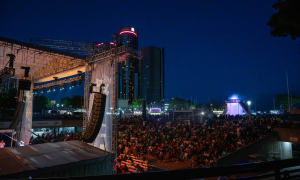
Increasingly, as the years add up, the Monterey County Fairgrounds—MJF’s OG home turf--qualifies as historic grounds in jazz annals....For starters, the festival did its due diligence in paying respects to the synchronicity of twin 100-year anniversaries of the birth of jazz Gods Miles Davis and John Coltrane, as many festivals around the world are doing this year. The difference here is that both powerfully influential figures performed here.
Monterey, CA
September 25-27, 2026 As the legendary Monterey jazz festival leans into its 70th year in 2027, the artistic and commercial mission remains steadfast, while the leadership chair has been in rotation the last few years. After Tim Jackson retired after 32 years of noble and forward-thinking duty as director, the director role has been passed to Darin Atwater for a year (and a very good year it was), then onto last year's interim director Bruce Abatie and now this year's model, a collaborative effort between artistic advisors Gerald Clayton and Jason Olaine. They come well-recommended: Clayton is the multi-gifted and evolving pianist who is been intricately involved in Monterey for some years, while Olaine has been in charge of no less an institution than Jazz at Lincoln Center.
Increasingly, as the years add up, the Monterey County Fairgrounds—MJF's OG home turf—qualifies as historic grounds in jazz annals. This is the spot of origin and continuation for the MJF, proudly basking in its bragging right status at the world's oldest continuous jazz festival (Newport briefly preceded and influenced MJF, but that festival has had lapses and location moves over the years). That history-centric point, and general theme, was not lost in this edition of the Monterey festival.
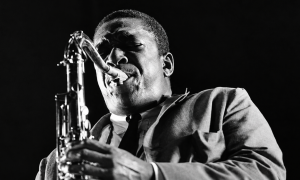
For starters, the festival did its due diligence in paying respects to the synchronicity of twin 100-year anniversaries of the birth of jazz Gods Miles Davis and John Coltrane, as many festivals around the world are doing this year. The difference here is that both powerfully influential figures performed here, twice each in the 1960s (although Miles' electric period is noticeably MIA from the festival programming archive, due to original director Jimmy Lyons's anti-avant and anti-fusion biases).
On this weekend, we heard varied genuflections to Coltrane—as in Isaiah Collier's ferocious wall-of-sounding set—and Miles—e.g. Gregory Hutchinson's "Kind of Now" project, featuring MJF artist-in-residence Ambrose Akinmusire as a reasonable surrogate Miles voice. Suitably, the festival wrapped up with a warmly nostalgic—if strangely loose and ill-focused—exclusive duet with famed Miles alums Herbie Hancock and Ron Carter, during which the icons jammed on run-of-the-mill standards and long solo ventures while avoiding the fascinating body of work they created in the great mid-60s Miles quintet—the mythic stuff of albums including ESP, Nerfertiti, and Sorcerer.
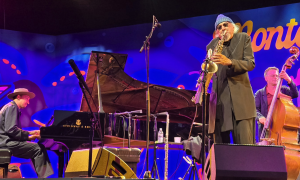
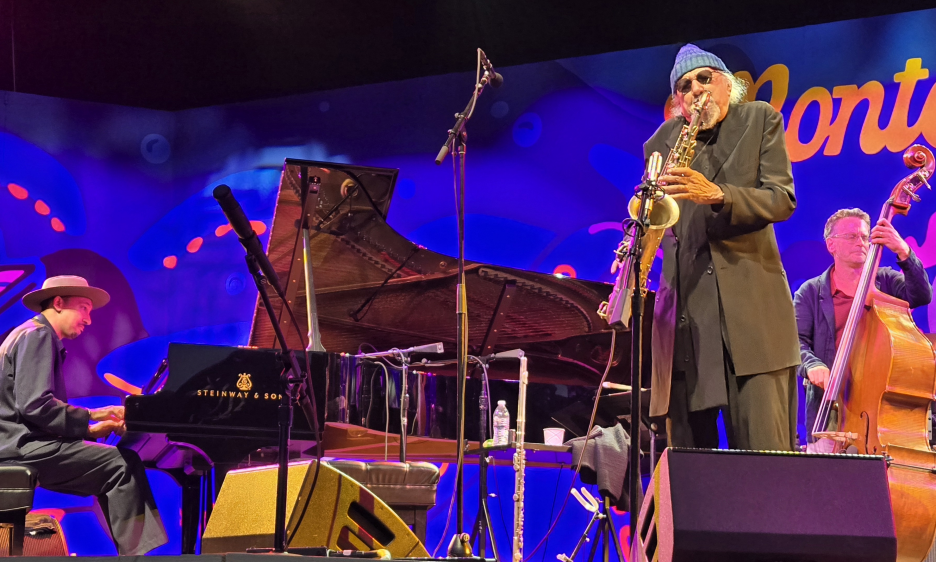
Speaking of festival history, the Fab Duo finale came on the heels of a set from frequent Monterey visitor Charles Lloyd, in town to commemorate the 60th anniversary of his performance of the arena stage which resulted in his million-dollar hit live album Forest Flower: Charles Lloyd at Monterey, on which the centerpiece was his beloved anthem "Forest Flower." Lloyd shrewdly designed his latest Monterey set to culminate with the "Flower," duly stretched out and sent afloat in an ether of major 7th-y good vibes into the Monterey twilight. Lloyd was abetted by a stellar band—the ever-versatile pianist Clayton, who has developed into a fertile oil for Lloyd, bassist Larry Grenadier and the remarkable Brian Blade, who opened the set with a drum solo, in honor of the late great Jack DeJohnette, part of the group that cooked up the original "Forest Flower" on this very stage.
MJF's history was again on the spotlight in a fascinating program dubbed "Monterey Surprise (1958 Throwback)." Clayton served as a fitting music director and curator for a set of tunes by artists who appeared at the original 1958 lineup, such as Dave Brubeck, Billie Holiday, Duke Ellington, as brought respectfully up-to-date by some of the more rewarding present day artists in jazz, Akinmusire, tenor saxophonist Melissa Aldana, Blade and Grenadier in the rhythm section. A vintage-visceral symbiosis shook the Ray Drummond West End stage.
Sounds of old also circulated through the festival's opening set from Jazz at Lincoln Center—featuring the final Monterey performance with founder-leader with Marsalis before he retires from his long-held post at the end of this season. Accordingly, he displayed his organically flowing chops and taste in the first solo of the program on the theme of Jackie McLean's "Appointment in Ghana Again."
Although the crackerjack JALC big band can run a gamut of jazz sub-genres and levels of sophistication, this set played it fairly safe and down-the-middle. The band did venture into original turf on Carlos Henriquez' "Cumbia de Pas" and saxophonist Alexa Tarantino's "The Neutralizer," a sleek vehicle of a chart, but mostly kept the temperature on the conservative side. They also lent deserved spotlights to guest singers, new and established: impressive Young Texan Kate Kortum (remember that name) made of bold impression on Billy Strayhorn's "Daydream" and the Nancy Wilson-covered "Happy Talk;" a more august spotlight went to legend in-the-making Cecile McLorin Salvant.
Her storied pathway to her current lofty standing amongst jazz singers begin a decade ago, partly through the championing of Marsalis and company. Thus, a sense of poetic full circle covered over her performances of "Sentimental Journey" and "Why Don't You Do Right" here.
In fact, McClorin-Salvant was part of a small and elite group of artists at the festival who rose to the top of the list of festival highlights this year, all artists who "happened to be women." In addition to cameo-ing with JALC, McLorin-Salvant showed up to show how respectful but personal Billie Holiday tribute-making is done, in the 1958 group, and later, on the main stage, she impressed (as usual) with her own quartet, with her usual ally Sullivan Fortner replaced by another accomplished pianist, Glenn Zaleski.
Aldana was another woman of note, with various forums around the grounds. She showed up not only in the 1958 episode, but as an alum star from the "Eddie Palmieri Experience" (tribute to the late Latin Jazz pioneer, along with masterful tenor saxophonist David Sánchez), and as leader of her captivating quartet. Her group set confirmed strong impressions of her musical life in progress, with structures beyond just head-solo-head formats for her sensitively intertwined band. Aldana wears her Wayne Shorter-influenced but personally evolved style well.
Another woman artist of rightful renown at MJF's West End Stage was the progressive pianist-leader Kris Davis, with her highly empathic trio featuring formidable allies, bassist Robert Hurst and drummer Johnathan Blake.
Davis' set, in the wake of a new album, Lost in Geneva, was a festival highlight, and also one of the few shows qualifying under the general umbrella of an avant-garde direction (another being the Artifacts Trio, with flutist Nicole Mitchell, cellist Tomeka Reid and drummer Mike Reed). Davis' set included the feverish yet also witty urgings of "Run the Gauntlet," culminating with a feverish drum solo and a cathartic intensity which found the piano grabbing clusters of keys with well-placed forearm jabs on the keys.
I had heard her do this at the North Sea Jazz Festival this summer and I asked her about it after her set. Davis explained, half-joking, "maybe I had this was a way of relieving stress." Worked for me.
I found my stress most effectively relieved this weekend by basking in the splendor of drummer-bandleader Blade's Fellowship Band. The band's subtle gospel overtones harken back to Blade's spiritual nature, as the son of a famed father in the church—Brady L. Blade Sr., pastor of the Zion Baptist Church in Shreveport, Louisiana since 1961. I had heard the Fellowship Band in Monterey a few years ago, but was distracted and in transit: to sit through the organically organized program of a complete show revealed one of jazz' fascinating, unique and emotionally satisfying ensembles.
Of course, Blade's drumming—always in listening ode and in flux, not bound by feels or stock grooves—is a wonder of the known jazz world, but his compositional and conceptual gifts are amply on display in the project. Blade is best known for his sideman work, with Wayne Shorter and others—and in such collaborations as the rich Still Dreaming project, a tribute to Old and New Dreams, with Joshua Redman, the late great Ron Miles and Scott Colley, which also performed in Monterey.
But Blade's Fellowship Band, formed in collusion with pianist Jon Cowherd, dates back to its debut album, produced by Daniel Lanois in 1998. Circa 2026 in Monterey, the band is going strong and in spirited form, featuring proper vibe-capturing saxists Melvin Butler and Myron Walden. File under project deserving wider recognition and love. They got plenty of those qualities from a rapt Monterey crowd.
All in all, MJF 69 delivered its usual musical payload, both reveling in history and showcasing discoveries and hidden and semi-hidden gems within the broad cosmos that is jazz. The tacit axiom here is to offer a weekend sampler implying the message of: "this is jazz, now, and then."
 FOLLOW Josef Woodard
and get notified whenever a new article published.
FOLLOW Josef Woodard
and get notified whenever a new article published.
Josef Woodard is a freelance critic / journalist on the arts, with a focus on jazz. He is also a musician.
About Charles Lloyd
Tags
PREVIOUS / NEXT
Charles Lloyd Concerts
Become a Sustaining Member

Since 1995, All About Jazz has championed jazz as an art form and supported the musicians who create it. Over three decades, it has grown into one of the world's leading jazz resources, serving hundreds of thousands of readers, musicians, presenters and industry professionals each month.
Help Build the Future of All About Jazz
Your support helps us continue building All About Jazz for the next generation—expanding our editorial coverage, preserving jazz history, developing new community features and creating better ways to discover the music and the people behind it.
Become a sustaining member for as little as $20 per year and you'll immediately enjoy an ad-free experience along with access to subscriber features and future articles for a full year.
Together, we're not simply sustaining All About Jazz—we're building its future. Thank you for being part of the journey.