Home » Jazz Articles » So You Don't Like Jazz » Iconic Music in Film: Boomer Edition
Iconic Music in Film: Boomer Edition
Courtesy Screen Capture
Before the 1960s, a "serious" film score usually meant orchestral sweep—Maximilian Schauensteiner, Bernard Herrmann, Miklós Rózsa, that whole grand tradition. Then something happened. Popular music stopped being background flavor and became the emotional engine of the movies themselves. A needle-drop could tell you who a character was, where America was headed, and what a generation was feeling before a line of dialogue was spoken.
This list isn't meant to be definitive, and it certainly isn't a ranking. These are twelve moments where the right piece of music met the right film and suddenly seemed larger than either one.
1. Eumir Deodato, "Also Sprach Zarathustra"—Being There (1979)
It takes a certain amount of nerve to funk up Richard Strauss, and even more nerve to make it work. Eumir Deodato 's 1973 CTI recording of "Also Sprach Zarathustra," sometimes billed as "Also Sprach Zarathustra (2001)," could easily have been a novelty record. Instead it became one of the great crossover statements of the early fusion era.Deodato didn't mock Strauss' famous fanfare; he relocated it. The grand, mountain-top proclamation of the original becomes something sleek, urban, and rhythmically alert. The arrangement keeps the cosmic drama but gives it a Fender Rhodes shimmer, a groove, and that polished CTI sheen. With musicians such as John Tropea on guitar, Ron Carter and Stanley Clarke associated with the sessions, Billy Cobham on drums, Airto Moreira and Ray Barretto in the percussion orbit, the track sits right at the intersection of jazz, funk, studio craft, and pop accessibility.
In Being There, the Deodato version has a special kind of irony. Peter Sellers' Chance the Gardener walks into the corridors of Washington power with no real understanding of the world around him, yet the music makes his entrance feel almost mythic. That is the joke, of course, but it is also the brilliance. The film uses this once-lofty Strauss theme—already transformed by Kubrick in 2001—and filters it through 1970s fusion cool.
Deodato's single was not some underground jazz curiosity either. It became a major pop hit in 1973, reaching the upper end of the Billboard chart and winning a Grammy. For listeners who had grown up with classical music on one side and soul, rock, and jazz on the other, Deodato made the case that those categories were far less stable than people thought.
2. Isaac Hayes, "Theme from Shaft"—Shaft (1971)
It is hard now to imagine just how radical "Theme from Shaft" sounded coming out of movie speakers in 1971. Isaac Hayes didn't merely write a theme song; he created a complete sonic identity for a new kind of screen hero.That opening hi-hat pattern is already a city at night. Then comes Charles "Skip" Pitts' wah-wah guitar, one of the most recognizable guitar figures in American film music. Hayes' spoken introduction—"Who's the Black private dick that's a sex machine to all the chicks?"—isn't a gimmick. It is character exposition, attitude, and rhythm all at once. By the time the horns arrive, John Shaft has already entered the room.
Hayes' background at Stax mattered enormously. He understood groove, repetition, and dramatic build. But he also had a real arranger's ear. The track has the confidence of soul music, the sweep of a film score, and the sly sophistication of big-band writing. The strings don't sweeten the funk; they sharpen it. The horns don't just punch accents; they help build a whole urban mythology.
"Theme from Shaft" won the Academy Award for Best Original Song, making Hayes the first Black composer to win an Oscar in a non-acting category. That fact matters, but so does the record itself. This was not Hollywood borrowing soul music as decoration. This was soul music taking command of the screen.
For boomer audiences, especially in the early 1970s, Shaft arrived at a moment when Black popular music was expanding in every direction—Marvin Gaye, Curtis Mayfield, Sly Stone, Stevie Wonder. Hayes proved that funk could carry cinematic weight equal to any symphonic score.
3. Bee Gees, "Stayin' Alive"—Saturday Night Fever (1977)
The Bee Gees did not invent disco, but with "Stayin' Alive" they helped define its most durable architecture. The record is so familiar that it is easy to miss how strange and expertly constructed it is.At the center is a groove that feels both human and mechanical. The famous drum track was built from a loop of Dennis Bryon's playing—an inspired bit of studio problem-solving by the Bee Gees' production team of Barry, Robin, and Maurice Gibb with Albhy Galuten and Karl Richardson. Long before digital looping became ordinary studio practice, "Stayin' Alive" had that hypnotic, perfectly repeating pulse that made the track feel inevitable.
Harold Cowart's bass line gives the song its strut. The guitars scratch and chatter without overcrowding the arrangement. The strings provide cinematic lift, while the Gibb brothers' falsetto harmonies float above the track like neon light. The whole thing is leaner than people remember. It is not a wall of sound in the John Tropea sense; it is more like a carefully engineered dance machine, every part locked into place.
What often gets lost in disco backlash is how sophisticated the writing could be. The Bee Gees were masters of harmonic tension, and their vocal arrangements often contain passing colors and suspensions that would not embarrass a jazz vocal group. The emotional content is also darker than the beat suggests. "Life goin' nowhere, somebody help me" is not exactly escapist fluff.
That is why the song works so well in Saturday Night Fever. Tony Manero's walk down the Brooklyn sidewalk is funny, stylish, and iconic, but underneath the swagger is desperation. "Stayin' Alive" is not just about dancing. It is about survival in platform shoes.
4. Earth, Wind & Fire, "That's the Way of the World"—That's the Way of the World (1975)
The movie That's the Way of the World never became as famous as the music attached to it, which is one of those cases where the soundtrack completely outran the film. Harvey Keitel starred, Earth, Wind & Fire appeared as the fictional group. After seeing the screening, Verdine White was worried the film might kill their upcoming debut album. Thankfully, their label was all in on the group, and their album became one of the most celebrated and spiritually generous albums of the decade.The title track is not a protest song in the conventional sense, but it carries the weight of the mid-1970s. Post-Watergate, post-Vietnam, with the economy tightening and the old promises looking shaky, Earth, Wind & Fire offered something rare: optimism that did not sound naïve.
Maurice White's vocal has a preacher's calm, but the arrangement is pure ensemble sophistication. Verdine White's bass gives the song buoyancy, the electric piano glows, and the Phoenix Horns—players such as Don Myrick, Louis Satterfield, Rahmlee Michael Davis, and Michael Harris—function almost like a second vocal group. The horns don't merely decorate the track; they comment, answer, and lift.
Charles Stepney's role in the Earth, Wind & Fire sound cannot be overstated. He brought orchestral imagination to R&B without making it stiff. The result is music that feels arranged but never overdetermined. There is space for air, rhythm, spirit.
For jazz listeners, Earth, Wind & Fire's best records have always offered plenty to admire: sectional writing, harmonic movement, rhythmic layering, and soloistic personality inside a pop framework. "That's the Way of the World" is a reminder that sophistication and sincerity do not have to cancel each other out.
5. Santana, "Soul Sacrifice"—Woodstock (1970)
The Woodstock film preserved many legendary performances, but Santana's "Soul Sacrifice" still feels like one of the great revelations. At the time of the festival, Santana was not yet a household name. Their debut album would arrive shortly afterward. For many viewers, the film was the first time they saw this band, and what they saw was a new musical language being born in real time."Soul Sacrifice" is usually filed under rock, which is fair enough, but it is also one of the most jazz-inflected moments in the entire Woodstock documentary. The rhythm foundation comes from Latin music, especially the clave-based vocabulary that Santana absorbed from Afro-Cuban and Latin jazz traditions. Michael Carabello and José "Chepito" Areas give the percussion its fire, while bassist David Brown and organist Gregg Rolie keep the center from flying apart.
Carlos Santana's guitar does not behave like a typical late-1960s blues-rock guitar. His tone sings, sustains, and bends with a vocal quality that owes as much to horn players and singers as to guitarists. He has often spoken of his love for John Coltrane, Miles Davis, and Gabor Szabo, and you can hear that in the way he phrases: long arcs, repeated cries, sudden bursts of heat.
Then there is Michael Shrieve, barely out of his teens, playing one of the most famous drum solos in rock-film history. It is not just athletic. It is conversational. The band gives him room, he takes it, and then the whole performance snaps back into collective motion.
For boomer audiences, this was the thrill of genre boundaries dissolving. Latin, blues, jazz, rock, and psychedelia were not separate compartments. They were different dialects of the same search.
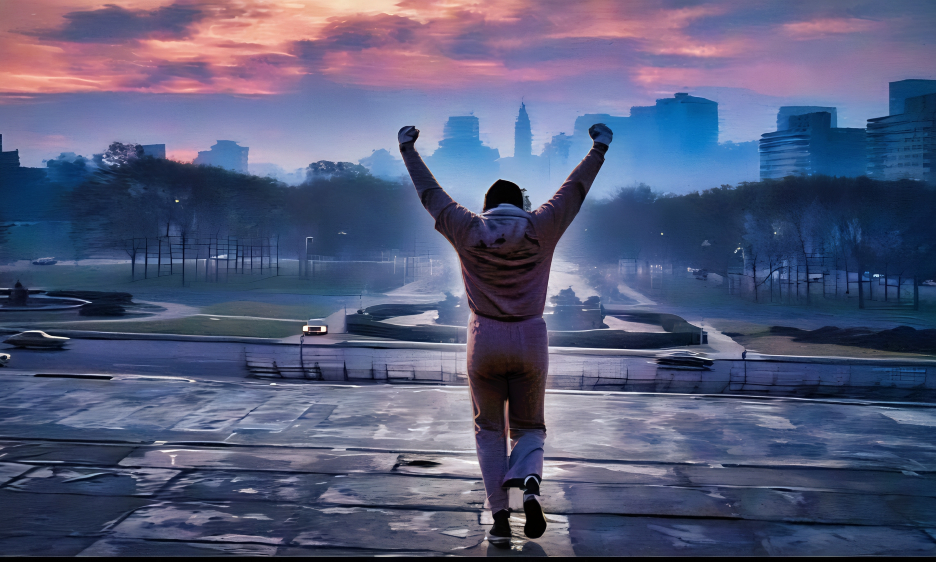
6. Bill Conti, "Redemption"—Rocky II (1979)
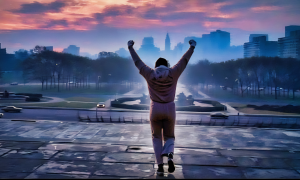
Bill Conti's original Rocky score gave the 1970s one of its great underdog themes in "Gonna Fly Now." By the time of Rocky II, the emotional terrain had changed. The first film was about discovery and dignity. The second film had to deal with aftermath: expectation, disappointment, pride, injury, marriage, fatherhood, and the burden of being asked to become a symbol."Redemption" works because Conti does not simply repeat the original triumph. He darkens the palette. The minor-key material gives the music a reflective quality, and when the score moves toward uplift, it feels earned rather than assumed. Conti understood that the Rocky story was never really about winning a boxing match. It was about whether a man could absorb punishment—physical, emotional, economic—and still remain recognizable to himself.
There is a jazz-adjacent quality to Conti's best writing, not because it is jazz in any strict sense, but because of how it handles emotional motion. The themes often move like standards: tension to release, melancholy to affirmation, private doubt to public declaration. The brass writing, especially the trumpet colors associated with the Rocky sound, carries a lonely, street-corner nobility.
In the context of late-1970s America, that mattered. The easy optimism of earlier decades had taken a beating. Rocky II did not promise that life was fair. It suggested that endurance itself could be a kind of grace.
7. Richard Strauss, "Also Sprach Zarathustra"—2001: A Space Odyssey (1968)
Stanley Kubrick's use of Richard Strauss' "Also Sprach Zarathustra" in 2001: A Space Odyssey is one of those decisions that now feels inevitable, though it was anything but. He took the opening "Sunrise" section of Strauss' 1896 tone poem and placed it against images of planets, alignment, birth, technology, and human evolution. In doing so, he changed how millions of people heard the piece.Kubrick did not arrange it, modernize it, or soften it. He trusted the original recording's monumental force. The organ pedal, trumpets, timpani, and rising harmonic architecture do exactly what the film requires: they announce not merely an event, but a threshold. Something is beginning, or perhaps beginning again.
The famous opening had already been programmatic music—Strauss responding to Nietzsche and the idea of human ascent—but Kubrick gave it a new mythology. After 2001, those opening bars no longer belonged only to late-Romantic Europe. They belonged to space, cinema, evolution, and the strange optimism of the Apollo age.
The timing is crucial. 2001 appeared in 1968, the same year Apollo 8 carried human beings into lunar orbit. Science fiction was no longer just fantasy. The future had become a schedule. Kubrick's use of Strauss made that future feel philosophical rather than merely technological.
Jazz musicians and listeners have often admired Kubrick's musical instincts because he understood placement, contrast, and silence. He knew that a pre-existing piece could improvise a new meaning when placed in the right cinematic context.
8. The Soggy Bottom Boys, "I Am a Man of Constant Sorrow"—O Brother, Where Art Thou? (2000)
Strictly speaking, O Brother, Where Art Thou? falls outside the classic boomer-era timeline, but it belongs here because of what it awakened. The soundtrack reintroduced a mass audience—many of them boomers—to an older American musical vocabulary: old-time music, bluegrass, gospel, blues, work songs, and mountain harmony."I Am a Man of Constant Sorrow" has a tangled folk history. The song is commonly associated with Dick Burnett, who published a version in the early twentieth century, and it circulated widely through oral tradition before and after its early commercial recordings. By the time Dan Tyminski sang lead on the O Brother version, the song already carried nearly a century of accumulated memory.
The record's power comes from how lovingly T Bone Burnett and the musicians avoided museum-piece stiffness. Tyminski's lead vocal has grain and authority, while Harley Allen and Pat Enright's harmonies give the Soggy Bottom Boys their deceptively casual blend. Players such as Stuart Duncan helped create an acoustic sound that felt rooted without becoming antiquarian.
Jazz fans should have no trouble understanding the appeal. Bluegrass and jazz share a great deal: instrumental virtuosity, ensemble responsiveness, regional identity, and the thrill of hearing musicians negotiate structure and freedom in real time. A good bluegrass band, like a good jazz group, is a conversation.
The surprise success of the O Brother soundtrack proved that American roots music still had commercial and emotional power. It helped prepare the ground for the Americana revival and reminded listeners that "old" music is not necessarily nostalgic. Sometimes it is unfinished business.
9. The Beatles, "A Hard Day's Night"—A Hard Day's Night (1964)
Has any opening chord in pop music produced more analysis than the first crash of "A Hard Day's Night?" It lasts barely a moment, but it announces an entire era: bright, dissonant, jangling, modern, and slightly out of control.The sound comes from The Beatles and George Martin working as a unit: George Harrison's 12-string Rickenbacker, John Lennon's rhythm guitar, Paul McCartney's bass, Ringo Starr's cymbal and drum attack, and Martin adding piano color. Scholars and engineers have pulled the chord apart for decades, but its real magic is emotional. It sounds like a door being kicked open.
As a song, "A Hard Day's Night" is compact and efficient, but there is nothing simple-minded about it. Lennon's vocal phrasing carries the influence of American R&B, while McCartney's melodic answering lines and Ringo's forward-driving feel give the record its momentum. George Harrison's 12-string sound would soon ripple through folk-rock, especially the Byrds.
The film itself was just as important. Richard Lester's black-and-white direction borrowed from Beatles documentary style, the French New Wave, and British comedy, creating a pop film that did not feel like a stiff promotional vehicle. The Beatles were not presented as polished movie idols. They were quick, funny, restless, and slightly anarchic.
For jazz listeners, George Martin's production philosophy is the bridge. He treated the studio not as a neutral recording space but as an active musical partner. That idea would soon matter enormously to rock, soul, and jazz-fusion production. "A Hard Day's Night" is pop, certainly, but it is also studio modernism in two minutes and change.
10. Ennio Morricone, themes from the "Dollars Trilogy"—A Fistful of Dollars, For a Few Dollars More, The Good, the Bad and the Ugly (1964-1966)
Ennio Morricone changed the sound of the western by refusing to behave as if he were scoring a traditional western. The Hollywood model had been wide-screen orchestral grandeur: strings, brass, heroic themes, open plains. Morricone gave Sergio Leone something stranger—whistles, electric guitar, whip cracks, bells, ocarina, wordless voices, and percussion that seemed to come from both the desert and a recording studio laboratory.The famous whistle in The Good, the Bad and the Ugly—performed by Alessandro Alessandroni—functions almost like a character. It is lonely, mocking, and instantly memorable. The electric guitar, often twanged and reverberant, brings the western into the rock era without making it contemporary in any obvious way. The result feels ancient and futuristic at the same time.
Morricone's genius was not minimalism alone. He could move from near-silence to overwhelming grandeur. "The Ecstasy of Gold," with Edda Dell'Orso's soaring wordless vocal and the gradual orchestral build, is one of the great examples of cinematic escalation. It begins in suspense and ends in a kind of fevered transcendence.
The jazz connection lies partly in Morricone's use of space. He understood that a sound placed against silence can be more powerful than a full orchestra roaring from beginning to end. Like a great improviser, he knew when not to play. He also had an arranger's fascination with timbre—how a whistle, a guitar, a bell, or a human voice could carry meaning beyond melody.
After Morricone, film composers had permission to think differently. A score could be sparse, eccentric, popular, experimental, and unforgettable all at once.
11. Steve Vai, "Eugene's Trick Bag"—Crossroads (1986)
The guitar duel at the end of Crossroads is gloriously over the top, and that is part of its charm. The movie is a blues fable filtered through 1980s guitar-hero mythology: Robert Johnson, the crossroads legend, the devil's bargain, and then, suddenly, high-velocity neoclassical shredding.Steve Vai's role was central. He appeared onscreen as Jack Butler, the devil's guitarist, and recorded the electric guitar parts for the climactic duel. Ry Cooder handled much of the film's blues-rooted guitar language elsewhere, which is one reason the movie has more musical credibility than its fantasy premise might suggest.
"Eugene's Trick Bag," composed by Vai, is famously built around Paganini's Caprice No. 5, not Caprice No. 24 as is sometimes misstated. The joke, and the thrill, is that the hero defeats the demonic rock virtuoso by answering with classical firepower of his own. It is blues mythology colliding with conservatory technique and 1980s hot-rod guitar.
What makes the scene work musically is its call-and-response structure. One guitarist states a challenge, the other answers. The phrases escalate, mutate, and become more absurdly demanding. That competitive dialogue is older than rock guitar. You can hear versions of it in cutting contests, jazz battles, blues exchanges, and gospel shout traditions.
For boomer guitar fans who had lived through Clapton, Hendrix, Beck, Page, Duane Allman, and Eddie Van Halen, Vai represented another stage in the evolution: frightening technique, theatrical confidence, and a composer's sense of structure. "Eugene's Trick Bag" may be a stunt, but it is a beautifully executed stunt.
12. Steppenwolf, "Born to Be Wild"—Easy Rider (1969)
"Born to Be Wild" was not written for Easy Rider, but it might as well have been. Mars Bonfire wrote the song, Steppenwolf recorded it in 1968, and Dennis Hopper's film made it inseparable from motorcycles, open highways, and the uneasy promise of American freedom.The opening riff is wonderfully blunt. It sounds like an engine turning over, which is exactly what the film needed. John Kay's vocal is not subtle, but subtlety would have been wrong. "Get your motor runnin'" is less a lyric than a command. The phrase "heavy metal thunder" would later take on a life of its own, but in the song, it still feels physical: machine, road, weather, danger.
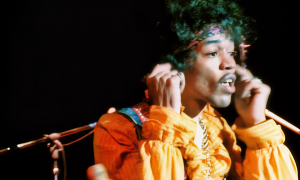
The brilliance of the Easy Rider soundtrack is that no single style explains America. Steppenwolf brings biker rock. The Byrds bring folk-rock shimmer. Jimi Hendrix brings psychedelic blues with "If 6 Was 9." The Holy Modal Rounders bring oddball countercultural color. Jack Nitzsche contributes scoring that helps bind the fragments. In the film, music becomes a map of a divided country.
Easy Rider is often remembered for its dark ending, but the soundtrack preserves something more complicated than despair. It captures the exhilaration of movement, the beauty of landscape, and the fragile hope that freedom might still be found somewhere beyond the next bend in the road.
There is even a jazz-like quality in the film's loose structure. Hopper and Peter Fonda's characters seem to drift, respond, and discover rather than march through a conventional plot. The movie moves like a jam: uneven at times, inspired at others, but alive to accident.
"Born to Be Wild" endures because it reduced a generational fantasy to a riff, a beat, and a few words. The dream was simple. The country was not.
Those are a dozen that came to mind, but I'm sure I missed lots of other possibilites—share your favorite in the comments.
 FOLLOW Alan Bryson
and get notified whenever a new article published.
FOLLOW Alan Bryson
and get notified whenever a new article published.
An American based in Europe, fascinated by the art of tone, drawn to the muse of the blues.
Tags
PREVIOUS / NEXT

Become a Sustaining Member

Since 1995, All About Jazz has championed jazz as an art form and supported the musicians who create it. Over three decades, it has grown into one of the world's leading jazz resources, serving hundreds of thousands of readers, musicians, presenters and industry professionals each month.
Help Build the Future of All About Jazz
Your support helps us continue building All About Jazz for the next generation—expanding our editorial coverage, preserving jazz history, developing new community features and creating better ways to discover the music and the people behind it.
Become a sustaining member for as little as $20 per year and you'll immediately enjoy an ad-free experience along with access to subscriber features and future articles for a full year.
Together, we're not simply sustaining All About Jazz—we're building its future. Thank you for being part of the journey.