Home » Jazz Articles » So You Don't Like Jazz » Sonic Loops: Eight Miles High on the Psychedelic Trane
Sonic Loops: Eight Miles High on the Psychedelic Trane
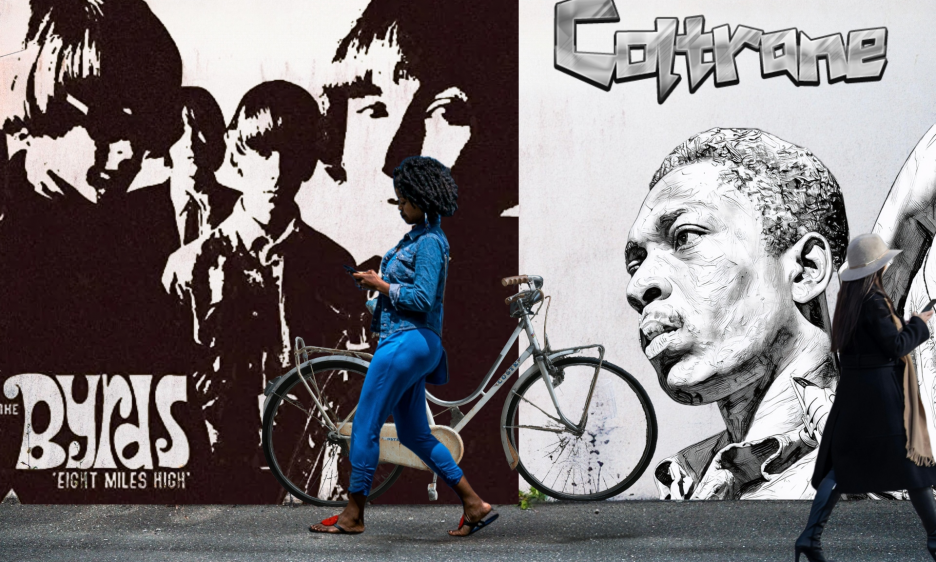
Courtesy Stock collage

This group dynamic helped shift popular music away from the dance-oriented 45-rpm single back toward the deeper, more immersive 33-rpm album, turning listening into a serious, repeated engagement. The transistor radios and low-fidelity 45-rpm record players were replaced with high-fidelity stereo setups. The modern rock group carried a clear set of characteristics. It rejected the "somebody and the whatevers" model that had dominated the '50s, where a charismatic frontman stood at the microphone while hired hands provided the backing. Instead, members shared a collective identity that felt more democratic, at least in presentation. They wrote and arranged their own material, traded lead vocals and rich harmonies, handled their own instruments on stage and (increasingly) in the studio, and projected a cohesive lifestyle or generational statement. The group itself became the brand, the auteur, and the institution—empowering artists against traditional industry hierarchies and opening the door to greater creative autonomy.
The Beach Boys: Arguably America's First Self-Contained Group
Long before Beatlemania swept America in February 1964, the The Beach Boys were already functioning as a genuine self-contained unit. Formed in 1961 by the Wilson brothers, their cousin Mike Love, and friend Al Jardine, the band operated as a family-and-friends garage collective that wrote, arranged, harmonized, and performed its own material. From the earliest surf hits—"Surfin' Safari," "Surfin' U.S.A.," and "Surfer Girl"—they projected a democratic brotherhood and a distinct West Coast lifestyle that felt authentic rather than manufactured. Their ability to deliver high-energy shows night after night culminated in the landmark Beach Boys Concert (Capitol, 1964) album, which topped the Billboard 200—the first live album by a rock group to reach No. 1. This combination of songwriting autonomy, vocal interplay, instrumental performance, and group identity made them the clearest American prototype of the modern nationally successful rock band.Their quieter moments revealed the depth this new format enabled. "In My Room," recorded in July 1963 and released that September—fully four to five months before the The Beatles landed at JFK—showed the group moving beyond party anthems toward introspective, harmony-rich balladry. "The Warmth of the Sun," recorded in early January 1964 and released in March, was released in the very first weeks of the British Invasion. Yet it already displayed a sophisticated melancholy and emotional vulnerability that felt a whole level above the exuberant simplicity of early Beatles singles such as "I Want to Hold Your Hand." These tracks demonstrated that the self-contained group model could support both commercial hits and more personal, album-oriented listening experiences.
Despite their vastly different images—one sunny, suburban, and rooted in California youth culture; the other cosmopolitan, irreverent, and shaped by the gritty energy of Liverpool and London—the Beach Boys and the Beatles did not treat each other as adversaries in any hostile sense. Instead, they engaged in a remarkably respectful and mutually inspiring dialogue. Across oceans they seemed to appreciate each other's musical prowess and contrasting aesthetics. Brian Wilson has described the exchange not as competition but as "mutual inspiration," with each band spurring the other toward greater ambition and innovation. This creative back-and-forth unfolded largely through the records themselves, creating one of the most fertile artistic exchanges in popular music history.
The dialogue reached a notable peak with the Beach Boys' Pet Sounds (Capitol, 1966). Widely regarded as Brian Wilson's masterpiece of emotional depth, intricate harmonies, and sophisticated studio craft, the album was directly inspired by the Beatles' Rubber Soul (Parlophone, 1965). Paul McCartney, in turn, has repeatedly credited Pet Sounds as a major catalyst for the Beatles' Sgt. Pepper's Lonely Hearts Club Band (Parlophone, 1967). He played the record obsessively for the band and later reflected that it raised the bar so high he wondered, "What the hell are we going to do?" The result was the Beatles' own leap into conceptual ambition and sonic experimentation. The two groups even crossed paths spiritually in 1968 when Mike Love of the Beach Boys joined the Beatles at Maharishi Mahesh Yogi's ashram in Rishikesh, India, for Transcendental Meditation training.
The Beach Boys' influence went well beyond the Beatles. In a 1998 interview with Bob Mills, Eric Clapton recalled first encountering their music while playing gigs with the Yardbirds (or John Mayall), when a DJ dropped "I Get Around" and it blew them away—they thought, well, "It's over." He went on to describe the Beach Boys' deeper impact: "We were forming Cream when Pet Sounds (Capitol, 1966) came out. Actually that became the primary influence for a lot of the songwriting. We couldn't get it, but we would listen to that album non-stop." As a self-contained power trio of virtuoso musicians who wrote, arranged, and performed their own material with collective identity and album-length ambition, Cream embodied the very rock-group model the Beach Boys had prototyped in America. Clapton's acknowledgment underscores how Brian Wilson's innovations rippled across the Atlantic, shaping not only the Beatles but the broader British rock scene.
The Jazz Hook
Jazz had actually anticipated aspects of this collective spirit well before rock discovered it. The Modern Jazz Quartet, formed in 1952, stands as one of the foremost examples. Billed simply as the MJQ rather than "John Lewis and...," the four musicians operated as equal partners in a formal corporation. They submerged individual egos into a refined, chamber-like sound that blended cool jazz with classical influences and counterpoint. Their longevity and critical respect demonstrated that a small ensemble could function as a sustained artistic collective without relying on a dominant star. Other jazz units, from the Jazz Crusaders (later simply the Crusaders) in the '60s to various AACM collectives, similarly emphasized democratic interplay and shared creative control—yet they remained overwhelmingly instrumental.Jazz explored collective democracy with great sophistication, but it rarely integrated traded lead vocals, rich group harmonies, and broad youth-culture accessibility in the same package that rock would soon deliver. What rock accomplished in the '60s was to vocalize and broadly market this group ideal, creating a template that eventually looped back to enrich jazz itself. The youthful energy, lifestyle packaging, and album-oriented ambition of the self-contained rock band influenced the first wave of jazz-rock fusion in the late '60s and early '70s. Ensembles such as Weather Report and the Mahavishnu Orchestra adopted collective identities, fluid roles, original composition, and immersive studio explorations—qualities that echoed the rock-group ethos of shared sovereignty and deeper listening experiences. In this way, rock did not simply borrow from jazz; it helped reshape the very notion of what a working musical ensemble could achieve.
This cross-pollination extended beyond fusion into Black American music of the era, where ensemble traditions of harmonic power and collective performance were already evolving. The The Isley Brothers brought raw, gospel-rooted group energy to the early '60s with their explosive 1962 hit "Twist and Shout"—a call-and-response showcase that the Beatles had already been covering in their high-energy Hamburg club sets as early as 1962. The Isley Brothers were well aware of the Beatles' version during the height of Beatlemania, and no doubt realized that song's raw vitality had directly inspired the Beatles. Touring with backing musicians (including a young Jimi Hendrix on guitar in 1964), the Isley trio kept the vocal and performative center as a tight family unit. Eventually in the '70s, after numerous iterations, the Isley Brothers became a "group" with hits such as "That Lady" and a hit cover of "Summer Breeze." Similarly, the The Chambers Brothers transitioned from gospel and folk to psychedelic soul, adding white drummer Brian Keenan in 1965 to become one of the first prominent interracial bands; their extended 1967-68 epic "Time Has Come Today" blended group harmonies, improvisation, and social urgency into a true album-oriented statement.
Another intriguing chapter in this saga was Earth, Wind & Fire. Formed in 1969 by Maurice White, a former drummer with the Ramsey Lewis, the band grew out of Chicago's jazz, soul, and session scene. White infused the group with jazz-trained musicianship and a visionary collective approach, blending intricate horn arrangements, tight vocal harmonies, funk grooves, and spiritual themes into a unified sound. While celebrated primarily as a pioneering R&B/funk ensemble with strong jazz-fusion elements, Earth, Wind & Fire fully embodied many self-contained group traits: shared identity, multi-instrumental versatility, traded vocals, and spectacular live performance as a cohesive entity. Earth, Wind & Fire thus stands as one of the most successful Black-led ensembles to fully internalize and evolve the '60s group dynamic into new hybrid territory. Their 1974 collaboration with Ramsey Lewis on the album Sun Goddess (Columbia, 1974)—featuring several EWF members and yielding the hit title track—beautifully symbolizes the ongoing conversation between jazz roots and the expansive group model that rock had helped normalize across genres.
While the Beach Boys arguably established the template for America's first fully self-contained rock group—writing, arranging, performing, and projecting a unified identity from their Hawthorne garage—the Beatles represented something equally transformative. As the first British act—and effectively the first international act—to dominate the American charts with multiple number one singles, they globalized popular music. Yet even within their own ranks, the songwriting dynamic was distinctive: the Lennon-McCartney partnership was not only deeply collaborative but also intensely competitive, spurring a level of prolific output that left limited room on albums even for a gifted composer like George Harrison.
In this light, the mid-'60s unfolded as a remarkable three-way exchange between Brian Wilson and the Lennon-McCartney team, each side listening closely and responding with ever-greater ambition. What began as a transatlantic dialogue between contrasting aesthetics soon drew in a wider circle of highly creative bands. Covering the Beatles proved notoriously difficult; their arrangements often felt so complete that few could meaningfully outdo them with the same material. Yet the later jazz-influenced Earth, Wind & Fire managed exactly that.
The Beatles had never released "Got to Get You Into My Life" as a single, but Earth, Wind & Fire transformed the track—complete with its original George Martin horn arrangement—into fluid, funky new heights. The cover reached No. 1 on the Billboard Hot Soul Singles chart and No. 9 on the Hot 100, and Paul McCartney himself praised it as one of the best Beatles covers he had ever heard. In doing so, they showcased Black ensemble mastery and claimed fresh territory in the very musical space the conversation had opened. The result was a rich legacy that birthed dozens of influential groups and profoundly shaped the direction of popular music across genres for decades to come.
Group Legacy
This remarkable 30-plus-year period of the self-contained group—roughly spanning the mid-'60s through the mid-'90s—saw bands regularly occupying 40 to 55 percent of chart positions in the United States, their democratic interplay and collective identity shaping the sound and spirit of popular music. That era has now largely given way to a different landscape. By 2023, bands accounted for just four percent of Hot 100 chart spots, with zero reaching No. 1 that year and only a handful of weeks at the top across the entire first half of the 2020s—compared to more than 140 weeks in both the early '80s and early '90s. On streaming platforms like Spotify, among the top 400 most-listened-to artists, only a tiny fraction are bands formed in the last 10 years.The dominant figures of the 21st century, according to Billboard recaps, have been overwhelmingly solo artists: Taylor Swift has towered over yearend and overall charts, joined by names such as Drake, Beyoncé, The Weeknd, and Rihanna. Even successful recent "groups" remain rare exceptions, often in the form of polished K-pop collectives or occasional standouts like Måneskin, while many boy bands and girl groups from earlier decades ultimately splintered into even bigger solo careers.
In this sense, popular music has quietly looped back toward an earlier model—one centered on individual stars, with producers and labels operating more prominently in the background. Yet a surprising counter-trend has emerged among serious music lovers of later generations, particularly Gen Z listeners raised on streaming. Many have embraced vinyl LPs with genuine enthusiasm, driving nearly two decades of steady growth in the format and pushing U.S. vinyl revenue past $1 billion in 2025. These younger fans often turn not only to contemporary releases but to the rich catalog of groups from the later part of the 20th century, drawn to the tangible ritual of the album experience, the depth of liner notes, and the immersive, harmony-layered sound that self-contained ensembles delivered so naturally.
In the end, the legacy of that mid-'60s dialogue—sparked by the Beach Boys' garage-born prototype and amplified through the transatlantic exchange with the Beatles and beyond—continues to resonate. What began as a sunny suburban experiment in collective creativity helped normalize the idea of the self-contained ensemble across genres, leaving behind a body of work that still invites deeper listening whenever audiences seek something greater than any single voice.
Loops Flow in a Circle
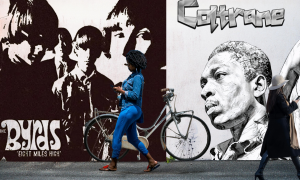
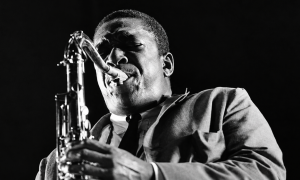
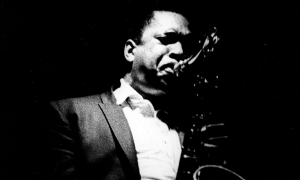
While rock groups in the '60s were indeed a creative catalyst, during this time the creative loops between rock and jazz always circulated. To the best of their abilities, rock players eagerly absorbed jazz influences, improvisational freedom, and ensemble interplay. Jazz fed off rock melodies, energy, and structure. Nowhere is this reciprocal exchange more vivid—or more surprising—than in the birth of psychedelic rock itself. Aficionados may debate the origins of psychedelic rock, but in terms of the first psychedelic hit songs, the Byrds' "Eight Miles High" is widely regarded as one of the first true psychedelic rock singles.David Crosby was a John Coltrane fan before the Byrds existed. Crosby (while very high) saw Coltrane at McKie's on Chicago's South Side around 1963/64. Coltrane played an intense solo, walked offstage still playing, and continued in the bathroom (where the acoustics were good). The performance overwhelmed Crosby so much that it felt like "my brain ran out my nose." He has described it as a transformative, almost spiritual encounter that deeply affected his musical outlook.
In 1965, as the Byrds toured the United States, David Crosby brought along a cassette that became the band's constant companion on the bus: recordings of John Coltrane's Africa/Brass (Impulse! Records, 1961) and Impressions (Impulse! Records, 1963), particularly the track "India," on one side, Ravi Shankar's ragas on the other. The tape was played relentlessly. Out of that immersion emerged "Eight Miles High." Roger McGuinn has described the song explicitly as "a tribute to John Coltrane" and "our attempt to play jazz." He adapted the recurring modal motif from Coltrane's "India" onto his twelve-string Rickenbacker, creating the track's signature droning guitar lines and exploratory solo.
The loop continues as this was Coltrane's attempt to translate the spiritual depth and scalar intricacy of Indian classical music through the saxophone. During the Byrds' first trip to England in August 1965, Crosby brought along a Ravi Shankar album in his suitcase. He gave it to George Harrison, who was immediately intrigued, and the rest is musical history. Thus the mid-'60s dialogue between the Beach Boys, the Beatles, and their peers did more than redefine popular music; it helped set in motion a broader conversation across genres whose echoes are still heard today.
About John Coltrane

Tags
PREVIOUS / NEXT


Become a Sustaining Member

Since 1995, All About Jazz has championed jazz as an art form and supported the musicians who create it. Over three decades, it has grown into one of the world's leading jazz resources, serving hundreds of thousands of readers, musicians, presenters and industry professionals each month.
Help Build the Future of All About Jazz
Your support helps us continue building All About Jazz for the next generation—expanding our editorial coverage, preserving jazz history, developing new community features and creating better ways to discover the music and the people behind it.
Become a sustaining member for as little as $20 per year and you'll immediately enjoy an ad-free experience along with access to subscriber features and future articles for a full year.
Together, we're not simply sustaining All About Jazz—we're building its future. Thank you for being part of the journey.