Home » Jazz Articles » So You Don't Like Jazz » Jimi Hendrix: Showman and Sculptor
Jimi Hendrix: Showman and Sculptor
Courtesy YouTube
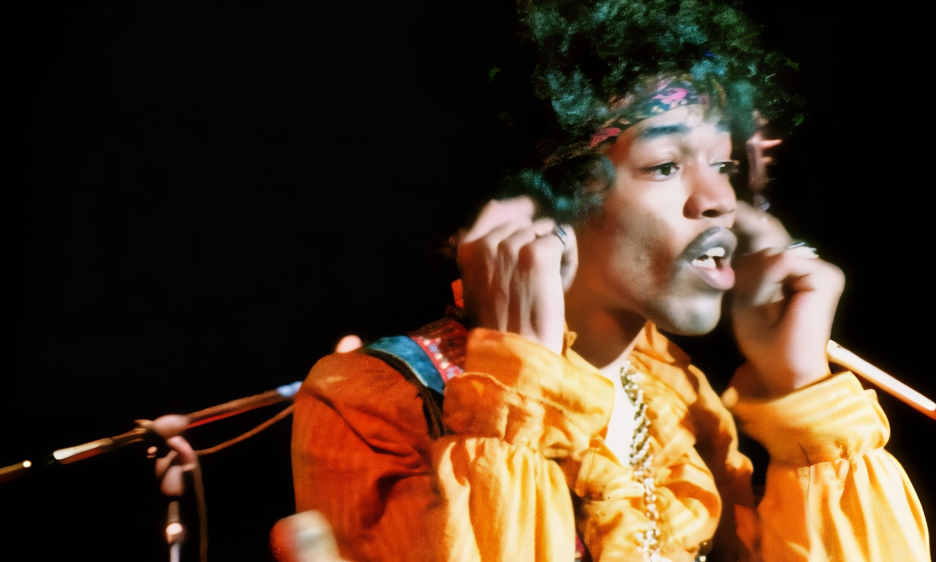
On a cool March 10th afternoon in 1968, my teenage buddies and I were among the 4000 ticket holders at the sold-out early show of the The Jimi Hendrix Experience. (There is actually a bootleg recording out there of the evening show.) It was a particularly tumultuous moment in time. A few weeks later Washington became a war zone after the assassination of Dr. Martin Luther King Jr., followed in June by the assassination of Robert F. Kennedy, and then by the late summer riots in Chicago. There was a palpable tension in the air that day, and for the rest of 1968.
The Washington Post's star reporter Jim Hoagland described the Hendrix experience for the Washingtonians who missed it: "wildly sexual gyrations" and "to-hell-with-it attitude," noting that the "22-year-old guitarist" [sic—actually 25] was "more evil than Elvis ever dreamed of being—and the teenagers know that it infuriates their parents." Hoagland also called him the "P.T. Barnum of rock," and it was indeed obvious to anyone there that Hendrix knew exactly what his audience craved.
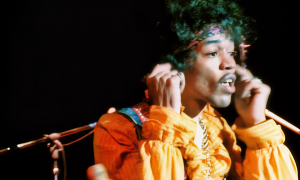
When the doors opened, there were rows of policemen with heavy wool coat uniforms and hats, standing along the walls, seemingly ready to pounce. The air crackled with tension even before Hendrix came out, and it quickly took on an ominous feel once he took the stage. He went to the mic and acknowledged the police presence: "This is for the boys in the penguin suits," and then proceeded to use his Strat as a phallus as he had virtual intercourse with his stack of Marshall amps. That was accompanied by the wail of a deafening sonic wall being erected—you felt it and heard it—there was no law on the books to forbid that volume, but combined with the visual it was beyond provocative. I vividly recall looking at the face of a cop nearby and anticipating they would take the stage at any moment and shut it down. Although they remained tense, they did not intervene.
At one point some character with a rooster mask charged the stage, and (to the best of my memory) managed to wrap his arms around one of Hendrix's legs. He was swiftly removed by the police, and Hendrix, while still playing, moved to the mic and said understatedly, "Love you too baby."
Otherwise, it was like a musical drive-though window, the songs were served up quickly. There was the now famous transformed line: "'cuse me while I kiss this guy" in "Purple Haze," as Hendrix pointed to Noel Redding. He played with his teeth and performed his trademark gymnastics. The crowd loved it, it was provocation wrapped in artistry, rebellion set to a blistering soundtrack. The short set tore through his debut album. But reflecting on having seen him live during his brief, meteoric reign, my impression diverges from the mythology. To more fully understand Hendrix, we have to separate—without dividing—the master showman from the grandmaster sculptor.
My personal point of reference is Duane Allman. Having seen both men live in the same era offered me a fundamental study in contrasts. Allman had the bearing of a jazz musician: no theatrics, a workmanlike attitude, consumed by the music, while taking the audience along on his sonic odyssey. Hendrix, at least on the surface, was a performer in a different register. My lasting takeaway was that his true genius—the kind that set a standard few have ever come close to meeting—did not fully reveal itself onstage. That happened in the studio.
Let's begin with his roots. Long before looping microphones and smashed guitars became standardized rock theater, there was the Chitlin' Circuit. Before he was the psychedelic avatar of the late 1960s, Hendrix was Jimmy James: a product of a highly disciplined and deeply coded Black American performance tradition. He was a R&B sideman who learned his craft backing artists such as Little Richard and the Isley Brothers.
The Chitlin' Circuit demanded a very specific kind of virtuosity. It was not enough to play well; backup guitarists employed a bag of tricks and theatrics to share the spotlight—playing guitar behind their heads, or with their teeth, doing in splits, or playing while in motion. It was an environment of relentless visual and sonic one-ups-manship, and Hendrix was a direct heir to that lineage. What later audiences considered "rock theatrics" was, in fact, an extension and amplification of a Black American performance tradition. Hendrix did not invent musical spectacle; he introduced it to a new audience and turned up the voltage. In that sense, he belongs on the same performance continuum that would later produce icons such as Michael Jackson and Prince.
But Hendrix absorbed more than stagecraft. Importantly, he internalized musical principles from the artists around him. From Little Richard, he learned the raw physics of commanding an auditorium. From King Curtis, he absorbed the idea that flash, properly deployed, could itself be a serious musical device—never merely decoration, but emphasis, punctuation, and attack. And most crucially, there was Curtis Mayfield. Hendrix acknowledged that Mayfield was a great guitarist whose "sweet sound" had a profound influence upon him.
Mayfield's influence is especially evident in material listeners often describe as Hendrix's "soft" side, when in fact what they are hearing is harmonic sophistication disguised as ease. Mayfield approached the guitar almost as a second singing voice, favoring vocal phrasing, suspended harmony, and remarkable economy. He fretted bass notes with his thumb—an innovation Hendrix adopted and expanded—freeing his fingers to articulate upper-structure triads, ninths, elevenths, and gospel-derived harmonic movement. That thumb-fretting technique enabled Hendrix to voice chords with a pianist's approach, sustaining independent bass motion beneath more complex harmonies. It was not just a stylistic flourish; it was a bridge toward jazz conception and orchestration on the guitar.
By 1965, whether backing singers or working in Curtis Knight's orbit, Hendrix had grown restless within the formulaic demands of the R&B sideman role. His move to Greenwich Village in 1966 exposed him to a wider and more experimental ecosystem: folk, folk-blues, and early psychedelia. There he formed Jimmy James and the Blue Flames, playing residencies at Cafe Wha? and other clubs where stylistic borders were unusually porous. The Village functioned as an incubator, a space in which Black R&B, folk lyricism, and psychedelic experimentation could converge. It gave Hendrix permission to move beyond the tight dance grooves and toward something more open-ended, textural, and exploratory.
It was also during this period that psychedelics entered the picture and catalyzed a deeper change in his musical imagination. The transition from the uppers-driven velocity of the Chitlin' Circuit to the altered perceptual field of LSD cannot be dismissed; it was musically consequential. Psychedelics intensified his sensitivity to timbre, spatiality, and duration. He began to paint with sound rather than merely play notes—and viewed time through an Alice in Wonderland lens. The extended jams at Cafe Wha? became a laboratory in which the solo became less a demonstration of technique than a passage through altered states of perception.
Yet when Chas Chandler brought Hendrix to London in late 1966, he was initially framed for a more conventional pop breakthrough. The strategy was brilliant, but also constraining. The Jimi Hendrix Experience—Hendrix, Noel Redding, and Mitch Mitchell—was a power trio in the Cream tradition, and in 1967 America it was marketed through hit singles, compact LP structures, and often short, explosive shows. A trio, by nature, is a sparse format. Without a second guitarist or keyboardist to fill the midrange, Hendrix had to generate mass through sound itself. Pushing early Marshall amplifiers into overdrive did more than make him louder: it created dense harmonic overtones that thickened the field and enlarged the instrument's apparent size. Volume became not merely force, but provocative orchestration. Distortion was aggressive, but also added color.
Still, that pop framing and that lean live format generated an unresolved tension. My own experience of seeing Hendrix live was revelatory, but not in a way his records had prepared me for. Onstage, he was indisputably commanding. He brought with him the full inheritance of the R&B showmanship: spectacle, force, charisma, and visual dominance—and managed to frame it as a trippy-dropout insurgency.
We can see the tension clearly in his famous appearance at the Monterey Pop Festival in 1967. The Who , at that point, were the reigning specialists in rock spectacle, already known for their destructive stage ritual. Hendrix utterly eclipsed them, live, and subsequently on the big screen, revealing to the entire rock world "Who's Who." Setting his guitar on fire during "Wild Thing" was not really an act of rebellion, it was a theatrical take down. Yet Monterey, for all its legend, was theater.
The late-1960s rock shows—especially with primitive P.A. & sound systems struggled to reproduce the sheer pressure of the sound—so the more profound temporal and perceptual dimensions of Hendrix's art were harder to sustain. I was not swept away by him in the way I was by Duane Allman. Allman's greatest playing was inseparable from the live moment itself. Hendrix's live was a thrilling spectacle—but the deeper artistic journeys Hendrix had begun to imagine were far more difficult to convey in live performances.
To locate where his singular magic most fully emerged, we have to turn to the studio. If the auditorium was Duane Allman's canvas, magnetic tape was Hendrix's.
In the studio, Hendrix evolved from showman into alchemist. His obsessive experimentation—layering guitars, shaping controlled feedback, reversing tape, manipulating panning and ambiance, and treating the console itself as an extension of the instrument—he turned sound into sonic gold. He took the harmonic sophistication he had absorbed from Curtis Mayfield and drove it to new heights through overdriven Marshalls, Univibes, fuzz circuits, and studio processing, creating a spectral density unavailable to a clean guitar in open air. Thanks to the VU meter, the distortion was no longer mere loudness; it became harmonic enrichment—a way of making the guitar behave less like a stringed instrument and more like an electronically expanded orchestra.
In that controlled environment, his altered state of perception could be translated into structure. Time-stretching, and synesthetic color could be rendered tangible through overdubbing, editing, looping, and spatial design. Tracks such as "Third Stone from the Sun," and the coda of "Bold as Love" are not simply songs in an expanded rock format; they are composed sound-environments, carefully balanced and architecturally realized. They belong to both the logic of performance and to the logic of sonic design. In them, Hendrix achieved what the live pop setting often prevented: the ability to inhabit a fluid now-space and give it durable form.
Any historical judgment must allow for incompleteness. The historical record is fragmentary, my memory is fallible and shaped by my tastes, and no artist of Hendrix's standing can be reduced to a single thesis. But the central premise remains persuasive: Hendrix's legacy is fundamentally dual. He was one of the great showmen in American music, heir to and transformer of Black performance traditions, capable of conquering the rock and pop marketplace with sheer theatrical force. Yet the deepest register of his genius—the level at which he altered the vocabulary of modern music—was realized in the studio. There he fused his R&B grounding, his Village-era experimentation, and the expanded perceptual ambitions of the psychedelic era into a new sonic architecture—and set a bar few, if any, have ever approached. Even Miles Davis, who befriended Hendrix and planned to record with him, was fascinated by this studio alchemy and drew inspiration from it for his own electric explorations. It was there, more than anywhere else, that Hendrix set a bar few, if any, have ever approached.
 FOLLOW Alan Bryson
and get notified whenever a new article published.
FOLLOW Alan Bryson
and get notified whenever a new article published.
An American based in Europe, fascinated by the art of tone, drawn to the muse of the blues.
About Jimi Hendrix

Tags
PREVIOUS / NEXT

Become a Sustaining Member

Since 1995, All About Jazz has championed jazz as an art form and supported the musicians who create it. Over three decades, it has grown into one of the world's leading jazz resources, serving hundreds of thousands of readers, musicians, presenters and industry professionals each month.
Help Build the Future of All About Jazz
Your support helps us continue building All About Jazz for the next generation—expanding our editorial coverage, preserving jazz history, developing new community features and creating better ways to discover the music and the people behind it.
Become a sustaining member for as little as $20 per year and you'll immediately enjoy an ad-free experience along with access to subscriber features and future articles for a full year.
Together, we're not simply sustaining All About Jazz—we're building its future. Thank you for being part of the journey.