Home » Jazz Articles » Profile » ¡Viva la resistencia! Cafe Central, Madrid
¡Viva la resistencia! Cafe Central, Madrid
The old saying "wherever you go, there you are" is one of those deceptively simple adages that never lets you down. And yet, the longer I've lived with it, the more I've come to believe that there are certain times and places when a person is just a little more where they are.
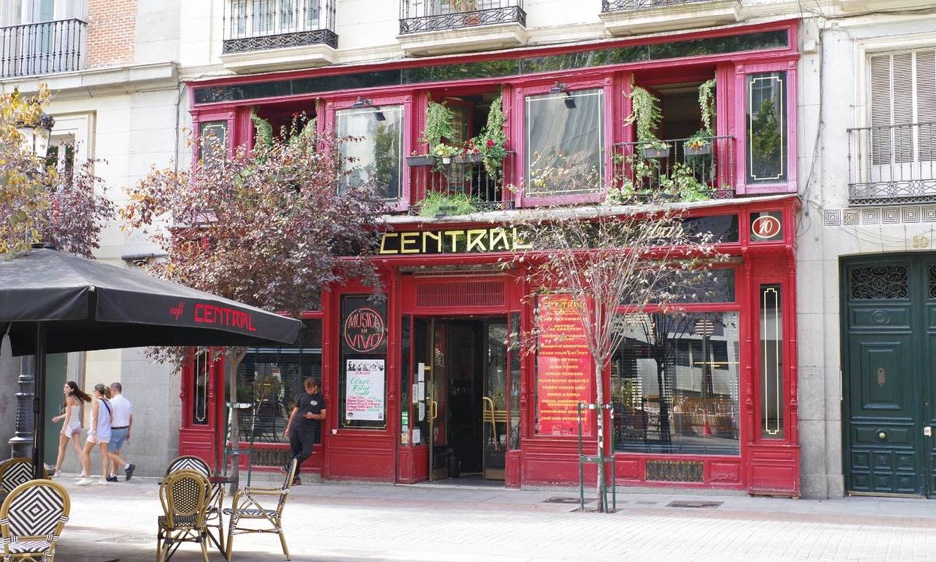
In my life, there is one place above all others that has marked my adult years—a place that has been as constant as the calendar itself. And next week, as the calendar turns, it is closing. Café Central, located at Plaza del Ángel 10, just off the Puerta del Sol—considered to be Kilómetro Cero of Spain, the point from which all national roads are measured—is one of Madrid's most enduring music rooms. For decades, café culture, jazz, and the daily life of the city have coexisted there.
The club sits within the Barrio de las Letras, the neighborhood of writers, where the shadows of Cervantes, Lope de Vega, and Calderón still hang casually over the narrow streets like a canopy. The cultural and intellectual life of Spain has long unfolded in public. Going back to the late 19th century, Madrid's cafés functioned as informal salons: places for conversation, politics, chess, poetry, and late-night reflection. Even before it became a well-known music venue, "the Central," as it's known, a few steps from the city's symbolic center, became a natural meeting point for artists, writers, and night owls.
Café Central's identity as a jazz club took shape in the early 1980s, during Spain's post-Franco cultural reopening. As Madrid reinvented itself—La Movida on one end (punk music, Almodóvar, dada, street fashion, sexual freedom) and institutional rebuilding on the other (high-speed trains, modern airports, a newly modern civic life)—there was also a growing hunger for international music, and for a freedom of expression that hadn't always had a public home. Although Spain had already been a refuge for a small group of American expat jazz musicians, including the largely overlooked organist Lou Bennett, and had produced its own innovators, like piano phenomenon Tete Montoliu, the country had remained culturally isolated behind Franco's curtain. When he finally died—in 1975—after nearly four decades in power, the floodgates opened and all hell broke loose.
Still, I always felt there was something quietly provincial about Madrid as a city until recently. Throughout the 1990s and well into the 2010s, it remained a kind of island, largely undiscovered by the tourists and digital nomads who had already descended on Prague, Berlin, or even Barcelona. This gave it the feeling of being on the inside of something, in on a secret, or the secret itself.
Café Central was started by a group of young, idealistic music enthusiasts in 1982. It was run by committee and, from the start, was doomed never to make money. While there was nothing overtly political about the partners' profit allergy, the mere existence of the club could be read as an act of resistance that would have been impossible just a few years earlier. Roles were loosely defined. Gerardo Pérez emerged as the undisputed booker and creative director. Others—Nanye, Lale, Manolo—took turns minding the shop.
Everything operated in week-long cycles. Bands were booked a week at a time, which meant that at most the club could host fifty-two acts per year. In reality it was fewer, because certain anointed musicians returned again and again. I use the word anointed deliberately. Given the scarcity of opportunity, it was considered a privilege to play Café Central.
The money was never good. The club was notorious for treating musicians with cautious aversion, customers with brute force, and journalists with mild disdain. And yet, to be invited felt like a victory. Playing seven nights in a row on the same stage is nearly unheard of, and it allows the music to develop over time and space—in conversation with a city—in a way that is increasingly rare. As they say, it's not only about the notes; it's also about the spaces between them. Over seven days, a city enters the music quietly: between sets, between meals, between thoughts.
Jazz clubs are, by definition, bad businesses. Sharing the meager wealth among more than a couple of partners is a recipe for disaster. Café Central may be the best example I know of a place that has been "going out of business, in the same location, for over forty years."
Within that precarious structure, an American pianist, Joshua Edelman, became one of the defining figures of Café Central. He arrived in Madrid in the early 1980s and helped shape the sound of the scene and its ethos. He was deeply grounded in bebop, but even more importantly, he was generous with information, with time, and with encouragement. He understood instinctively that scenes grow through circulation rather than competition.
One of his most consequential acts was bringing pianist and educator Barry Harris to Madrid repeatedly to perform and to hold his legendary masterclasses. (Harris had codified and systematized Charlie Parker's bebop language and taught it in workshops around the world.) In doing so, Edelman didn't just book a pianist; he imported a method, a lineage, a way of thinking about the music. Through Barry, a generation of Spanish musicians encountered bebop as a living oral tradition. That kind of transmission doesn't happen every day and it can permanently alter the soil.
Over the years, the Café became a central node for American jazz musicians touring Europe, like Brad Mehldau, Kenny Barron, George Cables, Steve Grossman, Lew Tabackin, Don Pullen, Eric Alexander. At the same time, something distinctly local was taking shape. Alongside deepening fluency in bebop, a generation of Spanish musicians began reimagining their own inheritance. Drawing on flamenco, folk traditions, and modern jazz, players like Chano Dominguez, Jorge Pardo, Perico Sambeat, Guillermo McGill, and Javier Colina developed a hybrid language that felt neither imported nor nostalgic.
One of the clearest documents of that sound is Marc Miralta 's album New York Flamenco Reunion (Nuevos Medios, 2000). It remains an important record in my musical education. Years later, when I spoke with George Colligan, who plays on the album, about it for The Third Story Podcast, what struck me was how literal the connection was: that record didn't just draw inspiration from Café Central. It walked off the stage there and straight into the studio. The room itself played no small part in all of this. Café Central is not a space you would design intentionally as a jazz club. Many great rooms favor darkness, low ceilings, and tight sound. The Central is the opposite. It's filled with mirrors, bright red-and-white painted columns, high ceilings, and a stone floor. The room is extremely live. The stage is positioned so that much of the audience sits to one side or the other, giving musicians the sensation of being surrounded. It's a beautiful feeling but it also blurs the line between the observer and the observed.
The club sits at street level, fully exposed. Nothing is hidden. Large floor-to-ceiling windows face the street, pulling curious pedestrians into the orbit of the music. The mirrors and windows give the room a multidimensional quality—a feeling that there is always another angle, another perspective. You are always aware of being seen, and of seeing yourself seeing. There is a sense of grandeur, of accumulated history, a shabby kind of decadence.
My own story with Café Central began in the fall of 1997, when I was a 20-year-old exchange student living in Spain. It was love at first sight. I sat at the same corner of the bar for twelve hours, from afternoon coffee to late-night wine, watching a band rehearse and then perform. Jazz had always been my passport. If you spoke the language, you could walk into a room anywhere in the world and join the conversation.
That night, I stepped into a phone booth in the Plaza del Ángel and called my father, Ben Sidran, in Wisconsin. I told him I had found the place he needed to play in Madrid.
At first, it didn't work. When my father met the booker, Gerardo later that year, Gerardo listened politely and said simply, "I don't think your music will work in my club." And that was that. Until it wasn't.
Shortly after that, my father and I were invited by our new friend Laura García Lorca to play a concert in connection with the centennial of her uncle, the Spanish poet and playwright Federico García Lorca. That one event changed everything for my family in Spain. The performance was recorded and released as The Concert for García Lorca (Go Jazz, 1999), an album that positioned both of us in Spain—each in our own way—for the next three decades.
From that point on, Café Central stopped being something we chased for gigs and became something we returned to every year, until we became inextricably linked to its legacy. Every November. One week at a time. Then two. Albums came and went. Lineups shifted. Soloists rotated. But the calendar held. Until we ultimately spent hundreds of nights there over the course of nearly 30 years, until as recently as June of 2025.
In 2024, I was taken into the back office of the club and shown an entire wall plastered with articles, clippings, and posters documenting our nearly three-decade run of shows there. Then I was handed a staff T-shirt and told, simply: "The Sidrans are Café Central."
And then there was Jorge.
In the fall of 1999, in the exact corner of the bar where I had spent twelve hours on my very first day in the club, I met Jorge Drexler—the songwriter whose records I had been obsessing over ever since I arrived in Spain, who I dreamed of meeting one day. Of course it had to take place, purely by chance, at the Café Central.
That encounter led to a long friendship and working relationship. It eventually included our Oscar-winning collaboration "Al otro lado del río" for the film The Motorcycle Diaries. A case can be made that without Café Central, there would be no "Al otro lado del río," no Oscar, and neither Jorge's life nor mine would be the same today.
Jorge has become part of our extended family in Madrid. And family, in all its forms, turned out to be central to the continuity we experienced at the Café.
My mother almost always joins my father and me on the road—still today. We weren't just a band; we were a small traveling tribe. There was something grounding about watching a family move through the world to make music together night after night, and take in new friends along the way. Over time, the ritual turned into a tradition, and the tradition turned into a legacy.
At the end of our two weeks in 2006, Gerardo pulled me aside and told me that the following year would mark our 100th performance at Café Central. We decided it should be recorded. That was how our album Cien Noches (Nardis, 2008)u (featuring Bob Rockwell, Louka Patenaude, Moses Patrou and Gegè Telesforo) came to happen—a document of duration.
When I met my wife, Amanda, in 2003, she started joining me on the annual pilgrimage to Madrid as well. One night, a few years into our marriage, we were sitting across from each other at a late-night pizza place down the street from the Central after a gig, talking about names for the baby we were expecting.
"Sol Parker Sidran," Amanda said. "Sol—the S for your grandmother, Shirley, and also Sol for Madrid. And Parker for Charlie Parker."
The fact that Café Central sits just steps from Kilómetro Cero, the Puerta del Sol—the point from which all roads are measured, and to which all roads lead—didn't feel like a coincidence to me then, and it still doesn't. Without the Central, there would be no Sol Sidran.
For years, Gerardo warned me that the club was in danger from landlords, from neighbors, from the city, from time itself. So year after year, as we said our goodbyes, we said them as if they were final, only to return again the following season. Gerardo remained philosophical. I used to tease him about his gruffness toward musicians.
"Being a jazz club owner," I'd say, "is like being a zookeeper. You might think the lion is your friend until one day he eats you." The zoo was wearing him out.
As he and the original partners aged out, the club's future grew more precarious. I was there the night in 2018 when the new owners, Guillermo (Willy) and Jorge, agreed to buy the club. They were childhood friends of Gabriel Edelman, Joshua's son, and had grown up going to Café Central. I wrote to Joshua afterward to thank him for helping keep the place alive. He wrote back simply: "It was in the stars."
The passing of the torch from the original owners to the new ones coincided with a surge of international interest in Madrid. The little provincial secret in the center of Spain was becoming one of the hottest cities on the planet. We should have known then that the Café's days were numbered. And while Willy and Jorge had bought the place for sentimental reasons, they were also proper businessmen, unlike the original partners. One of the first moves the new owners made was to change the booking policy and mostly do away with week-long residencies. A couple of legacy acts—us included—were still invited to play seven nights at a stretch. But for the most part, the Central began to run more like a standard venue: an act for three or four nights, and the room "turned" between sets to effectively double the possible audience.
It made all the business sense in the world. But it also marked a steady move into the dwindling future and away from the illuminated past.
And, in a twist of timing that feels almost poetic, that shift also opened the room to me in a new way. Without Gerardo's bebop gruffness as the final filter, and with a younger booker and a changing model, I began bringing my own band to the Central. I first played there under my own name in 2018, and I've returned every year since.
Rumors of closure still persisted. I stopped believing them. I started to joke that Café Central was like a cockroach that could not be exterminated. But in June of 2025, sitting in the plaza after a show with friends from the club, we learned that this time it was true. Café Central would close on October 12. The rent was just getting too high to survive. There was no way around it.
I was invited back to play in September for a run of farewell concerts. Preparing for those shows, I began to do the math. When I added it up, I realized I had spent close to nine months of my life on that stage—the amount of time it takes to gestate a human being. No wonder it felt like the place that made me who I am.
On the final night, after telling the audience as many stories as I could stand to remember, I stood still onstage, breathing in the room one last time. And I cried. Later that night, the staff told me the lease had been extended yet again. Café Central would survive a little longer.
Of course it would.
So I returned again in November for what were now being called the Concerts of Resistance. I told the audience that I refused to say goodbye again. I preferred to remain indefinitely in the resistance. "¡Viva la resistencia!" I proclaimed from the stage.
Now, by all accounts, Café Central will close on January 1. Who knows if it will. It would be somewhat typical for this saga to continue indefinitely. To quote my father's paraphrasing the poet García Lorca in our 1998 concert, "A dead man is more alive in Spain than anywhere else in the world."
There is even talk of reopening nearby and carrying as much of the original room with it as possible. Just moving it all down the hill. Which raises the question: if you take the same instruments, the same tables and chairs, the same mirrors, and the same people, and move them to a new address, is it the same place?
Is it true that wherever you go, there you are? Or are some places simply more of what they are than others?
I'll let you know what I find out. To be safe, I've already booked a few nights in early 2026 at the new Café Central.
"¡Viva el Café Central! ¡Viva la resistencia!"
 FOLLOW Leo Sidran
and get notified whenever Leo has a new article published.
FOLLOW Leo Sidran
and get notified whenever Leo has a new article published.
Multi-instrumentalist, composer, producer and podcast host.
About Leo Sidran

Tags
PREVIOUS / NEXT
Become a Sustaining Member

Since 1995, All About Jazz has championed jazz as an art form and supported the musicians who create it. Over three decades, it has grown into one of the world's leading jazz resources, serving hundreds of thousands of readers, musicians, presenters and industry professionals each month.
Help Build the Future of All About Jazz
Your support helps us continue building All About Jazz for the next generation—expanding our editorial coverage, preserving jazz history, developing new community features and creating better ways to discover the music and the people behind it.
Become a sustaining member for as little as $20 per year and you'll immediately enjoy an ad-free experience along with access to subscriber features and future articles for a full year.
Together, we're not simply sustaining All About Jazz—we're building its future. Thank you for being part of the journey.