Home » Jazz Articles » Reanimating Conversations Past » And His Name Was Max
And His Name Was Max
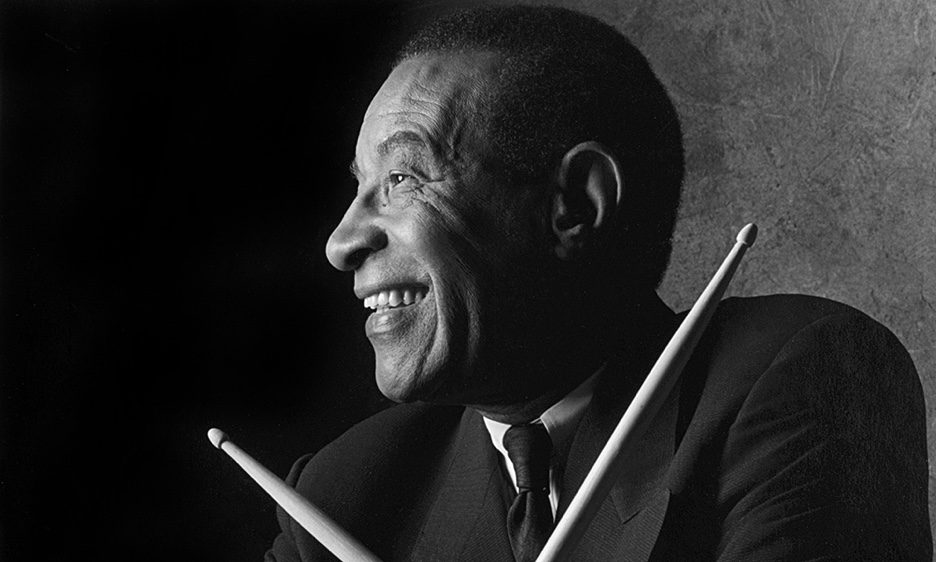
Negro spirituals are the heaviest protest music I have ever heard.
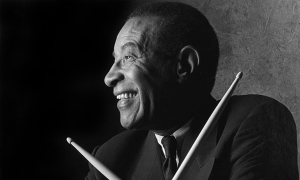
A favorite topic: musicians who dedicate their artistic lives to the spirit of collaborations. When I was writing about Max Roach in the late 1980s, I was astounded by how many projects he seemed to be simultaneously engaged in. A giant among giants when bebop was on the march during the 1940s, Max would go on to perform with all manner of musician through the decades. The feature that ran in DownBeat's November 1990 issue was a clipped version of what follows here: the complete interview, into subjects covered cursorily in that story. It's everything that went down on that wonderful autumnal afternoon on the last day of August.
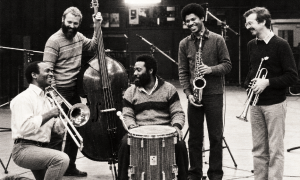
I caught up with Max when he was performing at the 1990 Chicago Jazz Festival with his then-current/ongoing quartet of Cecil Bridgewater, Odean Pope and Tyrone Brown. Not surprisingly, elsewhere he was also working with his Double Quartet (including the Uptown String Quartet), the eight-drummer ensemble M'Boom, and the Japanese percussion group Kodo. Add to this his compositional forays (a world-premiere "bopera"), working as an artist-in-residence at the Thelonious Monk Institute of Jazz (as of 2019, the Herbie Hancock Institute of Jazz), collaborating with rapper Fab 5 Freddie in something called From Bebop to Hip-hop, taking on commissioned works, the recipient of honorary doctorates as well as holding down his chair (since 1973) as a professor in the Music and Dance department at the University of Massachusetts, Amherst. And you might rightly suspect the man had a full schedule, one that went in more directions than your "typical" jazz musician. Indeed, as Max always reminded us, "I am not a jazz musician, I am not a drummer. I am an artist."
When we sat down for what I thought would be a short interview, what resulted was a very sweet interview that ran for well over 90 minutes at Chicago's downtown Hyatt Regency. Here was the picture of an artist with a firm grasp on his past who was very much living in the present. His embracing of musical conversations and new musical environments was key to his ever-developing, ever-consistently expanding artistic and musical drum style. A philosophy of not only music but of life as well.
I started off by asking Max about his move to become a bandleader (and leaving off his role as a prodigious sideman coming up in the 1940s), which started in earnest in 1954. He paused and appeared to take a deep breath as he ventured forth: "You know, you never really look to being that; it kinda happens to you. If you were doing something, that attracts the attention of an agent, or someone like that. In my case, when I went to the Lighthouse [in Hermosa Beach, California], as part of the Lighthouse All-Stars: Howard Rumsey and Bud Shank, and Bob Cooper, Claude Williams and that group out there ... what I was doing caught the ear of a producer and record company. Gene Norman came to the club and said, 'Why don't you start your own band?' And I said, 'I really never ... even though I'd recorded prior to that, and had a little company [Debut Records] that [Charles] Mingus and I had formed ... I was having a lot of fun out there with those guys. Gene Norman was the one who got me out, and the first band ... so, I sent for Clifford Brown. We also had Teddy Edwards."
He interrupted himself and then said, "The first saxophonist we had was Harold Land, Carl Perkins was the pianist, George Duvivier was the bassist. And we opened up a club called the California Club, and I left the Lighthouse All-Stars; I had taken Shelly Manne's place with the All-Stars, and Stan Levey took my place. And that's how it really started. It wasn't like I said, 'Now, I'm gonna be a bandleader.' But I've always had in my mind not to be a timekeeper as a percussionist; I felt the percussionist had more to say than that. I've always felt that percussion could stand on its own. And that's when I started doing these solo things. Conversation With The Drums in the '40s; in the '40s was when I started thinking about it. And I had the support of some of the musicians, especially Charlie Parker... he loved it.
"People talk about the drums having no melody, a harmonic thing. But, no matter what it is you're doing artistically, it has to adhere to certain principals, and those principals are the architecture, what you're dong with the structure and the form. A poem is not melodic and harmonic; however, as you're saying it has a rhythm to it. And that's what's important.
"So, with that in mind, I approach the drums that way, with statements and question marks. Hence, the Conversation With The Drums is like that. You could play a melodic instrument, but it's inhuman to just [mimics a blurry drone], like you get a dictionary and it just talks and talks and talks. What makes it human is that it can breathe. The point being where you have to pause. And not only that, it also gives the lay people out there a chance to assimilate the statement you've made in sound, and enjoy it before you crowd 'em up with another thought. So, that's the way I've dealt with the drum solos. Cause it's not a wind instrument that you can blow into and you automatically have to be human, something you can just rattle on and on and on. When I began to realize that that could work, then I knew that it could happen. And of course, I heard people like [Andres] Segovia, and Chatur Lal and [Ravi] Shankar when they first came from India to the United States in the '40s, where Lal played tablas and he had a spot where he played by himself. And he was marvelous, and the whole audience was enraptured by what he was doing. All that made me realize you could do it, you could take and organize it and give it structure."
Then I asked Max what and how had his ways of playing changed over time?
"I could play with a person like Bud Powell," he intoned, full of life, in his fully resonant, deep-seated voice, "which was totally different than playing with a person like Cecil Taylor. Or to play with Charlie Parker and then to work with Anthony Braxton. That's a radical change. Or to play in the context of ... I did a piece with John Williams conducting the Boston Pops [the film The Five Satins], that's another thing. And each time with me, you try to make that adjustment. And I think, this music allows that. You have to change what you're doing if you're playing ballads, or you're playing something like 'Giant Steps.' I think that change is really stimulated by the musical environment that one is in at that particular time; especially in this music. If I'm playing 'Embraceable You,' or accompanying some guy who's playing it slowly, you're not gonna play it like you're playing 'Giant Steps.' And I'm hoping that I do sound good; I don't try to."
I then asked him to translate how working with bop pioneer Bud Powell stood next to playing with the avant-outsider Cecil Taylor.
"His use of space is nil.
"Well, you see, what he does is what people used to say about John Coltrane: it's like 'sheets of sound.' And with Cecil doing it, it's a little different. I get a different feeling from him. He just throws sound at you. It's all in your face constantly." Max gestures near his head. "And you have to equal that. He allows you to do it. He's one of the very few where you don't feel like it's, well... planned. His technique is impeccable.
"I find, sometimes, if I use the short phrases against his torrents of sound, I get more going; the contrast. I just create my own line. I always try to balance it out like that. You have to listen, or else he backs you up against the wall. With Cecil, you have to fight for your life. You have to listen, because he backs you up against the wall."
Then versus now, Max added, "To me, he was the next logical step from Bud and that group. The person who I respond to is not a person who sounds like ... you know, the person I respond to is not someone who sounds like Bud Powell or Charlie Parker, but a person who sounds just the opposite, someone who brings something new, like they did, to the world of music. I enjoy playing with Anthony Braxton more than I would playing with someone who plays just like Charlie Parker, having worked with Charlie Parker."
This is what real jazz is, what young players were doing that drew heavily on the music of the '50s and '60s.
"I don't know about that. I think what happened was, during that period of the big bands [and what followed], we worked in clubs and people began to sit down and listen. It's almost demanded that every generation do something on their own, be creative. Okay, so you like Lester Young, I can come up with something. That's why there was John Coltrane. And that doesn't mean that Lester's a drag now, he's obsolete. He's right on top of everything. I think that when you're at it, like moving something along, that's where we get into trouble. Let's take Bach or Vivaldi and that crowd; I'm still listening to that as much as I would Alban Berg, Schoenberg or anybody else. I don't think that Schoenberg's moved the music along doing what he did, or Alban Berg. And I like Louis Armstrong and what he did. Just because somebody comes over... Dizzy [Gillespie] did not move the music along when he started playing like he did, to me. That's his responsibility to be creative; not trying to be, 'Okay, now what I'm doing makes everything that's gone before me obsolete.' I don't think that's what it's all about. Just because you got Picasso doesn't mean the old Dutch Masters can't paint. 'He's improved upon painting.' I don't see that he has. People still write today, but Shakespeare and those guys wrote their asses off."
Then there's working with Miles [Davis] and change, coming out of the '40s and '50s.
"Well, you know, you almost don't have any other alternatives. It's like policing the past. You don't want to do what you did before, no matter how good."
But what does that say about the art?
"It says everything about the art."
And what about pushing it along?
"I don't think anything pushes anything along artistically. It's not like a foot-race. But what happens with us, in this business, is you go to a record company: 'Okay, what you did with Charlie Parker, with Clifford Brown, with John Coltrane and Gil Evans... it's over with.' So, we're always faced with a challenge. And, as you said, Miles is more successful in dealing with that proposition than anybody I know of. And making something of it. So, he says, 'Okay, I can't do the things I did with Gil Evans. Not because I don't want to, but these people aren't alive, first thing.' Miles is probably a purist in his own way. He's gotta look for new things to survive artistically. You cannot write the same story over and over again. So, it's not that you are intent on pushing things. The business demands that you come to terms of whether it's good, bad or indifferent. He might fall flat on his face, but at least it's different. Not for the sake of being different. But he couldn't record if he did the same thing over and over and over. Nobody can survive in this business."
But the impression is that Miles doesn't want to, anyway.
"No, he has to!" Max raises his voice, becomes enlivened in a unique moment. "So, he decided to make a clean breakup with the record companies. 'You want something new, and this is something today, and I'm gonna deal with it.' With his own ingenuity. And he's still very creative, I think. I hear these rock groups are playin' his things now. Just like the guys played before. He's something, man. People knock him down, but he changes, he changes. And we all know you have to, we've all known that. You can't do the same thing. Hence, my way of doing things. But it's the same principle. Very few have survived that. I mean, Count Basie's band is one of them. Glenn Miller's band is one of them: that they live today like it was today, and people react to it. That's on record, and records are good. Those bands are still popular; the Glenn Miller orchestra could work 365 days a year if it wanted to. It's the sound that people have got. Basie band's got that, I hear it. I don't hear too many people doing that. Still doin' the same thing, still makes you smile when you hear 'One O' Clock Jump.' But, other than that, the record companies are vicious."
The companies want the same thing. They want you to do what they've already been able to sell.
"Michael Jackson saved the day. 'So, okay, you did Thriller... the whole record industry, 'Do another Thriller.' But he can't! He's still gotta do something different."
Why?
"The success of Thriller is based on sales. They're not saying anything about the aesthetics."
But he could just play a variation on Thriller.
"But the kids are gonna say, 'Aw, I knew that.'"
Really?
"Yes."
Just because it's old doesn't mean it's over.
"I'm with you on that. When somebody comes up with something new, that's it. 'Something new, oh wow. That's it.'"
How about M'Boom?
"We're celebrating our 20th anniversary this year. It's the same group of people, and it's closer to what the intention was in the beginning, which was to create a fabric with all these diverse personalities. We're creating a sound fabric more than virtuosity; although that comes up. We've learned how to do things together. We have everything on the stage and just one drum set. We've come a long way, but we still have a long way to go."
The subject veered off into talk about the advent of so-called world music.
"I listen to other music in order to confirm what we're trying to do here in the USA."
Max pointed out that he wasn't into just mixing different cultures ad hoc, where you "dabble, and put it all in the pot. When you start throwing things in, then it becomes something that's out there. And people say, 'What is it?' 'Then they call it world music.' But the blues is something that's really American. So, if I find anything that comes out of the world from Africa or any place else, it's to confirm to me that we really do have an identity."
How do you avoid the dabbling that results in mimicking?
"That's hard to do. I think the artist has a right to try all kinds of things. We've developed a lot of things in this country; it's open-field running for us. We're always encouraged, especially by music from other cultures. The time that I worked with the Japanese percussion group Kodo, I went to their island and spent some time with them because we were going to do some engagements together. So, I learned something about them. But they were so fascinated with the technique of the drum set. And they can play; they're good musicians, they can read anything you write down. And they are into Japanese percussion; they're not trying to deal with anything else. When you see Kodo perform, it's strictly from where they are. Even though they all love the set, and all of them try to play rock, or anything, they appreciate it for what it is. So, working with them, we didn't try to put anything together. We just use what they did and what I did, to create some work and pieces out of it. And, they're very theatrical, and the way they use martial arts. They do different things, but they're persistent in dealing with it in the tradition of Japanese culture. And I respect that."
This led to comments about how country singers and blues musicians also, in their own ways, are persistent in adhering to similar traditions in this country. Also with singers like, as he mentioned, Ella Fitzgerald and Sarah Vaughan. And that academia really hasn't got a handle on teaching that to students.
"There's a way you use your throat and the way you phrase that makes the difference. People feel it."
Then there's a mention of John Lee Hooker and Willie Nelson. But they didn't go to school.
"School has nothing to do with it. We're talking about art now," Max says with emphasis.
"What happened to me, when I came out of high school, I decided to go to the conservatory. And I said percussion is what I'll enroll in. Freddie Albright was the teacher, and I walked into his studio to take an audition. I picked up the drumsticks behind the snare. He didn't even let me touch the drum. He said, 'You're holding the sticks wrong. If you're going to play you must put the sticks in your hands this way and you must stand this way.' And I said, 'Oh, shit. If I play like that and go down to 52nd Street and play with Charlie Parker... 'Cause he hears everything in a certain musical environment, the classical way of dealing with percussion in the orchestra. Nobody's wrong, but I think, if I start taking this seriously, then, this way of approach to playing percussion I won't be able to make any money to send myself to school 'cause of what I want to do now.
"So, it made me do two things. First of all, I went to the dean of the school and told him I wanted to change my major [to Composition]. 'Cause I realized to be an instrumentalist, you have to adhere to certain things, and I thought I wouldn't be able to play through school if I dealt with that technique, so I would be learning something else, that we have different techniques in this place. And that was another thing: it's not just one technique. If I wanted to play in a symphony orchestra I'd have to deal with that technique. If I wanted to be a blues player, even in percussion, there's a way of dealing with blues and that shuffle and that backbeat; if I wanted to be a rock player, there's a technique that goes along with that. If I wanted to play bebop, straight-ahead, all that stuff. Serious technique. We're talking about sophistication. The reason we go to school is so that we can become people who contribute to the welfare of our society; we get a job, support our families, send our kids to school and pay taxes. People who are doing that are people who aren't necessarily, especially in the arts, people who got all this training and know just what to do in the symphony orchestra, and you can't find a job and you're working [e.g., waiting tables]. To get a job in the symphony orchestra, it's hard."
"With a democratic approach, it's away from that imperialistic attitude where there's gotta be a composer and conductor and everybody else out there is actually a peon. If you don't do their bidding, you get fired; if you don't adhere to these two strong voices that control everything. Whereas jazz is very democratic... you come in: 'You play the piano, I'll play the drums. Who's gonna play bass? What are you gonna play?' It's a different approach to everything. To me, the whole attitude of the music itself has always been evolutionary. It's the attitude of the collective."
How many people did you know who went to school to be blues musicians or country & western musicians?
"None. You gotta come out into the streets. People often ask me, 'What's happening to the music?' I say it's going to the universities, if you want to learn anything about this music we call jazz. The university environment is healthy. We came up in the joint. We could learn and play all the time."
So, it's about education and opportunity?
"Most of the great musicians that we know in the world of jazz, early on in their lives they were privy to musical education in underprivileged communities. Today, the cultural difference has been wiped out in the university. Hence, that rap is going on with a bunch of people who hear things. You don't have a situation where people are sitting around like when I was in school, when Charlie Parker, when Miles was going to school; there were people who gave of themselves after school. They have to get more money for that, overtime. There was a sense of pride, they wanted to attract teens to be better than the school across town. So, they put in extra time for us. Now, with teachers' unions it's different. Time is what is valuable. Like the track coach who stays after school. You're not getting paid any extra money. They don't have access to higher education. There's Billy Taylor's Jazzmobile. It takes money to do all that. Access to higher education. Everybody went through that. Charlie Parker, they accomplished what they did in spite of the situation. They didn't have to go the conservatory. He had someone around him who encouraged him to do what he was doing, in Kansas City. You can go to a conservatory and get locked in."
How is today any different?
"Today is different because we live in a computerized world. You gotta go to college now."
Couldn't a Charlie Parker still come up and dazzle people?
"They are, it's happening in the rap world. They heard something, and have created a world of sound [despite a lack of access]. Not music in the traditional music sense. They make something out of it, communicating to people all over the world. I've been working with them for several years. Because it keeps me interested in that community I grew up in. And I owe it to them; whatever I am comes out of that community, and I wanna put something back. I've learned more from them than they've learned from me.
"That's the interesting thing about Miles, his autobiography. He had decided he was gonna become a trumpet player at 8 or 9 or 10 years old. And I noticed that I was the same way. And we've never done anything else, and that whole group of people who came of age artistically in the early '40s, who had the same background; it's amazing to me, that all of a sudden we all came up at the same time: Charlie Parker, Dizzy Gillespie."
I then asked him, does it involve a change in his drumming?
"I've always had in my mind not to be a timekeeper as a percussionist. I felt that percussion had more to say than that. I felt percussion could stand on its own. That's why, in the '50s and '60s, I started doing those solo things, like Conversations and Drums Unlimited, with certain principles in mind—the architecture and structure, the form. A poet is not melodic and harmonic. However, poetry's a thing of beauty and has a rhythm to it. And so, I approached my drum solos with spaces and periods and question marks."
It was Max's way of reminding me that he was referring to drums as musical instruments.
A few highly relevant add-ons, one pointing to an aspect of his work as an artist that pointed toward the political: "Negro spirituals are the heaviest protest music I have ever heard"; another, a tipping of the hat to a foundational music: "The blues came out of people who were artistically inclined." And what about rap and rappers? "I don't separate them from Louis Armstrong or Charlie Parker."
I gave that story the title "Mr. Maximum." I wouldn't change a word of it. Max Roach stayed true to his mission up until his passing in 2007. I can still hear his relaxed, firm and deeply felt voice as he says the name "Charlie Parker."
 FOLLOW John Ephland
and get notified whenever a new article published.
FOLLOW John Ephland
and get notified whenever a new article published.
A lover of music finds the words to express it. Once in a while.
About Max Roach

Tags
PREVIOUS / NEXT

Become a Sustaining Member

Since 1995, All About Jazz has championed jazz as an art form and supported the musicians who create it. Over three decades, it has grown into one of the world's leading jazz resources, serving hundreds of thousands of readers, musicians, presenters and industry professionals each month.
Help Build the Future of All About Jazz
Your support helps us continue building All About Jazz for the next generation—expanding our editorial coverage, preserving jazz history, developing new community features and creating better ways to discover the music and the people behind it.
Become a sustaining member for as little as $20 per year and you'll immediately enjoy an ad-free experience along with access to subscriber features and future articles for a full year.
Together, we're not simply sustaining All About Jazz—we're building its future. Thank you for being part of the journey.