Home » Jazz Articles » Live Review » Leon Buckley Quartet At Scott's Jazz Club
Leon Buckley Quartet At Scott's Jazz Club
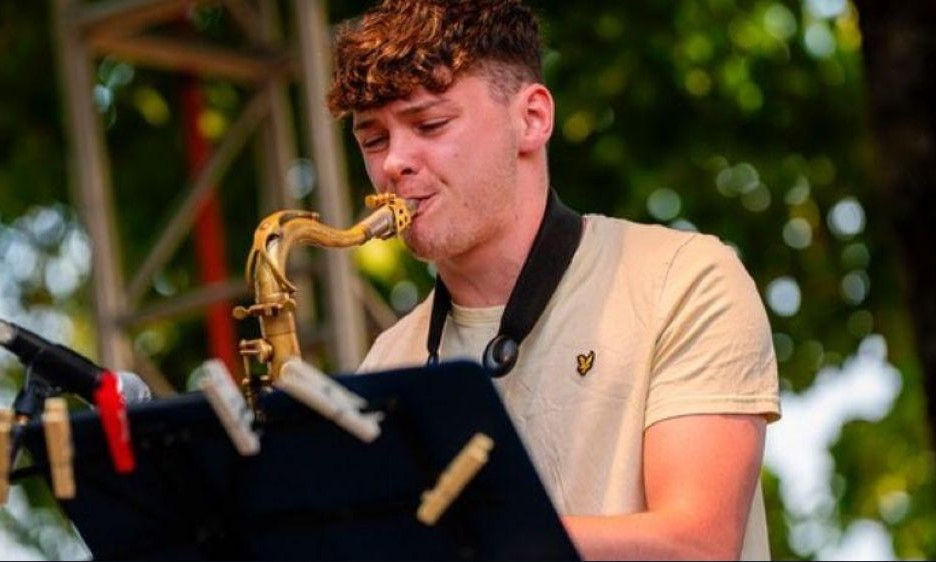
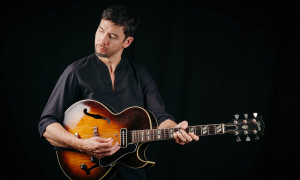
Courtesy Michael Buckley
Scott's Jazz Club
Jazz Futures
Belfast, N. Ireland
July 24, 2026
There is nothing like a good typo to induce the titters. Hats off to the Belfast gig guide who listed this one as the 'Leon Bucket Quarter.' It could have been worse. In a 1631 reprint of the King James Bible, the printers made a hash of the Seventh Commandment: "Thou shalt commit adultery," it intoned righteously. Many, no doubt, took it literally—after all, it was the word of God. The Belfast jazz faithful do not need commandments to make their way to Scott's Jazz Club, the pearl of Belfast's Upper East Side. Just the surname Buckley will reel them in.
At twenty-one, Leon Buckley is the latest branch on a family tree of esteemed Dublin jazz musicians. Starting with his saxophone-playing grandfather Dick Buckley in the 1970s, the following decades have seen his father, Michael Buckley, his uncle, Richie Buckley—saxophonists both—and his cousin, guitarist Hugh Buckley, leave an indelible mark on Irish jazz. When the country's jazz history is finally written (The History of Irish Jam? The Histrionics of Irish Jazz?), the Buckleys may well require their own chapter. As emcee Cormac O'Kane put it: "There's probably a whole box of Buckleys unopened yet." Should they ever form a band, A Box of Buckleys (A Pox of Buckleys?) would have to be the name.
With pianist James Fennell, double bassist Donagh Kelly and drummer Jarlath Byrne, Buckley has been holding court on Wednesday nights at Egan's, a new pub with old-school charm on Dublin's Aungier Street. With the experienced Shane O'Donovan taking over drum duties this evening, the quartet was making its Belfast debut.
Artists much longer in the tooth than Buckley might have opted for the relative safety of a high-octane bebop opener to let off steam and settle the nerves; instead, the Dubliner embraced the slow sinews of "Central Park West," one of John Coltrane's most affecting ballads. Against spare bass and brushes accompaniment, Buckley explored the tune's contours with deftly weighted lyricism, his finesse mirrored by Fennell and Kelly on their own brief but bright excursions. It was a bold opening gambit, stepping forward into the intimacy and under-the-microscope exposure of a revered ballad. The quartet's fine handling, however, only accentuated the high level at which these musicians operate.
Standards dominated the set, with the quartet settling comfortably into swing mode on Sonny Rollins' "Without a Song" and Benny Golson's "Stablemates." On these staples, Buckley demonstrated fluidity, invention and technical prowess beyond his years. He may have grown up playing the saxophone in a school band, but he only caught the jazz bug at seventeen. In just a few short years he has developed a remarkably assured voice, full of emotive heft. In the midst of all the walking bass lines, blues-based swing and processional solos, Wayne Shorter's "Deluge" shone like a beacon from another time and space. Buckley admitted that it had taken him a while to decode Shorter's language, but his confident embrace of this typically enigmatic tune suggested he may yet be drawn down the road less travelled. This is not to suggest that the rhythm and rhyme of Rollins, Golson et al. and the poetry of Shorter exist in binary opposition. There are biways aplenty between them. Even so, Shorter's less rigidly sculpted compositional lines seemed especially well suited to Buckley's exploratory temperament.
Like Buckley, Fennell and Kelly have also passed through Dublin City University's jazz programme, and both impressed with their intuitive support and a series of engaging solos. O'Donovan, a mainstay of the Irish jazz and electronic scene for the past couple of decades, brought infectious propulsion and loose-wristed panache to the proceedings—always swinging, ever agitating. Ireland does not boast too many top-notch jazz quartets—it is a very small nation, after all—but Buckley's quartet posted notice of its potential in abundance.
The second set followed a similar pattern. Earthy bass and rippling piano announced "All Blues," Buckley's molten solo giving way to Fennell's and Kelly's more measured, bluesy responses on a feisty interpretation of Miles Davis' classic. Billy Strayhorn and Duke Ellington's "Isfahan" brought a thoughtful change of pace. Inspired by a visit to Isfahan, Iran, in 1963, Ellington was clearly smitten, declaring of the ancient city that "everything is poetry." One of the songwriting duo's most beautiful compositions, Buckley and company tipped their hat with a finely judged balance between sweet lyricism and kinetic swing.
Coltrane's "Moment's Notice" drew the quartet's most intense collective statement of the set, with Buckley's impassioned playing to the fore. Impressive in full flow though he was, Buckley's original composition, "Hard to Find," a brushes-steered ballad, also stood out. In the saxophonist's gently snaking trajectory, a little of his various touchstones—Shorter, Coltrane and Golson—coalesced to poetic effect.
It was something of a surprise that the quartet chose to bow out with a lesser-known tune in Lenny White's "L's Bop." Penned in 1982, though evocative of 1940s bebop, the driving rhythms drew expansive closing statements from Fennell, Buckley and O'Donovan.
This was the ninth concert in Scott's Jazz Club's ongoing Jazz Futures programme, a series that provides a platform for up-and-coming Irish jazz talent. On this evidence, Buckley already looks well ahead of the curve. Buckets of talent—and undoubtedly a name to watch.
 FOLLOW Ian Patterson
and get notified whenever a new article published.
FOLLOW Ian Patterson
and get notified whenever a new article published.
Ian is dedicated to the promotion of jazz and all creative music all over the world, and to catching just a little piece of it for himself.
About Leon Buckley

Tags
PREVIOUS / NEXT

Become a Sustaining Member

Since 1995, All About Jazz has championed jazz as an art form and supported the musicians who create it. Over three decades, it has grown into one of the world's leading jazz resources, serving hundreds of thousands of readers, musicians, presenters and industry professionals each month.
Help Build the Future of All About Jazz
Your support helps us continue building All About Jazz for the next generation—expanding our editorial coverage, preserving jazz history, developing new community features and creating better ways to discover the music and the people behind it.
Become a sustaining member for as little as $20 per year and you'll immediately enjoy an ad-free experience along with access to subscriber features and future articles for a full year.
Together, we're not simply sustaining All About Jazz—we're building its future. Thank you for being part of the journey.