Home » Jazz Articles » Live Review » Emmet Cohen Presents: Miles and Coltrane at 100 at Jazz Alley
Emmet Cohen Presents: Miles and Coltrane at 100 at Jazz Alley
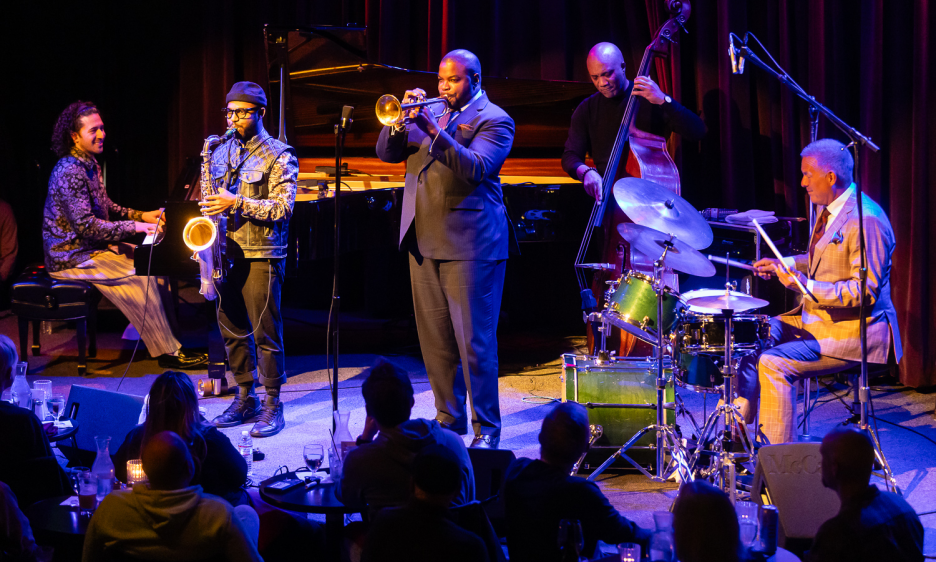
Courtesy Lisa Hagen Glynn
With a year of many such Miles Davis / John Coltrane programs ahead, the pianist’s compositional approach may just be the most appropriate way imaginable to honor two of the great masters of Black American music.
Jazz Alley
Seattle, WA
April 16, 2026
Pianist Emmet Cohen was not on the top of any list predicting who might hit the road touring in celebration mode of the Miles Davis / John Coltrane 100 phenomenon over the course of 2026. He has certainly risen to the top tier of jazz touring artists over the past few years, always in the spirit of fun and innovation—yet taking on the eclectic legacy of John Coltrane, or the diverse and emotive narrative of the music of Miles Davis was not something one might suppose. In contrast, the virtuosic Cohen gathered together a unit of musicians plainly suited to the task.
Drummer Joe Farnsworth is noted for bringing forward a style of hard bop drumming often attributed to the great Jimmy Cobb, a mainstay in Davis' band in the 1950s and early 1960s. Trumpeter Jeremy Pelt has toured with the Miles Electric Band, and is well versed in the lexicon of the legendary trumpeter. Tenor saxophonist Tivon Pennicott has the dynamic edge required of his role in the proceedings, with Ruben Rogers embracing and anchoring things on bass. Most importantly, all of these musicians are not typically prone to playing a role outside of their own musical persona—they arrive with the spirits willing, and dedicated to innovation within the journey of each performance. To those whose musical preferences lean towards both Davis and Coltrane, the six night run at Seattle's Jazz Alley seemed an opportunity to look back with respect and look forward with great anticipation.
With Cohen at the piano and Farnsworth behind the kit, the set promised to be swinging—and so it was right out of the shute. The evening began with a trio interlude leading to the introduction of frontline members Pelt and Pennicott. The quintet came out swinging on the classic John Lewis tune, "Two Bass Hit," with Cohen offering fleet passages and immaculate technique. Farnsworth brought the full house to a roar with a torrential solo.
The quintet then gave ballad treatment to the Marcus Miller gem, "Amandla," the title track from Davis' 1989 release with the bassist. Pelt carried the tune in muted, stating the melody within well placed pauses and melodic phrases. The arc of the tune rose to its apex with Pennicott's offering, beginning with a counterpoint interpretation of the melody with Pelt spinning lines between the cracks of the tenorist's sumptuous, melancholic solo. It served as a major blaze along the trail of this performance, the ballad exposing the most vulnerable aspects of each band member's artistry. Cohen virtually directed the band from behind the piano with his sense of dramatic ebbs and flows.
"Green Dolphin Street" is a tune both Coltrane and Davis broached during their career, but after hearing a refined acoustic version of "Amandla," it seemed to veer off course a bit in terms of the alleged theme of the evening. A burning Pelt solo began softly, with scant figures between Rogers' bass line and Farnsworth's brush work. His robust and pure sound carried great strength through the changes. The familiarity of the tune allowed the audience to plainly see Cohen playing with more of a unity of sound with the band than usual, perfectly allowing Pelt's lines to lag ever so slightly behind the pianist's chordal assertions.
Pelt and Cohen entered "Blue in Green" as a soft pedaling pair, with a muted loose interpretation of the scant melody. Cohen's solo was as a deep breath, taking in the sweetness of the Seattle night, unfolding gently to a slow gated swing. Pennicott's solo gave way to Pelt's unmuted line on the way out.
To this point in the show, I did not feel the close presence of either Coltrane or Davis, just a sterling example of quintet post-bop jazz featuring five of the music's finest players. One would suppose that would be good enough, if not for the title of the evening's performance. It was ironic then, that the Miles / Trane legacy seemed to be unwrapped with a suite of Cohen originals from his soon to be released album, Universal Truth (Mack Avenue, 2026). "Eternal Glimpse" opened the three-song suite embellished by a brilliant solo from Pennicott. As the band melded into "Compassion," the more spiritual presence of Coltrane came to mind. Cohen's minimalist support behind Pennicott's lush melodic playing was almost prayer-like. Rogers dug deep for one of two solos during the set, settling things down before a powerful reemergence into "Universal Truth." Now swinging in high gear, Pelt unleashed a scorching, high flying burst, followed by his tenor counterpart's deeply penetrating chorus that quoted Coltrane's "Acknowledgement" along the way. Pennicott's contribution ended in duo with Farnsworth. When the drummer broke into an extended solo on the set's final piece, the tenorist stuck around, eventually adding percussive assistance on his instrument without blowing a note. Farnsworth then led the band into a vocal chant from Clifford Jordan's "John Coltrane." The haunting chant brought the spirit of Coltrane front and center. Cohen's suite, more than the rest of the evening's more standard fare, was a higher form of tribute to Davis and Coltrane than the two legend's actual compositions. With a year of many such Davis / Coltrane programs ahead, the pianist's compositional approach may just be the most appropriate way imaginable to honor two of the great masters of Black American music.
Earlier in the week, Joe Lovano led an all-star cast at Seattle's Moore Theater in a stellar salute to Coltrane. The set had eclectic qualities to it that stayed with the audience long after the music stopped. For those who attended both shows, Cohen's definition of tribute may have seemed barely attributable. It certainly focused on different aspects of inspiration from Coltrane and Davis in a repertory sense. Yet when you consider that this great musical legacy's main value was and is how it moves new generation musicians to create and express the wholeness of human emotion and spirituality in their music, one would have to recognize that Cohen's goals had been realized.
 FOLLOW Paul Rauch
and get notified whenever a new article published.
FOLLOW Paul Rauch
and get notified whenever a new article published.
I am a writer, producer and coordinator in the jazz community, living in Seattle.
About Emmet Cohen
Tags
PREVIOUS / NEXT
Emmet Cohen Concerts

Become a Sustaining Member

Since 1995, All About Jazz has championed jazz as an art form and supported the musicians who create it. Over three decades, it has grown into one of the world's leading jazz resources, serving hundreds of thousands of readers, musicians, presenters and industry professionals each month.
Help Build the Future of All About Jazz
Your support helps us continue building All About Jazz for the next generation—expanding our editorial coverage, preserving jazz history, developing new community features and creating better ways to discover the music and the people behind it.
Become a sustaining member for as little as $20 per year and you'll immediately enjoy an ad-free experience along with access to subscriber features and future articles for a full year.
Together, we're not simply sustaining All About Jazz—we're building its future. Thank you for being part of the journey.