Home » Jazz Articles » Live Review » We Four at Dazzle
We Four at Dazzle
Dazzle
Denver, CO
October 21, 2017
The majority of Twentieth Century jazz was represented on stage at Dazzle Saturday night. Either the players were there, in person, or they were merely one degree of separation from the key action and the dominant personalities. History lessons can be nice, but jazz is a performing art and it's what's happening on stage right now that counts. There was no problem in that department because the result was bebop in the highest degree.
Tenor saxophonist Javon Jackson brought the ensemble he calls We Four to town for a couple nights. Joining Jackson were Jimmy Cobb on drums, Eddie Gomez on bass and JoAnne Brackeen on piano. All four members of the quartet are former members of Art Blakey's Jazz Messengers. The lineup also included two NEA Jazz Masters, a shoe-in for a future Jazz Master, a highly probable future Jazz Master, bandmates of Miles Davis, Bill Evans, Dizzy Gillespie, Sarah Vaughan, Billie Holiday and many more, as well as the honoree of the evening: John Coltrane.
Although the evening was billed as a tribute to Coltrane, the band eschewed Impulse! era Coltrane and even much of his Atlantic output and focused primarily on his work in the 1950s and early '60s, often with Miles Davis or Thelonious Monk. The opening tune, "So What?" from Miles Davis' Kind of Blue (Columbia, 1959) set the tone for the evening. Drummer Jimmy Cobb played on that album which is generally regarded as the best-selling jazz album of all time. Coltrane, too, played on the album. "I Mean You" followed a bit later; that one composed by Monk and recorded with Coltrane again as a sideman. The songs in the set list that came from the Atlantic albums were primarily covers of jazz standards.
Jackson, a veteran of Art Blakey's Jazz Messengers, was the leader of the group. Originally from Denver, the gig was a bit of a homecoming for him. Although ostensibly playing the part of Coltrane, he didn't try to copy Trane's style; after all, this was a tribute, not plagiarism. He only occasionally and briefly burst forth with sheets of notes, more often taking a more melodic approach, working his way around the melody.
At 88, Cobb was the sentimental favorite of the evening. But he wasn't the favorite just because of his age; all evening long, he delivered the goods. Like so many of the greats, he played with a casual efficiency. He propelled the band with a solid swing and an economy of motion. His direct connection with the songs on the set list went beyond "So What?" and included "My Shining Hour" which was on Coltrane Jazz (Atlantic, 1961) as well as "Stella by Starlight." Miles Davis recorded that one on Jazz Track (Columbia, 1958). Both Coltrane and Cobb were on that album.
Eddie Gomez, another former Jazz Messenger, hasn't yet joined the Jazz Masters club, but his induction is inexorable. For now, he'll just have to be satisfied with two Grammys which he won during his eleven year sojourn with Bill Evans. Like Cobb, he counts Miles Davis as a former employer. Saturday night, his playing was solid and he was a sympathetic match with Cobb's drumming. A few times he threw in some two-note bass chords reminiscent of some of Jimmy Garrison's playing on Coltrane's A Love Supreme (Impulse!, 1965).
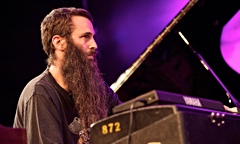
JoAnne Brackeen has been compared to Pablo Picasso, and rightly so. Hers is not a traditional approach to her art. Although she sat at a traditional grand piano in a fairly traditional jazz quartet, her soloing transcended tradition and entered a unique realm. Often her solos displayed a quirky intensity, an iconoclastic determination. Her right hand runs yielded constant surprises and she often mixed unexpected rhythmic changes into her solos. Just this year she joined the NEA Jazz Masters club; another in a long list of awards and accomplishments. Another one of those is her membership in Art Blakey's Jazz Messengers as the first and only female member of that unit. Throughout the evening, she was the one that provided the most surprises; the one that provided the highest contrast between the 1950s' origins of most of the evening's music and a new and different sound.
The 1950s was a good decade for jazz. Coltrane was forming his chops with some of the greats. Of course he went on to greater creative sonic accomplishments with his own bands which created a sound and an attitude that hasn't been duplicated. In a program dedicated to Coltrane, it may have been nice to hear some of that era. Coltrane as a composer has left numerous standards in his wake, but only "Naima" made the cut Saturday night (and maybe "Vierd Blues"). Still, the 1950s bebop aesthetic is worthy of continued exploration. And keeping it alive, especially with some of the original participants is something to celebrate.
Set List: First Set: So What? Miles Davis, Kind of Blue (Columbia, 1959); Good Bait, Soultrane (Prestige, 1958); I Mean You, Thelonious Monk; Every Time We Say Goodbye, My Favorite Things (Atlantic, 1961); My Shining Hour (Arlen/Mercer), Coltrane Jazz (Atlantic, 1961); Someday My Prince Will Come, Miles Davis, Someday My Prince Will Come (Columbia, 1961). Second Set: Vierd Blues a/k/a John's Blues, Miles Davis Quintet, Workin' (Prestige, 1959); Naima, Giant Steps (Atlantic, 1960); Stella by Starlight, Miles Davis, Jazz Track (Columbia, 1958); If I Were a Bell, Miles Davis Quintet, Relaxin' (Prestige 1956); Someday My Prince Will Come; Body and Soul, Coltrane's Sound (Atlantic, recorded 1960/released1964).
 FOLLOW Geoff Anderson
and get notified whenever Geoff has a new article published.
FOLLOW Geoff Anderson
and get notified whenever Geoff has a new article published.
Geoff Anderson digs jazz in the Denver area and is a DJ Tuesday nights from 8 to 10 MT playing jazz and every other Saturday from 4 to 6 playing blues on KUVO; kuvo.org.
About Javon Jackson

Tags
PREVIOUS / NEXT


Javon Jackson Concerts
Become a Sustaining Member

Since 1995, All About Jazz has championed jazz as an art form and supported the musicians who create it. Over three decades, it has grown into one of the world's leading jazz resources, serving hundreds of thousands of readers, musicians, presenters and industry professionals each month.
Help Build the Future of All About Jazz
Your support helps us continue building All About Jazz for the next generation—expanding our editorial coverage, preserving jazz history, developing new community features and creating better ways to discover the music and the people behind it.
Become a sustaining member for as little as $20 per year and you'll immediately enjoy an ad-free experience along with access to subscriber features and future articles for a full year.
Together, we're not simply sustaining All About Jazz—we're building its future. Thank you for being part of the journey.