Home » Jazz Articles » Live Review » Charles Tolliver Quintet At Miner Auditorium
Charles Tolliver Quintet At Miner Auditorium
Courtesy Steve Roby
His Coltrane tribute at SFJAZZ delivered a powerful hour of music, but little context or acknowledgment of its young players.
Miner Auditorium
Charles Tolliver Presents Africa/Brass: Trane Forever
San Francisco, CA
October 25, 2026
Charles Tolliver had plenty to communicate at Miner Auditorium on Sunday night. He clapped to summon the brass, pointed a section toward its entrance, and pulled his hands back as though tightening reins on the ensemble's gathering force. A sharp downward gesture silenced the horns while the rhythm section pressed ahead. His hands seldom lacked something to say.
What was missing was any spoken commentary.
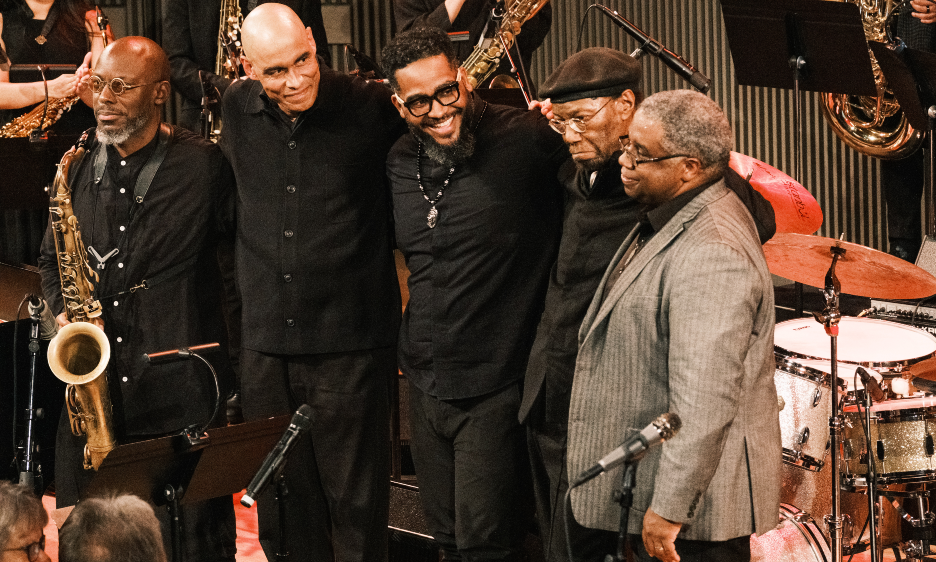
Tolliver's Africa/Brass: Trane Forever, presented October 25 at the SFJAZZ Center, delivered a powerful, sometimes exhilarating encounter with John Coltrane's orchestral music. Joined by Tolliver's quintet and 15 musicians from the San Francisco Conservatory of Music, the trumpeter and composer led a crowded stage through five selections in a brisk hour. The music commanded attention. The presentation offered little insight into the recording behind it, the centennial being celebrated, or the young musicians helping bring it to life.
Dressed in a black suit and beret, Tolliver played a few opening trumpet notes before devoting himself to conducting. His instrument stayed on its stand as he moved among the players, watching, listening, and shaping their responses. From the terrace behind the band, his physical involvement became one of the evening's most compelling sights: a close lean toward a section, a finger marking an entrance, an overhead clap signaling the next surge.
Coltrane's 1961 Africa/Brass was his first album for Impulse! Records, placing his improvisational group within an expanded orchestral setting. The original LP featured three pieces: "Africa," "Blues Minor," and the traditional "Greensleeves." Later releases included additional music from the sessions. Sunday's five selections went unannounced, leaving their relationship to the original album unexplained.
Tolliver's stage adaptation began in 1998, when original-session bassist Reggie Workman asked him to reconstruct the work. With Eric Dolphy's scores unavailable, Tolliver spent months transcribing the recording and, at Workman's request, adding a choir. That history gives the project considerable weight. On Sunday, however, listeners had to bring that background with them or discover it afterward.
The performance itself provided ample reasons to investigate.
Marcus Strickland carried the featured saxophone role with an absorbing blend of sound and physical commitment. He leaned forward, rocked back, and shifted his weight as his lines unfolded. Repeated phrases took on an almost incantatory insistence, while lower-register passages gave the music depth beneath the orchestral movement surrounding him.
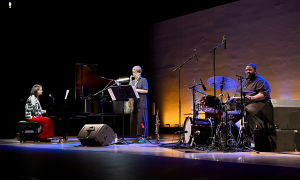
At a lidless nine-foot Steinway, Keith Brown was an equally consequential presence. His intricate soloing drew substantial applause, but his command of repetition could be equally effective. Small figures built tension, making the eventual return of the horns feel earned. Bassist Ugonna Okegwo, sometimes smiling with his eyes closed, provided a steady center amid shifting instrumental weight.
"Greensleeves" offered the evening's clearest point of recognition. Its familiar contours emerged within a performance that kept shifting in scale. Saxophone and piano held the foreground; repeating figures tightened the suspense; Tolliver drew the larger ensemble forward, then abruptly cut it away. Drums, bass, piano, and saxophone continued beneath the space he had opened.
The Conservatory players contributed both force and texture. Some horn passages sounded less secure in tune, but their collective entrances could transform the room. Tolliver's direction made those transitions visible: fingers spread, palms lowered, then hands lifting to ask for more. An approving thumbs-up briefly completed the exchange.
Here was the evening's most persuasive expression of continuity across generations. Younger musicians performed this demanding repertoire under the direction of an artist who had heard Coltrane firsthand. Whatever preparation preceded the concert, the onstage exchange was tangible—in the cues, the responses, and the effort to give the arrangements their full expressive range.
Oakland-raised drummer Darrell Green delivered the most arresting episode of the closing stretch. As other members of the quintet stepped aside, he reduced the scale to soft mallets and resonant, timpani-like tones. The room grew still. Delicate sounds gave way to mounting intensity, and the returning musicians gradually rebuilt the ensemble around him.
The final cutoff was decisive. The audience rose, cheering loudly as Tolliver led his quintet forward for bows. The Conservatory musicians eventually filed out without being introduced or thanked from the stage.
After a grueling sixty minutes—short of the roughly ninety-minute span familiar for many Miner Auditorium evenings—the stage door remained closed. Despite the standing ovation and sustained cheers, Tolliver did not return for an encore.
The abrupt ending compounded the evening's omissions. A few words about Coltrane, the repertoire, or the Conservatory players would have deepened an already substantial musical experience. Tolliver had shown how vividly this music could still speak. He left its history and much of the story of the performers for the audience to piece together.
 FOLLOW Steven Roby
and get notified whenever a new article published.
San Francisco-based Steven Roby is a music journalist, best selling author, and host of the Backstage Bay Area.
About Charles Tolliver

Tags
PREVIOUS / NEXT

Become a Sustaining Member

Since 1995, All About Jazz has championed jazz as an art form and supported the musicians who create it. Over three decades, it has grown into one of the world's leading jazz resources, serving hundreds of thousands of readers, musicians, presenters and industry professionals each month.
Help Build the Future of All About Jazz
Your support helps us continue building All About Jazz for the next generation—expanding our editorial coverage, preserving jazz history, developing new community features and creating better ways to discover the music and the people behind it.
Become a sustaining member for as little as $20 per year and you'll immediately enjoy an ad-free experience along with access to subscriber features and future articles for a full year.
Together, we're not simply sustaining All About Jazz—we're building its future. Thank you for being part of the journey.
Near

San Francisco Concerts