Home » Jazz Articles » Live Review » Moldejazz Jam Sessions: What Makes Them Tick?
Moldejazz Jam Sessions: What Makes Them Tick?
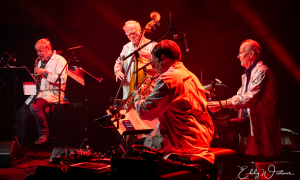
Courtesy Daniel Mège
You can go up and play even if you are 14. You do not need to be a big star.
—Rino Sivathas
Moldejazz jam sessions through time
All About Jazz: Have jam sessions been part of the festival since its beginning, in 1961?Rino Sivathas: The jam sessions have been a huge thing at the festival for many years. I grew up hearing a lot about how it was before, and about the legendary jam sessions in the basement of Scandic Alexandra Hotel. People still talk about those legendary, long nights, and the jazz legends who have played at the jam session. The famous musicians from the U.S. and everywhere were playing there. Back then, the jam sessions used to be the whole night, and it has since then been a central hangout place and meeting point for both musicians who play at the festival, and listeners who visit the festival or live in the city. When I grew up, people were talking a lot about how it was before.
On Saturday this year [2026], the last day of the festival, I met Cecilie Nogva. She was the festival's acting Director last year. Now she's the finance and administration coordinator. She told me that when she was young, jam sessions at Moldejazz would start at three in the morning and go until seven or eight. It was at the Scandic Alexandra hotel, but a different spot than the basement. All the musicians were sleeping at this hotel, so it was easy for them to hang around there. They were playing the whole night, smoking a lot of cigarettes and drinking beer, exactly how a jam session should be.
AAJ: Where did the sessions move?
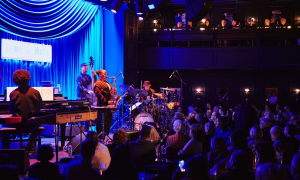
RS: In 2012, I was 16, and while I was at high school in Molde, they used to run the jam session inside the Storyville jazz club upstairs at Plassen [the cultural centre of Molde, also serving as a cultural hub for Møre og Romsdal county]. During that period, the jam sessions were not the biggest thing, the audience was often sparse. Not so many musicians were going up and playing. The room wasn't also the best place to host jams, due to pretty dark lighting, really like a serious concert vibe. The bar was also outside, so it really felt like a concert, rather than an open jam session where everybody could just go up, play and hang out.
In 2017, I joined the band who opened the jam session. The festival also decided that year to move the jam session to the space outside the Storyville room, where the bar is located. I think that was a good idea. It felt more like a place where it is possible to hang out in addition to listening to the music. The only problem was that the space was too small. There was often a queue outside to get in. Therefore, in 2019, the jam session was moved downstairs in the same building, to the much bigger hall outside of Teatret Vårt. During these years the jam session started to be more crowded and a bigger thing at the festival. The hall is very tall, and has a huge staircase up to the roof where a lot of people can sit. It was better, but the acoustics were not ideal, it was difficult to hear the musicians, who were often drowned out by people talking. During 2020 and 2021, there were no jams at the festival, because of Covid-19.
AAJ: Was it after this that they moved to Kroa, where the jams are located now? [Kroa, "the pub," is located in the park of Molde's chateau, see Moldejazz 2026]
RS: In 2022, I had a meeting with the festival, and we decided to move the jam session to Kroa. It is a bit outside of downtown. There is also the park space to hang out, which makes the venue a nice alternative to the other places where concerts also occur late at night in town.
AAJ: How did you end up in the opening jam band, and organizing the jam sessions at the festival? How did the festival find you?
RS: Very simply! I am from Molde and grew up with the festival. Moldejazz has been a really important part of my music and general life. It has always given me tons of inspiration, and a scene to play on since I was at a really young age. I've had many of my best musical experiences at the festival and heard a lot of my heroes. Everyone from Ornette Coleman when I was 11 years old to Kendrick Lamar. It is a huge range of musicians who have played and inspired me through the years. And I have been playing there since 2006, when I was 9. I started to play at Alexandraparken [one of the main Moldejazz venues], where bands of youngsters can play during the daytime. I played almost every year. In 2016, I went to Trondheim to pursue a bachelor's in jazz [known as the jazzlinja] at the Norwegian University of Science and Technology (NTNU). I was 19. It was at that time that I got involved in jam session organization.
There was a local band opening the jams, with some of my earlier teachers from the Molde cultural school [Kulturskole; see Moldejazz 2026] and Sund folk high school [Folkehøgskole], in the Inderøy municipality. Arne Torvik and Sindre Klykken were my teachers at the music program of the Molde upper secondary school, and they had the responsibility to organize the jams back then. Arne also played with Tuva Halse on Monday at Storyville this year at the festival, and Sindre with the Bech & Skeidsvoll New Orleans band on Saturday. They asked me if I wanted to join the band on drums, which was a perfect gig for me. The jam opening band back then was with me on the drums, Kristoffer Eikrem on trumpet, Espen Bjarnar on guitar, Arne Torvik on piano and Sindre Klykken on the double bass. All five of us are from Molde, and it was really fun to play with this band. I was the youngest in the band and had just started to study at NTNU. I was 19 at that time, and it was really great and inspirational for me to play in the opening band at that age. In the first years, the festival jam sessions were lasting three days only, Wednesday-Friday. After the break during Covid-19 in 2020 and 2021, the festival asked me if I wanted to take the responsibility of organizing the jam sessions. I have been doing that since that time.
AAJ: The jam sessions start at sunset, around 11:30 p.m., and continue almost to sunrise. It would be fun to ask Moldejazz if it could be synchronized with the sunset and sunrise...
RS: That would be cool! Maybe I should mention that to them, but I fear there's a lot of practical stuff around it that would make it a bit difficult, compared to the early days. Now there are rules in Norway about when the bar should stop selling alcohol. There is also a lot of staff working around the jam sessions as security, sound technicians, and at the bar. That's the main reason why we can't keep it that late anymore.
AAJ: I remember a security guard complaining last year while the musicians kept playing. She was trying to explain it wasn't possible to continue, and nobody was listening to her.
RS: This year on Monday and Tuesday we stopped the jam session closer to 2:30, because there weren't many people left. It is good to follow the energy in the room. On Saturday, we could probably have played until seven in the morning. For me 3 a.m. it's fine, even though sometimes I feel we should play more, like on Saturday, but that's how it is, and I'm totally fine with that.
Running the Jam
AAJ: How do you recruit the musicians who open the jam sessions?RS: I mostly just look at the program and see who's playing, and then I send them a message, on Instagram, Messenger or by email, and ask if they want to open the jam. It's that simple. I try to have a variation on the opening bands, so each night has a different vibe. I think it's a good thing to have a bit of variation in the opening band, both in style and in which direction we're going with the music. I also try to set up musicians I think would fit great to each other, to generate the best energy on the stage.
AAJ: Where do the jam session instruments that are on stage at Kroa come from?
RS: They belong to the backline, which the festival rents. They have a backline store at Plassen, and they send out instruments and gear to all the stages at the festival. So for the jam session we have a list of the gear we need, which includes instruments like drums, piano, and also PA system, amps etc. The backline people transport all that to Kroa. This backline system is really well organized, it is easy to communicate with them, and they will get additional instruments to the jam session if we are missing anything.
AAJ: Sasha Berliner was surprised to find at the jam session the same vibraphone as the one she had 30 minutes earlier at Storyville. Is it true that the vibraphone was the one that Gary Burton used to play from the studio in Oslo where he recorded his ECM Records albums?
RS: Maybe, have you heard it?
AAJ: This is what Åsmund Skjeldal Waage told me. I got confirmation later that it was purchased by Storyville.
RS: Interesting.
AAJ: So you started taking responsibility for the jam sessions in 2022. It is quite a lot of time already. Are you happy with it?
RS: Yeah, I'm very happy, and I feel like the jam is evolving every year. I have played in the jam bands for almost 10 years now, which is also really cool to think about. Almost one third of my life.
AAJ: What a CV!
RS: Hehe. That's quite an achievement actually. Proud of that!
AAJ: During the week you were quite frequently the drummer of the session band. Does that mean that you didn't find anyone else?
RS: This year was the first time I'm doing it together with Isak Austnes Brekken. He has joined me to help organize the sessions.
AAJ: It is true, he has always been around. He's a co-organizer now?
RS: Yes. It's easier. We felt it's good that one of us is always in the band, because there's so much more practical stuff around than just playing some tunes as the opening band. We have the responsibility that there are people playing on stage for the whole night, and that globally, everything proceeds smoothly. It is also easier for us to have control over everything practical between the musicians and the festival. We could also just hand it to others, but then someone would still need to be there to stop it at the right time, helping the younger musicians, and all that. That's one of the reasons we decided that either me or him is going to be in the band every day.
This year I also played at a different festival on Friday called Vinjerock, in Jotunheimen National Park, with the vocalist Sanyu (Sanyu Christine Nsubuga). So I was at the jam on Monday, Tuesday, Wednesday and Saturday, and Isak was there Thursday and Friday. And on Tuesday and Saturday we were in the opening band together.
AAJ: It is also useful to have someone else available to look around, because people are spread over the park. Actually, most people stay in the park, drink and talk, you need to somehow keep an eye on everything there too.
RS: Yeah, that's also a good point. I feel I have an advantage that I'm from Molde, and also have a good overview of the Norwegian and the general jazz scene. That could be nice to use, when we need some people to go up and play. People also love to drink and hang out, you know. If no one's playing, then it's our job to find people to play, or to go up and play ourselves. The jam isn't running by itself.
Normally we play three to four tunes before the jam is open for all. And it is everyone from young musicians to international jazz stars who come up and play. Which I think is a nice combo. I also need to be there to support the young musicians, like one day, a mother came to me and asked if her daughter could play. She was about 15 and was a bit nervous. She told me the tune, so I found a band for her who could play the tune. I had to go through the park outside and find my fellow students from Trondheim and ask them if they want to join this tune. In that way, I think it is great to have someone people know they can go to if they have questions, or if they want to try out some new music.
Young, creative and fearless
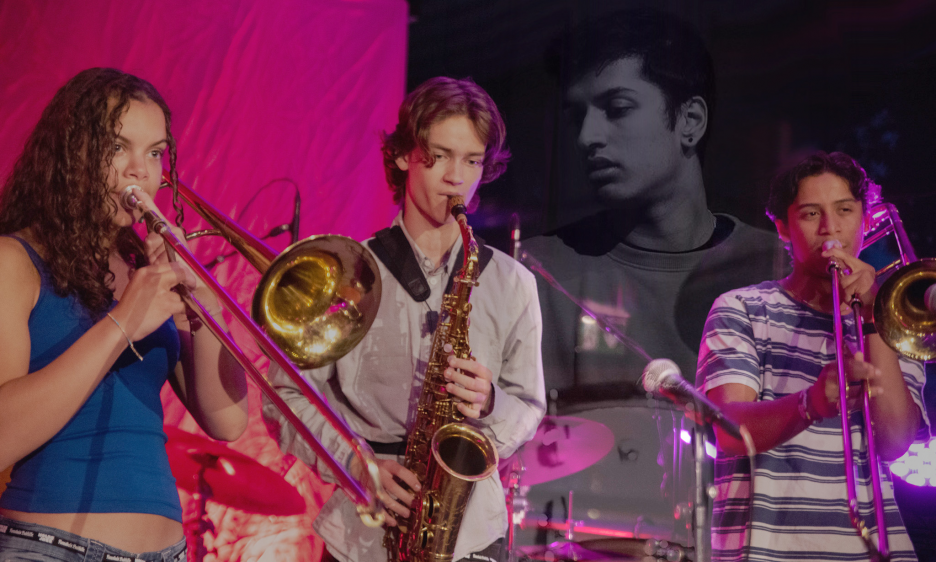
AAJ: In a small venue with a restricted audience, the Kroa jam sessions probably help the youngest musicians, including those still in high school, to be more self-confident. I have in mind the Tuesday jam session this year, with Ellinor Drevvatne, a very good violin player still at upper secondary school. Tuva Halse took time to pop up at 1 a.m. and play with her, although she had a very long trip to Tromsø where she had a gig the day after. Understandably, Ellinor looked really stressed. They had a fantastic duo on Thursday; it was like a lesson in itself, the two of them together, Tuva encouraging her with her gaze and through her own violin playing, helping her build confidence. This summed up what makes the Moldejazz jam sessions at Kroa so special.RS: That's great to hear. There were a lot of young musicians playing at the jam this year, which I think is really cool. I think the young musicians are already on a high level, and the future is really looking bright. There are more and more young people in Norway playing standards and playing on jam sessions at a younger age now than before. Learning jazz standards has in my eyes a higher status for younger musicians now than earlier, and we can see the results of that in the jazz festivals around in Norway, including here at Moldejazz.
AAJ: Where do they come from? For instance, one of the youngest ones this year, the trombone player, Miriam Jiménez Franke. She's 14. She came from Oslo.
RS: She's probably at the cultural school, you start when you are eight...
AAJ: She is not...
RS: Really?
AAJ: No, she is at the Norwegian Academy of Music (NMH). She started playing in the local school band at Grünerløkka [an Oslo district], they have excellent instructors there, I was told. She has learned with trombone players Lars Sutterud and Alexander Salas Johansen. At NMH she follows the Talent Development Program(TUP)... What do they do at TUP?
RS: A lot of people I know from Oslo have been on that program. Seems like a good program for young musicians. A lot of places in Norway have schools and classes for young musicians to develop themselves as musicians. In Molde there is Jazzlogen [the Jazz Lodge]. This is the band playing in the parade every day during the festival.
AAJ: Is it similar to cultural schools?
RS: At the cultural school, every week you have lessons. You normally get one lesson a week on the instrument you're playing; for me it was drums. I also did guitar, so I had two different lessons. I'm from a small place outside Molde called Kleive, and I used to take the bus to town after school. We had half an hour or 40 minutes of lesson, then my father would come and pick me up, and drive back. That's the normal scheme; then you can have something extra on top of that, playing in the big band in Molde, which plays at the festival every year, called the Kulturskolens Ungdomsstorband. You can also play in marching bands and at Jazzlogen. When I was at the cultural school in Molde, I also played in Jazzlogen, which I learned a lot from.
In Oslo you also have the Akershus and Oslo Youth Jazz Orchestra [Akershus og Oslo ungdomsjazzorkester, AOJO], which is a bigger orchestra for young musicians. A lot of people I studied with in Trondheim have played in AOJO.
AAJ: You said that there are now more young musicians coming in, from high school?
RS: Yeah, I think it's a new thing. And they are more focused on standards, at a higher level than before. When I was that age, we also had people who played standards really well, but we also played other stuff. Learning and playing standards has become much more popular.
AAJ: What's the reason, you think?
RS: Standards are not easy to play. It takes a certain level of skill to master. And it is not easy to learn it, regardless of which instrument you play. I also talked a lot with musicians at the festival about this topic and Martin Horntveth, you know him, the drummer in Jaga Jazzist, who played on Friday. We had a talk at the jam session, and he told me it's a new thing, so many musicians both young and older playing standards at the festivals. He told me it wasn't like this 20 years ago at the jazz festivals in Norway. I feel like it's a cultural thing, and more people start to do it when they see their idols doing it.
Guarding an Atmosphere
AAJ: Do you think the chateau is a good place for the jam, with the park around it?RS: Yeah, I think it's nice. The place could almost be a bit bigger.
AAJ: Yes, because the Kroa room is a bit confined.
RS: Yeah, some people sit at the front, but some of the front seats are often free; everyone stands behind, and it gets really packed back there. It would be nice to get people a bit further forward; that's one thing. And the sound isn't great in that space either; it's a bit hard to hear sometimes, for instance the bass. But for now, it's settled there. It may stay like that for some years. On the other hand, it's also great that the park lets us have drinks there.
AAJ: That helps keep people around too. I love that place, in spite of these shortcomings.
RS: Yeah, drinks help, even alcohol, I would say, without overstating it.
AAJ: If the place had to change, you would need to find somewhere similarly open, where people can stay and keep talking. It seems to work as a meeting place too, since not everyone in the park is actually there to listen.
RS: Yeah, absolutely, a lot of people don't even know it's a jam session. They're just there to hang out in the park, which is also nice. The venue is a little outside the town center, which could be good, but maybe it would also be nice to have it more central. It's not that far. It's just around the corner really. You just have to walk over there and step outside the center a bit, and that's sometimes enough for people to say, ah, we're heading home. Hard to say.
AAJ: Would you think it would be nice to have more people?
RS: Maybe get more people up playing, but that's also a thing we are working with. This also depends on who's in town to play at the festival. The booking can actually influence how many people show up to play at the jam session.
AAJ: Definitely. Is that common at jam sessions at other festivals and venues too, that mix between the younger ones and the already established musicians? Do you think it is a specific thing in Molde, or perhaps in Norway?
RS: I definitely think Molde has its own jam session style, compared to other places, both in mix of age, but also in the music style that is accepted to play. You can go up and play even if you are 14. You do not need to be a big star. That's unique with this festival, and a thing I hope will develop even more through the years. If you go to the night jam sessions at Smalls in New York, it's not the same at all. I am not sure you can just be 15 or 16 and show up out of nowhere at Smalls. I also lived in Copenhagen before. It is a totally different vibe there. You have to play in a very specific way, in line with history, which is very difficult to do at such a young age.
AAJ: On Monday this year, your band opened the festival ceremony. An Invitation...
RS: Yes, we were Tarald [Kongshaug], Isak, Tuva and me, the same band which opened the jam session that evening. We played one tune, "Invitation," an idea of Tuva's. We played a version close to Roy Hargrove's [on Nothing Serious (Verve Records, 2005)]. A lot of people have played it, Joe Henderson and others. Linda [Melsom, the director of Moldejazz] introduced us, and since there were a lot of people at the opening, perhaps a thousand people, she said something like, we're playing "Invitation," and that's also an invitation to everyone to come to the jam session!
 FOLLOW Daniel Mège
and get notified whenever a new article published.
FOLLOW Daniel Mège
and get notified whenever a new article published.
Scientists search by day, musicians find by night.
About Rino Sivathas
Tags
PREVIOUS / NEXT

Become a Sustaining Member

Since 1995, All About Jazz has championed jazz as an art form and supported the musicians who create it. Over three decades, it has grown into one of the world's leading jazz resources, serving hundreds of thousands of readers, musicians, presenters and industry professionals each month.
Help Build the Future of All About Jazz
Your support helps us continue building All About Jazz for the next generation—expanding our editorial coverage, preserving jazz history, developing new community features and creating better ways to discover the music and the people behind it.
Become a sustaining member for as little as $20 per year and you'll immediately enjoy an ad-free experience along with access to subscriber features and future articles for a full year.
Together, we're not simply sustaining All About Jazz—we're building its future. Thank you for being part of the journey.