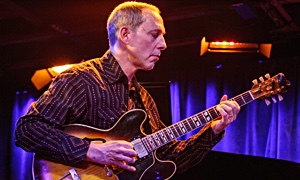
Home » Jazz Articles » Interview » Matt Marantz: About Music, Money and Mouthpieces
Matt Marantz: About Music, Money and Mouthpieces

MM: Well, sure it is. I have done it before, but for someone like me, it doesn't make as much sense to try and travel with my band. I prefer to keep it local, and local for me happens to be New York City which is a culturally rich place with a huge pool of talent to pull from. So if I get the chance to book a date for my quartet at Smalls Jazzclub, for example, I have an incredible list of musicians that I know to call as players for the rhythm section. So it's sort of the best of all worlds because I like staying here. I've already traveled far & wide and I'm very lucky to have seen much of the world already on the road as a sideman. I'm just interested in making great music at this point rather than building a touring career for my band, so when I do get the chance to do that, because of where I live, it usually feels successful.
When I get called to play with other people's bands, I'm especially happy to be a sideman and in a lot of ways, I prefer it. As a sideman, there is nothing to focus on except executing the music, listening to the other musicians, and playing your instrument well. None of the stresses of bandleading, being responsible for the travel schedule, or worrying about the turnouts at the door gigs.
AAJ: Isn't that why touring musicians book a few stops on the way there or back?
MM: Yes, for sure. Usually on a jazz tour, there's something that serves the purpose of the "anchor gig" that either makes traveling to a particular starting or ending point make more sense economically, or even potentially funds the whole run. I guess I've learned that by paying attention to the way the tours I've been a part of as a sideman have been structured.
AAJ: One of those was playing in Alex Goodman's combo.
MM: Yes! Absolutely. Alex is not only one of my favorite guitarists of our generation, but I am lucky enough to have gotten to tour with his band as well. One of the best times I ever had in jazz was going out with his band for a wide tour of Canada that lasted 3 weeks and culminated in a 2-day recording session that turned into his 2017 CD, "Second Act." One of the best things about Canada is how much they support their artists. Alex received a grant from the Canadian Arts Council that made it possible for us to travel to the gig destinations and record that album, which from the outside to me as an American seemed like an amazing thing. Alex's music is also very challenging to play well, so I feel like I got better as a musician from touring that heavily playing music as demanding as what he wrote for the band. That band happened to be made up of some stellar people as well, so hanging out with them on the road was great.
AAJ: You've talked about the music and the hang being enjoyable aspects of touring. Where is the downside?
MM: Well, the downside of touring is probably very unique to each situation. I think you can always find a downside if you try hard enough, even at the highest levels of the music industry. I guess in the case of jazz-specific touring, I would say since the budgets are a lot lower, in the past I've done tours where I was sleeping on someone in the band's friend's couch after the gig, or the bandleader's relative's floor in a sleeping bag, or the local jazz foundation donor's house on a couch, or whatever... It isn't always glamorous. There are a lot of long drives and sometimes you're rushing overnight to get to the next destination in time for the next gig.
On the flipside, a more positive way of looking at it is that I have traveled to play in a lot of rural areas where people might otherwise never get to hear this type of music played live. On Alex's Canadian tour I mentioned earlier, we flew into White Horse, Yukon, and then drove all the way up to Dawson City. That's way up in the mountains, and as you may already know, it's a historic gold rush town from the 1800s. Somehow, the people there loved our music. A lot of the places we performed at were in economically depressed communities, and we would play in libraries and community centers in those places. It seemed like a lot of people always came out to the concerts too though, and you could see the music uplifting them a lot of times.
AAJ: Would you say fusion is your preferred style of music or more of a mixed bag because I've heard different styles from your recordings?
MM: Well, yes and no. I came up on nothing but acoustic jazz and early British & American rock and some r&b and American artists who were popular during my younger years like D'Angelo. When I first heard Allan Holdsworth way later around 2012, his music blew me away. I mean, when I heard him take a solo for the first time, it was like round two of discovering Charlie Parker for me. He has a lot of really unique sounds in his music, like the scales, the harmonies, the textural layers to it. I tried to soak up as much of it as I could. But when I study someone's music, I don't really want to figure out the solos exactly because I'm not trying to copy their playing, usually. I just want to figure out what's going on with the foundation of the songs, so I can still sound like myself and be original while playing over them. With his music, it's the otherworldly compositions that are almost even more compelling than the ethereal solos.
In my earlier studies, I would often transcribe people's songs like Keith Jarrett's or Brad Mehldau's originals, with the goal of getting that type of harmonic movement into my writing by an osmosis of sorts. Allan's music is so complex that I often don't even know exactly what to call some of the chords, but I've still learned a few over the years. With Holdsworth's guitar & Synthaxe playing, it's got everything: The time feel, the execution, the ferocity. He had massive hands; The guitar was like a toy in them. The funny thing about him is he said in an interview that growing up in England, he really wanted to play the saxophone and loved Bird (Charlie Parker). He listened to a lot of bebop but purposefully didn't want to play guitar like that. That's why you hear him playing more diatonically than beboppers who all used more chromaticism and passing tones, but Allan's sense of compositional harmony is so intricate that playing diatonically over it still sounds futuristic. So, in a way, that's why even when I'm playing fusion, I'm probably still going to come off sounding a little more like Cannonball or Bird modernized a little bit. It's just in my blood. But, oh man, when I saw Holdsworth play with Gary Husband and Jimmy Haslip at Iridium in around 2014, he was still in his musical prime. It was what I imagine seeing Coltrane play with Elvin must have been like; The musical ferocity and communication between Allan and Gary was bordering on the telepathic. Total lights-out level playing!
AAJ: You covered one of Joe Henderson's songs ("In and Out") on your last record. Is he a favorite?
MM: Joe Henderson is absolutely my favorite jazz musician, and not just on sax. Every tenor player will usually eventually get around to studying his music because Joe had a voice on the instrument that was among the most unique in Jazz. Personally, I would never try to directly imitate sounding like him because his style is not easy to copy, and a lot of things about his sound and articulation were completely unique to him. I've never heard anyone else truly sound like him, and not to mention I can't play or come up with half of the stuff he could play or come up with anyway. On the other hand, Joe wrote a lot of tunes that are now considered Jazz classics, and if I ever choose to perform or record one of his or any other jazz musician's compositions, I prefer to think of it more as a tribute to them as an artist while I try to put my own stamp on it as an improviser. I generally do not arrange other people's music, because I figure that if they wrote it that way, that's probably the way they wanted it played. I'm still glad to try and sound like myself on their tunes, though, and that's actually mainly what makes it a challenge to play other people's music well anyway.
AAJ: When will this long-awaited new record of yours come out?
MM: Well, I started recording the new record in 2020, and that is approaching 6 years ago now. I can explain that a bit, and here is what generally happens as a freelancer: As soon as I catch up with all of my work obligations at any given time, more work comes in to take its place. Working on my own records ends up taking a back seat to all the things I feel like I have to do for a living, which isn't really the greatest situation for my music.
I actually recorded two records that year in 2020, and one of them was Sonoran which obviously came out already, so I feel great about that project's completion. The composition & framework of the fusion record is a lot more complex with a lot of different parts, really specific overdubs, and I know once I commit to finishing it I'm going to be wrapped up in that for possibly two or three months. So I want to set aside some time this year and make that happen.
I can't say I'm not still excited about it though: I recorded the framework of it myself at my studio with my brother Luke on Fender Rhodes & synths, the great drummer Kush Abadey, and one of my favorite electric bassists in jazz today Orlando le Fleming. The band really crushed my music energetically, and I think a lot of that energy was down to the fact that at that point, none of us had played music with each other for about 8 months because it was the fall of 2020 during the pandemic. We blew through recording final takes of 10 tunes in 8 hours since everyone was worried about being in the same room for too long because of the virus, and we were all in masks except when I played my EWI parts... It was quite the experience.
That's the other thing about it-The record will feature me mostly on EWI, which is something I haven't done before on one of my own records. I got deep into the EWI and synths when I discovered Allan's music because when I heard what he was doing with the Synthaxe, I immediately wanted to learn how to do something resembling that, too. The Akai EWI has served as a fairly seamless bridge to that world of synthesis and multi-octave improvisations, which allows you to think a bit more like a guitarist or a keyboardist in terms of the language you can improvise with. It's a very different instrumental layout from the saxophone, which generally sounds better with bebop lines and melodies than it does playing multi-octave patterns and arpeggios soaring throughout multiple octaves. The EWI, on the other hand, excels at that style of improvising and almost outright calls for you to play it that way, so learning that instrument has also enhanced my playing in terms of learning more musical language and different ways to improvise than just your typical bebop tenor school of thought.
My foray into the world of EWI and synthesis recently led to a great gig this past summer building sound patches for Ashun Sound Machines' latest creation, the Diosynth. It's a brand new wind controller design with a really deep sound engine, and not only did I get to make 100 of the factory sounds that ship with the instrument, but I was featured playing the Diosynth with my quartet in some of ASM's video promotions for the instrument at NAMM 2026 and other places online during the time of its commercial release.
Like I said earlier, it's great to be involved with music from a lot of different angles. You wind up doing some things you never thought you'd end up doing, and that keeps it fresh and interesting all the time.
About Matt Marantz

Tags
PREVIOUS / NEXT

Become a Sustaining Member

Since 1995, All About Jazz has championed jazz as an art form and supported the musicians who create it. Over three decades, it has grown into one of the world's leading jazz resources, serving hundreds of thousands of readers, musicians, presenters and industry professionals each month.
Help Build the Future of All About Jazz
Your support helps us continue building All About Jazz for the next generation—expanding our editorial coverage, preserving jazz history, developing new community features and creating better ways to discover the music and the people behind it.
Become a sustaining member for as little as $20 per year and you'll immediately enjoy an ad-free experience along with access to subscriber features and future articles for a full year.
Together, we're not simply sustaining All About Jazz—we're building its future. Thank you for being part of the journey.