Home » Jazz Articles » Interview » Jacopo Fagioli: The Relentless Pursuit of Sound
Jacopo Fagioli: The Relentless Pursuit of Sound
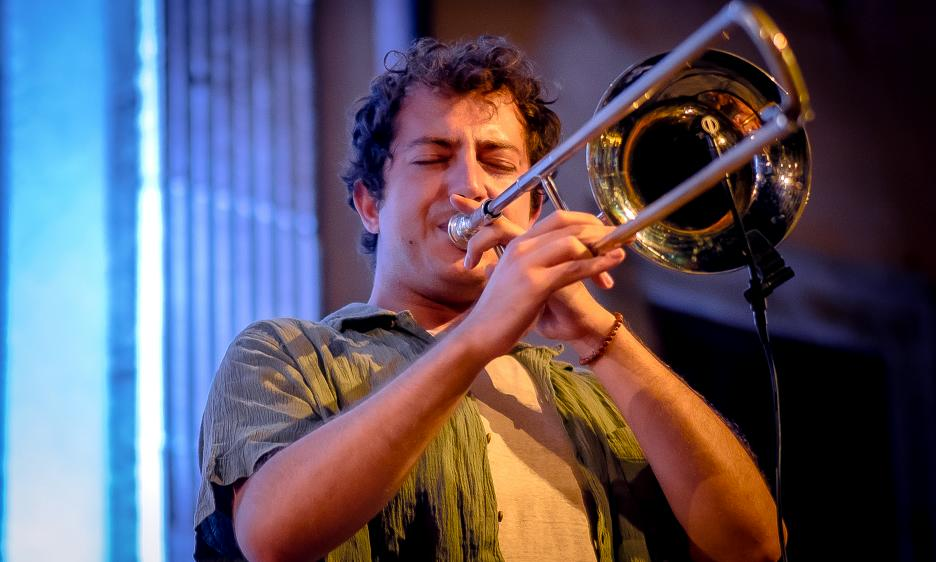
Courtesy Sanzio Fusconi
I have never been particularly fond of the new talent label, because it puts emphasis on the future, whereas young musicians are already an integral part of the present.
—Jacopo Fagioli
All About Jazz: Since we have known each other for a long time, I would like to go beyond the usual questions. You were recently voted Best New Italian Talent. Accolades can be both an honor and a curse. I remember how Roberto Ottaviano joked—though perhaps not entirely—that being named Musician of the Year twice did not bring him much luck. Let's start there. "Best New Talent" tends to define an artist more by what they promise than by what they already are. Does this recognition give you greater freedom to experiment, or do you feel the pressure of having to live up to expectations?
Jacopo Fagioli: I have never been particularly fond of the "new talent" label, because it puts emphasis on the future, whereas young musicians are already an integral part of the present. As for expectations, I think it depends on each individual's outlook. I am grateful for the attention I am receiving right now, although I do not know how long it will last. What makes me especially happy is that a collective and highly original work such as my quartet's Dialogue has been recognized, despite the fact that there is a significant degree of risk involved in that music. With the exception of a couple of pieces built around more traditional structures, the album thrives on motivic and free improvisation. I think this recognition sends a positive message to musicians who, like me, choose paths that are not always the safest ones. I am always looking for projects that allow me to dig deeper. If there is no space for "research," I do not embark on a new endeavor.
AAJ: Dialogue carries a strong social and political dimension. You managed to translate ethical and social concerns into music that does not rely on words. Is this a direction you intend to explore further?
JF: Yes. The next step will probably be to introduce lyrics in order to make the message even more direct and powerful. I am thinking about a project connected to the GKN Gesture Rebellion [Translator's note: an artistic and musical project created in solidarity with the worker-led occupation of the ex—GKN automotive plant in Campi Bisenzio, near Florence] involving a young freestyle rapper. I've also discussed this idea with Ralph Alessi. One of the main inspirations is Origami Harvest (Blue Note Records, 2018) by Ambrose Akinmusire.
AAJ: In that work, the use of rap language within an orchestral setting is particularly fascinating because Akinmusire mirrors the phrasing of spoken rhythm through the trumpet itself.
JF: Exactly. It is an incredible achievement. I am fascinated by the freestyle battles that very young performers organize in public squares. Lately I've been disguising myself as one of them to go and listen—and in a way study them—both in Florence and in Prato. It is music created by young people sharing a moment of life through an art form. The next step for me is to make the message clearer and more powerful through the use of spoken, rather than sung, words in future projects.
AAJ: On Bilico, your duo with Nico Tangherlini, silence and empty space play a central role. How do you write silence into a jazz score? Is it an aesthetic choice, an instinctive one, or perhaps a response to the information overload that surrounds us?
JF: A duo naturally offers more room for silence. For me, silence is fundamental, both in composition and improvisation. My main reference in this respect is Miles Davis. His ability to remain silent for entire choruses and then enter with a single note that becomes powerful precisely because of the silence preceding it is an extraordinary tool. Silence is part of life. It creates expectation, just as it does in a conversation.
AAJ: You're also a member of Funk Off, an energizing and highly physical ensemble that seems worlds apart from the rarefied atmosphere of your own projects. How does the physicality of street performance influence your phrasing and technical precision?
JF: I've been playing with Funk Off for four and a half years, and it has been an incredible school. In that project, silence does not have much room. We play music fueled by energy and movement. You learn how to manage choreographies that change on the spot, how to function within a moving orchestra, following the cues of Dario Cecchini, who might suddenly call for a background figure or an ending. Playing in a town square and hearing the sound bounce off the surrounding buildings is priceless. Those experiences have deeply influenced the way I carry myself on stage, whether with my quartet, in a duo, or in other settings. Today I am much more comfortable using my body as part of my performance.
AAJ: What is your relationship with unpredictability and mistakes during a performance?
JF: I've made peace with unpredictability. Mistakes bother me more in the recording studio, where even a small flaw can throw me off balance. Also, when I practice I try to make as few mistakes as possible; when I perform, I try not to worry about them too much. Often a mistake can become the beginning of a new path. If you have a healthy relationship with your music, you treat every sound event as material that can be shaped and developed.
AAJ: In moving from the duo format to the quartet, you replaced the traditional piano with Davide Strangio's electric guitar. Was that a stylistic choice aimed at freeing your language, or did it make the management of textures more challenging?
JF: Davide is fantastic. His use of electronics creates extraordinary sonic landscapes that sometimes resemble an entire brass section. Since the guitar is the only harmonic instrument in the group, it has a lot of space, and the colors he produces are a tremendous asset. The idea of building a group around the sound of a guitar came from listening to Fingerpainting (Verve Records, 1997) by Nicholas Payton, where those musicians performed compositions by Herbie Hancock in a trio setting with trumpet, guitar and bass. Another important reference is the duo of Fabrizio Bosso and Irio DePaula. Trumpet and guitar is a combination I love. Compared to the piano, the electric guitar immediately moves the music beyond a purely chamber-jazz environment.
AAJ: Your musical education took you through Pistoia, Siena, Rovigo and Amsterdam. If you had to assign a specific lesson or influence to each of those places, what would it be?
JF: It is really a journey of intersecting circles. I attended high school in Florence, where I first immersed myself in bebop and hard bop. At Siena Jazz I deepened my understanding of original music and the tradition through figures such as Mingus, Armstrong, Ellington and Monk, studying with teachers like Silvia Bolognesi, Fabrizio Puglisi and Gabriele Evangelista. But the real impulse toward radical improvisation came from pianist Stefano Battaglia and his seminars. Playing at the nearby festival Serravalle Jazz in August 2017, marked my first major breakthrough.
In Amsterdam I experienced the world of big bands through Bob Mintzer, and I studied konnakol—the rhythmic language of Carnatic music—with Harmen Fraanje, after first being introduced to that world by Fulvio Sigurta. I also studied there with Ruud Breuls, whose approach I now recognize in musicians such as Alex Sipiagin. In Rovigo, my classical studies raised the bar in terms of technique and score reading through composers such as Bartók, Mahler, Strauss, Verdi and Stravinsky. It was also there that I discovered the piccolo trumpet, an instrument I have loved since high school. Today, living in Prato, I find inspiration even in the rituals and bells of the New Year celebrations by the local Chinese community.
AAJ: The use of the piccolo trumpet in contemporary improvisation is fascinating because it removes the instrument from its traditional Baroque environment. What attracts you to it?
JF: I fell in love with it while listening to the virtuosity of Maurice André. I eventually graduated playing works by Telemann and Haydn on the instrument. Today, I often discuss it with Ralph Alessi, who also plays it and is a friend of Peter Evans, one of my idols. The piccolo trumpet has a very distinctive timbre and lends itself well to unconventional manipulations and extended techniques. Ralph constantly encourages me to explore sounds "from mezzo-forte downward," searching for intermediate colors instead of the traditional triumphant brilliance associated with the instrument is standard repertoire in D major.
AAJ: What is your relationship with technology and, in particular, with Artificial Intelligence applied to music?
JF: For now, I use it very little. My relationship with technology begins and ends mostly with notation software such as Sibelius. That said, I think rejecting it outright would be anachronistic. I was discussing this recently with Ferdinando Romano, who is conducting research in Cuneo and at IRCAM in Paris. He explained how he trains algorithms to interact with his playing while controlling the degree of randomness in their responses.
AAJ: I had the opportunity to speak with Ferdinando during the Connetto Jazz 2025 Festival, where he was presenting his Paris research and the software he developed, shortly before leaving for the United States to demonstrate it at a lecture-concert. On that occasion, we experimented together. I improvised on trumpet while he "played" with the system. It was a remarkable experience that unfolded on two distinct levels. At first, when the machine was operating on its own, the results were certainly interesting, but still somewhat limited. The real breakthrough came when Ferdinando began modifying parameters in real time. As I changed rhythms and harmonic references, the machine followed me, creating a genuine interplay. It was a striking moment. When a person interacts with the machine, something fundamentally different emerges because human input remains constantly present. Left entirely to itself, at least at the current stage of development, the machine produces a very different experience.
JF: Even though I do not yet have the technical tools to engage with it directly, it is definitely a world I would love to explore.
 FOLLOW Marco Iacoboni
and get notified whenever a new article published.
FOLLOW Marco Iacoboni
and get notified whenever a new article published.
I try to tell a story, the story of my passions
About Jacopo Fagioli
Tags
PREVIOUS / NEXT

Become a Sustaining Member

Since 1995, All About Jazz has championed jazz as an art form and supported the musicians who create it. Over three decades, it has grown into one of the world's leading jazz resources, serving hundreds of thousands of readers, musicians, presenters and industry professionals each month.
Help Build the Future of All About Jazz
Your support helps us continue building All About Jazz for the next generation—expanding our editorial coverage, preserving jazz history, developing new community features and creating better ways to discover the music and the people behind it.
Become a sustaining member for as little as $20 per year and you'll immediately enjoy an ad-free experience along with access to subscriber features and future articles for a full year.
Together, we're not simply sustaining All About Jazz—we're building its future. Thank you for being part of the journey.