Home » Jazz Articles » Rising Stars » Introducing Vocalist Kate Kortum
Introducing Vocalist Kate Kortum
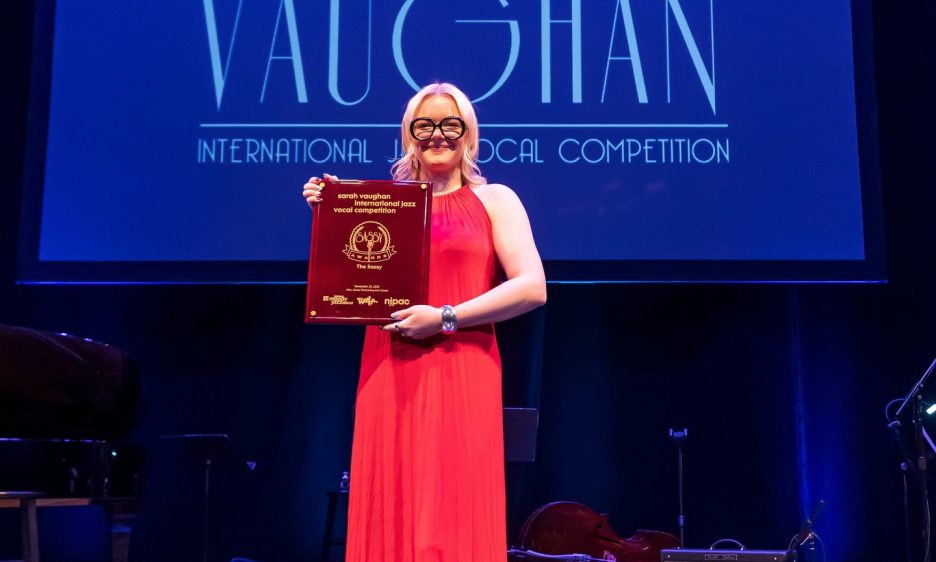
Courtesy Fresco Alessandro
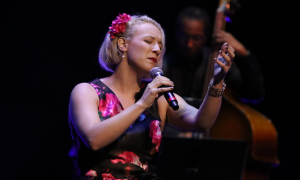
When you hear her sing—look out. She's able to tell a story through her music, and it makes everyone around her want to stop and listen.
—Donald Vega
Despite her fixation on Fitzgerald, Kortum didn't start singing right away at Houston's High School for the Performing and Visual Arts. Instead, she joined the jazz band as a saxophonist and flutist. "I was never very good at the saxophone and flute," she said. "I loved playing them, but I wasn't anything special. I was in the lower level of the jazz bands. So, I went to Norman Sneed, the Jazz Director, and said, 'I want to sing in the band. I think I would be much more use there than playing saxophone. Mr. Sneed really encouraged me to follow that. He didn't want me to keep doing something that I didn't feel passionate about."
Evidently, it was the right decision. Last month, Kortum won the 14th annual Sarah Vaughan International Jazz Vocal Competition, part of the New Jersey Performing Arts Center's TD James Moody Jazz Festival. (The 23-year-old Kortum had applied three times before, but this was the first time she made the Top Five).
For the Sarah Vaughan finals, held on Sunday, November 23, at NJPAC, Kortum's song selections were: "Easy Come Easy Go Blues," recorded in the 1920s by Bessie Smith; "You Are There," a Dave Frishberg composition; and "What a Little Moonlight Can Do," a standard written by Harry M. Wood for the 1934 British film, Road House.
"Some of the songs that Bessie Smith recorded," Kortum said, "you don't hear recorded again very often. So, I heard 'Easy Come Easy Go Blues' and felt like there wasn't another song that captured that vibe. It wasn't quite a 12-bar blues, but it captured the essence and feeling of the blues. And, it's silly and playful, one of my favorite things in music and jazz. One of the reasons I picked singing over playing instruments is because you can be silly and playful with words in a way that affects the audience more than playing an instrument.
"'You Are There,'" she continued," is a Dave Frishberg song, which I haven't seen for a really long time. It's one of the first ballads I heard that I felt very personally connected to. It's written in a way that's so stream of consciousness storytelling. For the first time, I tried to write a little bit, so I wrote an intro and an outro with that song. It's one of my favorites to do because people don't know it, and when they hear it, it seems like it was part of the Great American Songbook."
Kortum selected "What a Little Moonlight Can Do" for the opposite reason. "I picked that because so many people have recorded it. It's such a behemoth —one of those songs you hear a lot of vocalists do. But it's such a challenge to perform it and execute it well. I've always been fascinated by all the different versions—Anita O'Day), Nancy Wilson)—so I wanted to take my approach to it."
In her last year of high school, Kortum took some classical vocal lessons. For college, she chose the University of Miami's Frost School of Music because "I just felt like it was a fit, and I knew some of the undergrads there from camps I had done. I didn't think I was quite ready for New York yet. Frost did some really good things foundationally for me." When she first arrived there, though, "I got thrown into the ringer. I'd never sung in a choir before. I had never taken a jazz vocal lesson."
Her first instructor was vocalist/keyboardist Charlie Christenson, a teaching assistant. "I feel like he taught me how to use notation software and arranging techniques. In one year of lessons, he really flipped me upside down." Christenson, now Associate Professor, Voice Department, at the Berklee College of Music, recalled that Kortum arrived at Frost "fully formed musically: a mature sense of style, a great ear for the sound and language of jazz. She's got this warm, centered sound with amazing facility and agility; and, inside this seemingly laid-back, bright-eyed freshman was just a total killer of a musician. So, her win at the Sarah Vaughan competition feels less like a surprise and more like the natural next chapter."
The four years at Frost, Kortum said, prepped her, "and then I really had the bug to go to New York." That meant studying for her Master's Degree at Juilliard, which she received in the spring of 2025. At Juilliard, pianist Donald Vega, Kortum's small ensemble teacher, "took me under his wing."
Vega described Kortum as, "an exceptional talent. She was so fun to teach because she approached the music with curiosity and fearlessness, but also with the seriousness needed to perform at the highest levels. And, when you hear her sing—look out. She's able to tell a story through her music, and it makes everyone around her want to stop and listen."
Kortum has released two albums on the Bandstand Presents label: Good Woman (2023) and Wild Woman (2025). The recordings include such standards as Cole Porter's "What Is This Thing Called Love?" and the Gershwins' "The Man I Love." A goal in both albums was to sing songs written by men with a female perspective. "The first album," she said, "touches on taking those songs and poking at them a little bit through interpretation and arrangement. The second album focuses more on emotions that maybe the men writing those songs for women weren't touching on."
After Kortum's early exposure to Ella Fitzgerald, she discovered Carmen McRae. "I must have listened to her Great American Songbook album at least 1,000 times when I was in high school. Shortly after that, Nancy Wilson and Sarah Vaughan made their way into my stream. Also, for someone more modern, I think Cecile McLorin Salvant was a really big inspiration to me."
As for favorite composers? "Johnny Mandel and Hoagy Carmichael in terms of the Great American Songbook. Obviously, Duke Ellington, who wrote some of the most revered jazz songs." And, she also includes the previously mentioned Frishberg in that list. "He had kind of a funny style of writing —very driven, very silly. He wrote for Schoolhouse Rock. That shows in his writing."
In addition to her own recordings, Kortum was featured recently on So Many Memories, an album released by Loren Schoenberg and His Jazz Orchestra on Turtle Bay Records. It features music recorded by vibraphonist Red Norvo from charts written by Eddie Sauter. Eleven of the songs were originally sung by Mildred Bailey, Norvo's wife. Reviewing the album in the December Jersey Jazz, Joe Lang praised Kortum for capturing "the way that Bailey paid attention to the lyrics that she sang." The title track, he added, "receives a well-deserved revival with Kortum at her best."
Kortum was a featured vocalist with Jazz at Lincoln Center's Big Band Holidays concerts in December, and she will be performing at JALC's Unity Jazz Festival, as part of the Sunhouse Singers, on January 9th at Dizzy's Club. Later this month—January 30 and 31—Kortum will be joining pianist Luther Allison in a show featuring Duke Ellington's "secret works" at JALC's The Appel Room. "It will be a big production with strings, and horns, and other singers," she said.
I first saw Kate Kortum perform last May in Wayne, NJ, as part of the Big Swingin' Big Band co-led by pianist Caelan Cardello and trumpeter Jonny Gittings. After hearing her sing the Nat King Cole hit, "The Late Late Show," Hoagy Carmichael and Johnny Mercer's "Skylark," and Lionel Hampton's "My Little Red Top," I described her on njjs.org as a "brilliant young vocalist who energized the audience." That, I realize now, was an understatement.
 FOLLOW Sanford Josephson
and get notified whenever a new article published.
FOLLOW Sanford Josephson
and get notified whenever a new article published.
Sandy is the editor of Jersey Jazz, a Jersey Jazz Society publication.
About Kate Kortum

Tags
PREVIOUS / NEXT


Kate Kortum Concerts
Become a Sustaining Member

Since 1995, All About Jazz has championed jazz as an art form and supported the musicians who create it. Over three decades, it has grown into one of the world's leading jazz resources, serving hundreds of thousands of readers, musicians, presenters and industry professionals each month.
Help Build the Future of All About Jazz
Your support helps us continue building All About Jazz for the next generation—expanding our editorial coverage, preserving jazz history, developing new community features and creating better ways to discover the music and the people behind it.
Become a sustaining member for as little as $20 per year and you'll immediately enjoy an ad-free experience along with access to subscriber features and future articles for a full year.
Together, we're not simply sustaining All About Jazz—we're building its future. Thank you for being part of the journey.