Home » Jazz Articles » Interview » Dorota Piotrowska: Jazz With International Voices
Dorota Piotrowska: Jazz With International Voices
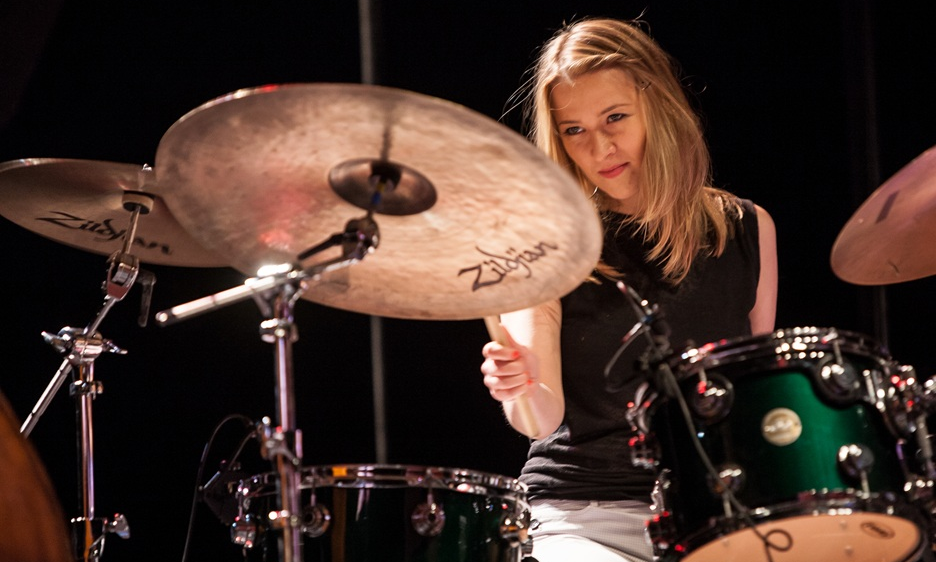
Courtesy Slawek Przerwa
There is something in jazz that I really have to know about, that really resonates with who I am, with my soul and everything
—Dorota Piotrowska
At age seven her piano studies centered on classical music, as is the case with most kids taking up the instrument. But in high school, she had a friend who played in a band of his peers. She was invited to attend a rehearsal. There was no drummer.
"They gave me sticks, you know," Piotrowska says recently from central Poland where she lives. "It was more of a joke for me. But then it turned out that I had so much fun. I wanted to keep playing. I started searching for a professor there in a small town."
Now, 42, Piotrowska is a fine drummer who has played on the international jazz scene , including the United States. Among the drummers who helped guide her are greats Billy Hart and Ralph Peterson.
This year she released her first CD, Voices of Human Consciousness (Inner Circle Music). It reflects her love of the many different cultures in the world and sounds range from jazz, to folk to Nordic soundscapes. It's ethereal at times and swinging as well.
Piotrowska, who also has a degree in international relations and worked for the United Nations for a time, says "it's very inspiring for me to see how people from different cultural backgrounds meet together and how they can talk and find solutions to different things and agree on different things, and also disagree on certain things. It always fascinated me. This is why I love to travel, and I went to study here and there. I think that the cultural richness of this world is really fascinating to me."
And so, "The whole record is sort of like a summary of these 20 years or so of my different encounters with a lot of musicians."
She came to the drums a little later in life, but she made up quickly for lost time and went looking for drum teacher in her area.
Her teacher wasn't a great reader of music and her education was a process, but he exposed Piotrowska to a lot of good music and provided her with recordings to listen to.
"I was discovering the world of rock music. Then when I went to study French philology (the study of language in written and oral historical sources). When I graduated from high school, I didn't think of playing drums professionally, or even applying to a music academy. I was doing this private school in Poland. We have this system of education where, if you want to go to classical education school, you have the primary school, six years, and then you have high school, sort of like a musical high school, six years again. Then you do music academy.
"My first six years I did on piano from the age of seven. This classical piano training helped me a lot with hearing harmonies, and especially hearing the piano players, because I loved the sound of piano since I was very small."
But by the time she graduated, she was not so fond of classical piano. She resisted continuing. "But the drums somehow gave me the fun of playing music again" While studying French, she took drum lessons from a teacher who was prominent in Poland. He was into fusion music and she was exposed to the likes of Peter Erskine.
"But I still kept searching," she says. Things would change even more in her favor. A concert was put together by a Polish saxophonist who would often bring in musicians from the U.S. He invited Hart.
"That concert literally changed my perception of what the drums can do, and how the drums can sound," she says. "It showed me an entirely new musical landscape. That was really a transforming experience. Because I was on this verge where I was enjoying playing all these funky rhythms. But it was boring to me. I felt like I had to just keep time and make sure everybody knows where 'one' is, and it was boring to me. When I heard Billy, it was just like, 'Wow.' It didn't sound like drums to me. It was crazy. This was one of the first really groundbreaking moments."
Though she now had a degree in French, she decided to commit to playing drums. After a year of intense practice she graduated from the private music high school. She was playing timbales with a Cuban ensemble called Omni Con Ire, where the conguero showed her the proper way to play.
"I really appreciated him. This is how I discovered Cuban music. I really fell in love with the rhythms, with everything. We had a few shows only because then I eventually entered the Conservatorium van Amsterdam" in the Netherlands. There, she was in contact with a lot of students on exchange from Manhattan School of Music. She hung out a lot with a drummer, named Austin Walker who taught her a lot about American swing music and got her to listen to records by Count Basie and Duke Ellington.
"Sometimes he would put on a record and say, 'If you want to understand swing, you have to dance to it.' So we would dance," she recalls with a laugh.
She was learning more and more, from colleagues, not just teachers. Then a drummer friend took Piotrowska to Groningen in the Netherlands where there was another music program, called New York Comes to New York at Prince Claus Conservatoire. Ralph Peterson was involved. The friend wanted her to meet Peterson, but first he told her to learn the Rudimental Ritual, the Rudimental Ritual—a long series of rudiments put together in a way that allows the practitioner to exercise a vast majority of commonly used drum sticking patterns. It was developed by another drum great Alan Dawson and it is written out in a book.
"He showed me the book and told me how to study it. I learned the whole first part before I even went to meet Ralph. I immediately fell in love with Ralph. I knew I had to change schools to study with him. Also, fortunately, thanks to this friend, I had the first part of the Rudimental ritual. I played it for him, and I knew he liked it."
"Ralph took me under his wing," she says. There were other teachers from New York which "made it really like a family situation. We were not so much students just going and listening. No. We were a family. We were spending time with them. We were having dinners with them. We partied together. It was also a smaller program. That's where I met (singer) Sanem Kalfa, also (pianist) Tarek Yamani" who are both on Voices of Human Consciousness.
Peterson "was really bringing us together. He was teaching through stories, a really amazing person. From there I went on a one-week trip to New York, because the school was giving us the opportunity. When I went to New York, that was for me." She went to live shows and listened to more recordings, one of which was Money Jungle (|United Artists, 1963)).
"It was one of the records that I understood, that there is something in jazz that I really have to know about, that really resonates with who I am, with my soul and everything. So then I started discovering and discovering."
In New York at last, she started searching for an opportunity for an exchange program in the United States. The program in Groningen wanted to send her to Temple University in Philadelphia. But she wanted New York and ended up at Long Island University Brooklyn. Sam Newsome, Greg Lewis and Carlo De Rosa were teachers there.
She studied composition with Newsome and learned a lot, "but I have to say, for me it was about being in the city. I would sometimes literally spend an entire night at Smalls , and then in Fat Cat and then all these places. Zinc Bar. The clubs were really my education. The first two years I was there every night. I was listening to every band."
She ended up transferring her credits to the renowned New School in Manhattan to continue her jazz education. Piotrowska was also getting gigs.
Another mentor at the time was trumpeter Jeremy Pelt. "He was very kind and nice to me. I got a lot of respect from the elders, for some reason, because I think they saw my commitment. I was really every night in the clubs, every night. I really wanted to learn." Young musicians like Tivon Pennicott, Camille Thurman and Jazzmeia Horn were among her contemporaries.
"But at the time, I really wasn't thinking about gigging. I think I didn't feel ready. Whatever came, I was very grateful for, but it was just a bonus for me. I really wasn't feeling that I deserved it somehow. I was very humble to be part of this amazing experience at the time."
De Rosa got her some big gigs like Carnegie Hall, where Piotrowska played in a band behind a choir from the United Kingdom. There was another at Avery Fisher Hall in a semi-classical situation. Gigs piled up with local jazz musicians. She played with Pelt as well as Luques Curtis and Zaccai Curtis, "because they would also play with (Moore) a lot. So I started traveling back and forth between Poland and the U.S. I actually took Zaccai and Luques to play a gig in Poland for a singer. So it was started to be like a little of this collaboration, me bringing musicians (to Poland). I did this longer tour in Poland where I invited Jeremy Pelt as a guest."
The drummer started to contemplate her next move, New York or Poland? Some gigs weren't paying much in the U.S. Was it worth it? She wondered. For bands getting hired from the U.S. to tour Europe, she said promoters wanted an all-U.S. band. "I wasn't so much of an exotic thing, you know, to go back to where I was from. They like the bands to be actually from America.
"I saw that I have to really fight for myself. I have to really establish myself more in the space of who I am, rather than depend on gigs with other people." Staying in the U.S to get another music degree didn't make sense. "So, I thought if I do a degree, I want to do it in something else that will give me a foot into something maybe interesting. I also have a mind that doesn't settle. I'm interested in so many things. I thought: international relations. I don't know why, but that was my interest for a very long time."
She found a program at City College in New York and earned a master's in international relations. She did an internship at the United Nations.
"I kind of like got away a little bit from the music. But I was still part of the scene, still doing gigs. But somehow this other interest of mine came into my life very strongly. And I'm happy it did, because later on I had the opportunity to work at a very nice campaign to elect a woman as secretary general of the United Nations. We didn't succeed, but I met a lot of very interesting people, including the candidates for the U.N. secretary general. But then there came the time when somehow I didn't see a point of staying in New York so much anymore. I met my husband, who is Polish. And I think I was also feeling very lonely and I was missing family a lot. So as much as I loved the New York scene, I found myself spending so much time on the phone with my grandmother, with my mother, with all my family at that time."
Back in Poland, Piotrowska started a summer program called New York Jazz Masters International Workshop. "We did three editions of it, because then we didn't get any money from the Ministry anymore," she says. "We were bringing musicians from New York. We brought Aaron Goldberg, Kendrick Scott, a lot of amazing musicians. That's where I met my husband. I knew him from high school already, but I re-met him, so to speak, after many years. That was the moment when I knew there's another reason for me to go back home. I want to have my home. I want to have a little bit better quality of life. So I came home. But I did not lose interest in music and playing with people.
"Everything was stopped for some time. It was a difficult time for me. There were no gigs ... I was feeling a little bit like everything stopped, and I didn't see a way out. I was feeling 'I'm stuck here now, away from New York, away from gigs, away from playing,' and there was no end to it. I thought, 'Okay, this is it for me now. I'm going to be a Polish mother.'"
Then she got a phone call from a friend in New York, saxophonist Steve Carrington. "That was really what I needed at that moment. I started prepping up and organizing and working out the details of the tour. That's where (bassist) Ameen Saleem came into play. The moment I started to play with Ameen, it was like, 'Whoa.' And then he took different piano players, Anthony Wonsey was playing with us at some point, then Mark Whitfield was on one tour with us," she says.
Freddie Hendrix played trumpet on the first tour. So the band was constantly shifting. "It was great because Steve (Carrington) was really pushing hard for me to play a lot of up tempos and long extended solos. So I really had to get back to form and keep playing."
European collaborations included Danish singer Cӕcilie Norby, trumpeter Hildegunn Øiseth and saxophonist Nicole Johänntgen. They formed a group that recorded Sisters in Jazz for ACT records with Siggi Loch producing. Piotrowska said the experience, the feel of the music, influenced her current new recording.
"I really loved those sounds. I knew that if I wanted to do something on my own that I wanted to have that in there too," she says. "I was very interested in jazz for many years, from the moment I discovered it. But I also loved African music. I also love Cuban music. Brazilian music. Every kind of music that really sounds good to my ears is fascinating me. Also Middle Eastern music.
"It was always fascinating to me that all these people from around the world meet, and New York is such a melting pot for that, for that exchange of people. So when I was thinking about the record, I wanted really to put all these ideas there. I didn't know how this is going to work out. I didn't know how to do this. But I wanted to kind of connect these two worlds, the world of my fascination, how rich it is and how beautiful it is, and then also of this musical journey that I have experienced through jazz. All these people that I met, and that are on the record, I met because of jazz music. Because I wanted to study it and pursue it in the best way I could. It turned out that people from Turkey also studied jazz, and from Indonesia. These are the connections I made in the Netherlands. There were so many people from Indonesia, from Korea, from Turkey, from the Middle East."
For the new CD, she thought "We all love this music, but we also have our own musical identities in us. We are coming from a certain place where the music is still present and very beautiful and very rich. Let me show this. Let me try and put all these little ingredients in there. Then I thought it would never be true if I don't have someone that really can anchor us in the American jazz tradition. After all, this is American jazz music."
For that, she thought of Greg Osby.
"Greg has been a huge influence on me, his records are really amazing. Some of them I would play on repeat all the time. I really like his style of playing, and the things he plays. Also the way he approaches changes, and what he plays on the music, on what you give to him. It really just speaks to my soul. It's the best way I can describe it. It's so difficult to talk about why you like someone's playing."
She knew Osby casually from different events in her career. They discussed the project over lunch.
"I was telling him about my idea, his eyes were getting wider and wider. I knew that if anyone would be open to these kind of experiments and music, it would be him," she says. "He was listening and listening. At some point the idea was clear in my mind that I really want to do this. I had a break in the work I was doing with international relations so I had a lot of time on my hands. I decided, 'This is the moment. I have to grab it.' So I called everyone."
Piotrowska is pleased with the recording.
"Sometimes there's always things you find, and you say, I could have done this better, maybe this could have been... I have to say that with this record I had to put the self criticism away a little bit. What came out is so much bigger than just my playing. I feel that what everyone else contributed is so powerful. We all contributed in a way. There's a lot of dialog, there is a lot of, input from everybody in the band. I'm happy about this record."
As for the future, Piotrowska would like to play a lot with this band. A few concerts are scheduled and she is expanding her publicity and management team.
"That's my dream, really, to share this music with people, and ideally in the biggest format possible. But because we are really coming from all different places in the world, it's difficult to adjust our schedules so that everybody is available. The second thing is that it's an expensive as a project... But I am still hopeful. It's a work in progress."
 FOLLOW R.J. DeLuke
and get notified whenever a new article published.
FOLLOW R.J. DeLuke
and get notified whenever a new article published.
R.J. DeLuke is an indefatigable jazz fan and arbiter elegantiarum who aspires to ultimate hipness; also an upstate NY freelance writer for various media.
About Dorota Piotrowska

Tags
PREVIOUS / NEXT

Become a Sustaining Member

Since 1995, All About Jazz has championed jazz as an art form and supported the musicians who create it. Over three decades, it has grown into one of the world's leading jazz resources, serving hundreds of thousands of readers, musicians, presenters and industry professionals each month.
Help Build the Future of All About Jazz
Your support helps us continue building All About Jazz for the next generation—expanding our editorial coverage, preserving jazz history, developing new community features and creating better ways to discover the music and the people behind it.
Become a sustaining member for as little as $20 per year and you'll immediately enjoy an ad-free experience along with access to subscriber features and future articles for a full year.
Together, we're not simply sustaining All About Jazz—we're building its future. Thank you for being part of the journey.