Home » Jazz Articles » Bailey's Bundles » The Golden Era of Art Pepper on Contemporary Records (1957-1960)
The Golden Era of Art Pepper on Contemporary Records (1957-1960)
 Art Pepper
 Meets the Rhythm Section
Craft Recordings
1957/2023
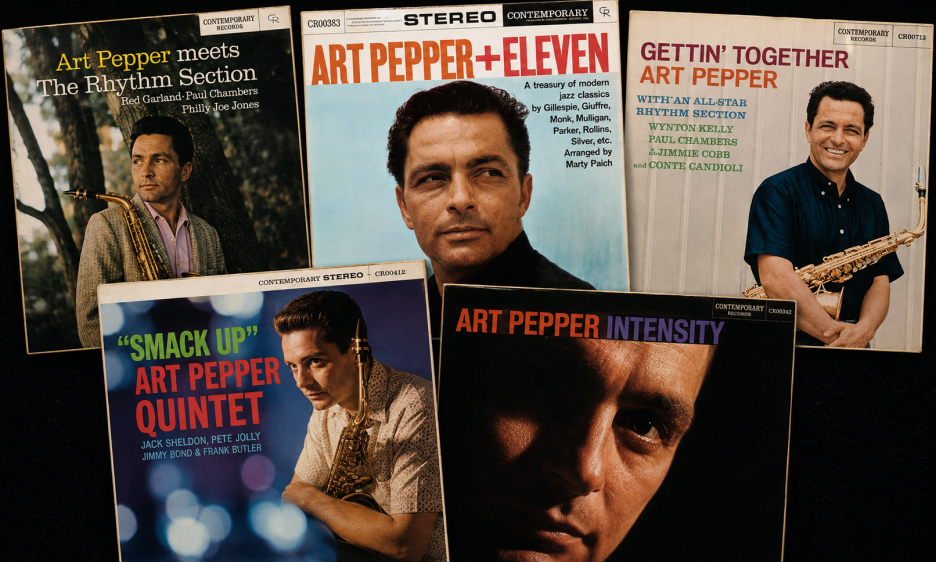
On the morning of January 19, 1957, Art Pepper awoke in a state of panic. He was deeply addicted to heroin, had not touched his saxophone in two weeks, and his instrument was suffering from a severely leaking, taped-up cork. To his horror, his wife revealed she had booked a recording session for him that very afternoon with Miles Davis's first great rhythm section—pianist Red Garland, bassist Paul Chambers, and drummer Philly Joe Jones—who were in Los Angeles. Paralyzed by stage fright and feeling entirely unprepared to face the most ferocious rhythm unit in jazz, Pepper went to the studio anyway, having fixed a large amount of heroin.. He added more tape to his broken saxophone, closed his eyes, and channelled his raw panic into a single-afternoon masterpiece. Meets the Rhythm Section represents the absolute apex of Pepper's 1950s output. It bridged the geographic divide of the era; while East Coast altoist Phil Woods was releasing high-velocity bop like Phil and Quill (Prestige, 1957), and Lou Donaldson was anchoring Blue Note's soulful hard bop scene (Blues Walk (Blue Note Records, 1958), Pepper offered a lyrical, beautifully exposed alternative. On tracks like "You'd Be So Nice to Come Home To," his airy West Coast tone didn't shrink away from the aggressive East Coast engine—it danced atop it. For the Craft Recordings reissue, Bernie Grundman preserved Roy DuNann's famous, wide 1950s stereo split without artificially bleeding the channels. The remaster completely clears away decades of generational tape distortion. Paul Chambers' walking bass lines gain a tight, tactile weight, while Philly Joe Jones' ride cymbal and snappy snare rim-shots strike with a lifelike, acoustic clarity that brings the tense energy of that January afternoon back to life.
 Art Pepper
Art Pepper + Eleven—Modern Jazz Classics
Craft Recordings
1959/2022
By 1959, Pepper was experiencing a brief window of relative personal stability and heightened critical acclaim. Seeking to break him out of his small-group comfort zone, producer Lester Koenig paired the saxophonist with the West Coast's premier big-band arranger, Marty Paich. The concept was ambitious: take twelve foundational bebop classics and filter them through a tightly orchestrated, eleven-piece brass ensemble. Pepper thrived under the challenge, demonstrating his deep multi-instrumental versatility by doubling on tenor saxophone and clarinet across three separate session dates in March and May. The year 1959 was an explosive pivot point for jazz. Ornette Coleman was tearing down traditional harmony with The Shape of Jazz to Come (Atlantic Records), Miles Davis was exploring modal minimalism on Kind of Blue (Columbia Records), and Cannonball Adderley was pioneering gospel-infused soul-jazz with his Quintet in San Francisco (Riverside). Amidst this radical avant-garde and modal turnover, this record was a fiercely logical backward glance. Pepper's crystalline, impeccably mathematical soloing on complex architectures like Thelonious Monk's "'Round Midnight" and Charlie Parker's "Donna Lee" proved that classic bebop structures still possessed immense modern utility. The original recordings presented a massive sonic hurdle, as the dense mid-range frequencies of the brass, French horns, and woodwinds risked sounding muddy on older pressings. Craft Recordings' AAA reissue beautifully unpacks Paich's complex charts. The brass section bites with a brilliant, authentic shine without ever turning shrill, and the precise instrument separation allows the listener to pinpoint Pepper's physical movement in the room as he switches between his three woodwind horns.
 Art Pepper
Gettin' Together
Craft Recordings
1960/2024
Flushed with the commercial and critical success of his big-band experiment, Pepper returned to the studio on February 29, 1960. Lester Koenig wanted to replicate the lightning-in-a-bottle magic of the 1957 Davis pairing. This time, he brought in Miles Davis's Kind of Blue rhythm section: pianist Wynton Kelly, bassist Paul Chambers, and drummer Jimmy Cobb. Unlike the frantic, drug-addled panic of 1957, a well-rehearsed Pepper arrived at the studio feeling highly confident, energized, and fiercely competitive alongside West Coast trumpeter Conte Candoli. This session serves as a crucial sonic bridge in Pepper's discography. The jazz landscape of 1960 was growing darker and heavier; on the East Coast, Jackie McLean was injecting a sharp, blues-drenched existential angst into hard bop with albums like Capuchin Swing (Blue Note Records). Pepper met this heavy New York groove head-on. On tracks like "Softly, as in a Morning Sunrise," he adopted a much more aggressive, muscular rhythmic attack, showing a hardening of his tone that foreshadowed the emotional weight of his later life. Mid-century acoustic piano recordings were notoriously difficult to master smoothly, often leaving Wynton Kelly's comping sounding boxy or buried. The Craft remaster completely remedies this. It allows Kelly's piano notes to bloom with organic, percussive realism. Jimmy Cobb's bass drum carries a physically felt punch, and the sharp sonic contrast between Candoli's brassy trumpet and Pepper's biting alto creates a beautifully balanced front line.
 Art Pepper
Smack Up
Craft Recordings
1960/2024
By October 1960, the legal and chemical walls were closing in on Pepper. His heroin addiction had spiraled dangerously out of control, a dark reality he leaned into by naming his next album Smack Up—a direct, grim double entendre referencing both superb musicianship and his drug of choice. Conceptually, Pepper curated the album to feature compositions written only by fellow jazz saxophonists, including Harold Land, Benny Carter, and Buddy Collette. It was a brilliant artistic statement made on the floating edge of disaster. This album was recorded just as Ornette Coleman's "New Thing" was polarizing the jazz world. While traditionalist alto peers like Sonny Stitt dug their heels into traditional bop formulas and openly dismissed free jazz, Pepper showed a profound harmonic openness. He recorded Coleman's slow blues "Tears Inside," using his fluid bebop phrasing to anchor Coleman's loose, avant-garde melodic concepts. It proved that the West Coast mainstream could intelligently absorb the lessons of the underground. Tragically, this would be Pepper's final quintet session before a devastating narcotics arrest resulted in a lengthy sentence at San Quentin prison. The rhythm section of Pete Jolly, Jimmy Bond, and Frank Butler gave this album a highly complex, rhythmic bounce. Craft's release captures the rapid transient speed of Frank Butler's intricate drum work with zero analog smear. Every snare hit and tom-tom roll stops and starts instantly, leaving the natural decay of Pepper's alto saxophone reed vividly transparent against the rhythm section.
 Art Pepper
Intensity
Craft Recordings
1963/2023
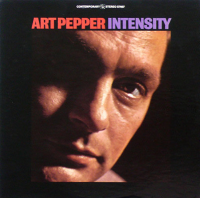
Recorded on November 23 and 25, 1960—just weeks after the previous sessions—this album was Art Pepper's bittersweet, haunting farewell to the recording studio. He knew fully that his impending imprisonment would violently disrupt his career and strip away his freedom for years. Backed by a minimalist quartet featuring pianist Dolo Coker, bassist Jimmy Bond, and drummer Frank Butler, Pepper threw his remaining liberty into a deeply emotional session consisting entirely of standard ballad and pop structures. Contemporary Records sat on the tapes for three years, finally releasing the album in 1963 while Pepper was behind bars. By the time the public heard the record in 1963, the jazz world had completely transformed. Eric Dolphy was pushing the alto saxophone to its absolute physical limits on Iron Man (Douglas International, 1968) with wild microtones, and John Coltrane was unleashing thunderous sheets of sound on Live at BirdlandM (Impulse!, 1964). Amidst this avant-garde storm, the session stood as a poignant time capsule—an island of pure, emotionally naked bebop phrasing. Tracks like "Gone with the Wind" and "Too Close for Comfort" proved that deep, wrenching emotional urgency did not require breaking the structures of standard songbook tunes. Because this is a sparse, intimate quartet date, there is nowhere for tape hiss or mastering flaws to hide. Craft Recordings' AAA remaster delivers perhaps the most emotionally raw record of the series. Free from any digital compression or artificial processing, the noise floor drops to near-silence. Dolo Coker's delicate piano chords and Jimmy Bond's walking bass walk through a three-dimensional space, leaving the absolute, tragic vulnerability of Pepper's alto tone completely exposed.
Tracks and Personnel
Meets the Rhythm SectionTracks: You'd Be So Nice to Come Home To; Red Pepper Blues.
Personnel: Art Pepper: alto sax; Red Garland: piano; Paul Chambers: bass; Philly Joe Jones: drums.
Art Pepper + Eleven—Modern Jazz Classics
Tracks: Move; Groovin' High.
Personnel: Art Pepper: alto/tenor sax, clarinet; Jack Sheldon: trumpet; Pete Candoli: trumpet; Al Porcino: trumpet; Bob Enevoldsen: trombone; Dick Nash: trombone; Vince DeRosa: French horn; Russ Freeman: piano; Mel Lewis: drums.
Gettin' Together
Tracks: Whims of Chambers; Bijou the Poodle.
Personnel: Art Pepper: alto/tenor sax; Conte Candoli: trumpet; Wynton Kelly: piano; Paul Chambers: bass; Jimmy Cobb: drums.
Smack Up
Tracks: Smack Up; Las Cuevas De Mario.
Personnel: Art Pepper: alto sax; Jack Sheldon: trumpet; Pete Jolly: piano; Jimmy Bond: bass; Frank Butler: drums.
Intensity
Tracks: I Can't Believe That You're in Love with Me; I Love You.
Personnel: Art Pepper: alto sax; Dolo Coker: piano; Jimmy Bond: bass; Frank Butler: drums.
 FOLLOW C. Michael Bailey
and get notified whenever a new article published.
FOLLOW C. Michael Bailey
and get notified whenever a new article published.
I'm Sanctified and Southern Fried / Mama tried and daddy cried / I tell the truth 'cept when I've lied / And like my huevos on the side.
About Art Pepper

Tags
PREVIOUS / NEXT


Become a Sustaining Member

Since 1995, All About Jazz has championed jazz as an art form and supported the musicians who create it. Over three decades, it has grown into one of the world's leading jazz resources, serving hundreds of thousands of readers, musicians, presenters and industry professionals each month.
Help Build the Future of All About Jazz
Your support helps us continue building All About Jazz for the next generation—expanding our editorial coverage, preserving jazz history, developing new community features and creating better ways to discover the music and the people behind it.
Become a sustaining member for as little as $20 per year and you'll immediately enjoy an ad-free experience along with access to subscriber features and future articles for a full year.
Together, we're not simply sustaining All About Jazz—we're building its future. Thank you for being part of the journey.