Home » Jazz Articles » Interview » Without a Net, and with Love, Uncle Miles
Without a Net, and with Love, Uncle Miles
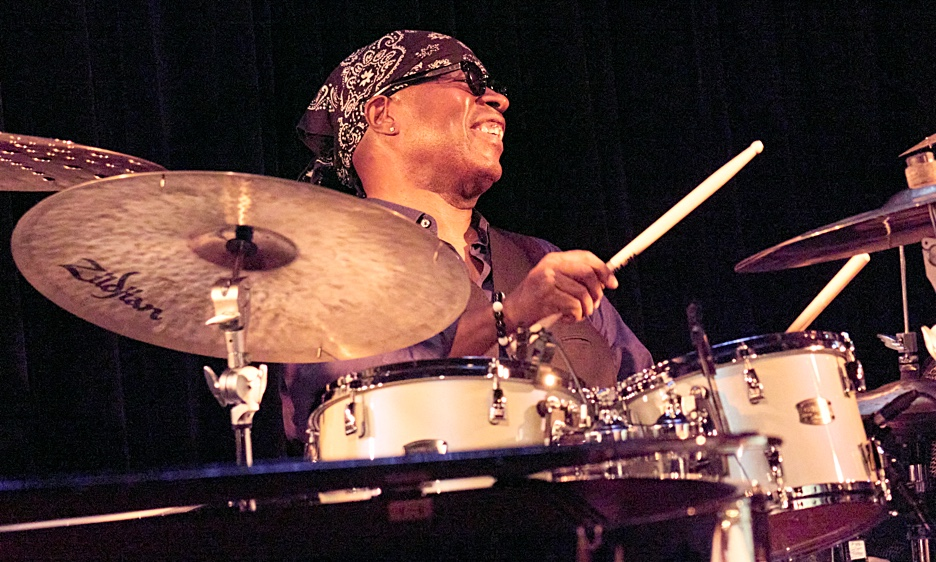
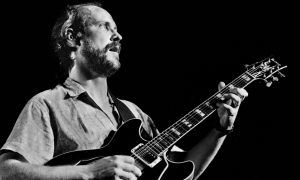
Courtesy Takuo Sato
I was taught by Uncle Miles to listen, to listen to everything.
—Vince Wilburn Jr.
Vince Wilburn Jr. is sitting in the Chicago house where he grew up when he tells me about the telephone, which is how I find myself picturing one of those absurdly long cords people used to have. The kind you could drag halfway through a house and somehow still remain connected to whoever was on the other end. In his family house, the cord had a particularly important job: it had to reach the basement.
Wilburn was a teenager rehearsing downstairs with a band that included Robert Irving III on keyboards, Randy Hall on guitar and Felton Crews on bass. Miles Davis would call Wilburn's mother and ask her to put the phone down toward the stairs so he could listen.
"Let me hear what they're doing."
For several weeks, Miles listened this way, somewhere else while four young musicians played in a Chicago basement. After rehearsals, the phone made its way around the band and Miles offered critiques individually.
"You do this."
"You do that."
Until one day the critique became a question. "Do you all want to make a record?"
The invitation brought the young Chicago musicians to New York in 1980, into the sessions surrounding Davis' return to recording after five years away, with some of that material eventually appearing on The Man With The Horn (Sony Records, 1981). Wilburn remembers Gil Evans coming into the studio and sitting quietly in the corner to check them out. All of which would already be a hell of a story, except Wilburn is telling it to me from the house where it happened.
"A flashback," he says. "You feel them. Their souls." He is looking around while we talk.
"This is the home that I was raised in. I mean, because I have so many great memories here. This is the house where Uncle Miles called and had my mother put the phone down."
And here is the part that gets me: "Had he not done that, you wouldn't be talking to Bobby and I."
He's right.
There is an entire lineage contained in the distance between that telephone call and ours, which is something I am already thinking about because I have just gotten off the phone with Robert Irving III, Bobby, the kid who had been down in that basement with him. I had also seen both of them months earlier with Miles Electric Band at Town Hall Seattle, where Wilburn was impossible for me to ignore behind the drums, shouting, listening, pushing, visibly having a blast inside music whose history could have made the whole room unbearably reverential. Instead, it moved. I wanted to know where that comes from, although I suspected I understood some part of it because my father is a jazz percussionist too, and there are ways of growing up around music that make it difficult to determine where your own memory begins. My childhood had drums in the basement, percussion lessons bleeding into whatever else I was doing, Miles Davis records playing before I knew enough to understand who Miles Davis was. I have an eight-year-old now and still play records aloud for him, which means I am old enough to watch music I received almost accidentally become something I am deliberately passing along. So I ask Wilburn where family memory ends and musical inheritance begins. Or whether he can separate them at all.
"You're right," he says. "It's more of a, like, an amoeba."
Perfect. Because before Miles Davis was Miles Davis to Vince Wilburn Jr., he was Uncle Miles. Wilburn remembers going to O'Hare as a child to meet him at the gate, walking through the airport and becoming increasingly confused by how difficult it was to get anywhere.
"I used to ask my mom and dad, I said, 'How come everybody, every five or ten steps, everybody's always stopping Uncle Miles?'"
He knew the person before he understood the magnitude.
"I didn't know how much of a genius and how much Uncle Miles had on the world and the industry," he says. "Because to me, he was just Uncle Miles."
Miles Davis is typically considered at monumental scale, especially in this year of a centennial. Wilburn remembers his uncle at household scale too. Miles called his mother while she was in the kitchen. Miles wanted to hear the kids downstairs, how cool is that. Miles also decided his nephew needed to listen to records. In the mail records started arriving Otis Redding and James Brown and Sly Stone and Jimi Hendrix. At the time, Columbia's regional representative Granville White, whom everyone called Granny, had these shipped to Wilburn directly. Wilburn did his homework near the record player from then on, with drums and a piano close enough to move between listening and trying things himself. His father took out a loan for his first drum set. Miles later sent him another kit. He tells me his mother was a schoolteacher who played records throughout the weekend. Musicians coming through Chicago gave the young drummer sticks and backstage passes. Joe Segal sometimes let the kids hang around the Jazz Showcase without even charging them a cover.
"He wanted us to enjoy the music too," Wilburn remembers. Enjoy it. Hear it. Get it. Nobody in Wilburn's telling seems particularly interested in separating education from exposure, or discipline from love, and maybe that is why the phrase he uses later makes so much sense.
"Miles Davis University."
I laugh and tell him he should trademark it.
"I thought about it," he says.
The curriculum was listening. Wilburn tells me about Miles leaving Herbie Hancock, Ron Carter, Tony Williams and Wayne Shorter downstairs during an early rehearsal and listening from another room through an intercom. Without Miles physically standing there, the musicians loosened.
"They were freer."
The story makes Wilburn reconsider his own basement. After enough rehearsals, he says, he and his friends stopped thinking about the fact that Miles Davis might be listening through the telephone.
"We didn't even think that he was on the phone. We were just playing. We were free."
I love this because the lesson begins to reveal itself backward. Miles was listening, of course, but he may also have understood the pressure created by being listened to by Miles Davis, and removing himself from the room allowed him to hear something else: what musicians did when they forgot to impress him.
"He had a knack of hearing things and bringing it out of all of us." Wilburn calls him "the head chemist" running his lab, language Ron Carter has also used to describe Davis, and the image suits everything Wilburn is telling me about a bandleader who understood people as part of the composition. Put these musicians together. Hear what happens. Change the mixture. Leave the room. Listen again.
Wilburn remembers asking tabla master Badal Roy what recording On The Corner (Columbia Records, 1972) had been like. Roy described a room full of musicians waiting for direction until Miles looked at him and said:
"You start."
That was enough.
"There was always a song inside of a song, or a melody inside of a melody," Wilburn says. I tell him I have my own embarrassingly untechnical phrase for this: a soul song. Something you somehow already know. Every once in a while I hear a jazz recording I swear I recognize even though I cannot consciously place it, and given the amount of music playing around me as a kid, the likely explanation is that I heard it from another room when I was five years old and my brain filed it somewhere inaccessible until the right few notes opened the drawer. For Wilburn, that kind of listening became physical early. He started drumming in kindergarten. He played against records. He absorbed musicians from backstage and bandstands and clubs. Eventually he found himself behind Miles Davis himself, where listening stopped being something happening around him and became an instruction.
"I was taught by Uncle Miles to listen," Wilburn says. "To listen to everything. To listen to all the musicians onstage."
Miles also told him: "Never take your eyes off of me."
With a wireless microphone system freeing Davis to move across the stage with his trumpet, Wilburn watched him from behind the kit, looking underneath cymbals to keep track of him while listening to everyone else at the same time. A set list could change in the middle of the set because Miles heard somewhere else to go.
"You had to be ready for that."
Readiness comes up repeatedly while we talk, although neither of us calls it that at first. I call it posture: the way a person positions themselves toward whatever happens next. Improvisation as something larger than a musical technique, because growing up around improvisers teaches you fairly quickly that paying attention and knowing what to do with what you hear are inseparable skills.
Wilburn understands immediately.
"It's the legacy," he says. "And we are the messengers to continue the legacy and to create our own legacy while we do that." That last part catches. Create our own legacy. It is the reason Miles Electric Band makes sense to him as an extension of this history and the reason one description of the band very much does not.
"We're not a tribute band." He says it without hesitation.
"We're just playing things that Uncle Miles shared with us, and we're just putting our own spin on it. We're far from a tribute band." Of course they are, because a musician who spent his life moving would be a strange person to honor by standing still. Wilburn remembers talking with Miles about precisely that.
"His decision in life was to change the course of music," he says. "To change it, to evolve and never look back."
Why? "Because I have to do it for my soul," Miles told him. Wilburn saw the appetite everywhere. He remembers Miles in the 1980s with his trumpet nearby, a piano nearby and MTV running silently on television until something caught his attention. The sound came up. He listened. Records were sent to the house. Songs like "Human Nature" and "Time After Time," and eventually "Perfect Way," entered his musical vocabulary. I ask why pop music couldn't move him.
"His voice," Wilburn says. "Because his stamp of his voice, it changes the whole molecules of the song." The whole molecules. There are technically cleaner ways to describe what happens when an unmistakable musician enters somebody else's composition, but I'm not sure there are better ones. Wilburn remembers Miles listening to singers too, Frank Sinatra for phrasing, and from behind the drums he had one of the closest possible vantage points for watching that voice operate. Miles could move around the stage while playing, and Wilburn remembers watching entire audiences physically follow him.
"You could see the faces just move," he says. "The energy just moved when he moved."
His own voice changes while he remembers it.
"I tear up just thinking about it."
A beat.
"He hypnotized." There is the answer the little boy at O'Hare could not have understood yet. Everybody kept stopping Uncle Miles because the thing Vince knew intimately belonged, somehow, to millions of other people too. What strikes me about Wilburn is that he can hold both versions of Miles without collapsing one into the other. The musician was serious. The teacher was demanding. The bandleader expected everybody to hear everything and remain prepared to change direction. The uncle sent records home. The family called him Miles. The little boy watched strangers approach him in airports. And the nephew misses him. That part arrives softly... Wilburn talks about his parents, his uncles, his aunts, about preparing your spirit to receive people after they are gone. He does not describe memory as an archive. He describes presence. Sometimes Miles comes to him in dreams.
"He would just smile and disappear," Wilburn says. "He won't say anything."
I ask him when he feels closest to Miles.
"Every day."
There is no grand speech around it. Suddenly the house feels different to me too. Wilburn is sitting among the rooms where his mother played records, where his father made the drums possible, where Miles sent music, where the basement band rehearsed, where that ridiculous telephone cord once carried the sound of teenage musicians toward an uncle listening somewhere on the other end.
"You feel them," Wilburn had said earlier. "Their souls." He recently went to see Herbie Hancock and Ron Carter at the Hollywood Bowl and found himself feeling like a little boy again.
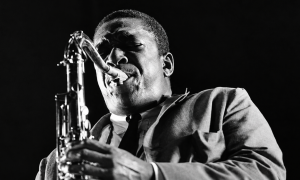
"They're larger than life, like superheroes." Ron Carter has played on Wilburn's own music. Wilburn has spent decades inside this world. None of that apparently cancels the kid who once stood near the bandstand and looked up. I recognize that feeling. I had just seen Herbie at Newport myself, and we start talking about the strange collapse of generations that jazz permits, where the person who changed your understanding of music can be standing in front of you, and the person who taught them can remain audible in what they play. Wilburn tells me Miles loved John Coltrane He remembers a photograph of Coltrane that Miles kept in Malibu, an image Wilburn now has in Los Angeles. When Ravi Coltrane played with Miles Electric Band, Wilburn became emotional.
"The music is in us," he says. "It's in our DNA."
"And here we are," I say.
"Here we are. It's a blessing. It's definitely a blessing."
It would be an elegant place to stop, so naturally we don't. I have just spoken to Bobby Irving. I am still thinking about Town Hall Seattle and what I heard when the two of them were onstage together, about how little the performance felt interested in embalming anything. I start trying to explain this to Wilburn and he catches where I am going before I get there.
"We can tie our stories in, because this is how much Miles meant to us," he says. "Miles touched Bobby in a certain way, touched me in a certain way."
They talk about Miles when they are together. They recognize pieces of the education in each other. And when they play, Wilburn says, they approach it through a phrase he associates with Wayne Shorter:
"Without a net."
"So we go out without a net," he says, "because this is what we were taught." No guarantee. No predetermined landing place. Enough knowledge to know where you are, enough listening to know who is there with you, enough trust to move when somebody moves.
"Don't play it safe."
I tell him that sounds like a way of life. A posture in life.
"What are you gonna do?" Wilburn's answer is simpler.
"Go for it."
"And those are things that Miles shared with us. We can hear it in each other."
By this point, I have spent nearly our entire conversation trying to understand what gets passed down when music is part of a family, and Wilburn has answered me without ever really separating the pieces. Of course he hasn't. The records, the parents, the clubs, the drums, Chicago, Miles, Bobby, the basement, the bandstand, the dreams—they belong to the same story because they belonged to the same life. The little boy who could not understand why everybody knew Uncle Miles grew up and learned exactly who his uncle had been to the world. He also got to know something the rest of us never could: what it felt like to have Miles Davis call the house and ask to hear what you were playing downstairs. More than forty years later, Vince Wilburn Jr. is back in that house when the phone rings and, in one of those strange little circles history occasionally allows, somebody is on the other end asking him to tell the story. This time, I am the one listening. And what he tells me is about Miles Davis, certainly, because how could it not be?
Mostly, though, he tells me about Uncle Miles...
Without a net, and with love.
 FOLLOW Emily Steinhilber
and get notified whenever a new article published.
FOLLOW Emily Steinhilber
and get notified whenever a new article published.
Seattle-based journalist Emily Steinhilber writes about jazz, culture, place and the people who keep music moving.
About Vince Wilburn Jr.

Tags
PREVIOUS / NEXT

Become a Sustaining Member

Since 1995, All About Jazz has championed jazz as an art form and supported the musicians who create it. Over three decades, it has grown into one of the world's leading jazz resources, serving hundreds of thousands of readers, musicians, presenters and industry professionals each month.
Help Build the Future of All About Jazz
Your support helps us continue building All About Jazz for the next generation—expanding our editorial coverage, preserving jazz history, developing new community features and creating better ways to discover the music and the people behind it.
Become a sustaining member for as little as $20 per year and you'll immediately enjoy an ad-free experience along with access to subscriber features and future articles for a full year.
Together, we're not simply sustaining All About Jazz—we're building its future. Thank you for being part of the journey.