Home » Jazz Articles » Interview » Steve Swallow: Music Is Elemental
Steve Swallow: Music Is Elemental
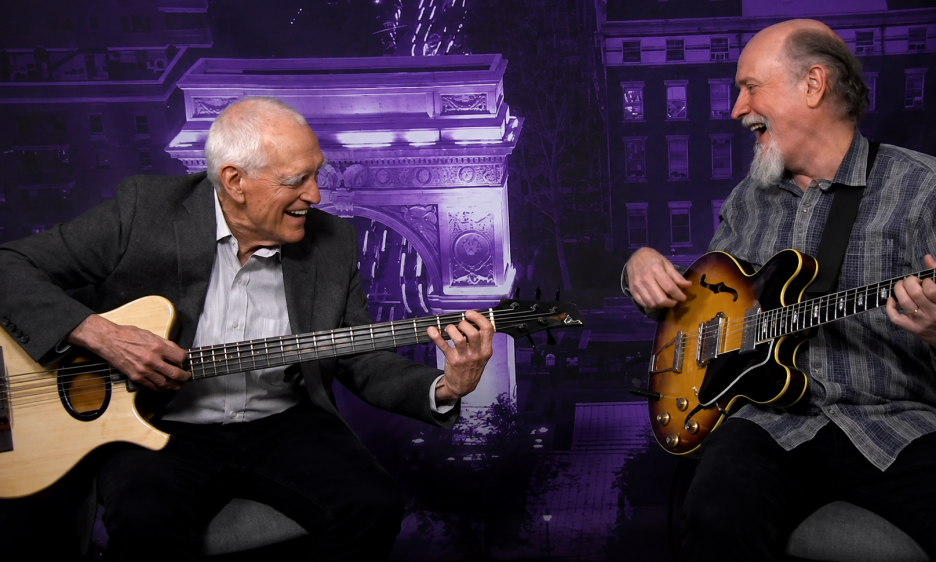
Jazz is young, a century and a half old. It's just learning to walk. There are vast horizons to explore.
—Steve Swallow
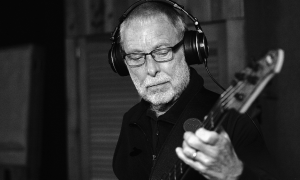
As a 20-year-old fresh out of Berklee playing with Paul Bley in Jimmy Giuffre's trio, Swallow would hang out at Bley's apartment observing how Carla Bley painstakingly wrote music and thought this was very systematic and deliberate work, with the accent on work. But as the years and decades passed, he found this was not without its rewards, which became readily apparent from his contributions to albums like the magnificent duo recording Hotel Hello (ECM, 1975) with Gary Burton, Swallow Tales (ECM Records, 2020), recorded by John Scofield, Carla (ECM Records, 1987), which he recorded for his wife, and of course numerous albums as a leader. Winter Songs is his first true leader date since Into The Woodworks (ECM Records, 2013) and his first recorded appearance on the label after Swallow Tales and Carla Bley's Life Goes On (ECM Records, 2020).
Losing Carla, his wife and companion of 60 years in 2023, was devastating. So, Swallow wrote music. "I began with the need to do something to fill each long day," he related, "and music rushed forward to sustain me. Before Winter Songs I had given music whatever I could, but as I made this album the tables turned: it gave me what I needed. Music is elemental, like the air we breathe."
Consisting of nine tracks numbered consecutively as titles, you might expect the music to be mechanical in nature, but that's far from what emanates though the speakers. The music is warming, like putting VapoRub on one's chest. The ensemble of close confidants accompanying him is as tight as clothespins holding up the laundry. With the expert but subtly applied horn section of Chris Cheek on sax and Mike Rodriguez on trumpet, guitarist Steve Cardenas, Gil Goldstein on piano, and Adam Nussbaum on drums and Swallow's bass keeping the time flexible, the nine collected originals act more as conveyors of patient reflection and calm than they do as inciters of turbulent improvisation. Each player uncorked hidden bottles of adrenaline and functioned at the summit of their potential, the music pulsing and swelling the hearts of lovers, stretched out angular and sensual like Modigliani nudes.
Swallow has taken a well-earned retirement from touring but has no desire to cease writing or making records. He is a music lifer with a career spanning over six decades spent offering his prodigious talents to jazz aficionados. In the wonderful television series, A Gentleman in Moscow, an imprisoned Russian nobleman favors a particular wine, Châteauneuf-du-Pape, believing a proper vintage captures a unique moment in history, telling a distinct story of its time. The comparison to uncorking a vintage Swallow album is undeniable. The following Q&A provides readers with a few reflections of the bassist, who has crushed the art of making and playing music as a vigneron would crush grapes to create fine wine.
All About Jazz: In almost a half century of recording as a leader, this is your first album as a leader in nearly a decade.
Steve Swallow: It's been more than a decade. I'm proud to say you shouldn't make too many of those things.
AAJ: Well, you certainly kept yourself busy with other side projects. It's interesting that the title is Winter Songs since you recorded it in the autumn of 2024 and released it in the summer of 2026. What went on during the spring?
SS: Absolutely nothing I can recall. I have seemed to avoid winter altogether. No, the title references the period in which I wrote the music. I wrote it in a very specific period from mid-October of '23 to April of '24. And for me, that's a first. I'm a very slow writer and I've always accumulated an album's worth of music over a lengthy period of time. But on this occasion, the music for the album came to me in a matter of months, and it came unified in a way that my previous recordings had not. There are motivic threads that extend through all nine of the songs on the album, and there's a unifying mood to the music as well, I felt, which is why I chose to just number the tunes rather than title them individually. It took until September to organize the guys and the studio and everything it took to make the recording. And then it took a while for Manfred Eicher to get off his ass and release the thing. That explains the chronology. But in his defense, he has an astonishing backlog of really excellent music on his hands. I'd hate to be him and make the decisions that he has to make.
AAJ: For those of us who use images from titles to develop an overall understanding or as a reference point, you bypass that with your simple one-to-nine numbering.
SS: I meant to leave only the overall impression that it's winter. And I think the guys in the band responded to that prompt of the unspoken aspect of the project and tuned into it in their playing. I'm really grateful to them for that.
AAJ: In the press materials, this statement was made, "The music is not performed as a means to an end, but has become an end in itself." So, in less enigmatic terms, what does that actually mean?
SS: Well, it means the writing of this album in particular, but I guess the playing of it, as well, marked a departure for me. I'd always in the past had my eye on the sparrow. I had it in mind that that album would register on its audience in a certain way, and that it would be impactful. There was a purpose of activity going on right from the very beginning, from when I began writing the music. It was as if the music came to me after years of faithful service. The music said, "Okay, this one is on me."
AAJ: Does writing music become easier or more difficult as the years pass?
SS: That's an interesting question and I'll pause for a moment. I would have to say it's no less difficult than it's ever been. Writing music is hard for me and it's definitely work. You punch in. It's a factory job. You take your coffee to the piano. You don't sit at the breakfast table with it. You put in your hours. And for me at least, often that involves days if not weeks of just sitting there sweating it out without any reward at all, just waiting with the confidence that somewhere there's a big book that says Steve Swallow has to wait for 21 days and then a good idea will come. You just very obediently punch in day after day. That's my experience with writing at any rate, and but it's not without its rewards.
Every now and then you'll get something and there'll be a brief moment of, and that's your reward. Then that passes and it's back to the trenches because the process for me involves sitting until I've gotten an idea, again, a matter of very deliberate and systematic work. You have to look at where you've got this idea and examine its ramifications and the possibilities for expanding it. It's time consuming, but it's just the necessary footwork that goes into making a song out of a good idea. And that process has always taken me weeks to finish. This album, Winter Songs, was written over a period of about five months and for me that's just lightning fast, as if I could barely keep up with the pencil on the paper. And I am a pencil and paper guy; I'm still buying reams of manuscript paper.
AAJ: Writing articles is similar in that it is not easy work and often the finished result is very different from what was anticipated.
SS: That sounds familiar to me. I must say if you're living near Knoxville, you've got Cormac McCarthy looking over your shoulder when you write. That's kind of like up here, I've got Percy Heath looking over mine.
AAJ: When you're selecting musicians, I'll turn around your means and means to an end line. Do you look for those who fit a vision or the vision in itself?
SS: Well, just to continue the analogy to writing fiction, it's very complex, the interaction with the characters who play the music. In this case, I began writing the songs without a cast of characters, but within a few weeks, they began to contact me. I began to see Chris Cheek dancing before me as I wrote a melodic line,—Aha! That's a line for tenor saxophone and more specifically that's a line for Chris. And, aha! There's a trumpet line, and that's a Mike Rodriguez line. All of the people playing on the album are guys I've known for a long time and whose music I've known for a long time.
The inmates take control of the asylum at some point. The characters start to assert their preferences. Chris Cheek's manner of playing began to influence the kind of lines I wrote for the tenor saxophone. It was the same with all of the guys in the band. I thought, for instance, of Gil Goldstein in terms of orchestration, even when he was simply playing the piano. He is just a born orchestrator and I counted on that. I heard him doing that as I wrote his parts, and I gave him parts that reflected my faith in his orchestrating abilities and my desire for him to exercise them in the music.
AAJ: Cheek and Steve Cardenas were in the combo when you played with Paul Motian.
SS: I've had a long history with them, and they were on the previous record that I'd made, which was I think in 2014. We had a history in that regard and Adam Nussbaum, the drummer and I go back, for better or worse, to 1980. So this was a reunion of sorts gathering all of these guys together.
AAJ: You've played with certain musicians consistently over the years, for example, Gary Burton. Hotel Hello was an outstanding album in its time and is still. Didn't you write most of it?
SS: Yes. I'd intended in fact for it to be my first album, and it was in response to a request by Manfred Eicher. So as much as my relationship to all the guys in the band goes back, so does my relationship with Manfred. He wrote to me before there was an ECM, saying that he intended to have a record company and wanted me to make a record. At the time, I was in my brief excursion from the East Coast. I was living North of San Francisco in a little town called Bolinas, and I was thrilled to receive this message from the music world because I had turned my back on it in going to Northern California. I'd had my fill of the music business, and all of a sudden here was this voice from the benign side of the business, an actual principled person talking about making recordings. It drew me back into the process of making music in the real world.
While I was in California, I began writing what was to be an album for Manfred, and then came back to the East Coast to rejoin Gary Burton's band. It was just taking me entirely too long to find the material for a full album. So, Gary and Manfred conspired to shove me into Hotel Hello. They said, "Well, look, you've almost got it. Here's this great piece by Mike Gibbs. Here's another great piece by Carla. We've got the makings of an album here and let's go otherwise you'll be... " I wanted them to give me a few more months. And I'm glad they didn't. They said, "Nope, time to put up or shut up." I like very much that it devolved into a duet album as well, and Manfred had a hand in that. It was still in the early days of multi-tracking without degrading the signal from one generation to the next. Gary and I had done a bit of that right at the outset of the technology when 4-track became 8-track, became 16, et cetera. So, we were having a lot of fun in the studio with that technology. I'm also fond of Hotel Hello, which is an obscure fondness. There aren't many of us out there.
AAJ: It is a rather unique combination for a duo of vibraphone and bass.
SS: No, there aren't many of those and there's probably reason for that, but we'll let that lie. And I must say also in the course of making that album, I played a fair amount of piano and so did Gary. It was just before synthesizers overwhelmed the musical landscape, but we were using keyboards that were available to us with the Hammond B-3, for instance. We were really like kids in a candy store. With a minimum of planning, we hit the studio and said, "Well, it'd be nice if we put this here and how about we'll try that. " And the album came together quickly over a couple of days doing a lot of experimenting right in the studio.
AAJ: When you switched from double bass to electric bass, was that like a jazz version of Dylan going from acoustic to electric?
SS: That's a nice way of putting it. I'd like to think so. And like Bob Dylan, I got my share of flak from the jazz community for doing it, as I knew I would. When I first picked up the electric bass, I fell in love and it was a kind of instantaneous thing. My very first thought was, "Oh shit, I'm in trouble. This is not going to go over well with a lot of my dear friends." And indeed, it kind of cleared the slate. I started again in many ways at the age of 30 when I picked up the electric bass, but that's a wonderfully exciting thing to happen to one in the middle of life to discover something so compelling and so exciting that you have no choice but to go with it.
AAJ: Did the musicians you had been playing with look askance at your switching from double bass to electric?
SS: Yes, indeed. And I had shared the jazz community's disdain for the electric bass. Everything was wrong about my making this switch, but when I first touched the instrument, there was an immediate and undeniable bond. I just had to follow it.
AAJ: In music as with any technology, there is a slow creep toward innovation as the years go on. Jaco Pastorius was certainly an innovator with electric when he came on the scene with Weather Report and continuing to solo work.
SS: Of course. He helped a lot to make the electric bass undeniable in certain circles.
AAJ: Is there a main bass you like to play? And what do you like about it?
SS: I do. And I have an embarrassing number of them hanging around the house. Ten in fact, and I'm ashamed to say made by the same guy, Harvey Citron, who lives nearby. This number 10 by Harvey I've had for, gee, I don't know—he'd know exactly to the day—but three or four years, which is actually a long time in our history. I like it because it's the closest I've come to the sound in my head. I've been thinking and talking about this recently. Paul Bley, the pianist with whom I worked in the early 1960s, said something memorable one day. He told me, "You get the sound you hear." That's stuck with me, and I believe it to be true. It's really essential, I think, that as a young musician, you hear a sound in your head and you pursue that sound. I've been doing that for decades on end now, and the bass that I'm currently playing has gotten me a good step closer to that sound. I should add immediately that the sound resides more in one's fingers and in one's ears than in that thing that you're playing, the instrument and the amplifier and the whole chain outside of your body and fingers.
AAJ: In your case, fingers holding a pick.
SS: I do play with the pick and have since a couple of years into playing the electric bass. I just felt I was, again, getting closer to the sound I heard in my head and in particular, getting some additional clarity and definition to the sound.
AAJ: How would you describe the difference in sound between playing with your fingers versus a pick?
SS: Well, the immediate thing is the pick tends to have a brighter, clearer sound than the fingers. The fingers maybe have a little more warmth and depth to their sound, but beyond that, there's a difference in the articulation, specifically in the attack of the pick as opposed to the fingers. There's a point to the note that's very particular. I've found that playing with the pick has given me a special feeling of empathy with guitar players, and I've played with a lot of them. On Gary Burton's band, there was an ever-evolving chair of guitarists, and I got to play with a wonderful set of guitar players, and others outside of that context as well. Also, there is something about manipulating the pick playing the bass that allowed me to lock into the phrasing, to lock into the intentions of the guitarists I was playing with. It goes beyond sound to encompass a whole world of phrasing and rhythm and articulation.
AAJ: I get that. As a guitarist, I went in the opposite direction, from a pick to fingerstyle.
SS: Well, you're in the minority, but you're not alone. During the several years I played with Mick Goodrick, who was one of my favorite guitar players, he abandoned the pick and returned to fingers. It was kind of funny to look at the Gary Burton band of those days, because the bassist who should have been playing with his fingers was playing with a pick and the guitarist who should have been playing with a pick was playing with his fingers. Mick was able to obviously exploit the advantages of finger playing, being able to make a chord sound in perfect unison and the notes in perfect unison instead of swept through with a pic. You know the advantages of that.
AAJ: You've played a lot with John Scofield. What can you say about him?
SS: He's a strong presence in my life and remains so to this day. We've played together since 1975. Here's a story for you. Just as I met Sco, I was teaching at Berklee in Boston, something I did for a couple of long years. He had just finished going to Berklee and was hovering in Boston, dragging his feet. It was time for him to go to New York and he knew it, but he was hesitating. I caught him at that moment. We played together and it was one of those impactful encounters in my life. I knew the first time I played with him that we would have a history, that we were going to play together a fair amount.
I wanted to quickly cement our relationship and to get to know him well. So, we fell to talking and all of that, and he started complaining about the neck of his guitar and the intonation. I took a look and said, "Oh, it's bowed and the truss rod needs tightening on this thing. It's a simple thing. I can do it." And he said, "Gee, thanks." I tightened this truss rod to the point where I broke the neck of this venerable, beautiful old Gibson. And to his credit, our relationship survived this. This was John and I just getting off to decades of friendship.
AAJ: Do you know what happened to his Gibson?
SS: Well, he got it fixed and continued playing it for some time. And I think, in fact, he has still got that very instrument, but he is locked into the feel and the response of the Ibanez that's his model. He actually plays that thing and seems always to return to it whenever he tries another guitar.
AAJ: You've spoken of Carla Bley as a writer who also plays. What is the difference?
SS: It was nice that we came together from those positions that seemed to be in opposition but aren't really. Carla and I played together first in 1960. I seem to be naming dates throughout this, but I remember it well and I remember the music we've made together in some detail. She was in fact the first composer I was able to observe in the wild. I was playing with Paul Bley and hanging out at Paul and Carla's apartment all the time, watching Carla deliberate for days over a single note. I said, "Okay, so that's what a composer is." And my early response was I wouldn't want to mess with that. Here I can just pick up the bass and play with the band and produce more notes in an hour than she produces in a year, in a decade. And it kind of confirmed my identity as a player.
But as we played more and more often together and then began our relationship, we really started to impact each other, and I became more and more composerly in the way I approached improvising. And she began to improvise with more abandon as I insisted that she come down to the basement with me and play. I think it was very good for each of us that we profited from what the other brought to the table. And at this point, my favorite improvisers are also composers: Thelonious Monk, Wayne Shorter, Carla herself in particular. She's grossly undervalued as a player. The sly inventive way in which she improvises can blow right past you, but if you take a moment to listen to what's going on there, it's just circles within circles and jokes and puns. There's a whole world in her playing that has yet to be discovered.
AAJ: Upon first listening to her recordings, admittedly I had a hard time picking up on them. Eventually, I warmed up.
SS: Well, her music is difficult. I'm with you. One of the things that I find remarkable about it is that on some level it is quite accessible. She went out of her way to make a spectacle, to make her music conspicuous in the world. But beneath that, there always was an element of theater in her music. There was a number system at play, a really rigorous attention to the numbers in music. And music at one level is a system of proportions.
AAJ: How much potential is there for something new in jazz?
SS: Oh, limitless. Without hesitation, I can say that there are worlds yet to be traversed. Jazz is young, a century and a half old. It's just learning to walk. There are vast horizons to explore.
AAJ: We have taken up much of your morning. You probably haven't had your breakfast. Do you have a go to breakfast?
SS: I do. A bowl of meticulously cut fresh fruit with some yogurt and a slice of toast with marmite on top of it. Marmite is a British abomination. It tastes like nothing else on earth, and you either love it or you hate it, and I fall into the former camp. I don't mean to be glib but it's the truth. My day takes an unusual shape. I find that I do my best work, especially composing work, first thing in the morning with a cup of coffee in hand before I've put food in my stomach. And I've come to stretch that period so that I don't eat until the day is already three or four hours long. And in fact, I haven't had my breakfast yet today and am greatly looking forward to it. My response to your question comes straight from my stomach.
AAJ: One more thing before we call it a wrap. Do you have plans to tour or play some gigs supporting the new album?
SS: Not at all. I'm strictly a studio musician these days. You'll have to be content to listen to it.
 FOLLOW Dean Nardi
and get notified whenever a new article published.
FOLLOW Dean Nardi
and get notified whenever a new article published.
I am a retired journalist, first covering pro sports in Boston for a daily newspaper then publishing two magazines.
About Steve Swallow

Tags
PREVIOUS / NEXT


Become a Sustaining Member

Since 1995, All About Jazz has championed jazz as an art form and supported the musicians who create it. Over three decades, it has grown into one of the world's leading jazz resources, serving hundreds of thousands of readers, musicians, presenters and industry professionals each month.
Help Build the Future of All About Jazz
Your support helps us continue building All About Jazz for the next generation—expanding our editorial coverage, preserving jazz history, developing new community features and creating better ways to discover the music and the people behind it.
Become a sustaining member for as little as $20 per year and you'll immediately enjoy an ad-free experience along with access to subscriber features and future articles for a full year.
Together, we're not simply sustaining All About Jazz—we're building its future. Thank you for being part of the journey.