Home » Jazz Articles » Live Review » Michael Leonhart Orchestra at the 2026 NoMad Jazz Festival
Michael Leonhart Orchestra at the 2026 NoMad Jazz Festival
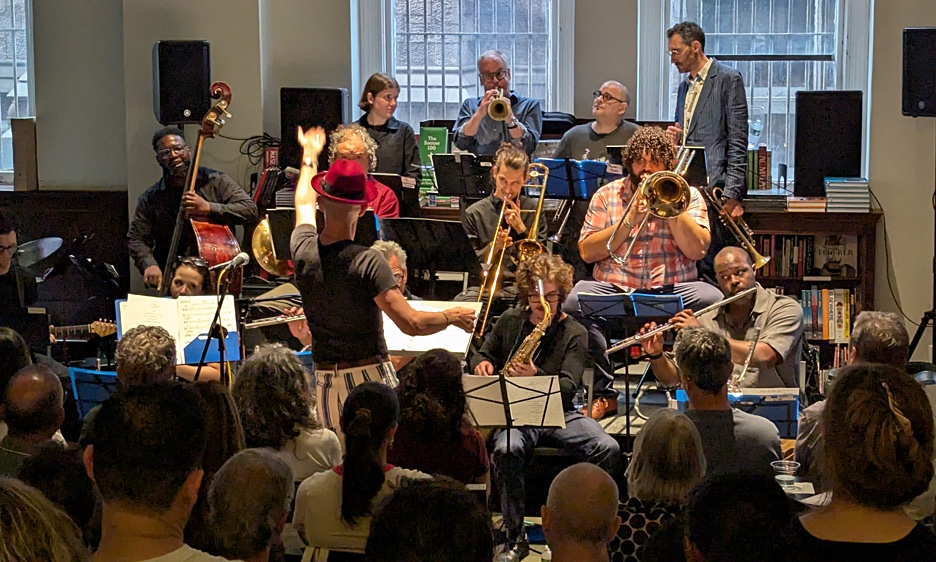
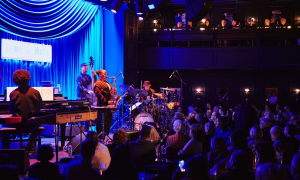
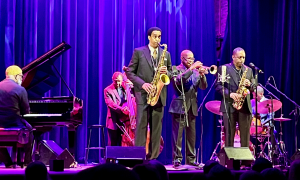
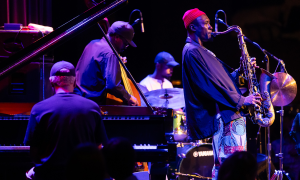
Courtesy Ludovico Granvassu
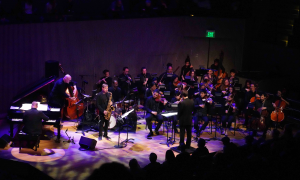
Leonhart's arrangements, many of lesser-known Miles Davis and John Coltrane compositions, brought orchestral richness to the often-spare original recordings of the pieces.
Rizzoli Bookstore
NoMad Jazz Festival
New York NY
August 2, 2026
Spontaneous creation in jazz usually doesn't extend to the arrangements for a 17-piece orchestra. But Michael Leonhart—who disclosed from the bandstand that his orchestra "did not rehearse for this performance"—wound up arranging on the fly for a chunk of his band's 95-minute twin tribute to Miles Davis and John Coltrane on Sunday.
During the looser numbers of the set—which was performed in a sold-out back room at Manhattan's Rizzoli Bookstore—Leonhart, variously, directed sections of the band to play repeating riffs, asked some soon-to-be soloists to switch to another of their instruments, and walked over to drummer E.J. Strickland to suggest a tweak to his playing. The smiling musicians took it all in stride, and the arranged-in-the-moment pieces—like a creeping, percussion-forward take on Wayne Shorter's "Footprints"—became intriguing workshops more than polished performances.
That they worked at all, as Leonhart announced with gratitude, was a tribute to the excellence and creativity of the players involved, at least one of whom—a rock-steady Dezron Douglas on bass—was making his debut with the Leonhart band.
That high standard of the playing shone through in the more tightly written arrangements that dominated the set. Some of those charts drew from The Miles Davis Suite, which Leonhart debuted with the ensemble in May at Jazz at Lincoln Center. Yet even these reprises were retooled from the earlier iterations, not least in their changes to the featured soloists. Fronting the band at the JALC debut in May were the plaintive harmonica playing of Gregoire Maret and the volcanic tenor saxophone of Donny McCaslin.
At Rizzoli, the guest soloist was Jeremy Pelt. On "Flamenco Sketches"—the best-known Davis piece of the night, recorded (as Leonhart noted) mere blocks away from Rizzoli, in 1959—the trumpeter took very much his own path. Eschewing the arid minimalism of Davis's style, Pelt played with his customary full-toned and emotive approach.
The arrangement too, with many more instruments than the sextet featured on Kind Of Blue (Columbia, 1959) was richer in texture. The blend included the warm tones of French horn, played by Eric Davis, which helped evoke the sound of Gil Evans, whose own Miles Davis arrangements often featured this least jazzy of the brass instruments.
The spotlight also settled on several orchestra members, none of them stars in their own right but all contributing worthy work. As examples, Scott Wendholt on trumpet and Jason Marshall on baritone saxophone and bass clarinet stepped up to play solos that were both solid and melded well into the ensemble sound. (Leonhart even stepped up himself, turning around from his conductor's podium to play brief trumpet exchanges with Pelt.)
"Sketches" aside, Leonhart leaned to less celebrated Davis repertoire, including closing the set with what he described as a "mash-up" of two pieces from the trumpeter's electric era: The title track of Tutu (Sony Records, 1986), and "Black Satin," from On The Corner (Columbia Records, 1972), the once controversial 1970s album that has more recently been critically embraced.
The set's Coltrane pieces, Leonhart said, sought to honor as a composer a musical giant known primarily—and justifiably—as a titanic saxophonist, almost all of them built around the blues, "Blue Train" leveraged what Leonhart described as the piece's "deceptive simplicity" to create a bluesy beauty, as was the case with "Mr. Day" later in the set. The set closed with a powerful and occasionally dissonant "Africa," from Coltrane's Africa/Brass (Impulse Records, 1961) album, powered by Douglas's pulsing bass and powerful solos from bassier instruments in the horn section.
 FOLLOW Paul Reynolds
and get notified whenever a new article published.
FOLLOW Paul Reynolds
and get notified whenever a new article published.
Journalist and programmer in jazz, folk, country and other musics
About Michael Leonhart

Tags
PREVIOUS / NEXT
Become a Sustaining Member

Since 1995, All About Jazz has championed jazz as an art form and supported the musicians who create it. Over three decades, it has grown into one of the world's leading jazz resources, serving hundreds of thousands of readers, musicians, presenters and industry professionals each month.
Help Build the Future of All About Jazz
Your support helps us continue building All About Jazz for the next generation—expanding our editorial coverage, preserving jazz history, developing new community features and creating better ways to discover the music and the people behind it.
Become a sustaining member for as little as $20 per year and you'll immediately enjoy an ad-free experience along with access to subscriber features and future articles for a full year.
Together, we're not simply sustaining All About Jazz—we're building its future. Thank you for being part of the journey.
Near

New York City Concerts