Home » Jazz Articles » Catching Up With » Pedro Molina: No Denial of the Power of a Music Video
Pedro Molina: No Denial of the Power of a Music Video
Keep experimenting and trying new ideas... One of the advantages of being an artist is that if we make a mistake, nobody gets hurt.
—Pedro Molina
All About Jazz: Pedro, how did you decide you wanted to do something very different from the typical video of a live performance in the studio or on stage?
Pedro Molina: I had the option of making the typical studio performance video, showing the band playing the music, but with the overall concept of the album, I felt something was missing. I know that many promoters and festival programmers prefer to see musicians performing live, but even a beautifully edited studio-session video doesn't really feel authentic. And because of the cost, having cameras rolling throughout the entire recording session, so that we could be sure the footage matched the actual take we chose for the album, simply wasn't a realistic option.
Since the album revolves around different ideas and perspectives on Alzheimer's disease, I wanted to complete the whole creative process with a video that also told a story. That may not be the most common approach for a jazz band, but considering the concept of the album and the fact that this project has a strong rock and pop influence stylistically, telling a story through a more artistic music video felt much more meaningful to me.
AAJ: Who came up with the concept? Was there a skilled media director/producer to flesh out the scenes, or was it a do-it-yourself project with the band?
PM: The initial concept was mine. To me, Alzheimer's has something strangely tragicomic about it. You gradually lose your abilities and skills in the reverse order in which you learned them. It's almost like a regression to childhood, but with a much darker and more dramatic side. I wanted to allude to that experience.
However, I didn't have the technical knowledge or filmmaking experience to fully develop everything I had in mind or figure out how to bring it to life. So, I asked a friend who works across music, performance, theatre and film if he could recommend someone with experience in this field.
That's when Miguel F. came into the project. Like me, he lives in Portugal. Miguel has extensive experience filming theatre and dance performances, and he was responsible for the production, direction and editing of the video. More importantly, he helped expand and shape my original idea until it became the final piece.
There was also a theatre director and performer, Angélica Liddell, whose work I deeply admire. I love the way she explores the darkest and most profound aspects of human nature through surreal imagery, absurdity, dark humour and grotesque contrasts. That's why the brutalist playground that appears in the second half of the video felt like the perfect setting to express those ideas.
Miguel was already familiar with Angélica's work, so he and I immediately shared the same visual language, and communication between us was very easy.
AAJ: How did the musical and visual components relate to each other?
PM: The composition itself is divided into two very distinct sections. The first is built around a double bass groove, while the other instruments develop their own ideas around it, with a short melody appearing from time to time (listen from 0:01 to 02:53). After a brief interlude, the second section starts (at 3:09), introducing a heavier double bass line, this time reinforced by the piano, which provides the foundation for the guitar solo. I think that the parallel transitions in the music and the scenery work really well maintaining the thread of the story.
AAJ: What was the filming process like?
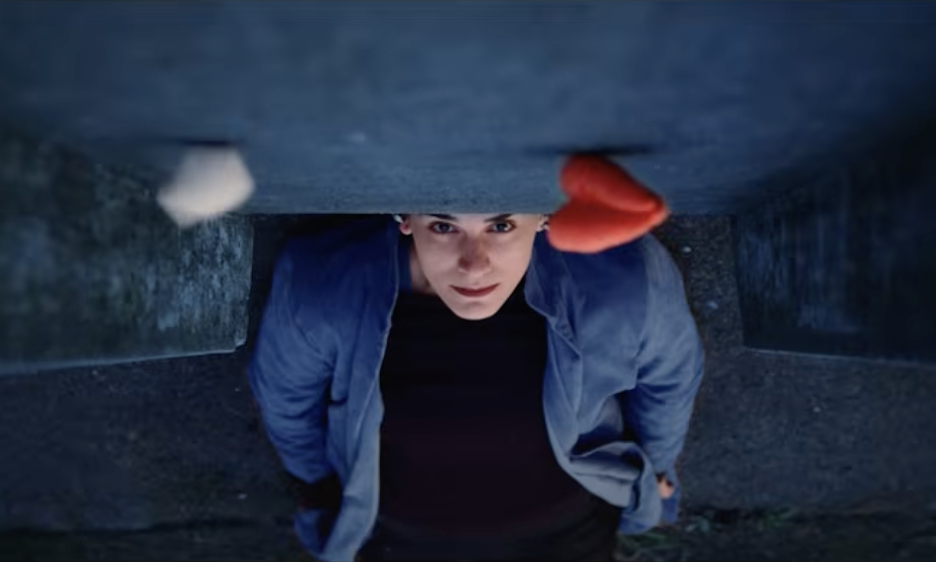
PM: We spent a day filming different situations and movements, exploring the space to create enough material for the final edit. It was actually Miguel who felt that the video wouldn't sustain a single location throughout. He surprised me by filming another series of images and movements in different locations, which eventually became the opening section of the video.
AAJ:Who is the main actor in the video? Where did you find her?
PM: We discussed several possibilities: creating artificial figures specifically for the video, using members of the band, or working with a professional performer.
In the end, given the direction the project took, we felt it was important to work with someone who had much greater body awareness and a stronger capacity for physical exploration and expression.
Because Miguel knows that world much better than I do, he recommended Magda, a contemporary dancer and performance artist who perfectly matched what we were looking for.
AAJ: Did you use professional cameras or smartphones? What video editing software was employed?
PM: Since Miguel works professionally in this field, everything was filmed using professional camera equipment.
The software used was Adobe Premiere Pro, a professional video editing application that's considered an industry standard.
AAJ: What about natural versus artificial lighting?
PM: The video's post-production is quite extensive. The natural light was heavily manipulated using multiple layers and masks, which also support the visual effect of multiplying the same body as it explores movement and performs the choreography. However, the filming itself relied entirely on natural light.
AAJ: Were there any special effects or video manipulation?
PM: There was a significant amount of post-production, particularly in the second half of the video. Several different performances were filmed from exactly the same static camera position and later layered together during editing. The footage was recorded separately, but visual effects were used in post-production to superimpose the different takes and create the final result.
AAJ: It looks like you inserted "found objects" in the video clips. For example, where did you obtain the red-and black-faced native figurine at 1:11?
PM: The native figurine was put together by Magda, the lead dancer in the video. It wasn't specifically designed for this project; we simply worked with pieces she already had and combined them to create a color palette that would work well with the urban setting where we filmed.
You'll also notice a few objects that appear throughout the video. They're there to evoke a sense of childhood and regression. The contrast between the fake vegetables near the beginning and the real ones at the end plays with the idea of the hallucinations associated with the Alzheimer's, blurring the line between reality and perception.
AAJ: In retrospect, would you recommend that other jazz bands be open to producing a video like that for "Denial?" Were the rewards worth the effort?
PM: I'm not sure I would recommend it to every jazz band. For me, it made sense because it allowed me to complete and reinforce the overall concept of the album by telling a visual story in a more artistic way. I probably wouldn't have considered doing something like this if the album had simply been a collection of unrelated compositions. But in this case, I'm genuinely very happy with the outcome, and I think the video represents the spirit of the record extremely well.
AAJ: What's the key to experimentation across media?
PM: What I would recommend to any artist is to keep experimenting and trying new ideas whenever they feel genuinely curious about them. One of the advantages of being an artist is that if we make a mistake, nobody gets hurt. Once the album and the video are released, how people respond is no longer up to me. Everyone will experience them according to their own tastes and sensibilities.
Working with artists from different disciplines, even if it was just for one music video, is always enriching. It broadens your perspective and opens up new creative possibilities. I'm very pleased with the results.
AAJ: By the way, what direction and talent were involved in designing the striking album cover art for A Name I Knew.
PM: The album cover was designed by Maria Mónica, who is responsible for creating all the cover artwork for the Porta-Jazz label's catalogue, including this release. The way we worked together was quite simple: I sent her everything I had related to the album (the music, the overall concept behind the record and the individual tracks, as well as some of the ideas for this video, which was still in development at the time) and then I let her respond to it creatively.
The final result is something that I think fits the overall concept and aesthetic of the album really well. The rough, almost childlike strokes create a composition that, at least for me, evokes a slightly unsettling feeling. It's difficult to explain exactly why, but I absolutely love it.
AAJ: Do you expect to produce more videos in the foreseeable future?
PM: I'm sure we'll have more videos of the band performing live in the future. I love watching live performances myself. But those will be genuine live recordings, rather than edited footage of musicians miming along to the album version, where what you see isn't actually what you're hearing.
 FOLLOW Scott Lichtman
and get notified whenever a new article published.
FOLLOW Scott Lichtman
and get notified whenever a new article published.
Jazz/fusion keyboardist & autograph collector in Stamford CT.
About Pedro Molina
Tags
PREVIOUS / NEXT

Become a Sustaining Member

Since 1995, All About Jazz has championed jazz as an art form and supported the musicians who create it. Over three decades, it has grown into one of the world's leading jazz resources, serving hundreds of thousands of readers, musicians, presenters and industry professionals each month.
Help Build the Future of All About Jazz
Your support helps us continue building All About Jazz for the next generation—expanding our editorial coverage, preserving jazz history, developing new community features and creating better ways to discover the music and the people behind it.
Become a sustaining member for as little as $20 per year and you'll immediately enjoy an ad-free experience along with access to subscriber features and future articles for a full year.
Together, we're not simply sustaining All About Jazz—we're building its future. Thank you for being part of the journey.