Home » Jazz Articles » Catching Up With » Goldings, Bernstein & Stewart on 35 Years Together and T...
Goldings, Bernstein & Stewart on 35 Years Together and Their New Album
These guys have heard me play almost as much as I’ve heard myself play, and that makes me want to look for something different.
—Peter Bernstein
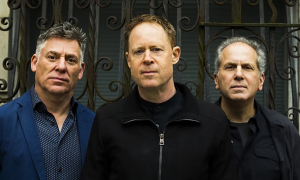
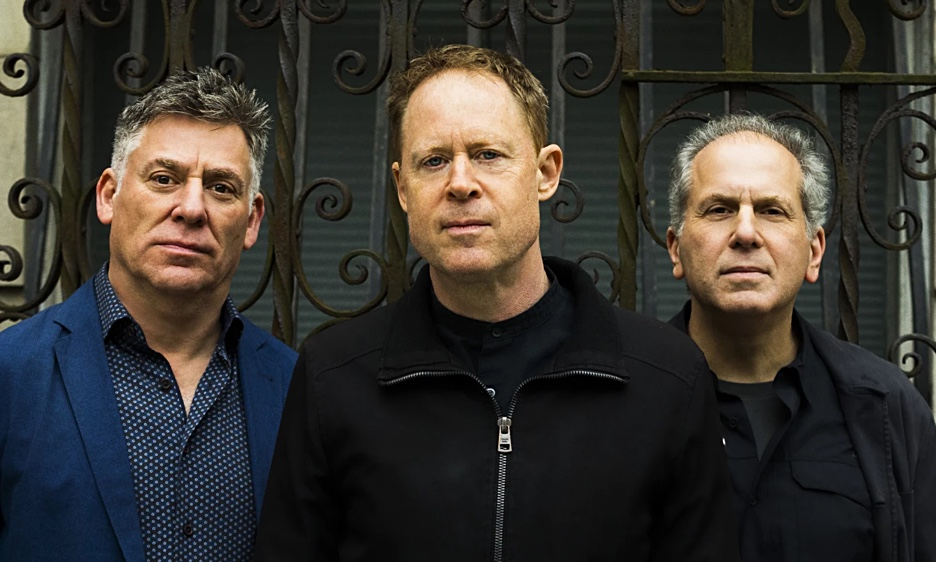
It's a useful measure when talking about Larry Goldings, Peter Bernstein, and Bill Stewart, a trio whose history stretches back more than three decades, and whose music still depends on that same essential exchange.
Logging onto a Zoom call with them, it's immediately clear that this is a group for whom the conversation has never really stopped, even when they've been apart. I ask how long it's been since they last saw one another.
"Not long enough," Stewart quips.
"We just finished a tour recently," Goldings adds.
There's an ease and an edge among the three men, who have been cracking wise together for the better part of their lives, going back to their student days. Today, this group is widely regarded as one of the most consistent, creative and influential organ trios on the planet. More remarkably, it is also among the longest-running jazz trios in the music's history. And yet the band itself was born out of largely unplanned circumstances.
Goldings and Bernstein met in the 1980s at the Eastman High School Jazz Program, two teenage musicians discovering jazz together. "I literally remember the first day I saw Pete," recalls Goldings. "We were very much kindred spirits. We both loved learning tunes and talking about how beautifully constructed a tune was."
Goldings eventually moved to New York as part of the first generation to graduate from The New School, while Bernstein and Stewart first crossed paths at William Paterson University in New Jersey. There was constant cross-pollination among young players at the time, much of it centered around Augie's Jazz Bar on Broadway between 105th and 106th Streets.
Augie's was a divey haven for students and emerging musicians, a place for jam sessions, and informal gigs paid in tips. Many of today's most established jazz artists passed through its doors while still finding their footing.
"That whole scene was so important to me," Goldings remembers. "It's where we made our initial friends and relationships. It was that rare thing, a great centralized place to play, where there was tons of young talent, young and old talent together."
What Augie's offered in community, it lacked in backline. Musicians brought their own gear every night. Stewart recalls, "I had a 1976 Datsun B210 hatchback. I'd pull up with my drums, then pack them up again at four in the morning, and drive back to Brooklyn."
Augie's also had no piano. That absence pushed Goldings, who had started exclusively as a pianist, to develop a hybrid keyboard setup that approximated a Hammond organ, combining two synthesizers to cover bass lines and chords. It began out of necessity, on a night when no bassist showed up.
"Leon Parker was kind of the reigning king of Augie's," Goldings recalls. "One night his bassist didn't show up. He called me and said, 'Can you come up with a DX-7 and walk bass lines?' And that's what happened."
Goldings refined the setup over time, adding gear and developing an approach that eventually led him to the Hammond organ. Today he's known as a highly identifiable organ stylist, with a clean, pointed and unmistakable sound. Back then, he was discovering the instrument, and his voice on it, in real time.
"I never got my hands on a real Hammond B-3 until maybe '91," he says. "I made a record on organ when all I really knew was a portable organ I'd been playing at Augie's."
Perhaps because of that circuitous route, Goldings was acutely aware of the organ-trio lineage, sometimes to a fault. "When we started, I was definitely more focused on asking how we fit into the tradition," he says. "Now I'm much more comfortable with this being what it is. It doesn't have to fit into any kind of organ-trio tradition."
When Goldings, Bernstein, and Stewart first played together in a New School practice room something clicked immediately. "It just felt fresh," Goldings recalls. "Bill was very mature and very confident about his approach."
Stewart's confidence was crucial from the outset. Rather than adopting the expected language of an organ-trio drummer, he brought the fullness of his musical identity to the group.
"I don't really think about it," Stewart explains. "If I want to do something that sounds like what an organ-trio drummer might do, fine. But it's really about the interaction with this group. It's a very conversational band."
What began as youthful energy and a semi-regular gig at Augie's gradually took shape as something more. There was no single turning point, but early on they went into the studio to make a demo.
"Just to make a demo took some sense that we should record this and see what it sounded like," Bernstein recalls. "We were all playing with other people, and I don't remember making demos with every group."
From the beginning, openness in repertoire was central to the trio's identity. "We don't play blues all night, we don't play rhythm changes all night," Goldings says. "It could be repertoire from any instrumentation."
Over thirty-five years and at least a dozen albums together, the repertoire has expanded, without displacing much of what was there at the start. "We've added tunes over the years," Bernstein notes, "but we'll still play things we recorded on our first record."
That same ease and trust carries onto the bandstand. All three musicians have become among the foremost practitioners of their instruments, working widely as leaders and sidemen. And yet they continue to return to this trio, like migrating swallows returning to Capistrano, to sustain their unique balance of comfort and exploration.
"The familiarity works both ways," Bernstein explains. "Because you're comfortable, you're actually in a better place to take chances. These guys have heard me play almost as much as I've heard myself play, and that makes me want to look for something different."
It's a balance that extends to the material on Rhombus (Smoke Sessions Records), the trio's first album since 2021's Perpetual Pendulum, also on Smoke Sessions Records. The original plan was to develop new material on tour and then bring it into the studio.
"We had been on the road," Goldings explains, "which is the perfect setup, playing every night and then going into the studio so it just feels like the next gig."
By the time they arrived at the studio, however, not all the material had been defined. "We had to get new tunes together in the studio," Bernstein says.
That's where decades of shared history paid off. With a single day to record, the band made several game-time decisions. Keith Jarrett's "Everything That Lives Laments," which opens the album, was suggested by Bernstein. Abdullah Ibrahim's "Mamma" came from Goldings, as did the title track, "Rhombus," a Goldings original learned in the studio.
In total, the album features compositions by four pianists: Jarrett, Ibrahim, Randy Weston ("Hi-Fly"), and Thelonious Monk ("In Walked Bud"). The latter two reach back deep into the trio's history.
"We've been playing 'Hi-Fly' for years," Stewart says. "I think we might have even played it back in the Augie's days. And 'In Walked Bud,' we've played that on and off for thirty years."
It takes a special kind of group to produce a recording made up of half material they just learned and half material they've played for decades and have it all come out sounding like themselves. The album was recorded quickly, with most of the music captured in first takes. Designed as a vinyl-length release, Rhombus is concise by intention, a snapshot rather than a construction.
"Maybe we just have more confidence now," Goldings reflects. "Confidence that we can go into the studio and pull it off."
It feels especially fitting that Rhombus appears on Smoke Sessions Records. When Augie's closed in 1998, Smoke opened in the same location, owned by Paul Stache, who had worked at Augie's. Smoke Sessions was later formed to capture the spirit of that room with a philosophy rooted in community, continuity, and conversation.
While many Smoke Sessions artists share that lineage, few trace it as directly as Goldings, Bernstein, and Stewart.
"With Rhombus," Bernstein reflects, "we're older, our lives are different, but we're still tinkering with the same things when we were 22. Trying to play time better, play the form better, create and improve."
The quiet truth at the heart of this trio is that they aren't trying to make a statement so much as continuing a conversation that began decades ago, and remains very much alive today. Rhombus captures that exchange in motion.
 FOLLOW Leo Sidran
and get notified whenever a new article published.
FOLLOW Leo Sidran
and get notified whenever a new article published.
Multi-instrumentalist, composer, producer and podcast host.
About Peter Bernstein

Tags
PREVIOUS / NEXT
Peter Bernstein Concerts
Become a Sustaining Member

Since 1995, All About Jazz has championed jazz as an art form and supported the musicians who create it. Over three decades, it has grown into one of the world's leading jazz resources, serving hundreds of thousands of readers, musicians, presenters and industry professionals each month.
Help Build the Future of All About Jazz
Your support helps us continue building All About Jazz for the next generation—expanding our editorial coverage, preserving jazz history, developing new community features and creating better ways to discover the music and the people behind it.
Become a sustaining member for as little as $20 per year and you'll immediately enjoy an ad-free experience along with access to subscriber features and future articles for a full year.
Together, we're not simply sustaining All About Jazz—we're building its future. Thank you for being part of the journey.