Home » Jazz Articles » Live Review » Henry Butler: San Diego, April 12, 2011
Henry Butler: San Diego, April 12, 2011
 Henry Butler
Saville Theatre, San Diego City College
San Diego, CA
April 12, 2011
The path that brought famed New Orleans pianist Henry Butler to the Saville Theatre on April 12 has been rich in diversity and inexorably directed to his core : the wide scope of Crescent City music, and the deep well of the blues.
Although he began his professional career in jazz as a thoroughly modern keyboard stylist—Fivin' Around (Impulse! 1986), an adventurous session featuring Charlie Haden on bass and Billy Higgins on the drums, followed by The Village, (Impulse!, 1987), with Ron Carter and Jack DeJohnette, positing his own take on post-McCoy Tyner realities—since 1990 he has returned to a more Louisianan examination of the blues in all its iterations.
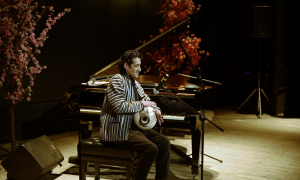
Blind since birth, he was led to the piano resplendent in a bright orange plaid suit, and once situated, began the music with a piece by fellow-New Orleans master Alvin Batiste called "Mozart." The melody borrowed a few recognizably Baroque phrases by the famed composer and stretched them gradually into something entirely different , but in the space of 90 seconds, the baroque became the barrelhouse.
He announced Scott Joplin's "the Entertainer" with the caveat, "It's not considered proper to improvise on a ragtime piece," but having said that, tore through the well-known tune, improvising at will, and taking it 12 steps further than Joplin himself could have imagined. His right hand spun manic high speed runs that double- and triple-timed the already furious tempo, which his left foot stomped out relentlessly like a pile-driving metronome.
Next was an intriguingly modern glance at the blues form, an original called "The Break," that Butler revealed was written after hanging out with pianist George Duke. He laid down a very busy left-handed ostinato offset by rolling chords voiced in fourths, an extrapolation that had the effect of disguising its blues form in the same way that many of Herbie Hancock's Blue Note recordings of the 1960s excelled at doing this.
Next he borrowed another tune from his frequent collaborator Batiste, "North American Idiosyncrasies," a slow, surging blues with a riff-style head. The pianist has got an intriguing take on the right-left hand relationship that was highlighted on this piece. He began with the standard demarcation, left hand pounding solid bass lines with the right involved in bluesy trilling—halfway through the piece, however, he moved both hands toward the middle register and started a series of octave-doubled runs remarkable in their clarity and alacrity.
Dedicating the next tune to New Orleans legend Professor Longhair, Butler opened "Orleans Inspiration" with an infectious, rollicking bass vamp that inspired an audience "clap-along" on the downbeats. Butler used the rhythm as a springboard for wild, rococo flourishes that expanded the vernacular in a multi-dimensional fashion.
After all of this manic, blues-based virtuosity, he brought down the house with a supremely sublime take on the standard ballad "That's All." He transfigured the acoustically pristine Saville Theatre and the grand piano into one gorgeous instrument on this piece—engraving each note of the melody with meaning, while his left hand gently rolled out the lingering harmonic structure.
Butler is also a vocalist of distinction, and he showcased this side of his musical personality with a furiously funky reading of "Let It Roll," a blues in G that traveled through many moods and styles, while rocking with sufficient urgency to induce another round of crowd-supplied downbeat clapping.
The pianist wrapped up the ebullient proceedings with another spirited vocal on, "Mardi Gras In New Orleans" from his 1990 disc on the Windham Hill imprint. The capacity crowd roared in approval.
Photo Credit:
Tom Westerlin
 FOLLOW Robert Bush
and get notified whenever a new article published.
FOLLOW Robert Bush
and get notified whenever a new article published.
Robert Bush has been involved with Jazz as a musician, listener and supporter for over 30 years.
About Henry Butler

Tags
PREVIOUS / NEXT


Become a Sustaining Member

Since 1995, All About Jazz has championed jazz as an art form and supported the musicians who create it. Over three decades, it has grown into one of the world's leading jazz resources, serving hundreds of thousands of readers, musicians, presenters and industry professionals each month.
Help Build the Future of All About Jazz
Your support helps us continue building All About Jazz for the next generation—expanding our editorial coverage, preserving jazz history, developing new community features and creating better ways to discover the music and the people behind it.
Become a sustaining member for as little as $20 per year and you'll immediately enjoy an ad-free experience along with access to subscriber features and future articles for a full year.
Together, we're not simply sustaining All About Jazz—we're building its future. Thank you for being part of the journey.