Home » Jazz Articles » Interview » Enzo Favata: Coming Home to Atlantico
Enzo Favata: Coming Home to Atlantico
Courtesy Hossam Ezzat
There are certain kinds of music that never stop pursuing the musicians who created them, even if those musicians never see one another again because they have stopped working on that music
—Enzo Favata
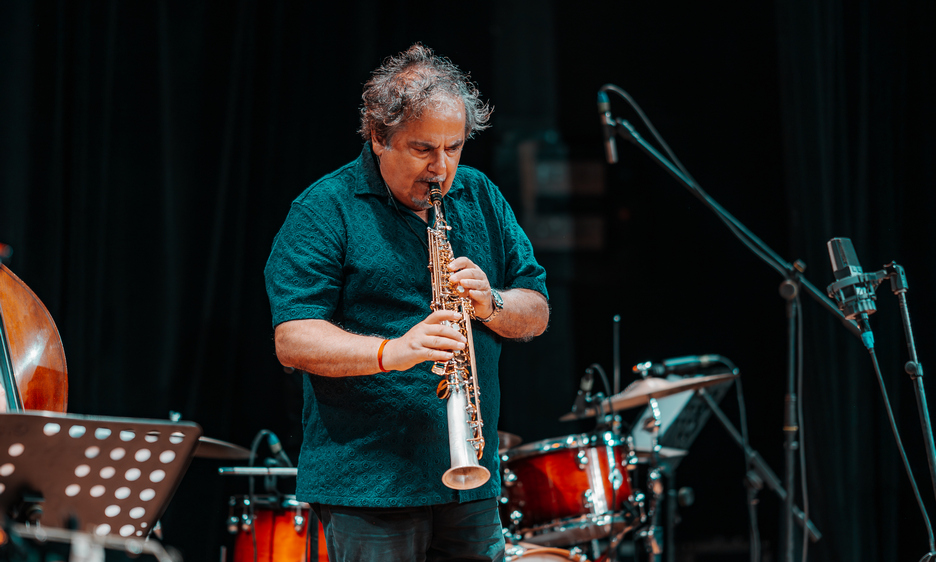
The album brings together eight compositions, some drawn from the group's historic repertoire—"Tukuman," "El Sur," "Milonga del sol"—and others new pieces that nonetheless preserve its distinctive poetics: musical narratives that draw imaginatively on a wide range of cultures, colored by Favata's reeds—soprano saxophone and clarinets—the fascinating sound of Daniele di Bonaventura's bandoneon, the rich textures of Marcello Peghin's ten-string guitar, and the elegant, colorful rhythm section of bassist Salvatore Maltana and drummer U.T. Gandhi, whose presence is especially poignant today following his sudden passing.
An album, which brings to mind some of ECM's historic productions from the 1970s through the 1990s, with unhurried tempos and suspended atmospheres, cohesive and consistently accomplished, with particularly refined and compelling moments on "Sine Nomine," "Donde nace el Viento" and "Albatros."
We spoke with Enzo Favata about the album.
All About Jazz: Ritornare is your first album for ECM. A title with many meanings.
Enzo Favata: Yes, because Atlantico is my longest-running group. The self-titled debut CD, Atlantico, was released by the Italian label Il Manifesto way back in 1999. And also because Daniele Di Bonaventura, Marcello Peghin, U.T. Gandhi and I had already recorded for ECM in 2009, with Anja Lechner as a guest, but the album was not released.
AAJ: So let's go back to the lineup of the late 1990s and early 2000s, before each of you set off in different directions.
EF: Besides being my longest-running group, Atlantico was also the one most loved, by audiences and musicians alike. Then, for more than eighteen years, I stopped playing that music, which nevertheless—as I mention in the liner notes of the new album—remains very close to my heart. I have always been counted among those artists who work within what is often called "magical realism," that sort of genre that combines real-life narrative with the fantastic. With my music I try to describe "non-places" and to make my listeners inhabit them. I remember that, shortly after Atlantico came out, we went on an extensive tour of South America, and people asked me how many years I had lived in Argentina, convinced that I was based there and had studied that music. In reality, Atlantico grew out of Ajò, the 1997 album I made with Dino Saluzzi, which was born from my great passion for the bandoneon, an instrument I discovered thanks to Dino.
AAJ: Ajò is the album through which I first discovered your music.
EF: It was my dream to play with Saluzzi. I remember telling my partner about it at the time. And that dream came true, in an extraordinary way, when I met him in Pisa, Italy. I had already sent him my records with a proposal to play together, and when we met he said to me, "Is there wind in Sardinia? Yes? Then I will come!" Those are the first words I remember Dino saying to me. We are still in touch, even though he is now in his nineties.
That music had stayed inside me, and since Dino could not join me every time I needed to play with him, I looked for a way to develop it without his presence, which was, in any case, rather imposing. That is how I discovered a young pianist who had been playing bandoneon for a year and a half. He sent me a tape to listen to: he was clearly still a beginner on the instrument, but I saw enormous talent in him, the talent he would indeed go on to demonstrate. A month later I decided to call him, and he himself told me I was crazy. His name was Daniele Di Bonaventura. These are the kinds of things that happen. The same thing had already happened with Salvatore Maltana, thanks to an openness and a willingness to listen that allow you to recognize an artist's potential even when they have not yet fully expressed it.
AAJ: And that, it must be said, is one of your gifts, because you have always managed to choose collaborators who are often little known but of extraordinary quality.
EF: Getting back to Atlantico, I decided to make this album after Voyage en Sardaigne (Il Manifesto, 1997), a record that had brought me considerable recognition, and to do it with Daniele, Salvatore on bass and Roberto Pellegrini on percussion, who sadly passed away many years ago. With that lineup we traveled the world, playing nearly five hundred concerts in less than four years and becoming one of the Italian cult groups of the time. There were Aires Tango, led by Javier Girotto, making music from Buenos Aires, and Enzo Favata's Atlantico, inventing and telling stories through music.
In the years that followed, always looking for new stimuli and new material, I first explored the sacred polyphonic music of Sardinia more deeply, which resulted in Boghes and Voices, The Sacred Mystery of Sardinia. Then I moved closer to electronics, which had always been a passion of mine since my musical beginnings, although my greatest successes came with acoustic music. Later, I developed various projects, some of which partially recaptured the atmosphere of Atlantico—such as the quartet Decoder, with Peghin, Danilo Gallo and Gandhi, or Song Book No.1 (Da Vinci, 2019), where Danilo was replaced by Salvatore Maiore—while others went in different directions, such as The Crossing (Niafunken, 2021), initially with Pasquale Mirra and Rosa Brunello, and later with other artists and different instruments.
Until, on a beautiful day of mistral winds—and I remember exactly when... it was November 2023—, I went outside into the countryside, looked at the sky, saw the sun, felt the cold, and said to myself, "I want to reunite the group, I want to reunite Atlantico!" I went back into the house, picked up the phone and started calling the members, beginning, naturally, with Daniele, who in the meantime had embarked on an entire personal journey of his own. We had not been in touch for some time. When you go in different directions and take on other collaborations, it's easy for contacts to become sporadic; the same thing had happened with U.T. Gandhi, whom I also heard from very rarely. But when I called them and—after the "hello, how are you?" and "what a surprise!"—told them I wanted to reunite the band, they all immediately agreed!
In December of that year we made our return with Atlantico, playing to packed theaters. The twenty-and thirty-year-olds of that time, the university students who had followed us when we too were younger, all came back, because Atlantico had remained an Italian cult band with an international audience. And that is how, in 2025, Manfred Eicher asked me to go to Munich to record this album, which we called Ritornare, "Coming Back" in Italian, with a flock of migratory birds on the album's cover as a metaphor: those birds spend part of their lives somewhere else, but then they always return, and they are still the same birds. We recorded it in just over one of the two days that had been scheduled for the studio session, and Manfred surprised me because he usually lets music settle after recording, whereas this time he decided to release it immediately. Right after the recording, in the studio, he embraced me, thanked me for having waited ten years, and told me that you could hear the sea and the wind in the music. Personally, I think you can also hear the ECM of an earlier era, the ECM of Saluzzi, Egberto Gismonti and Jan Garbarek, because that is the ECM that has always inspired me.
And in any case, I am very happy, because there are historic pieces alongside new ones that contain a great deal of maturity.
AAJ: You presented it at the Sardinian festival Musica Sulle Bocche, but unfortunately U.T. Gandhi had already passed away, suddenly, a couple of weeks earlier...
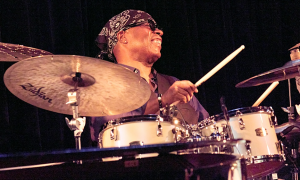
EF: Yes, and along with the sadness of his passing there is also the sadness that he could not be there for the album's release. We did so many things together, traveled to so many parts of the world, and he had been part of Musica sulle Bocche for perhaps ten years. He cared deeply about this album, and I am sorry he did not have time to see it released.
AAJ: You worked with him extensively, although he was not on the first album yet. How did he become part of Atlantico?
EF: I first met him while I was playing a concert in the Udine area, in Italy's North-East. I had heard about him, so I sent him a text message—I believe the photographer Luca D'Agostino had given me his number—and he came to the soundcheck, wearing the camouflage trousers he wore for so long and a kufi head covering, like the one Joe Zawinul wore before he began wearing the fez. He told me he could not stay, but we met and promised each other that we would do something together. Some time later there was an opportunity to play a concert with Django Bates and a Montenegrin singer, Klarisa Jovanovic. Peghin, Maltana and Elvis Stanic also took part. The project was called Balcantronics, and I invited him. We got along so well that when, shortly afterward, Roberto Pellegrini left Atlantico because he wanted to devote himself to contemporary music, I decided to call Gandhi to replace him. That was around 2002. From then on, he was Atlantico's drummer.
AAJ: And now?
EF: At the Musica sulle Bocche concert, he was replaced by Alessandro Cau (Sbiru), whom I had been keeping an eye on for some time—a drummer who is very melodic, dynamic and also percussive. He works with Mauro Sigura, who plays the oud, and for that reason I thought he might be able to come close to Gandhi's approach to drumming. We will continue with him on the very long tour ahead of us, starting now and throughout next year.
But beyond that, it was that mistral wind in November that brought me back to Atlantico. And it is a wonderful thing, because we found each other again like a family. Not like in some of my other groups, where some musicians are brothers, as in the case of Pasquale Mirra, while others may be brilliant but simply come, play and leave. In Atlantico, by contrast, we grew up together, so it is as if we were a family. Do you understand what I mean? It is neither a reunion nor a nostalgic operation: it is a return home.
AAJ: Certainly. After all your career started with Marcello; he has always been present in your life, not only artistically, while Daniele has been beside you on so many fundamental projects. He is a great arranger, and both of them have developed poetics similar to yours in their own projects. With that in mind, who wrote the pieces on Ritornare?
EF: Some are mine, a couple are Daniele's, a couple are Marcello's, and others are co-written or co-arranged. It is a very collective album, deliberately so, because that is the spirit of Atlantico. Even though the record is released under my name, in reality I am talking about the band Atlantico and "our return" to it, the way you return to a family. That is why I think the title is extremely representative of what happened: we spent almost twenty years without seeing each other, but then we returned home, naturally.
AAJ: In fact, I was asking about the authorship of the pieces precisely because I wanted to understand how much that sense of collectivity was reflected in the work from a compositional standpoint.
EF: As I said, it really is a family story. Just think that it also involved some of our respective children, and when we play, that becomes almost hypnotic: we put everything in common. A piece may be Daniele's or mine, but it carries the entire world of Atlantico with it. That is why returning to the group felt so spontaneous and natural: because there are certain kinds of music that never stop pursuing the musicians who created them, even if those musicians never see one another again because they have stopped working on that music. That is what happened to us.
 FOLLOW Neri Pollastri
and get notified whenever a new article published.
FOLLOW Neri Pollastri
and get notified whenever a new article published.
Filosofo prestato alla musica, studio l'improvvisazione non solo dal punto di vista musicale
About Enzo Favata

Tags
PREVIOUS / NEXT

Become a Sustaining Member

Since 1995, All About Jazz has championed jazz as an art form and supported the musicians who create it. Over three decades, it has grown into one of the world's leading jazz resources, serving hundreds of thousands of readers, musicians, presenters and industry professionals each month.
Help Build the Future of All About Jazz
Your support helps us continue building All About Jazz for the next generation—expanding our editorial coverage, preserving jazz history, developing new community features and creating better ways to discover the music and the people behind it.
Become a sustaining member for as little as $20 per year and you'll immediately enjoy an ad-free experience along with access to subscriber features and future articles for a full year.
Together, we're not simply sustaining All About Jazz—we're building its future. Thank you for being part of the journey.