Home » Jazz Articles » Rediscovery » David Friesen: Waterfall Rainbow
David Friesen: Waterfall Rainbow
 David Friesen
Waterfall Rainbow
Inner City
1977
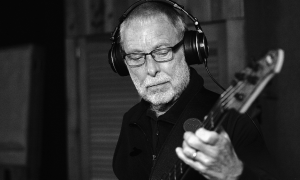
Today's Rediscovery is Waterfall Rainbow, from a bassist who garnered significant attention back in the '70s and '80s, but sadly never sustained it for reasons unknown—certainly nothing to do with his talent—and has, in the decades since, remained an active player, but one largely forgotten by the general jazz public.
After taking a relatively bold step and making Color Pool (Muse, 1975), his first album as a leader, a solo bass outing, David Friesen moved to Inner City Records and released Star Dance the following year. A quartet date that teamed the Pacific Northwest bassist with Oregon's reed/woodwind multi-instrumentalist Paul McCandless (whose 1980 Elektra solo album, All the Mornings Bring, is the subject of an earlier Rediscovery column), über-drummer Steve Gadd and John Stowell—a guitarist with whom Friesen would continue to collaborate through to the early 1980s—it was a record enthusiastically received by critics and fans alike.
Waterfall Rainbow, released a year later in 1977, brought Stowell and McCandless back from Star Dance but replaced Gadd with drummer Ra Kalam Bob Moses (already a name for his work with Gary Burton, Dave Liebman, Michael Gibbs and a young Pat Metheny), flautist Nick Brignola, percussionist Jim Saporito and, most significantly, another Oregon alum, Ralph Towner, here playing both classical and 12-string guitar and whose ECM recording, Sound and Shadows, is yet another Rediscovery. Recruiting two members of Oregon—whose 1980 In Performance is also a recent Rediscovery—undeniably colored the album in a very specific way. Still, Friesen—who ultimately collaborated with a third Oregonian, bassist Glen Moore, on the even more daring double-double bass In Concert (Vanguard, 1977)—ensured that Waterfall Rainbow possessed its own complexion by contributing all nine of its original compositions, his approach having little to do with the unique language already honed by Oregon over the past several years.
Friesen's penchant for emphasis on his low register instrument—combined with a gut-deep tone and powerful virtuosity that makes his current undervalued status all the more curious—might have rendered Waterfall Rainbow a bit too challenging for the average ear. But like fellow bassist Miroslav Vitous, his intrinsic lyricism makes even tracks like the closing "Flight of the Angels"—a three- minute tour de force for two overdubbed basses—strangely accessible.
Elsewhere, compositions like the opening "Spring Wind"—at just under eight minutes, Waterfall Rainbow' longest track, though the album's penultimate piece, "Dancing Spirits Before the Lord" comes close—are melody rich and, consequently eminently accessible in a pastoral fashion, with plenty of stretching space but always in service of the song. With McCandless' soaring oboe and Towner's pianistic approach to 12-sting guitar, there are clear hints of the music they were making in Oregon, but the rhythmic combination of the muscular Moses combined with Saporito's astute percussion choices significantly distance it from Oregon percussionist Collin Walcott's approach. The title track is a fierier exploration, with Friesen's Latin-tinged support bolstering a knotty theme doubled by McCandless and Brignola before opening up to lithe solos from both the flautist and Stowell (on a warm-toned electric guitar).
It may be the album's greater eclecticism that, while garnering it no shortage of critical praise at the time, positioned it as somewhat less successful than the more instrumentally focused Star Dance, but the benefit of hindsight and nearly four decades of distance has rendered Waterfall Rainbow, perhaps, the more memorable of the two. Still, with both albums possessing no shortage of charm, it's truly a case of hair-splitting. In fact, with Stowell and McCandless common to both, Star Dance and Waterfall Rainbow are best taken as an inextricably linked pair, both memorable in their own right...and both rife for Rediscovery.
So, what are your thoughts? Do you know this record, and if so, how do you feel about it?
[Note: You can read the genesis of this Rediscovery column here .]
 FOLLOW John Kelman
and get notified whenever a new article published.
FOLLOW John Kelman
and get notified whenever a new article published.
With the realization that there will always be more music coming at him than he can keep up with, John wonders why anyone would think that jazz is dead or dying.
About David Friesen

Tags
PREVIOUS / NEXT

David Friesen Concerts
Become a Sustaining Member

Since 1995, All About Jazz has championed jazz as an art form and supported the musicians who create it. Over three decades, it has grown into one of the world's leading jazz resources, serving hundreds of thousands of readers, musicians, presenters and industry professionals each month.
Help Build the Future of All About Jazz
Your support helps us continue building All About Jazz for the next generation—expanding our editorial coverage, preserving jazz history, developing new community features and creating better ways to discover the music and the people behind it.
Become a sustaining member for as little as $20 per year and you'll immediately enjoy an ad-free experience along with access to subscriber features and future articles for a full year.
Together, we're not simply sustaining All About Jazz—we're building its future. Thank you for being part of the journey.